Video: Animation as Theme and Medium — Frankenstein and Visual Culture

Above, you’ll find a video presentation of my talk, “Animation as Theme and Medium: Frankenstein and Visual Culture,” which I gave on April 20, 2013 at Dartmouth College — at the great Illustration, Comics, and Animation conference masterfully organized by Michael A. Chaney. Judging by the feedback I received at the time, my talk went over quite well — especially the visual presentation with which I illustrated my arguments (and particularly the “wall” of Frankenstein images you’ll see around 6:03, as well as the animated presentation of Marvel Comics’ Frankenstein series from about 12:52 onward).

(Note that a high-resolution video can be found by following the link to YouTube.)

Admittedly, the screencast video presentation is a weird medium. It tends to foreground things that, when presented live, serve as background images — images that are positioned above and behind a human speaker, talking and gesticulating, communicating (at least ideally) with an audience. In the screencast video, that speaker vanishes into the disembodied ether of a voiceover track, at times leaving images (like the title slide here) lingering on screen longer than might seem appropriate. Perhaps I haven’t yet mastered the medium and discovered a way to achieve the elegance we see in video essays, documentaries, and other related media; or perhaps the screencast video is simply doomed to be a forever awkward, weird, transitional, or incomplete medium.

In any case, the form is not everyone’s cup of tea, and an exemplar like this one is certainly pushing the limits at just over 18 minutes long. As a result, I have taken several steps to make sure that the video is as watchable and as useful as possible for anyone who might be interested in the arguments I make about Frankenstein, film, comics, animation, and visual culture. First, at the cosmetic level, I’ve added some music to deflect attention from my voice and to make the video a bit less “dry” than it otherwise might be (see below for music credits). Also, I have chosen to include the full text of the paper here, which you will find below; this way, you can skim, scan, and search, and “try before you buy” if you like, or decide what parts of the video you’d like to watch. Also, I offer a sort of “table of contents” to the video, with approximate times indicated for the various topics discussed:

0:00 — Introduction: Animation as Theme and Medium

1:30 — Animation as Framing Condition for Modern Visual Culture

4:28 — Frankenstein’s Monster as Iconic Emblem of Animation

5:30 — The Early Proliferation of the Monster’s Image

6:03 — The Plurimedial Explosion of Images and the Visual Serialization of the Monster (illustrated by the “wall” of images that many saw as the central visual attraction of the presentation itself)

7:40 — Frankenstein Films, Self-Reflexivity, and Animation

8:53 — Thomas Edison’s Frankenstein (1910)

12:52 — Marvel Comics’ Frankenstein (1973 – 1975)

17:25 — Conclusion

The presentation draws on several previous works, including Chapter 3 of my dissertation (on Edison’s Frankenstein) and an article called “Marvel Comics’ Frankenstein: A Case Study in the Media of Serial Figures” — so be sure to check those out if anything is of interest to you here.

Here is the text of the talk:

Animation as Theme and Medium: Frankenstein and Visual Culture

Shane Denson – Dartmouth College, April 20, 2013

Long marginalized in critical discourses, animation seems to occupy an unprecedented position in our popular and visual cultures today. It has been argued, for instance, that in the age of digital cinema all film becomes animated film as photographic images’ indexical relations to the world are severed by processes of digital rendering. And not only film: comics, too, seem to be caught in the tractor beam of animation – partly as a result of general convergence trajectories and partly as a result of specific transmedia franchising efforts that place ever more superheroes in sleek new CGI outfits. Simultaneously, comics proper migrate from paper to digital formats and devices, bringing with them animation processes as elements of images and of presentation formats (like the “guided view” function on iPhone apps, which animate the transition from panel to panel). But if it’s true that the boundaries between animation and other forms of visual media have become problematic in the digital age, I want to suggest that this is not entirely new. My aim is therefore to open up a sort of media archaeological perspective that will allow us to look at animation as both a theme and a medium that plays a significant if non-obvious role throughout the modern era. Drawing on retellings of Frankenstein in film and comics, I argue that the tale’s serial proliferation reveals a hidden backstory to our current situation, one in which animation can be seen as the very framing condition for much of our modern popular visual culture.

By emphasizing modernity and popularity, the visual culture I’m talking about is connected explicitly to industrialization, which coincided with the institution of a conceptual wedge between art and technology – i.e. between the fine arts and the applied arts – such that aesthetic experience was figured as “disinterested” and opposed to the realms of practical technology and commercial culture. And out of the industrial-era reorganizations within the broad realm of technē flow a variety of fears and fantasies of technical animation (embodied in automata like the Mechanical Turk, and in narratives such as E.T.A. Hoffmann’s “Der Sandmann” and Mary Shelley’s Frankenstein). Such thematic concerns with “animation” – or the giving of life to inanimate matter – would have a lasting impact on (popular/visual) culture as the arts became increasingly technical, industrial, reproducible, and (in more senses than one) serialized; from Metropolis to Blade Runner and beyond, the dream of artificial life has been a staple of science-fiction film. But beyond the thematic level, a medial aspect or determination of “animation” is also involved: not only was the technical infrastructure of steam-driven printing presses, automata, and pre-cinematic devices uncanny in its liveliness and activity; also, at the dawn of the industrial age, the fine arts were framed in such a way as to marginalize animation as a possible medium. Lessing’s famous division of temporal and spatial arts (with poetry, drama, and narrative on the one side, sculpture, painting, and image on the other) preemptively banished a range of popular forms from the domain of serious art. But against these injunctions of aesthetic purity, post-industrial visual culture is characterized by a preponderance of images that spring to life as they are set in motion and animated by mechanical means. Film and comics, most centrally, would blur the boundaries between the static image and the temporal flow of narration. Generally and conceptually speaking, if not narrowly and technically, “animation” names these media’s affront to the division of the arts – their violation both of the division between temporal and spatial arts and of their separation from the merely technical and commercial domain of modern popular culture. This is another way of saying that animation, broadly conceived, is a sort of framing condition for modern visual culture, which can be seen in constant struggle with the image granted life or set in motion, alternately advancing toward and retreating from the conceptual and technological threat of visual kinesis that aesthetics as such was born in order to contain.

Seen in this way, modern visual culture’s ambivalent relation to animation is not altogether different from Frankenstein’s initial fascination with and sudden repulsion by the creature he brought to life. And it is the creature, of course, who provides the iconic emblem of animation as a monstrous threat. I want to argue that this image embodies both the thematic and the medial aspects of animation that I’ve been discussing, and it self-reflexively probes animation’s role in a visual culture that is both technological and remarkably autonomous in its ability to multiply images across various channels or media. Exhibiting a promiscuous, plurimedial sort of seriality, the monster’s image – as an image of animation – presents a special case for thinking the dynamic intermedial networks that constitute our visual culture. Cinema gives us the “classic” version of the monster’s image, but the figure’s visual proliferation has a serial history that predates the cinema and lives on in other forms as well. At the center of visual interest is the creation scene, which Shelley’s novel of 1818 treats only in a very cursory manner, but which gives rise immediately to a growing number of theatrical adaptations. Shelley herself saw a performance of Richard Brinsley Peake’s 1823 play Presumption; or the Fate of Frankenstein, and thus witnessed her tale escaping her authorial control much as the story’s monster had escaped its creator’s, prompting her famously in the introduction to the 1831 edition of her book to “bid [her] hideous progeny go forth and prosper.” The image on the frontispiece of the 1831 edition thus entered into a stream of visual images proliferating on theater stages, in political cartoons, and later in film, comics, and other media. Taken together, these images are not, I suggest, just illustrations of a story but themselves enactments of a media-technical interrogation of modern processes of animation and the self-replicating action of our visual culture. Essential to this view is a conception of the monster not so much as a developed character but as a flat, serialized figure that has escaped the novel and acquired a life of its own. As such, the monster is marked materially by a form of seriality that is intimately tied to the serial production processes of industrial culture and, more specifically, to the sequentiality and reproducibility of images in modern visual media such as film and comics. Appearing again and again in various media, the monster becomes what I call a serial figure, existing not within a series but in fact as a series – as the expanding set of stagings or instantiations across media. The monster thus evolves not within a uniform diegetic space, but between or across such spaces of narration and visualization. As a serial figure, the monster leads a sort of surplus existence outside of any one given telling, thus placing it in a perfect position to reflect on the manner – and the media – of its repeated stagings. Specifically, it explores modern visual culture’s challenge to the inert spatial image, its tendency to transgress the injunction against animation. The familiar cry – “It’s alive!” – thus refers as much to the media of sequential and temporal images as it does to the creature they depict.

Let’s start with Frankenstein films. There’s a sense in which it’s tempting to see film itself as a sort of Frankensteinian technology. Like Frankenstein selecting parts from corpses and infusing life into a composite body, filmmakers utilize the technical means of film to (re)animate the “dead” (or photographically preserved) traces of living organisms (actors) into new visual narrative compositions. In his discussion of Frankenstein films, William Nestrick writes: “The film is the animation of the machine, a continuous life created by the persistence of vision in combination with a machine casting light through individual photographs flashed separately upon the screen. Since ‘life’ in film is movement, the word that bridges the worlds of film and man is ‘animation’ – the basic principle by which motion is imparted to the picture” (294-95). It will be objected, however, that this invitingly simple analogy is too general in its scope; it overlooks historically specific transformations in the way such “animation” has been staged. Luckily, the long history of Frankenstein adaptations amply documents such changes and makes up for the missing nuance.

Take, for instance, Thomas Edison’s Frankenstein from 1910, which stands between the early, image-technology oriented “cinema of attractions” and the coming narrative-oriented classical Hollywood style that would take shape around 1917. In 1910, the medium was in transition, torn between lowbrow technological spectacle and an uncertain reorientation along the lines of the respectable theater. Accordingly, advertising for the film emphasized both the “photographic marvel” of the creation sequence and the story’s origin in “Mrs. Shelley’s […] work of art.” The film aimed to be both visual and technological spectacle and narrative high culture. And this multiple address relates directly to the uncertain significance of “animation” at this historical juncture.

The creation sequence’s so-called “marvel” consists of footage of a burning mannequin projected in reverse – a bit of cinematic magic that, in the context of early film, served to exhibit cinematic technology by focusing attention on the filmic images themselves rather than the objects they depict. Frankenstein’s reactions here channel the scopophilic pleasure of a “primitive” viewer, for whom he stands in as a proxy. Importantly, “animation” here is a self-reflexive topos which links the monster’s creation with the term “animated photography,” still common in 1910 as a description of film in general.

However, the final showdown ambivalently signals a change of course towards narrative integration. The Edison Company claims that the scene communicates the story’s moral that love conquers all. But since the monster was identified with filmic technology in the creation sequence, Frankenstein’s battle with the monster is also with the medium of film as an animating technology, especially since trick effects are essential to the staging of the conflict. The film’s narrative closure is therefore mixed with a self-reflexive countercurrent. The mirror functions here like the projection surface of the cinema screen. The similarity is not merely abstract but in fact visually perceptible due to the scene’s technical means of production: the images in the mirror are themselves flickering filmic images. The result is a film within the film, and Frankenstein is again a film viewer. His battle with the monster is a battle with the images and especially with the “primitive” type of reception that he exemplified in the creation sequence. But this time he is reformed, and instead of staring at the medial surface, he now acquires the ability to look through rather than at the mirror. So Frankenstein is finally in a position to devote his attentions to the reality of his environment – which means, for us, to the world of the diegesis.

In the context of the cinema’s transitional phase, the film’s narrative development is linked to a larger, non-diegetic narrative of filmic development: Frankenstein’s psychological maturation, which is consummated in the mirror scene, allegorizes a historical-normative process of cinematic maturation and of spectatorial progress towards a proto-classical relation to film. And significantly, this transitional trajectory coincided with the historical differentiation of film, or “animated photography,” according to which animation in the narrower sense came to be distinguished from, and subordinated to, a more respectable form of live-action filmmaking that favored drama and characterization over novelty gags and trick-film effects. The monster, a literal product of animation, charts this differentiation at the same moment people like Winsor McCay were popularizing techniques of animation in its narrower sense. Thus, the monster embodies the technology of the animated spectacle, and his marginalization reflexively indicates the framing function of animation in film and visual culture more generally, reminding us that live-action cinema is animation too, but in a normalized or naturalized form.

Now I want to jump ahead to a comic-book appropriation that offers a somewhat different perspective on animation as theme and medium owing to its reflexive engagement with the formal properties of graphic narrative. Here the monster is recalibrated for an interrogation of the specific means by which comics animate their tales – that is, the means by which discrete images both remain discrete and are subject to combinatory reframings that bring a graphic story to life. Marvel’s series The Monster of Frankenstein (later retitled The Frankenstein Monster) ran for 18 issues from January 1973 to September 1975. The first four issues retell the tale of Shelley’s novel, and they reproduce its nested frame structure: the monster’s own tale is at the center, embedded in Frankenstein’s account of events, which he recounts to the Arctic explorer Captain Walton while aboard his ship; Walton, in turn, records everything and passes it along in the form of letters to his sister back home, and these letters make up the novel Frankenstein. Now the Marvel series, in its re-telling, ingeniously adds an additional frame: Walton IV, the great-grandson of the novel’s captain, narrates the outermost tale, set a full century after the novel, thus laying the ground for the story’s continuation into the twentieth century from issue #5 onward.

With an eye to the monster’s place in visual culture more generally, what interests me above all about this is the way that these various framings and reframings are navigated visually, and the role that the technically animated creature plays in the process. Issue #2 features several exemplary moments that I’d like to focus on. The monster’s tale is prefaced visually with a close-up of the monster’s face, which functions as a gateway or border between external and internal narrative frames (between the cave setting in which the monster relates his tale to Frankenstein and the innermost frame of the related tale) (6, panel 5). The creature tells how he came to his senses, how he observed a blind man and his family, learned their language, and was eventually driven from human society. Finally, his narrative closes with a close-up of the creature’s yellow eye in a wavy-bordered panel that exists liminally between one narrative frame and another (18, panel 3): Spatially attached both to the (self-narrated) monster persecuted by a mob of angry villagers and to the (narrating) monster in the mountain cave, the eye stands between and links the two temporal frames of narration. From this intermediate position, the monster’s eye mirrors the reader’s eye as well, the eye that moves from one graphic frame or panel to the next in the temporal process of reading. Emerging from the page in close-up and protruding from the narrated world to enter the space of the reader, this eye is medially self-reflexive in a strong sense: it directs attention towards the processes of medial construction at the same time that it serves a constructive medial purpose, viz. the transition from one visual and narrative frame to another. And something similar is staged several pages later. Having discovered the corpse of his friend Clerval, the traumatized Frankenstein is arrested for murder, and his face is foregrounded with a blank eye staring at—or through—the reader in a panel that transitions back to the outermost narrative frame, aboard Walton IV’s ship in 1898 (25, panel 4), which suddenly rams an iceberg and begins to sink, bringing issue #2 to a cliffhanger close.

At the outset of the next issue, sailors scramble into lifeboats in the belief that the monster, thrown overboard in the crash, is dead. But when the monster, whose hand juts ominously out of the water, boards their boat and begins wreaking havoc, one of the sailors exclaims, “God help us! It’s still alive!” (3)—an intensification of the standard line in Frankenstein films, fully self-aware of its seriality. Sparing the captain, his cabin-boy, and his guide, the monster rows them to firm ice. There, the monster insists: “The story, man! You must tell me the rest of the story!” (5). Then, with his back turned, Walton IV prepares to continue the narrative, while the monster’s face, set in profile, literally replaces the gutter between two panels and forms the border between two spatiotemporal frames as well: the “here and now” that he shares with Walton IV and the “there and then” of Walton’s story (6, panels 1 and 2). Once again, the monster’s face and eyes mediate the threshold between narrative frames, between temporal settings, and between the act and the content of mediation.

In conclusion, then, Frankenstein’s monster functions variously, as we have seen in these examples from film and comics, to envision the dynamic workings of modern visual culture. The creature doubles with the medium in order to envision visuality itself in its modern, highly kinetic forms. It gives visible form, in other words, to the invisible framing condition of animation, exposing the mechanisms by which static images routinely transgress their spatial borders and assert a temporal dimension, and exploring the role of mediating technologies in the serialized proliferations of images that animate the modern visual landscape.

Finally, here are the music credits for the video (all songs licensed with Creative Commons licenses and made available via dig.ccmixter.org):

1. Creative Commons License Constructions normales (Je ne suis pas un remix) by vo1k1 is licensed under a Noncommercial Sampling Plus (the song begins at 0:00 in the video);

2. Creative Commons License Sawmill by Gurdonark is licensed under a Attribution (3.0) (beginning ca. 4:04);

3.Creative Commons License pling by jaspertine is licensed under a Attribution Noncommercial (3.0) (beginning ca. 7:03);

4. Creative Commons License Yiourgh by DoKashiteru is licensed under a Sampling Plus (beginning ca. 12:18);

5. Creative Commons License Prism in the Ether by Fireproof_Babies is licensed under a Attribution Noncommercial (3.0) (beginning ca. 16:17).

Imagining Media Archaeology

Parikka_What-is-media-archaeology

On Wednesday, June 5, 2013 (at 6:00 pm in room 608 in the Conti-Hochhaus), the Film & TV Reading Group will meet to discuss two texts relevant to the larger theme of “Imagining Media Archaeology” (part of a semester-long series of events detailed here). The texts are:

1) Jussi Parikka, “Imaginary Media: Mapping Weird Objects.” In:What Is Media Archaeology? Hoboken: John Wiley & Sons, 2012. 41-62.

2) Wanda Strauven, “The Observer’s Dilemma: To Touch or Not to Touch?” In: Media Archaeology: Approaches, Applications, and Implications. Eds. Erkki Huhtamo and Jussi Parikka. Berkeley: U of California P, 2011. 148-163.

In case you missed it: both Jussi Parikka and Wanda Strauven will be keynote speakers at our symposium “Imagining Media Change,” which will be held on June 13, 2013 — for more info, check here and here.

As for the Film & TV Reading Group: we are always happy to welcome new participants to our informal discussion group! For more information, please contact Felix Brinker.

Techno-Phenomenology, Medium as Interface, and the Metaphysics of Change

Reno_1902_escalator_patent

On June 17, 2013, I will be presenting a paper at the conference “Conditions of Mediation: Phenomenological Approaches to Media, Technology and Communication” at Birkbeck, University of London. There’s a diverse and interesting group of keynote speakers, including David Berry, Nick Couldry, Graham Harman, Shaun Moores, Lisa Parks, and Paddy Scannell, and a list of other presenters — among whom I am proud to be counted — has also gone online now.

Below is the abstract for my modest contribution:

Techno-Phenomenology, Medium as Interface, and the Metaphysics of Change

Shane Denson, Leibniz Universität Hannover

Walter Benjamin famously argued that the emergence of modern media of technical reproducibility (photography, film) corresponded to sweeping changes in the organization of what he calls the “medium” of sense perception. To a skeptic like film scholar David Bordwell, Benjamin’s “modernity thesis” (along with Tom Gunning’s related arguments about the “culture of shock”) is pure hyperbole, for cognitive structures are subject to the slow processes of biological evolution while impervious to rapid technological change. The debate has tended to reach impasses over questions of the causal agencies and effects of media change—e.g. whether they concern the broad cultural domain of discourse and signification or the “hard-wiring” of the brain itself. In this presentation, I argue that a “techno-phenomenological” approach—which (following cues from Heidegger, Merleau-Ponty, and Don Ihde, among others) focuses on the embodied interfaces in which human intentionalities are variously mediated by technologies—enables us to see media change as involving experiential transformations that are at once robustly material, and hence not restricted to cultural or psycho-semiotic domains, while still compatible with the long durations of biological evolution. An “anthropotechnical interface,” based in proprioceptive and visceral sensibilities, will be shown to constitute the primary site of media change.

Imagining Cinematic Transformation

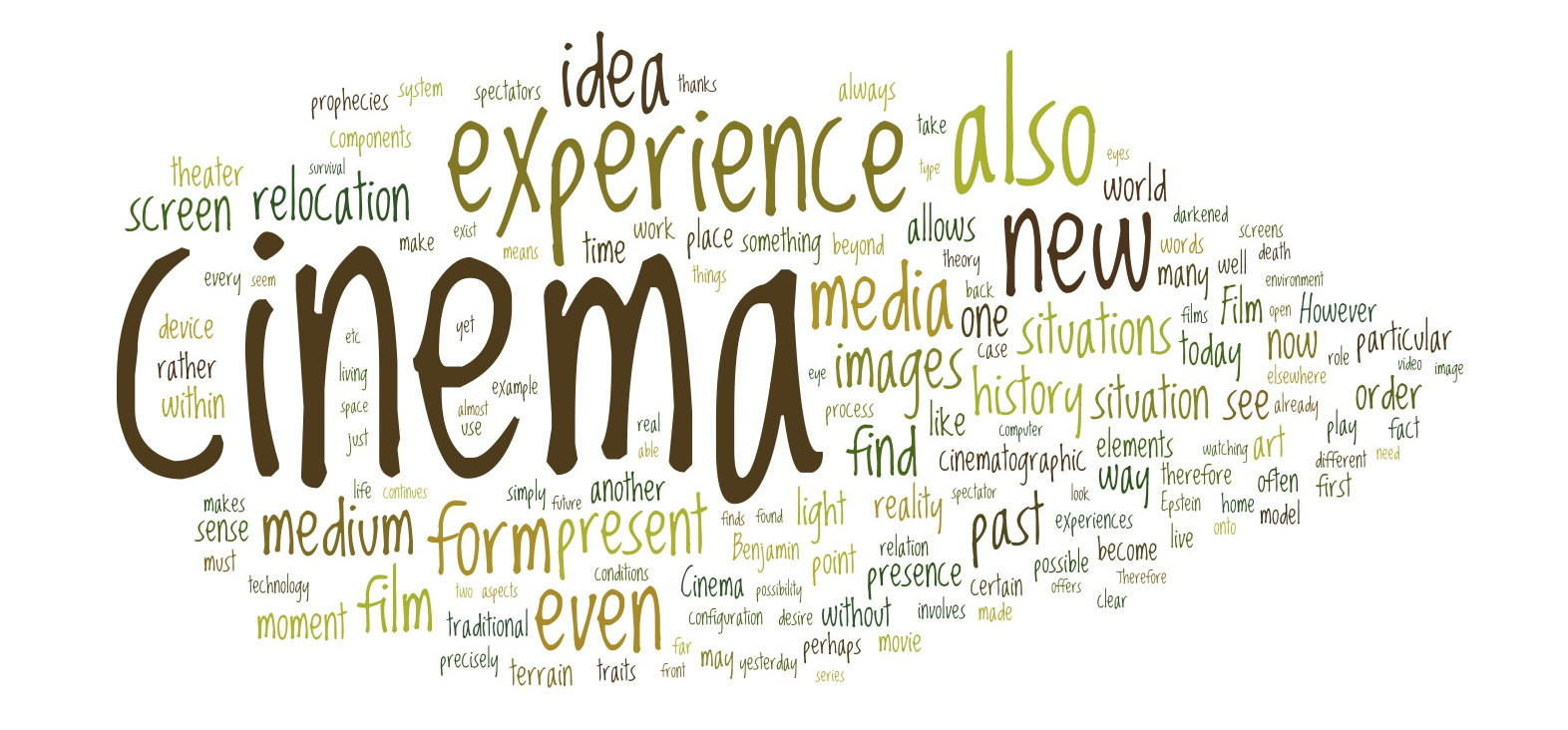
relocation_of_cinema_wordle

On Wednesday, May 8, 2013 (at 6:00 pm in room 608 in the Conti-Hochhaus), the Film & TV Reading Group will meet to discuss two texts relevant to the larger theme of “Imagining Cinematic Transformation” (part of a semester-long series of events detailed here). The texts are:

1) Francesco Casetti, “The Relocation of Cinema,” _NECSUS_ 2 (2012): online at http://www.necsus-ejms.org/the-relocation-of-cinema/

2) Thomas Elsaesser and Malte Hagener, “Conclusion: digital cinema — the body and the senses refigured?”, in: _Film Theory: An Introduction through the Senses_. New York and London: Routledge, 2010. 170-187.

We are always happy to welcome new participants to our informal discussion group! For more information, please contact Felix Brinker.

Imagining Media Change — Symposium Poster

Symposium - Imagining Media Change - poster

[UPDATE: See here for the complete symposium program and abstracts.]

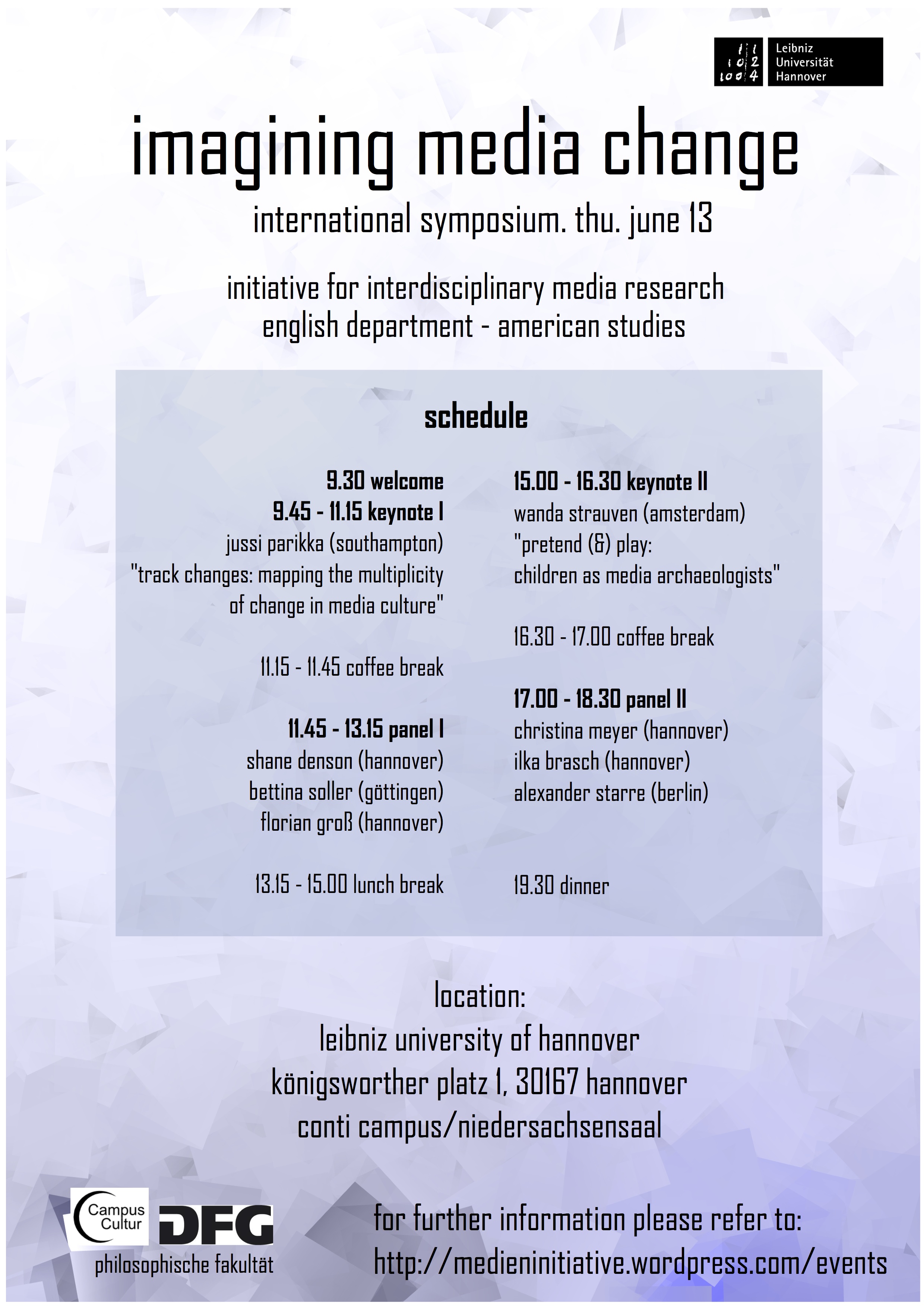
Recently, I posted the description for the symposium on “Imagining Media Change” that we’re organizing this June, with keynote speakers Jussi Parikka and Wanda Strauven — part of this semester’s larger series of events. Now I am proud to present the poster for the symposium (designed by Ilka Brasch and Svenja Fehlhaber), which includes an overview of the schedule and speakers. A more detailed schedule, including the titles of talks, will be made available soon.

Counterpoint: Game of Thrones, Narrative, and Affect

The Internets are all abuzz still following the kickoff this past Sunday of the third season of HBO’s flagship series Game of Thrones. There was a great deal of online anticipation in the weeks, days, and hours leading up to the season premiere, fed in part by a set of trailers (above, as well as here and here, for example) that circulated on Youtube, in the twitterverse, and beyond. And following the actual airing of the show, records were allegedly set for the most illegal downloads of a television episode, while discussions, analyses, and reviews continue to proliferate across fan sites, blogs, and news media.

(As a preliminary note to those who are either weary of reading such pieces or who are avoiding them due to spoilers — fear not: this post is neither concerned directly with the latest episode, nor will I give away anything that could ruin it for anyone who hasn’t seen it.)

Instead, I wanted to take the opportunity to comment on an aspect of the series that I’ve been thinking about (and which I recently wrote about in the more general terms of serial complexity and affect theory as applied to contemporary television). Specifically, Game of Thrones derives much of its momentum, I think, from an interplay between a continuing, complex narrative (in Jason Mittell’s sense of “narrative complexity”) and relatively discontinuous, punctuating moments of affective appeal — a directly corporeal, often visceral, sort of appeal that constitutes momentary “lines of flight” from the story’s ongoing line of development. Like much of HBO’s serial fare, these moments of affect often concern violent and/or sexualized body images which, while not completely devoid of narrative relevance, also exhibit a sort of surplus value as images. In other words, they not only serve the representational functions of depicting significant events and contributing meaningfully to characterization, etc.; over and above that, they also assert a strong presentational and extra- or para-narrational facet, the function of which is to engage the viewer’s body more than his or her interpreting, cognizing brain. Such body images — for example, in narratively gratuitous sex scenes, images of painful injury, torture, or beheading — resonate with the viewer’s own bodily sensibilities, serving to titillate or to arouse a sense of physical vulnerability, anguish, panic, or disgust.

Seen from afar (so to speak), in the overall context of a television series like Game of Thrones, the interplay between narrative development and these moments of bodily affectivity results in what I have described as a “contrapuntal” relation between the two: narrative continuity is punctuated, interrupted by body images that exceed any dramatic motivation, thus constituting more or less insular, episodic forms in the midst of the serial stream; but these islands of affect are (at least potentially) themselves elements in a serial progression that exists in parallel to that of the narrative (and following a very different temporal logic). Repetition and variation of body spectacles can thus be just as important as narrative suspense as a means of ensuring viewer attachment over the course of long serial arcs.

SerialBodies12.012

Of course, some series are more successful than others in their employment of such contrapuntal seriality, and there are certainly a wide variety of styles and modes of implementing the counterpoint. Some series are anything but discreet as they shift gears between narrative and body-based affective appeals (and in this regard, they resemble musicals or pornographic films as they move from one more or less self-enclosed “number” to the next). And certainly, some of this can be seen in Game of Thrones, but my overall impression of the series is that it works with a relatively tight integration of affective and corporeally self-reflexive appeals into the informationally complex storyworld and the unfolding tale of rival houses, subtle intrigue, and uncertain outcomes.

A particularly poignant example of contrapuntal integration is provided by episode 7 of season 1, “You Win or You Die,” where we see the following conversation between Jamie and Tywin Lannister:

http://www.youtube.com/watch?v=47MazYDnmaU

Set in any other situation, this conversation — which neatly exemplifies the informational complexity of the series — would have a completely different impact. Sarah Hughes, writing in The Guardian‘s TV & Radio Blog, sees the “skinning and disembowelling [of] a deer” here as a “heavy-handed bit of symbolism given the deer is the sign of [rival] House Baratheon,” and I think she’s right to see the visual component of the scene enacting a layer of complexity beyond the content of the verbal. It’s not only a symbolic dimension, though, that is here overlaid upon the Lannisters’ discourse; in addition, I suggest, a dimension of visceral and dermic appeal spreads itself out as the very milieu within which the characters’ words sound out materially. The innards of the deer are more than just a sign: they are matter, and their material image transmits an affective force, establishing a material relation with our own viscera. The forceful separation of the animal’s skin from its muscles emphasizes, moreover, both the stubborn durability and the ultimate finitude of the organic body, arousing a diffuse affective awareness of the corporeal basis upon which our discursive subjectivities are erected. And all the while, royal politics are being discussed in detailed, lofty, and eloquent language. The scene conveys a sense of the unconscious drives that lend momentum to conscious pursuits and political “plots,” conveys a sense of the base and physical “will to power” animating social conflict. And it communicates this “message” by way of a tight contrapuntal integration of narrative information and bodily affect, thus self-reflexively exemplifying the series’ own larger strategy of instrumentalizing affect, infusing the complex (at times, overly complex) narrative with an appeal to animal nature, and in this way crafting a form of serial complexity that partakes equally of the discursive and affective.

Symposium: Imagining Media Change

imagining_media_change

[UPDATE: See here for the complete symposium program and abstracts.]

Imagining Media Change

Symposium of the Initiative for Interdisciplinary Media Research and the American Studies department at the Leibniz University of Hannover, 13 June 2013 (Niedersachsensaal, Conti-Campus)

In the midst of the ongoing digitalization of our contemporary media environment, recent media and cultural studies have developed a renewed interest in the production and staging of technological innovation, in the occurrence and impact of media change, and in the ways these transformations inform the production, circulation, reception, and aesthetics of popular texts and media forms. The emergence of ‘new media’ in particular, it would seem, prompts us to rethink the role of mediating technologies within social and cultural spheres, and to explore how our everyday lives are transformed by a newly digitalized technical infrastructure. Such explorations are necessarily reflexive, however, as our attempts to imagine media change are themselves mediated by cultural texts and technologies in the grip of change. Dynamics of medial self-historicization guide our very thinking about media history: commercial logics, in particular, emphasize the superiority of the new, attest to the inevitability of the past’s obsolescence, and seek to captivate our imaginations with branded visions of the media-technological future. Seeking to look beyond these pressures, a reflexive engagement with recent media change is therefore called upon to reevaluate the impact of previous transitions and transformations throughout media history, and to excavate, if possible, discontinuities and ruptures in the development of modern media as they relate to broader social, cultural, and material processes of change. From a media-archaeological perspective, the history of media emerges not as a straightforward, linear process of technological innovation and implementation, but rather as a discontinuous series of media crises and negotiations of change. Understanding the uneven historical emergence and transformation of different types of media thus promises a renewed understanding not only of historical media, but also of contemporary media change and our present (in)ability to imagine its scope and impact. Crucial to this enterprise is an appreciation of reflexivity itself – a recognition of the fact that when media change, they also change our imaginations, including our imagination of media change. In the face of corporate and other interests that seek to capitalize on this logic and to steer our imaginations of the digital transition for their own benefit, what’s ultimately at stake in a media-archaeological excavation of our medial past and present is therefore nothing less than a political question: Will we be the subjects or merely the objects of “imagining media change”?

The symposium “Imagining Media Change” takes a broad view of media-historical and counter-historical developments and transformations since the nineteenth century, focusing in particular on the reflexive interactions between media undergoing change and media being used to imagine the parameters, effects, and significance of media-technological transformations. We are interested in historical and contemporary visions of change as they are articulated in or pertain to a wide range of media (including film, television, literature, and other visual, aural, textual, or computational media). The one-day symposium aims to bring together a variety of disciplinary perspectives and interests and to facilitate discussion of the material, political, aesthetic, and speculative dimensions of media change. Keynote lectures will be held by Jussi Parikka (University of Southampton, UK) and Wanda Strauven (University of Amsterdam, NL).

For more information about the symposium “Imagining Media Change,” please contact felix.brinker@engsem.uni-hannover.de or refer to the events page (http://medieninitiative.wordpress.com/events/).

Imagining Media Change

imagining_media_change

This coming semester, the Initiative for Interdisciplinary Media Research is proud to present a series of events organized around the topic “Imagining Media Change.” The flyer above (click for a larger view) details these events, which include a series of film screenings, thematically focused discussion groups, and a symposium featuring keynotes by Jussi Parikka and Wanda Strauven!

More details to follow soon…

Crazy Cameras, Discorrelated Images, and the Post-Perceptual Mediation of Post-Cinematic Affect — #SCMS13

Below you’ll find the full text of the talk I just gave at the Society for Cinema and Media Studies conference in Chicago, as part of a panel on “Post-Cinematic Affect: Theorizing Digital Movies Now” along with Therese Grisham, Steven Shaviro, and Julia Leyda — all of whom I’d like to thank for their great contributions! As always, comments are more than welcome!

SCMS_Crazy_Cameras_Title.001

Crazy Cameras, Discorrelated Images, and the Post-Perceptual Mediation of Post-Cinematic Affect

Shane Denson

I’m going to talk about crazy cameras, discorrelated images, and post-perceptual mediation as three interlinked facets of the medial ontology of post-cinematic affect. I’ll connect my observations to empirical and phenomenological developments surrounding contemporary image production and reception, but my primary interest lies in a more basic determination of affect and its mediation today. Following Bergson, affect pertains to a domain of material and “spiritual” existence constituted precisely in a gap between empirically determinate actions and reactions (or, with some modification, between the production and reception of images); affect subsists, furthermore, below the threshold of conscious experience and the intentionalities of phenomenological subjects (including the producers and viewers of media images). It is my contention that the infrastructure of life in our properly post-cinematic era has been subject to radical transformations at this level of molecular or pre-personal affect, and following Steven Shaviro I suggest that something of the nature and the stakes of these transformations can be glimpsed in our contemporary visual media.

My argument revolves around what I’m calling the “crazy cameras” of post-cinematic media, following comments by Therese Grisham in our roundtable discussion in La Furia Umana (alternatively, here): Seeking to account for the changed “function of cameras […] in the post-cinematic episteme,” Therese notes that whereas “in classical and post-classical cinema, the camera is subjective, objective, or functions to align us with a subjectivity which may lie outside the film,” there would seem to be “something altogether different” in recent movies. “For instance, it is established that in [District 9], a digital camera has shot footage broadcast as news reportage. A similar camera ‘appears’ intermittently in the film as a ‘character.’ In the scenes in which it appears, it is patently impossible in the diegesis for anyone to be there to shoot the footage. Yet, we see that camera by means of blood splattered on it, or we become aware of watching the action through a hand-held camera that intrudes suddenly without any rationale either diegetically or aesthetically. Similarly, but differently as well, in Melancholia, we suddenly begin to view the action through a ‘crazy’ hand-held camera, at once something other than just an intrusive exercise in belated Dogme 95 aesthetics and more than any character’s POV […].”

What it is, precisely, that makes these cameras “crazy,” or opaque to rational thought? My answer, in short, is that post-cinematic cameras – by which I mean a range of imaging apparatuses, both physical and virtual – seem not to know their place with respect to the separation of diegetic and nondiegetic planes of reality; these cameras therefore fail to situate viewers in a consistently and coherently designated spectating-position. More generally, they deviate from the perceptual norms established by human embodiment – the baseline physics engine, if you will, at the root of classical continuity principles, which in order to integrate or suture psychical subjectivities into diegetic/narrative constructs had to respect above all the spatial parameters of embodied orientation and locomotion (even if they did so in an abstract, normalizing form distinct from the real diversity of concrete body instantiations). Breaking with these norms results in what I call the discorrelation of post-cinematic images from human perception.

With the idea of discorrelation, I aim to describe an event that first announces itself negatively, as a phenomenological disconnect between viewing subjects and the object-images they view. In her now-classic phenomenology of filmic experience, The Address of the Eye, Vivian Sobchack theorized a correlation – or structural homology – between spectators’ embodied perceptual capacities and those of film’s own apparatic “body,” which engages viewers in a dialogical exploration of perceptual exchange; cinematic expression or communication, accordingly, was seen to be predicated on an analogical basis according to which the subject and object positions of film and viewer are dialectically transposable.

sobchack_film-viewer-relations

But, according to Sobchack, this basic perceptual correlation is endangered by new, or “postcinematic” media (as she was already calling them in 1992), which disrupt the commutative interchanges of perspective upon which filmic experience depends for its meaningfulness. With the tools Sobchack borrows from philosopher of technology Don Ihde, we can make a first approach to the “crazy” quality of post-cinematic cameras and the discorrelation of their images.

lens_flare_2

Take the example of the digitally simulated lens flare, featured ostentatiously in recent superhero films like Green Lantern or the Ghost Rider sequel directed by Neveldine and Taylor, who brag that their use of it breaks all the rules of what you can and can’t do in 3D. Beyond the stylistically questionable matter of this excess, a phenomenological analysis reveals significant paradoxes at the heart of the CGI lens flare. On the one hand, the lens flare encourages what Ihde calls an “embodiment relation” to the virtual camera: by simulating the material interplay of a lens and a light source, the lens flare emphasizes the plastic reality of “pro-filmic” CGI objects; the virtual camera itself is to this extent grafted onto the subjective pole of the intentional relation, “embodied” in a sort of phenomenological symbiosis that channels perception towards the objects of our visual attention. On the other hand, however, the lens flare draws attention to itself and highlights the images’ artificiality by emulating (and foregrounding the emulation of) the material presence of a camera. To this extent, the camera is rendered quasi-objective, and it instantiates what Ihde calls a “hermeneutic relation”: we look at the camera rather than just through it, and we interpret it as a sign or token of “realisticness.” The paradox here, which consists in the realism-constituting and -problematizing undecidability of the virtual camera’s relation to the diegesis – where the “reality” of this realism is conceived as thoroughly mediated, the product of a simulated physical camera rather than defined as the hallmark of embodied perceptual immediacy – points to a more basic problem: namely, to a transformation of mediation itself in the post-cinematic era. That is, the undecidable place of the mediating apparatus, the camera’s apparently simultaneous occupation of both subjective and objective positions within the noetic relation that it enables between viewers and the film, is symptomatic of a more general destabilization of phenomenological subject- and object-positions in relation to the expanded affective realm of post-cinematic mediation. Computational, ergodic, and processual in nature, media in this mode operate on a level that is categorically beyond the purview of perception, perspective, or intentionality. Phenomenological analysis can therefore provide only a negative determination “from the outside”: it can help us to identify moments of dysfunction or disconnection, but it can offer no positive characterization of the “molecular” changes occasioning them. Thus, for example, CGI and digital cameras do not just sever the ties of indexicality that characterized analogue cinematography (an epistemological or phenomenological claim); they also render images themselves fundamentally processual, thus displacing the film-as-object-of-perception and uprooting the spectator-as-perceiving-subject – in effect, enveloping both in an epistemologically indeterminate but materially quite real and concrete field of affective relation. Mediation, I suggest, can no longer be situated neatly between the poles of subject and object, as it swells with processual affectivity to engulf both.

dilation_of_affect_2

Compare, in this connection, film critic Jim Emerson’s statement in response to the debates over so-called “chaos cinema”: “It seems to me that these movies are attempting a kind of shortcut to the viewer’s autonomic nervous system, providing direct stimulus to generate excitement rather than simulate any comprehensible experience. In that sense, they’re more like drugs that (ostensibly) trigger the release of adrenaline or dopamine while bypassing the middleman, that part of the brain that interprets real or imagined situations and then generates appropriate emotional/physiological responses to them. The reason they don’t work for many of us is because, in reality, they give us nothing to respond to – just a blur of incomprehensible images and sounds, without spatial context or allowing for emotional investment.” Now, I want to distance myself from what appears to be a blanket disapproval of such stimulation, but I quote Emerson’s statement here because I think it neatly identifies the link between a direct affective appeal and the essentially post-phenomenological dissolution of perceptual objects. Taken seriously, though, this link marks the crux of a transformation in the ontology of media, the point of passage from cinematic to post-cinematic media. Whereas the former operate on the “molar” scale of perceptual intentionality, the latter operate on the “molecular” scale of sub-perceptual and pre-personal embodiment, potentially transforming the material basis of subjectivity in a way that’s unaccountable for in traditional phenomenological terms. But how do we account for this transformative power of post-cinematic media, short of simply reducing it (as it would appear Emerson tends to do) to a narrowly positivistic conception of physiological impact? It is helpful here to turn to Maurizio Lazzarato’s reflections on the affective dimension of video and to Mark Hansen’s expansions of these ideas with respect to computational and what he calls “atmospheric” media.

According to Lazzarato, the video camera captures time itself, the splitting of time at every instant, hence opening the gap between perception and action where affect (in Bergson’s metaphysics) resides. Because it no longer merely traces objects mechanically and fixes them as discrete photographic entities, but instead generates its images directly out of the flux of sub-perceptual matter, which it processes on the fly in the space of a microtemporal duration, the video camera marks a revolutionary transformation in the technical organization of time. The mediating technology itself becomes an active locus of molecular change: a Bergsonian body qua center of indetermination, a gap of affectivity between passive receptivity and its passage into action. The camera imitates the process by which our own pre-personal bodies synthesize the passage from molecular to molar, replicating the very process by which signal patterns are selected from the flux and made to coalesce into determinate images that can be incorporated into an emergent subjectivity. This dilation of affect, which characterizes not only video but also computational processes like the rendering of digital images (which is always done on the fly), marks the basic condition of the post-cinematic camera, the positive underside of what presents itself externally as a discorrelating incommensurability with respect to molar perception. As Mark Hansen has argued, the microtemporal scale at which computational media operate enables them to modulate the temporal and affective flows of life and to affect us directly at the level of our pre-personal embodiment. In this respect, properly post-cinematic cameras, which include video and digital imaging devices of all sorts, have a direct line to our innermost processes of becoming-in-time, and they are therefore capable of informing the political life of the collective by flowing into the “general intellect” at the heart of immaterial or affective labor.

The Paranormal Activity series makes these claims palpable through its experimentation with various modes and dimensions of post-perceptual, affective mediation. After using hand-held video cameras in PA1 and closed-circuit home-surveillance cameras in PA2, and following a flashback by way of old VHS tapes in PA3, the latest installment intensifies its predecessors’ estrangement of the camera from cinematic and ultimately human perceptual norms by implementing computational imaging processes for its strategic manipulations of spectatorial affect. In particular, PA4 uses laptop- and smartphone-based video chat and the Xbox’s Kinect motion control system to mediate between diegetic and spectatorial shocks and to regulate the corporeal rhythms and intensities of suspenseful contraction and release that define the temporal/affective quality of the movie. Especially the Kinect technology, itself a crazy binocular camera that emits a matrix of infrared dots to map bodies and spaces and integrate them algorithmically into computational/ergodic game spaces, marks the discorrelation of computational from human perception: the dot matrix, which is featured extensively in the film, is invisible to the human eye; the effect is only made possible through a video camera’s night vision mode – part of the post-perceptual sensibility of the video camera that distinguishes it from the cinema camera. The film (and the series more generally) is thus a perfect illustration for the affective impact and bypassing of cognitive (and narrative) interest through video and computational imaging devices. In an interview, (co)director Henry Joost says the use of the Kinect, inspired by a YouTube video demonstrating the effect, was a logical choice for the series, commenting: “I think it’s very ‘Paranormal Activity’ because it’s like, there’s this stuff going on in the house that you can’t see.” Indeed, the effect highlights all the computational and video-sensory activity going on around us all the time, completely discorrelated from human perception, but very much involved in the temporal and affective vicissitudes of our daily lives through the many cameras and screens surrounding us and involved in every aspect of the progressively indistinct realms of our work and play. Ultimately, PA4 points toward the uncanny qualities of contemporary media, which following Mark Hansen have ceased to be contained in discrete apparatic packages and have become diffusely “atmospheric.”

PA1-4

This goes in particular for the post-cinematic camera, which has shed the perceptually commensurate “body” that ensured communication on Sobchack’s model and which, beyond video, is no longer even required to have a material lens. This does not mean the camera has become somehow immaterial, but today the conception of the camera should perhaps be expanded: consider how all processes of digital image rendering, whether in digital film production or simply in computer-based playback, are involved in the same on-the-fly molecular processes through which the video camera can be seen to trace the affective synthesis of images from flux. Unhinged from traditional conceptions and instantiations, post-cinematic cameras are defined precisely by the confusion or indistinction of recording, rendering, and screening devices or instances. In this respect, the “smart TV” becomes the exemplary post-cinematic camera (an uncanny domestic “room” composed of smooth, computational space): it executes microtemporal processes ranging from compression/decompression, artifact suppression, resolution upscaling, aspect-ratio transformation, motion-smoothing image interpolation, and on-the-fly 2D to 3D conversion. Marking a further expansion of the video camera’s artificial affect-gap, the smart TV and the computational processes of image modulation that it performs bring the perceptual and actional capacities of cinema – its receptive camera and projective screening apparatuses – back together in a post-cinematic counterpart to the early Cinématographe, equipped now with an affective density that uncannily parallels our own. We don’t usually think of our screens as cameras, but that’s precisely what smart TVs and computational display devices in fact are: each screening of a (digital or digitized) “film” becomes in fact a re-filming of it, as the smart TV generates millions of original images, more than the original film itself – images unanticipated by the filmmaker and not contained in the source material. To “render” the film computationally is in fact to offer an original rendition of it, never before performed, and hence to re-produce the film through a decidedly post-cinematic camera. This production of unanticipated and unanticipatable images renders such devices strangely vibrant, uncanny – very much in the sense exploited by Paranormal Activity. The dilation of affect, which introduces a temporal gap of hesitation or delay between perception (or recording) and action (or playback), amounts to a modeling or enactment of the indetermination of bodily affect through which time is generated, and by which (in Bergson’s system) life is defined. A negative view sees only the severing of the images’ indexical relations to world, hence turning all digital image production and screening into animation, not categorically different from the virtual lens flares discussed earlier. But in the end, the ubiquity of “animation” that is introduced through digital rendering processes should perhaps be taken literally, as the artificial creation of (something like) life, itself equivalent with the gap of affectivity, or the production of duration through the delay of causal-mechanical stimulus-response circuits; the interruption of photographic indexicality through digital processing is thus the introduction of duration = affect = life. Discorrelated images, in this respect, are autonomous, quasi-living images in Bergson’s sense, having transcended the mechanicity that previously kept them subservient to human perception. Like the unmotivated cameras of D9 and Melancholia, post-cinematic cameras generally have become “something altogether different,” as Therese put it: apparently crazy, because discorrelated from the molar perspectives of phenomenal subjects and objects, cameras now mediate post-perceptual flows and confront us everywhere with their own affective indeterminacy.

Serial Bodies

Below you’ll find the full text of the talk I delivered today at the “It’s Not Television” conference in Frankfurt. Unfortunately, I had to leave the conference early, so I didn’t have time to discuss the talk in any detail following the brief Q & A. I’m hoping, then, that some of those people who expressed an interest in discussing my ideas and proposals further might take the opportunity to comment here. And, of course, even if you weren’t there today, comments on this early-stage work are very welcome!

SerialBodies1.001

Serial Bodies: Corporeal Engagement in Long-Form Serial Television

Shane Denson

In this talk, I want to consider the possibility and the purpose of an “affective turn” in television studies. I’ll try to explain what such a “turn,” or refocusing of scholarly attention, might entail, and I’ll consider some of the grounds for making such a move.

First of all, the “affective turn” as I’m using the term describes developments going on in various disciplines, including philosophy and media and cultural theory, since about the 1990s. Following theorists such as Deleuze and Guattari, Steven Shaviro, and Brian Massumi, the “affect” in question here refers to a domain of pre-personal feelings, not subjective emotions but raw intensities that transpire below the threshold of consciousness, as functions and correlates of non-voluntary processes: for example, the not-quite-conscious sensations associated with visceral, proprioceptive, and endocrinological changes in one’s overall body-state. Thus, affects are diffuse material forces and sensations, whereas emotions are their more narrowly focused correlates; affects precede consciousness and envelop the mind, while emotions can be seen to involve the subjective “capture” of affect, the yoking of affect to consciousness, or the filtering and processing that takes place when pre-reflective affect becomes available to reflective conscious experience. Theory and criticism undertaken in the wake of an affective turn seek to uncover the material and cultural efficacy of affect prior to this filtering.

But why would television scholars want to make this turn towards a subterranean domain of pre-personal affect? Briefly, I want to propose that an affective turn would help to highlight the richly material parameters of the televisual experience, to focus attention on embodied interfaces and non-cognitive transfers, thus providing a counterpoint to the dominant celebration of cognitive effort in recent television studies. In other words, the context for an affect-oriented intervention is the tendency, widespread in popular and scholarly accounts alike of recent television, to intellectualize the medium, to focus on complex narrative structures in an effort to redeem TV from long-standing prejudices and stereotypes that cast the bulk of programming as culturally inferior trash produced for a passive, undiscriminating, and distracted mass audience. Foregrounding the emergence of a new televisual “quality,” many recent critical approaches have focused particularly on contemporary serial television’s demanding textual forms, which seek to engage viewers with complex puzzles and intricately orchestrated plot developments – thus breaking with the formulaic repetition characteristic of simple episodic programs and providing mental stimulation in exchange for viewers’ long-term investments of attention. As early as the 1980s, the advocacy group Viewers for Quality Television had defined “quality” in the following terms: “A quality series enlightens, enriches, challenges, involves and confronts. It dares to take risks, it’s honest and illuminating, it appeals to the intellect and touches the emotions. It requires concentration and attention, and it provokes thought.” In short, quality TV does what good literature is supposed to do, namely: to engage the viewer/reader and make him or her think. And popular criticism has continued to pursue this tack in the effort to make television respectable, e.g. by comparing newer series to the nineteenth century novel – The Wire, for example, has been called “a Balzac for our time”, thereby suggesting that this paradigmatically complex series distinguishes itself by a heady sort of appeal that rewards the sophisticated viewer. Steven Johnson has famously claimed that such complex television provides its viewers with what he calls a “cognitive workout.” And Jason Mittell, who has probably done more than any of these people to explore the mechanics of complexity, has noted the way complex series reward viewers who assume the role of “amateur narratologists.”

SerialBodies5.005

Clearly, the critical reappraisal of the medium and its implied viewer is not without foundation, as it speaks to very real changes in television programming in the wake of industrial, technological, and cultural shifts. Over the past ten years or so, there has indeed been an unprecedented flowering of programs that would seem to encourage active and intellectually engaged viewing. At the same time, though, graphic scenes of sex and violence proliferate across contemporary television series, including shows widely valued for their sophisticated cognitive demands. In particular, bodies are now routinely put on display, violated, tortured, dissected, and ripped apart in ways unimaginable on TV screens just a decade ago. I want to be clear that I don’t think this in any way invalidates theories and analyses that foreground the cognitive appeals of narratively complex TV. But this explosion of body images – including images of bodies exploding – does, I think, challenge such approaches to reconcile intellectual and more broadly affective and body-based appeals. By advocating an affective turn, a turn towards a diffuse, inarticulate field of pre-personal affect, I am not urging a turn away from consciousness or a regressive turn back to the view of an unrefined, unintellectual viewer. Instead, I am asking for more thought about how cognitive and affective appeals coexist today, and specifically about how they might be seen to work in tandem to maintain the momentum of contemporary television’s serial trajectories.

trueblood_watchingtruedeathtrueblood_truedeath

Seriality is the key word here: seriality is one of the things that’s illuminated particularly well by broadly cognitivist and narratological approaches, and it’s seriality, I think, that marks the real challenge for an affective turn in TV studies. Consider Brian Massumi’s definition of affect as “a suspension of action-reaction circuits and linear temporality in a sink of what might be called ‘passion,’ to distinguish it both from passivity and activity” (28). This conception, which Massumi associates with the thinking of Baruch Spinoza, accords also with Henri Bergson’s notion of affect as “that part or aspect of the inside of our bodies which mix with the image of external bodies” (Matter and Memory 60). And the Bergsonian image of the body as a “center of indetermination,” where affect is an intensity experienced in a state of “suspension,” outside of linear time and the empirical determinateness of forward-oriented action, corresponds to a major emphasis in film theory conducted in the wake of the affective turn – namely, a focus on privileged but fleeting moments, when narrative continuity breaks down and the images on the screen resonate materially, unthinkingly, or pre-reflectively with the viewer’s autoaffective sensations. Such moments figure prominently in what Linda Williams calls the “body genres” of melodrama, horror, and pornography – genres in which images on screen are mobilized to arouse pity, fear, or desire directly in the body of the viewer. In his now classic study, The Cinematic Body, Steven Shaviro explores extreme cases like the self-reflexive attunement between gory images of zombies dismembering and disgorging on-screen characters, on the one hand, and the embodied spectator affected viscerally by these images on the other. But these are moments of caesura, when narrative and discursive significance dissolves and gives way to an “abject” experience of material plenitude prior to its parceling out into subject-object roles and relations. These displaced or “utopic” moments, dilated experientially to allow for a poetic sort of tarrying alongside images, are of course already exceptional in narrative cinema, but they must seem even more clearly at odds with the vectors of serial continuation that pull television viewers from one episode to the next, engrossing them in a story-world and concerning them with the lives of its characters week after week, over the course of several seasons.

So if television studies is to make an affective turn, it will have to account for the medial differences between long-form serial television and closed-form film, and it will have to distinguish the role of affect in each. One place to start with this comparison might be the self-reflexive “operational aesthetic” that Jason Mittell, following Neil Harris’s work on P.T. Barnum, has attributed to contemporary serial television as one of its central mechanisms. For Mittell, the operational aesthetic is related to the cognitive operation of tracing and taking pleasure in the complexities of narrative twists. At stake is an enjoyment not only of the story told but also of the manner of its telling, and the operational aesthetic involves the viewer in what might be described as the recursive pleasure of recognizing a series’ own recognition of the complexity of its narration. But if television’s “narrative special effects,” as Mittell calls them, can be explained in terms of an operational aesthetic, it’s important to note that this mode of engagement has also been attributed to closed-form film to explain the appeal of special effects of the ordinary, primarily visual and non-narrative, sort. Tom Gunning has applied the term “operational aesthetic” to the body-gag spectacles of slapstick. In this view, Charlie Chaplin’s or Buster Keaton’s body gets implemented as a thing-like mechanism in a larger system of things, and the spectator takes pleasure in tracing the causal dynamics of the system, which is in a sense also the system of cinematic images itself; the cinema in turn reveals itself as a complex (Rube Goldberg-type) contraption for the transfer of material intensities from one body – Chaplin’s or Keaton’s – to another – my own, as the latter is affected physically and compelled to laugh. Similarly self-reflexive mechanisms are at work in sci-fi and horror films, where visual and visceral spectacles interrupt narrative flow and bedazzle or shock with an operational appeal to the body rather than the brain. Monumental explosions, monstrous sights flashed on the screen without warning, and show-stopping effects seek in part to bypass the brain and imprint themselves in the manner of the physiological Chockwirkung that Walter Benjamin took to be central to the filmic medium.

But is this corporeal sort of self-reflexivity, an operational aesthetic that arouses the body more than the brain, possible in long-form serial television? And, if so, can it be a central component of televisual seriality, a motor of serial development, or must it remain a mere side-show in a medium dependent upon the forward momentum of narrativity?

As I noted before, there is certainly no shortage of body spectacles on contemporary television, and they seem in many ways to function like the cinematic spectacles I’ve been describing. Procedural, or what might more properly be called operational, forensic shows likes CSI or Bones, for example, resemble science-fiction film in their showcasing of technological processes – processes that are anchored in diegetic techniques and technologies but that serve to foreground medial technologies of visualization. These displays serve, like the special effects of science-fiction film, more to impress the viewer than to advance the story. Significantly, such digressive forensic displays revolve around bodies and their imbrications with medial technologies: corpses are subjected to analytical methods that issue not in cognitive but in visual and media-technological spectacles, thus providing the spectator with an affectively potent – but narratively rather pointless – formula that gets repeated week after week. The technological probing of bodies onscreen thus speaks to and motivates a doubling of the viewing body’s own technological interface with the television screen – the material site of affective transfer, which is crucially at stake in these biotechnical displays. A show like Grey’s Anatomy similarly problematizes the integrity of bodies and sets them in relation to technologies, both medical and medial, in order to establish an affective circuit between bodies onscreen and off. Bodies in pain, bodies injured, impaled, injected, or incised, bones sawed, organs exposed and removed: all of these things have their place in a narrative, but they also maintain an excessive autonomy as images, establishing in this way a relay between an affective awareness of one’s own embodiment and an emotional engrossment in a melodramatic story.

And while these shows may tend toward the episodic or the formulaic, their employment of body spectacles might be seen to illuminate a range of contemporary television, including shows widely recognized as qualitatively complex. Premium cable shows like Nip/Tuck, Six Feet Under, Dexter, or Californication, for example, revolve around a variety of corporeal explorations. And a series like True Blood manages to combine all three of Linda Williams’s “body genres” into a hybrid mix of soft-porn, horror, and melodrama. The Walking Dead positively obsesses over its media-technological ability to generate graphic images of all states of bodily decay, thus offering a series of visual and visceral challenges to the viewer that run parallel to and punctuate the story’s unfolding. And even a starkly serialized and celebrated complex show like Breaking Bad activates these mechanisms when it visualizes a scene of bodily destruction like this one:

So_they_really_meant_FACE_OFF

Here, there is a properly visual appeal, a showcasing of the image that involves the viewer by activating a sense of one’s own corporeal fragility – thus staging a deeply existential demonstration of physical vulnerability that culminates, and momentarily negates, all the narrative investment and development of character that has led up to this point. In other words, the affective force of this moment far exceeds its diegetic and medial temporality; with Massumi, we might say the image occasions “a suspension of action-reaction circuits and linear temporality in a sink of […] ‘passion’” or immersive involvement. But, I suggest, the scene demonstrates a synergistic or contrapuntal rather than strictly oppositional relation between narrative development and affective depth. The image of the exploded face retains a visual and affective singularity, an excess over and above the storyline in which it’s embedded, but its evocation of the viewer’s own delicate corporeality resonates as well with the series’ overall narrative focus on a protagonist whose body is under attack by cancer.

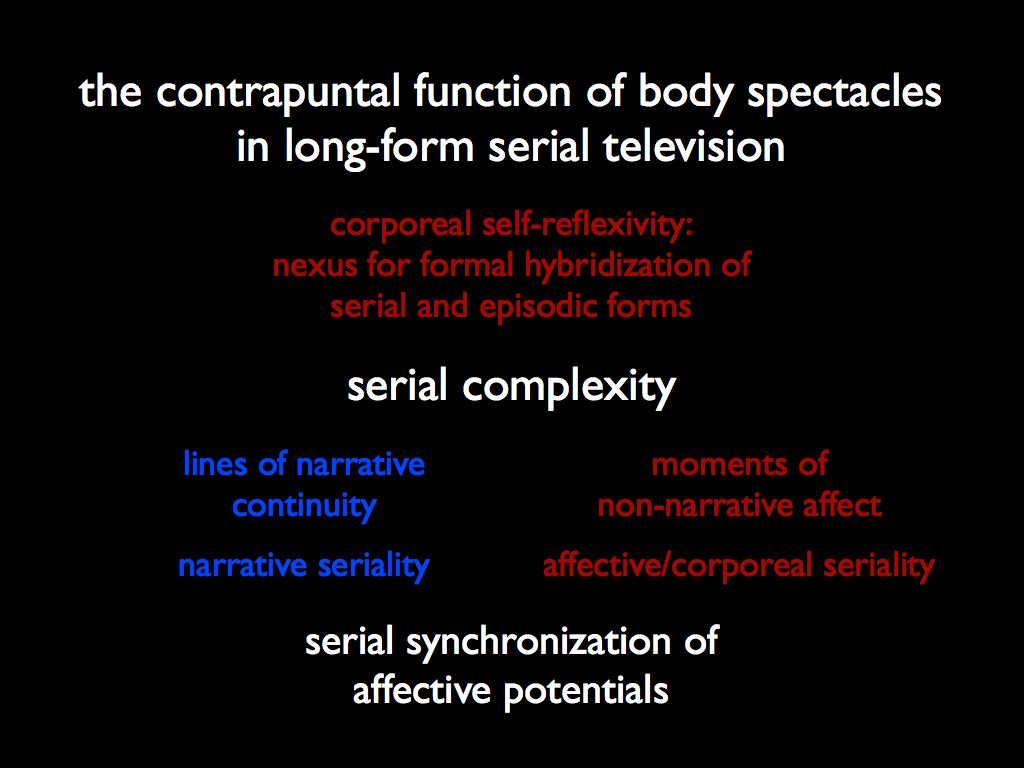
Finally, to generalize from these examples and wager a hypothesis about the contrapuntal function of such body spectacles in contemporary long-form serial television: I suggest that corporeal self-reflexivity, or the establishment of affective circuits by graphically opening up bodies for destructive, clinical, or sexual purposes, serves as a nexus for the formal hybridization of serial and episodic forms that Mittell makes central to his conception of narrative complexity. Not, of course, the nexus, but a nexus: in other words, a site where a certain sort of formal experimentation takes place, leading to an alternative form of “serially complex television” that activates an “operational aesthetic” for cognitive and corporeal means, in the process intensifying viewers’ investment in narrative developments by imbuing them with affective depth. I speak intentionally of “serial complexity” rather than “narrative complexity,” in order to account for the contrapuntal interplay between lines of narrative continuity on the one hand and moments of non-narrative affect on the other; by standing outside of series’ narrative temporalities, the latter moments punctuate continuity with discontinuity, but they also harbor the potential to establish an alternative seriality of their own, one that runs parallel to narrative development; this is an affective and corporeally registered seriality established through the repetition and variation of such poignant moments and images. Scenarios of the body-genre type serve then as fulcrum points for alternating between ongoing serial arcs and more episodically ritualistic engagements with affectively intense but narratively vacuous states of being: arousal by sexualized images, for example, or being moved to tears by highly melodramatic sequences (like the ritualized climaxes of Grey’s Anatomy, which employ music video techniques for a literally melodramatic presentation of bodily triumphs and defeats), or being shaken or disturbed by brutal violence and body horror (which can be occasioned by vampires, zombies, gladiators, serial-killers, or even health-care givers).

SerialBodies12.012

At stake, then, in television studies’ affective turn is the discovery of a broad, material site of serial complexity, of a nexus where shifts occur between serial and episodic forms or between repetition and variation, serially modulated through alternating appeals to cognitive effort and to bodily stimulation. By engineering self-reflexive feedback loops between onscreen body spectacles and the bodily sensitivities of offscreen viewers, contemporary series cement strong affective bonds between their viewers and the very form of complex seriality – with its shifting of gears and contrapuntal rhythms internalized at a deep, sub-cognitive level as the rhythms of one’s own body. Engagement with form thus becomes the embodiment of temporal vicissitudes that are as much those of the show as they are the flowing time of the spectator’s own affective life. At stake is a sort of serial synchronization of affective potentials, over and above (or perhaps deep below) the cognitive recognition of formal complexity. Such affective interfaces materially support and encourage mental engagements with narrative developments, but they do so by cultivating deep material resonances that, at the farthest extreme, institute a corporeal (perhaps endocrinological) need, a serially articulated demand for bodily replenishment or a weekly affective “fix.” The serialized probing of diegetic bodies is reflexively tied to a complex serialization of the viewer’s own body.