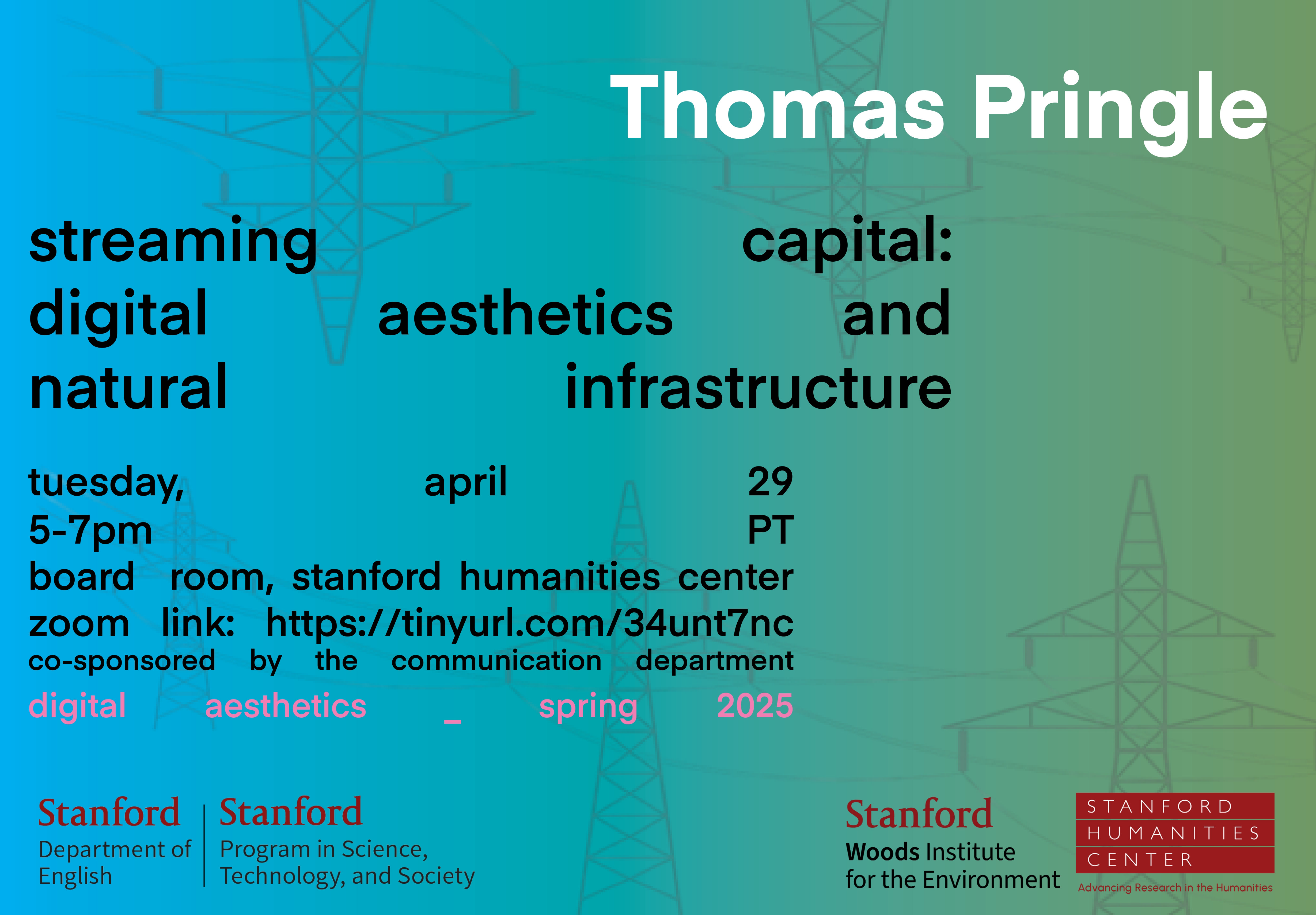
“Streaming Capital” — Thomas Pringle at Digital Aesthetics Workshop, April 29, 2025

Please join the Digital Aesthetics Workshop in welcoming Thomas Pringle, who will present “Streaming Capital: Digital Aesthetics and Natural Infrastructure” on Tuesday, April 29, from 5:00-7:00pm PT. The event will take place in the Board Room at the Stanford Humanities Center. We look forward to seeing you there!

Zoom link for those unable to join in-person: https://tinyurl.com/34unt7nc

Abstract:

In 2022, Netflix launched “Net Zero + Nature,” a program offsetting the streaming giant through purchase of carbon credits generated by the Wildlife Works Kasigau Corridor REDD+ Project. Promotional materials assert that trees growing in Kenya are an infrastructure supporting resource-intensive streaming media. Recent digital media have been critiqued as industrial, environmentally destructive processes. Yet this project suggests that the isomorphic relationships between an image and its ecological impact are aesthetic, with the Netflix offset program indexing a broader media-historical rationality linking digital representation to economically conditioned forms of physical change. What media-historical a priori lend legibility to the statement: environments are media infrastructure? 

In the late 1950s, cybernetic ecologist Howard Odum studied Corpus Christi Bay during his tenure at the Marine Institute at the University of Texas. Concerned with how ongoing petroleum logistical development threatened the turtle grass beds crucial to the estuary ecosystem, Odum drew on images of electrical circuitry to analogize seagrass to the local hay market, estimating that the work performed by the bay’s photosynthesis was worth $97.46 per acre per year. Turtle grass conservation would thus support various modes of production: fishing, tourism, natural gas electricity generation, and the ecological metabolism of industrial sludge. This humble act of labor-free monetization is among the first recorded arguments that conserved environments serve as infrastructure, or in Odum’s words as “life support functions supporting the economy without much conscious recognition.” In the context of recent degrowth advocacy, this case initiates a media historical narration of the aesthetic forms signifying the productivity of “natural infrastructures.” 

Bio:

Thomas Patrick Pringle is Assistant Professor of Cinema and Media Studies at the University of Southern California. With Gertrud Koch and Bernard Stiegler, he is the co-author of Machine (Meson and University of Minnesota Press, 2019). Pringle’s research on environmental media appears in NECSUS: European Journal of Media StudiesJournal of Film and VideoMedia-N, and New Media and Society, as well as the volumes Toxic Immanence: Decolonizing Nuclear Legacies and Futures (2022) and Power Shift: Keywords for a New Politics of Energy (2025). 

This event has been generously co-sponsored by the Woods Institute for the Environment, the Department of English, the Department of Communication, and the Program in Science, Technology, and Society.

“where do old sounds go to die?” and “murnau model” — Critical Making Collaborative, May 16, 2025

The Critical Making Collaborative at Stanford invites you to our Spring event — an evening of sharing and discussion with two recipients of the Critical Making Award, Lemon Guo and J. Makary, who will present their ongoing work in music and performance on Friday, May 16 (6PM) at the CCRMA Stage (3rd floor). 

Lemon Guo — where do old sounds go to die?

Since 2017, I have been visiting the Kam villages in Guizhou, China to work with the elder women singers. In my recent trips, I noticed that a sound that used to pulse through the village in all waking hours had disappeared. To make textile for clothing, many women used to spend months at a time hammering cotton outdoors. I made several field recordings of this practice, when it seemed commonplace and quotidian. As cultural tourism transformed the village soundscape, I started to listen to these files in my hard drive. In this piece, the performers were only allowed to listen to these recordings in the first rehearsal. They were not told that the field recordings would be taken away from them. This performance is made from what they can remember.

J. Makary — murnau model

For murnau model, I used a machine learning model trained on still frames from F. W. Murnau’s 1924 silent film The Last Laugh/Der letzte Mann to generate new hypothetical images that emerge from its lengthy dream sequence. After subsequent interventions to guide image generation and alter their evolution, the images were “married” back to the film through photographic capture of individual frames of the physical filmstrip. By embedding these digital apparitions into the material substrate of celluloid, I intended to create a dialogue between analog and digital dreams, from film to data and back again. The resulting work becomes a reflection on cinema’s dual nature as both technological process and dream machine.

“Forms in Motion” — Kartik Nair at Digital Aesthetics Workshop, April 25, 2025

Please join us in welcoming our next speaker at the Digital Aesthetics Workshop, Kartik Nair, who will present on “Forms in Motion: Elemental Effects in Contemporary Cinema” on Friday, April 25, 1:00-3:00pm PT. The event will take place in McMurtry 370, where lunch will be served.

Zoom link for those unable to join in-person: https://tinyurl.com/y48zask7

Abstract:

Motion capture is the practice of recording the movements of human bodies and using those movements to animate computer-generated bodies, thereby producing virtual character movement on the screen. Current scholarship on motion capture has critically examined the construction of this technology in trade reportage, industry journalism, and film promotion, detecting a discursive ambivalence arising from a struggle for recognition between live actors and motion capture technicians over the future of film performance. This talk will use motion capture as a heuristic to understand the many other kinds of human movements that are being captured in the processes of digital image-making. I will track the pipeline of atmospheric effects. Such atmospheric effects are ubiquitous in contemporary blockbuster cinema. Dust, fire, smoke, light, water and other particulate proliferate in the mise en scene, helping to ground impossible worlds even as they fascinate us with their own expressive qualities. Replacing the logic of photographic capture with one in which the frame is a ‘blank canvas’ to which elements are selectively added, such atmospheric effects vividly attest to the claim that digital tools have re-linked filmmaking with painting. Yet, unlike the painted canvas, which preserves brushstrokes in frozen perpetuity, virtual effects inscribe a trace of and in motion: these are instances in which the creative and corporeal motion of visual effects artists is captured and conveyed as motion. This process unfolds along a transnational path along which the mobile trace moves. Even as those generating it may remain immobilized by visa regulations, server locations, and time-zone differentials, their physical moves are eventually ex-propriated and assimilated into screen movement. Closely read, then, the spectacular conventions of blockbuster cinema can become legible as archives in and of motion.

Bio:

Kartik Nair is a film scholar working at the intersection of transnational cinema, film historiography, materialist media theory, and infrastructure studies, with a focus on popular genres and South Asian cinema. His first book, Seeing Things, is about the production and circulation of low-budget horror films in 1980s India. His current research explores the physical pipelines of digital cinema. He is an Assistant Professor of Film Studies at Temple University in Philadelphia, and one of the core editors of BioScope: South Asian Screen Studies.

This event has been generously co-sponsored by the Department of Art & Art History and the Stanford Center for South Asia.

Unintended Outcomes: AI in the Artist’s Studio — Roundtable at SF Art Fair, April 20, 2025

This coming Sunday, April 20, I’ll be on a roundtable with Halim Madi, Jill Miller, and Asthma Kazmi, moderated by Kate Hollenbach, organized by Gray Area at the San Francisco Art Fair.

In today’s cultural landscape, artificial intelligence has moved beyond buzzword status: machine learning-driven processes are thoroughly integrated—both visibly and invisibly—into the tools we use every day. Hailed as democratizing digital labor yet decried for diluting human creativity and agency, AI is clearly here to stay. As creators continue to experiment with AI, what has stuck? Beyond the hype, which tools and processes are making a real difference in artists’ studios, and how is that impacting a broader visual culture? How can artists reclaim agency over algorithmic processes, and take command of their own learning models? In this panel discussion presented by Gray Area, scholars of AI aesthetics and visual practitioners working with AI, will come together to map the current state of artificial intelligence and artistic creation. The panel includes Shane Denson (Professor, Stanford University Department of Communication), Halim Madi (Programmer, poet, and storyteller), Jill Miller (Visual artist and Professor, Department of Art Practice, UC Berkeley), and Asma Kazmi (artist). The discussion will be moderated by Kate Hollenbach, Education Director, Gray Area. 

More info here: https://sanfranciscoartfair.com/events/unintended-outcomes-ai-in-the-artists-studio/