Please join us in welcoming Katherine Behar, our next guest of the year, who will present “Isn’t Artisanal Intelligence K(NOT) AI?” on Wednesday, February 25, from 5-6:30PM PT. This event will take place in the Board Room at the Humanities Center; refreshments will be served. We hope to see you there.
“Isn’t Artisanal Intelligence K(NOT) AI?” unfolds a new theory of artisanal intelligence. Contextualized in Behar’s artistic practice, which concerns gender, race, class, and labor in digital culture, and specifically her current project, Inside Outsourcing, which takes inspiration from the un-automatability of basket-weaving, this lecture ties together neural networks and tacit knowledge to weigh the valuation of intelligences.
Bio:
Katherine Behar is an interdisciplinary artist who studies contemporary digital culture through feminism and materialism. She is Professor of New Media Arts at Baruch College and The Graduate Center, CUNY.
This event is generously co-sponsored by the Center for Spatial and Textual Analysis and Fiber Optics: Materials & Media, a Stanford Humanities Center Research Workshop.
Please join us in welcoming Patrick Keilty, our next guest of the year, who will present “Processing Pleasure” on Tuesday, February 3, from 5-6:30PM PT. This event will take place in the Board Room at the Humanities Center; refreshments will be served.
This talk examines the early history of electronic payment processing, as told by the engineers who developed the technology in the 1980s. Struggling to find a suitable customer for the invention, they initially sold their technology to adult magazines through the telecommunications giant, MCI. Little has been written about electronic payment’s origins within the sex industries, despite the ubiquity of electronic commerce today. Yet the sex industries have long been early adopters of new technologies. With electronic payment, adult magazines expanded the burgeoning phone sex industry through 1-900 phone sex lines, affording clients the anonymity and confidentiality of paying for pleasure. Electronic payment develops within a history of cultural and legal efforts to regulate, contain, limit, or eradicate the sex industries. When U.S. legal precedent ultimately centers the right to sexual pleasure in the home, the sex industries embraced technologies that did the same. Threatened with U.S. Congressional regulation, by the end of the decade, those same engineers sold their technologies to the growing televangelist industry. As a result, their payment infrastructure funded both sides of the U.S. “culture war.” This talk provides the historical context for a longer book chapter about the relationship between electronic payment, pleasure and desire, which are integral to the development of financial infrastructures that enable the social reproduction of capitalism.
Patrick Keilty is Associate Professor in the Faculty of Information and Cinema Studies Institute at the University of Toronto. Professor Keilty’s research focuses on the politics of digital infrastructures in the sex industries, adult film, and the materiality of media. His writing and editorial work has appeared in Camera Obscura; Feminist Media Studies; Information Society; Archivaria; JDoc; Porn Studies; Catalyst: Feminism, Theory, Technoscience; Scholar and Feminist Online; Feminist and Queer Information Studies Reader (Litwin Books, 2013); Uncertain Archives (MIT Press, 2021); Queer Data Studies (University of Washington Press, 2023); The Handbook of Adult Film and Media (Intellect, 2025); and elsewhere. He is currently working on two monographs — one examines the politics of technologies in the sex industries and the other is a history of two important French stag films from the 1920s.
This event is generously co-sponsored by the Program in Feminist, Gender, and Sexuality Studies.
We are excited to announce our first event of 2026! Hannes Bajohr will present on “The Latent Space of Meaning and the Novel” on Tuesday, January 13, from 5-6:30pm PT. The event will take place in the Stanford Humanities Center Board Room. Refreshments will be served.
“A world – nothing less – is the theme and postulate of the novel,” German philosopher Hans Blumenberg wrote in 1963. At that same moment, AI research, already emerging from its early optimism, turned to “world models” as a means of stabilizing its brittle systems. Today, these two conceptions of “world” – the literary and the computational – converge in large language models (LLMs), which use their latent spaces not just to generate plausible sentences, but entire narratives, even novels, albeit with still uneven results. Yet in what sense are the “worlds” of novels and of AI analogous, and what can each illuminate about the other?
The talk proposes that both novels and LLMs operate within structured networks of relations – assemblages of events, inferences, and expectations – that can yield a form of coherence even when classical causality is weak or absent. Literary techniques from realism to modernism build patterned universes: realist and naturalist fiction through causal-social dynamics, genre fiction through explicit world-building, and modernism through fragmented but still intelligible world-logics. These traditions offer a vocabulary for assessing LLM-generated texts.
Where early systems like SHRDLU pursued explicit symbolic world models and failed outside narrow domains, contemporary LLMs rely on distributed vector spaces that encode statistical regularities without grounding. My own experiments with a fine-tuned German-language model yielded narratives with stylistic unity but little causal depth. Like certain experimental novels, they evoke meaning through a “weak force” of association rather than strong narrative causality. This talk tries to follow these ideas and aims to resist both overhyping LLMs’ understanding and dismissing them as mere mimicry, thus placing AI-generated fiction, as the meeting points of the two uses of “world,” within a broader theory of modeling and meaning.
Bio:
Hannes Bajohr, is Assistant Professor of German at the University of California, Berkeley. His research focuses on media studies, political philosophy, philosophical anthropology, and theories of the digital. Recent publications include: Thinking with AI: Machine Learning the Humanities (as editor, London: Open Humanities Press) and “Surface Reading LLMs: Synthetic Text and its Styles” (arXiv preprint, forthcoming in New German Critique). In 2027, the English-language translation of his LLM-co-generated novel (Berlin, Miami) will appear with MIT Press.
This event is generously co-sponsored by the Stanford Literary Lab and Stanford Department of English.
With apologies for the late announcement, the Digital Aesthetics Workshop is delighted to welcome our first speaker of the 2025-26 academic year! Joseph DeLappe will present on “Making Politics: Commemoration, Resistance, and Play” on Wednesday, October 22, from 5-6:30pm PT. The event will take place in Wallenberg 433A, at the Stanford Center for Spatial and Textual Analysis (CESTA). Dinner will be served.
Below you will find the Joseph DeLappe’s bio and abstract. We look forward to seeing you there!
Abstract:
Can art be a catalyst for change in times of war and conflict? What role can creative acts of counter-memorialization, interventionist practices, play, and participatory art take to change how we perceive and act upon issues of contemporary and historical violence and in the broader politics of memory? Media artist and activist Joseph DeLappe will share documentation from a diversity of creative projects and actions developed over the past several decades that utilize digital and analogue processes to creatively address such questions. A lineage of works, including video games, public actions (online and IRL), participatory making, performance, play, protest and memorialization will illuminate upon his critical and interrogative strategies engaging the intersections of art, technology, and social engagement.
Bio:
Joseph DeLappe, born San Francisco 1963, is an artist, activist and educator, he relocated to Scotland in 2017 after 23 years directing the Digital Media program at the University of Nevada, Reno. Working with electronic and digital media since 1983, projects in online gaming performance, sculpture and electromechanical installation have been shown throughout the world. In 2006 he began the project dead‐in‐iraq, to type consecutively, all names of America’s military casualties from the war in Iraq into the America’s Army first person shooter online recruiting game. More recently he developed the concept behind Killbox (funded in part by a Creative Scotland), an interactive computer game about drone warfare created with the Biome Collective in Scotland. Killbox was nominated for a BAFTA Scotland (British Academy of Film and Television Arts) as “Best Computer Game”. His works have been featured in the New York Times, The Australian Morning Herald, Art in America, The Guardian and the BBC. He has authored several book chapters, including “Me and My Predator(s): Tactical Remembrance and Critical Atonement, Drone Aesthetics: War, Culture, Ecology, Open Humanties Press, 2022 and “Making Politics: Engaged Social Tactics, A conversation between Joseph DeLappe and Laura Leuzzi”, Art as Social Practice: Technologies for Change, Routledge, 2022. DeLappe was awarded a Guggenheim Fellowship in the Fine Arts in 2017.
This event is co-sponsored by the Silicon Valley Archives and the Patrick Suppes Center for History & Philosophy of Science.
On May 20, 2025, the Digital Aesthetics Workshop will hold our final event for the year: a roundtable on AI and Media featuring Sun-ha Hong (UNC-Chapel Hill), Johan Fredrikzon (KTH Royal Institute of Technology in Stockholm), Julia Irwin (Stanford University), and Hank Gerba (University of Southern California).
The event will take place from 5:00-7:00pm PT in the Stanford Humanities Center Board Room. Zoom link for those unable to join in-person: tinyurl.com/5n8mdpbb
Schedule :
5:00-5:15: Sun-ha Hong | Ruins of the Technofuture
5:15-5:30: Johan Fredrikzon | Prompting the Dead: Technological Spiritualism in the Age of Machine Learning
5:30-5:45: Julia Irwin | William James’s Neural Network, Fringe Consciousness, and Historical Time
5:45-6:00: Hank Gerba | The Generative Image
6:00-7:00: Q&A
Sun-ha Hong | Ruins of the Technofuture
Where are the ruins of artificial intelligence and the data-driven future, and what do they have to tell us? While abandoned data centres, electronics waste landfills, and vast mineral mining operations already cover large swathes of the planet in material destruction, we must also think of technofutures’ gleaming monuments as ruin: the litany of prototypes never to be built, the construction lots of AI-fuelled smart cities and utopian colonies (Neom), the loudly announced then quietly shriveled infrastructure projects (Stargate).
I will suggest three distinct genres of ruin, and the different theories of technological futures they prescribe: (1) the disavowed ruin, and contemporary AI futures’ total denial of decay and historicity, exemplified by the Bezos-funded 10,000 Year Clock; (2) the manufactured ruin, theorised by Albert Speer, the chief architect of the Third Reich; (3) the redemptory ruin in which, Walter Benjamin tells us, ruins provide a progressive alternative for articulating future visions.
Sun-ha Hong examines forms of uncertainty, doubt, speculation and (dis)belief aroundsurveillance, smart machines & AI. He is Associate Professor in Data Science andCommunication at UNC-Chapel Hill, and previous haunts include Stanford, Simon FraserUniversity, MIT and Penn. Sun-ha once wrote Technologies of Speculation (2020), and will oneday complete Predictions Without Futures.
Johan Fredrikzon | Prompting the Dead: Technological Spiritualism in the Age of MachineLearning
Technical media of recording and playback have, since the 19th century at least, been employed in attempts to contact the spirits of the dead. In these histories of technological spiritualism, humans themselves have often played the role of “media.” In this talk, I compare the mid 20th century phenomenon of Electronic Voice Phenomena (EVP) where tape recorders allegedly picked up messages from “the other side” with so called deadbots: machine learning systems trained to simulate deceased people. In particular, the talk will note the significance of error and labor in these practices and how they distribute the effort of interpretation between user and machine.
Johan Fredrikzon is a researcher at the Division of History of Science, Technology andEnvironment at KTH Royal Institute of Technology in Stockholm. He is currently a visitingscholar at Stanford University. In 2022–2024 he was a visiting postdoc fellow at The Universityof California, Berkeley. Fredrikzon holds a Master of Computer Science from StockholmUniversity where he also received his Ph.D. in the History of Ideas in 2021. In his research,Fredrikzon has been interested in problems of erasure, disappearance, waste, and decay asconditioned by processes of data management, office work, and archival practices. During2018–19 he was a research affiliate at Yale University. Fredrikzon’s current research project is athree-year study of the history of artificial intelligence (AI) from the perspective of errors andmistakes in humans and machines respectively, funded by the Swedish Research Council.
Julia Irwin | William James’s Neural Network, Fringe Consciousness, and Historical Time
This talk situates philosopher-psychologist William James as an originator of the neural network concept. I recover his ideas about the human mind and brain’s “fringe” qualities, which I argue are a precedent condition for human reason and creativity. Fringe consciousness is an ambiguous sensation—like the contents of one’s peripheral vision—that opens up the habituating nervous system to the possibility of novelty. It is also the very element within the mind and brain that cyberneticians overlooked; indeed, the electromechanical replication of the nervous system was possible because of the elision of fringe consciousness.
Contemporary discourse on AI either takes the position that statistically driven AI can merely rearrange past phenomena in the dataset or that deep-learning systems’ capacity to re-write their own objectives will bring about unprecedented calamity. History is either frozen or marked by an imminent radical break. Yet neither stance helps us understand what it means to be an agent of history in the age of artificial intelligence. In re-animating James’s concept, I articulate a new path for thinking with and against today’s intelligent machines, one that pushes us beyond replacement vs. augmentation narratives.
Julia Irwin is currently a postdoctoral fellow in the Department of Art and Art History and theInstitute for Human-Centered AI at Stanford University. She researches the history andphilosophy of artificial intelligence, with a focus on the relationship between theories ofintelligence and automation. Her writing has appeared in Grey Room, Film History, and Ki (QuiParle). She holds a PhD in Film & Media from UC Berkeley.
Hank Gerba | The Generative Image
What does artificial intelligence signal about the nature of images? This talk investigates the way in which AI externalizes and operationalizes the imaginative capacities which influence the genetic process of image-formation.
Hank Gerba holds a Ph.D from Stanford’s Film & Media Program within the Art & Art HistoryDepartment. Their work focuses on media aesthetics and AI. Currently, Hank is a researcher atthe University of Southern California, combining narrative theory with generative AI.
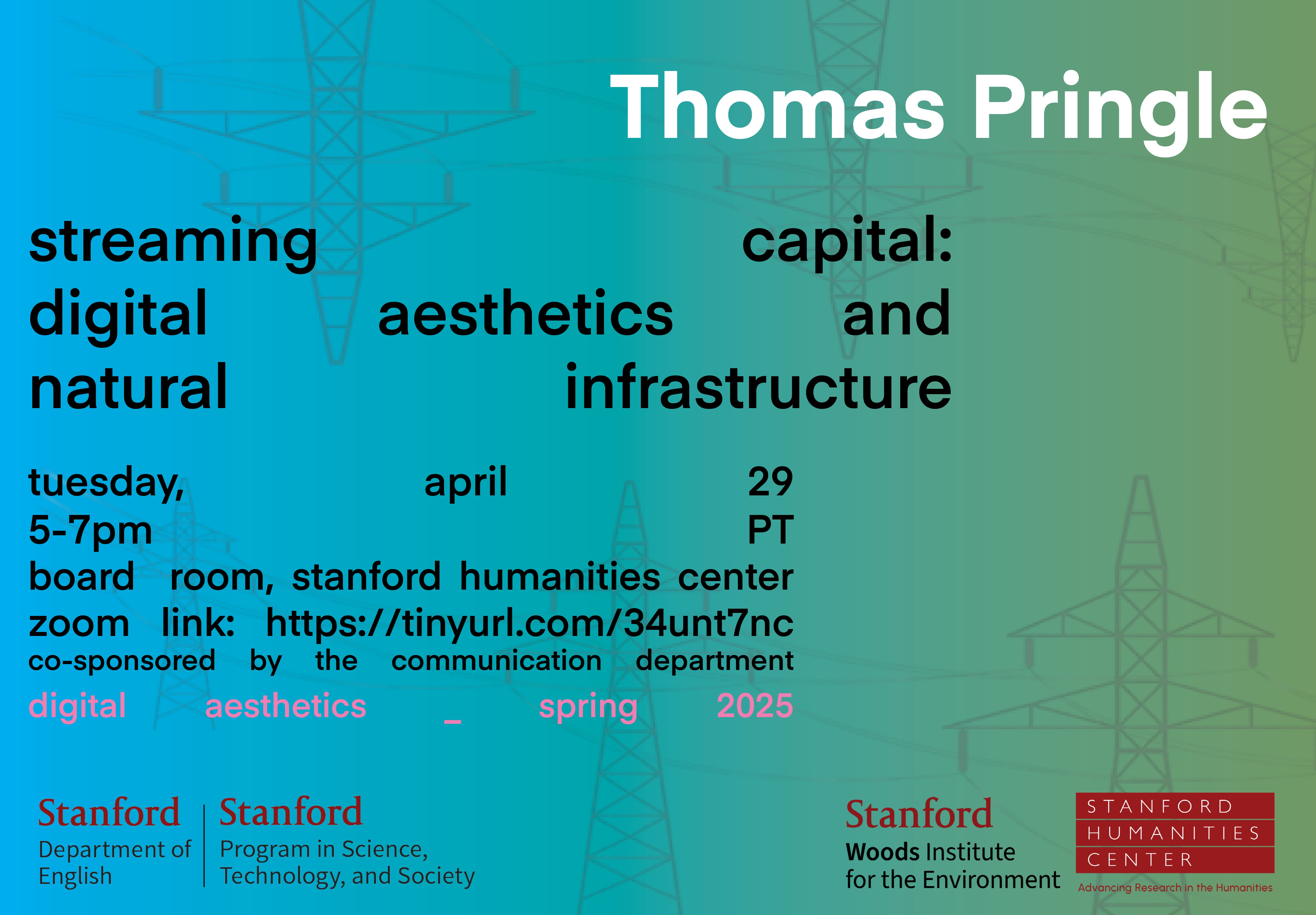
Please join the Digital Aesthetics Workshop in welcoming Thomas Pringle, who will present “Streaming Capital: Digital Aesthetics and Natural Infrastructure” on Tuesday, April 29, from 5:00-7:00pm PT. The event will take place in the Board Room at the Stanford Humanities Center. We look forward to seeing you there!
In 2022, Netflix launched “Net Zero + Nature,” a program offsetting the streaming giant through purchase of carbon credits generated by the Wildlife Works Kasigau Corridor REDD+ Project. Promotional materials assert that trees growing in Kenya are an infrastructure supporting resource-intensive streaming media. Recent digital media have been critiqued as industrial, environmentally destructive processes. Yet this project suggests that the isomorphic relationships between an image and its ecological impact are aesthetic, with the Netflix offset program indexing a broader media-historical rationality linking digital representation to economically conditioned forms of physical change. What media-historical a priori lend legibility to the statement: environments are media infrastructure?
In the late 1950s, cybernetic ecologist Howard Odum studied Corpus Christi Bay during his tenure at the Marine Institute at the University of Texas. Concerned with how ongoing petroleum logistical development threatened the turtle grass beds crucial to the estuary ecosystem, Odum drew on images of electrical circuitry to analogize seagrass to the local hay market, estimating that the work performed by the bay’s photosynthesis was worth $97.46 per acre per year. Turtle grass conservation would thus support various modes of production: fishing, tourism, natural gas electricity generation, and the ecological metabolism of industrial sludge. This humble act of labor-free monetization is among the first recorded arguments that conserved environments serve as infrastructure, or in Odum’s words as “life support functions supporting the economy without much conscious recognition.” In the context of recent degrowth advocacy, this case initiates a media historical narration of the aesthetic forms signifying the productivity of “natural infrastructures.”
Bio:
Thomas Patrick Pringle is Assistant Professor of Cinema and Media Studies at the University of Southern California. With Gertrud Koch and Bernard Stiegler, he is the co-author of Machine (Meson and University of Minnesota Press, 2019). Pringle’s research on environmental media appears in NECSUS: European Journal of Media Studies, Journal of Film and Video, Media-N, and New Media and Society, as well as the volumes Toxic Immanence: Decolonizing Nuclear Legacies and Futures (2022) and Power Shift: Keywords for a New Politics of Energy (2025).
This event has been generously co-sponsored by the Woods Institute for the Environment, the Department of English, the Department of Communication, and the Program in Science, Technology, and Society.
Please join us in welcoming our next speaker at the Digital Aesthetics Workshop, Kartik Nair, who will present on “Forms in Motion: Elemental Effects in Contemporary Cinema” on Friday, April 25, 1:00-3:00pm PT. The event will take place in McMurtry 370, where lunch will be served.
Motion capture is the practice of recording the movements of human bodies and using those movements to animate computer-generated bodies, thereby producing virtual character movement on the screen. Current scholarship on motion capture has critically examined the construction of this technology in trade reportage, industry journalism, and film promotion, detecting a discursive ambivalence arising from a struggle for recognition between live actors and motion capture technicians over the future of film performance. This talk will use motion capture as a heuristic to understand the many other kinds of human movements that are being captured in the processes of digital image-making. I will track the pipeline of atmospheric effects. Such atmospheric effects are ubiquitous in contemporary blockbuster cinema. Dust, fire, smoke, light, water and other particulate proliferate in the mise en scene, helping to ground impossible worlds even as they fascinate us with their own expressive qualities. Replacing the logic of photographic capture with one in which the frame is a ‘blank canvas’ to which elements are selectively added, such atmospheric effects vividly attest to the claim that digital tools have re-linked filmmaking with painting. Yet, unlike the painted canvas, which preserves brushstrokes in frozen perpetuity, virtual effects inscribe a trace of and in motion: these are instances in which the creative and corporeal motion of visual effects artists is captured and conveyed as motion. This process unfolds along a transnational path along which the mobile trace moves. Even as those generating it may remain immobilized by visa regulations, server locations, and time-zone differentials, their physical moves are eventually ex-propriated and assimilated into screen movement. Closely read, then, the spectacular conventions of blockbuster cinema can become legible as archives in and of motion.
Bio:
Kartik Nair is a film scholar working at the intersection of transnational cinema, film historiography, materialist media theory, and infrastructure studies, with a focus on popular genres and South Asian cinema. His first book, Seeing Things, is about the production and circulation of low-budget horror films in 1980s India. His current research explores the physical pipelines of digital cinema. He is an Assistant Professor of Film Studies at Temple University in Philadelphia, and one of the core editors of BioScope: South Asian Screen Studies.
This event has been generously co-sponsored by the Department of Art & Art History and the Stanford Center for South Asia.
We’re delighted to welcome our next speaker for the Digital Aesthetics Workshop, the first of the Spring quarter. Sybille Krämer present on “The Productivity of Artificial Flatness: On Digitality, The Cultural Technique of Flattening, and Artificial Intelligence” on Tuesday, April 8, from 5-7pm PT. The event will take place in the Board Room at the Stanford Humanities Center, where refreshments will be served.
Do chatbots understand human language? This is one of the most debated issues about contemporary artificial intelligence, oscillating between the opposing answers ‘able to understand’ (meaning-sensitive) and ‘unable to understand’ (meaning-blind). In this talk, I argue in favor of meaning blindness by highlighting several issues that are not considered enough in the debate. My arguments are based on a media-philosophical and cultural-technical approach. Artificial intelligence is becoming a ‘cultural technique’ in transitioning from print culture to digital literacy. However, it is an alien and non-human kind of performing intelligence and processing language. Not similarity and homology but difference and diversity are the foundations for successful interaction between humans and AI. This is explained by analogy with the ‘cultural technique of flattening’: Projecting visual and textual information into the two-dimensionality of inscribed and illustrated surfaces is not deformation and impoverishment, but a creative force. What is the key to the scientific and artistic productivity of artificial flatness (images, writings, diagrams, maps, screens)? And what is the connection between the cultural technique of flattening and Chatbots’ token-statistical operations?
Speaker Bio:
Sybille Krämer was a Full Professor for Philosophy at the Free University Berlin; since retirement in 2018, a guest professor at the Institute Cultures and Aesthetics of Digital Media, Leuphana University Lueneburg. Previously a member of the German ‘Scientific Council’ (2000-2006), of the European Research Council (2007-2014)); member of the ‘Senat’ of the ‘German Research Foundation’ (2009-2015), ‘Permanent Fellow’ at the ‘Wissenschaftskolleg’ zu Berlin/ Institute for Advanced Study (2005-2008). Several International Visiting Professorships and Fellowships (Oxford, UC Santa Barbara, Yale, Vienna, Seoul, Shanghai, Tokyo); 2016 Honorary Doctorate by Linköping University/Sweden.
This event is generously co-sponsored by the Stanford Literary Lab.
We’re delighted to welcome our next speaker for the Digital Aesthetics Workshop: Scott Richmond will present a hands-on demo, titled, “Computing, Intimately: On Computational Transitional Objects” on Friday, March 14, from 11:30am-1pm PT. We request that participants also take a look at the paper he has generously provided us with in advance (please email Grace Han for a copy: ghahahan at stanford dot edu). The event will take place in the Board Room at the Stanford Humanities Center and lunch will be served.
This hands-on workshop will engage computing historically, theoretically, and aesthetically. Drawing on the work of MIT computer scientist Seymour Papert in the 1970s, whose team made the Logo pedagogical programming environment, we will attend to the psychic and aesthetic dimensions of the computational transitional object as it emerged around 1970. Papert theorized the computational transitional object as our surrogate in the microworld of the computer. Participants will be asked to read a pre-circulated paper about Papert. They should bring a laptop to do hands-on coding in Ludus, a translation of Logo. No programming experience of any kind is required, and those who already know how to code should come with beginners’ mind.
Bio:
Scott C. Richmond is Associate Professor of Cinema and Digital Media in the Cinema Studies Institute at the University of Toronto, where they also direct the Centre for Culture and Technology. Their work lies at the intersection of film and media theory, queer and affect theory, avant-garde and experimental media aesthetics, and the history of computing. They are author of two books, Cinema’s Bodily Illusions: Flying, Floating, and Hallucinating (Minnesota, 2016) and Find Each Other: Networks, Affects, and Other Queer Encounters (Duke, under contract).
This event is generously co-sponsored by the Stanford Media Studies Colloquium.
The Digital Aesthetics Workshop is looking forward to welcoming Rizvana Bradley, who will present “Borrowed Time: Mediating the Nonevental” on Tuesday, March 4, at 5-7pm PT. The event will take place in the Watt Dining Room at the Humanities Center, where refreshments will be served. Below you will find the Bradley’s bio and a brief abstract, as well as the poster for the event. See you there!
This talk approaches the concept of mediality, which gets to the heart of a number of theoretical questions concerning the entanglements of raciality, mediation, and immediation, and the worldly violence of the everyday. Interrogating the racialized grammars of ontology, phenomenology, and (aesthetic) form, one can begin to further understand the depth of the violence and scope of the implications of what Bradley theorizes as black mediality. Black mediality has massive implications for both the grammar of technics that predominates in the philosophy of media, as well as the conception of mediality this grammar inscribes. Moving by way of artistic example, the talk demonstrates how both mediatic forms and the perceived technological exteriorizations of the modern human subject are bound to normative, phenomenological conceptions of temporality.
Bio:
Rizvana Bradley is Associate Professor of Film and Media and Affiliated Faculty in the History of Art and the Center for Race and Gender at the University of California, Berkeley.
Bradley’s book, Anteaesthetics: Black Aesthesis and the Critique of Form (Stanford University Press, 2023), moves across multiple histories and geographies, artistic mediums and forms—from nineteenth-century painting and early cinema, to contemporary text-based works, video installations, and digital art—in order to inaugurate a new method for interpretation, an ante-formalism, which demonstrates black art’s recursive deconstruction of the aesthetic forms that remain foundational to modernity.
Bradley serves on the Advisory Board of October. Her articles appear in journals such as Diacritics: A Review of Contemporary Criticism, Film Quarterly, Black Camera: An International Film Journal, Discourse: Journal for Theoretical Studies in Media and Culture, TDR: The Drama Review, Rhizomes: Cultural Studies in Emerging Knowledge, and Women and Performance: A Journal of Feminist Theory. Her art criticism has also been published in The Yale Review, Artforum, e-flux, Art in America, November, and Parkett, as well as numerous exhibition catalogs, including for the Serpentine Galleries, the New Museum, Whitechapel Gallery, Leslie-Lohman Museum of Gay and Lesbian Art, Institute of Contemporary Art Philadelphia, and the Berlin Biennale for Contemporary Art. Bradley has curated a number of academic arts symposia, including events at the British Film Institute, London, the Serpentine Galleries, London, and the Stedelijk Museum of Art, Amsterdam.