Shane Carruth’s Whiteheadian Metaphysics of Post-Cinema #SLSA14

SLSA-2014-Stengers-Carruth-Upstream-Color.001

Above, the final slide from my presentation on “Metabolic Media,” which I delivered today at the Society for Literature, Science, and the Arts conference in Dallas. I post it here because it includes one of my favorite recent discoveries: a quotation from Isabelle Stengers’s book Thinking with Whitehead that, in a discussion of Whitehead’s attempts to avoid the “bifurcation of nature” into primary and secondary qualities (as the early moderns put it) or into scientific and manifest images (in Wilfrid Sellars’s terms from the 1960s), comes surprisingly close to naming independent filmmaker Shane Carruth’s 2013 film Upstream Color — thereby unexpectedly helping us to understand the strange, post-cinematic experience of this film, which in its own way seems to reject the clear separation of subjective viewing positions and perceptual objects. Who knows? Maybe Carruth even took the title for his film from Stengers’s book. I have no evidence for this whatsoever, of course, but the resonance between the Whiteheadian project and what I call the “metabolic images” of Carruth’s film is so compelling, in my opinion, that the discovery of this quote makes it fun to speculate (idly) about the possibility…

Diagramming Media as the Environment for Life

WeHaveNeverBeenHuman

Both aesthetically and conceptually, the diagram above is imperfect in many ways. It is, necessarily, an oversimplification; I hope that it might nevertheless serve a positive purpose by giving visible form to an otherwise somewhat abstract argument. Developed for my talk at the upcoming “Philosophy After Nature” conference in Utrecht (you can find my abstract here), the diagram could also serve as an emblem for the argument I make in Chapter 6 of Postnaturalism. In that chapter, I look at (among other things) Mark Hansen’s concept of “the medium as an environment for life” (as introduced in his paper “Media Theory,” which appeared in Theory, Culture & Society); this concept, developed in conversation with Bernard Stiegler’s philosophy of technics, has been very important for my work, and grappling with it was central for me in the process of arguing that “we have never been natural.”

In the course of developing his concept, Hansen argues that there is an asymmetrical priority of human embodiment in the transductive relation between technics and the human. In Hansen’s engagement with Stiegler, this prerogative of embodiment is seen to be at odds, to a certain extent, with Stiegler’s argument about the synchronization or industrialization of experience through the action of recording technologies. The latter embody “tertiary retentions” of experience, beyond the primary and secondary retentions that Husserl theorized as the operations, respectively, of immediate temporal experience and of recollection or memory. According to Stiegler, in a complex argument that I will not try to summarize here, tertiary retention (technical recording) injects secondary retention (memory) into primary retention (the immediate experience of the “adherent present,” from which flows also the future) — effectively instituting a pre-formatted future on a mass scale (especially in the age of live television and real-time media).

Following an objection raised by Jean-Michel Salanskis, who sees a paradox or split in Husserl’s notion of primary retention — a split between the referential aspect that aligns primary retention with conscious experience, on the one hand, and a non-referential aspect that is wholly unconscious, on the other — Hansen argues that Stiegler’s argument diminishes the robust role of embodiment in the production of temporal experience. The synchronization envisioned by Stiegler is dependent, according to Hansen, on a bracketing of embodied agency; the “mnemotechnical constitution of time” prioritized by Stiegler is thus secondary to the “corporo-technical constitution of time” that Hansen identifies as an infra-empirical condition of experience. Hence the asymmetrical privileging of human embodiment in the medial transduction of human and technical agencies.

The diagram above summarizes my own intervention in the context of these debates. Rather than reinstituting the priority of the human within the anthropotechnical transduction, my suggestion is that we conceive tertiary retention (and media technics more generally) as similarly split between a referential (“mnemotechnical” or broadly representational) and a non-referential (materially embodied) aspect. With memory flanked on both sides by a non-discrete, smooth space of matter, cognitive life is then situated squarely in a realm staked out between robustly material agencies—between the subpersonal operation of the body, on the one hand, and the subphenomenal, infra-empirical material agency of technics on the other. As the diagram tries to indicate, a certain symmetry is restored in the anthropotechnical interface, which on this model describes the joint production of empirical reality — the distributed (human and nonhuman) agency by which the phenomenal realm is demarcated from out of the unmarked environment of material flux.

Nonhuman Media Theories and Their Human Relevance #Flow14

Photo-Synthesizers

As I wrote here recently, I will be taking part in a roundtable discussion on media theory at this year’s FLOW Conference at the University of Texas (September 11-13, 2014). My panel — which will take place on Friday, September 12 at 1:45-3:00 pm (the full conference schedule is now online here) — consists of Drew Ayers (Northeastern University), Hunter Hargraves (Brown University), Philip Scepanski (Vassar College), Ted Friedman (Georgia State University), and myself.

In preparation for the panel, which is organized as a roundtable discussion rather than a series of paper presentations, each of us is asked to formulate a short position paper outlining our answer to an overarching discussion question. Clearly, the positions put forward in such papers are not intended to be definitive answers but provocations for further discussion. Below, I am posting my position paper, and I would be happy to receive any feedback on it that readers of the blog might care to offer.

Nonhuman Media Theories and their Human Relevance

Response to the FLOW 2014 roundtable discussion question “Theory: How Can Media Studies Make ‘The T Word’ More User-Friendly?”

Shane Denson (Leibniz Universität Hannover, Germany / Duke University)

1. Theory Between the Human and the Nonhuman

Rejecting the excesses of deconstructive “high theory,” approaches like cultural studies promised to be more down-to-earth and “user-friendly.” While hardly non-theoretical, this was “theory with a human face”; against poststructuralism’s anti-humanistic tendencies, human interaction (direct or mediated) returned to the center of inquiry. Today, however, we are faced with (medial) realities that exceed or bypass human perspectives and interests: from the microtemporal scale of computation to the global scale of climate change, our world challenges us to think beyond the human and embrace the nonhuman as an irreducible element in our experience and agency. Without returning to the old high theory, it therefore behooves us to reconcile the human and the nonhuman. Actor-network theory, affect theory, media archaeology, “German media theory,” and ecological media theory all highlight the role of the nonhuman, while their political (and hence human) relevance asserts itself in the face of very palpable crises – e.g. ecological disaster, which makes our own extinction thinkable (and generates a great variety of media activity), but also the inhuman scale and scope of global surveillance apparatuses.

2. With Friends Like These…

The roundtable discussion question asks how theory can be made more “user-friendly”; but first we should ask what this term suggests for the study of media. Significantly, the term “user-friendly” itself originates in the context of media – specifically computer systems, interfaces, and software – as late as the 1970s or early 1980s. Its appearance in that context can be seen as a response to the rapidly increasing complexity of a type of media – digital computational media – that function algorithmically rather than indexically, in a register that, unlike cinema and other analogue media, is not tuned to the sense-ratios of human perception but is designed precisely to outstrip human faculties in terms of speed and efficiency. The idea of user-friendliness implies a layer of easy, ergonomic interface that would tame these burgeoning powers and put them in the user’s control, hence empowering rather than overwhelming. As consumers, we expect our media technologies to empower us thus: they should enable rather than obstruct our purposes. But should we expect this as students of media? Should we not instead question the ideology of transparency, and the disciplining of agency it involves? Hackers have long complained about the excesses of “user-obsequious” interfaces, about “menuitis” and the paradoxical disempowerment of users through the narrow bandwidth interfaces of WIMP systems (so-called because of their reliance on “windows, icons, menus/mice, pointers”). Such criticisms challenge us to rethink our role as users – both of media and of media theory – and to adopt a more experimental attitude towards media, which are capable of shaping as much as accommodating human interests.

3. Media as Mediators

The give and take between empowerment and disempowerment highlights the situational, relational, and ultimately transformational power of media. And while cultural studies countenanced such phenomena in terms of hegemony, subversion, and resistance, the very agency of the would-be “user” of media might be open to more radical destabilization – particularly against the background of media’s digital revision, which “discorrelates” media contents (images, sounds, etc.) from human perception and calls into question the validity of a stable human perspective. More generally, it makes sense to think about media in terms of agencies and affordances rather than mere channels between pre-existing subjects and objects – to see media, in Bruno Latour’s terms, not as mere “intermediaries” but as “mediators” that generate specific, historically contingent differences between subject and object, nature and culture, human and nonhuman. Recognizing this non-neutral, lively and unpredictable, dimension of media invites an experimental attitude that not only taps creative uses of contemporary media (as in media art) but also privileges a sort of hacktivist approach to media history as non-linear, non-teleological, and non-deterministic (as in media archaeology) – and that ultimately rethinks what media are.

4. Speculative Media Theory

By expanding the notion of mediation beyond the field of discrete media apparatuses, and beyond their communicative and representational functions, approaches like Latour’s actor-network theory gesture towards a nonhuman and ultimately speculative media theory concerned with an alterior realm, beyond the phenomenology of the human (as we know it). This sort of theory accords with the aims of speculative realism, a loose philosophical orientation defined primarily by its insistence on the need to break with “correlationism,” or the anthropocentric idea according to which being (or reality) is necessarily correlated with the categories of human thought, perception, and signification. Contemporary media in particular – including the machinic automatisms of facial recognition, acoustic fingerprinting, geotracking, and related systems, as well as the aesthetic deformations of what Steven Shaviro describes as “post-cinematic” moving images – similarly problematize the correlation of media with the forms (and norms) of human perception. More generally, a speculative and non-anthropocentric perspective equips us to think about the way in which media have always served not as neutral tools but, as Mark B. N. Hansen argues, as the very “environment for life” itself.

5. Media Theory for the End of the World

Perhaps most concretely, the appeal of this perspective lies in its appropriateness to an age of heightened awareness of ecological fragility. As we begin reimagining our era under the heading of the Anthropocene – as an age in which the large-scale environmental effects of human intervention are appallingly evident but in which the extinction of the human becomes thinkable as something more than a science-fiction fantasy – our media are caught up in a myriad of relations to the nonhuman world: they mediate between representational, metabolic, geological, and philosophical dimensions of an “environment for life” undergoing life-threatening climate change. Like never before, students of media are called upon to correlate content-level messages (such as representations of extinction events) with the material infrastructures of media (like their environmental situation and impact). The Anthropocene, in short, not only elicits but demands a nonhuman media theory.

Preview of Two Talks in Texas

wing-and-trees

My family and I are just about to relocate from Texas (where we’ve been based for the past couple of months) to North Carolina, where I will embark on a 2-year DAAD postdoctoral fellowship at Duke University beginning August 1. It turns out, however, that two conferences will have me returning to the Lone Star State this fall: first, the Flow Conference 2014, which will take place from September 11-13 at the University of Texas at Austin, and then the annual conference of the Society for Literature, Science, and the Arts (SLSA) the following month, October 9-12, hosted this year by Southern Methodist University in Dallas.

At the Flow Conference, I will be participating in a roundtable discussion on “Theory.” By way of preparation, participants are asked to prepare a short position paper, and I will post mine here in due time. For now, the ground I wish to cover is outlined in this brief answer to the discussion question “How can media studies make theory more user-friendly?”

Nonhuman Media Theories and their Human Relevance

Shane Denson

Rejecting the excesses of deconstructive “high theory,” approaches like cultural studies promised to be more down-to-earth and “user friendly.” While hardly non-theoretical, this was “theory with a human face”; against poststructuralism’s anti-humanistic tendencies, human interaction (direct or mediated) returned to the center of inquiry. Today, however, we are faced with (medial) realities that exceed or bypass human perspectives and interests: from the microtemporal scale of computation to the global scale of climate change, our world challenges us to think beyond the human and embrace the nonhuman as an irreducible element in our experience and agency. Without returning to the old high theory, it behooves us to reconcile the human and the nonhuman. Actor-network theory, affect theory, media archaeology, “German media theory,” and ecological media theory all highlight the role of the nonhuman, while their political (and hence human) relevance asserts itself in the face of very palpable crises – e.g. ecological disaster, which makes our own extinction thinkable (and generates a great variety of media activity), but also the inhuman scale and scope of global surveillance apparatuses.

Then, at SLSA, which revolves this year around the concept of “Fluid,” I’ll be returning to post-cinema, metabolism, and the films of Shane Carruth. Here’s my abstract for that one:

Metabolic Media: On the Fluid Images and Ecologies of Post-Cinema

In an age of computational image production and networked distribution channels, media “contents” and our “perspectives” on them are rendered ancillary to algorithmic functions and become enmeshed in an expanded, indiscriminately articulated plenum of images that exceed capture in the form of photographic or perceptual “objects.” That is, post-cinematic images are thoroughly processual or fluid in nature, from their digital inception and delivery to their real-time processing in computational playback apparatuses; furthermore, and more importantly, this basic processuality explodes the image’s ontological status as a discrete packaged unit, and it insinuates itself – as I will argue – into our own microtemporal processing of perceptual information, thereby unsettling the relative fixity of the perceiving human subject. Post-cinema’s cameras thus mediate a radically nonhuman ontology of the image, where these images’ discorrelation from human perceptibility signals an expansion of the field of material affect: beyond the visual or even the perceptual, the images of post-cinematic media operate and impinge upon us at what might be called a “metabolic” level, modulating the flow of lived duration itself.

Building upon Steven Shaviro’s theorization of “post-cinematic affect,” Maurizio Lazzarato’s Marxist-Bergsonist “video philosophy,” and Mark B. N. Hansen’s post-phenomenological analyses of “21st-century media,” this presentation focuses especially on the work of independent filmmaker Shane Carruth (Primer, 2004; Upstream Color, 2013) in an attempt to theorize the emerging interface forms through which contemporary moving-image media transductively generate experiences of a decidedly postnatural environment.

We Have Never Been Natural

myrtle-machine

Readers of the blog will recognize this post’s title — “We have never been natural” — as the nutshell slogan for postnaturalism, as it is developed in my forthcoming book of the same title. Now that slogan is also the title of a talk I will be giving at the 2014 Society for European Philosophy and Forum for European Philosophy joint annual conference, “Philosophy After Nature,” which will take place September 3-5, 2014 in Utrecht, Netherlands.

In the talk, I try to get to the media-philosophical heart of postnaturalism and develop the core argument to the extent possible in a 20-minute presentation. Here is the abstract:

We Have Never Been Natural: Towards a Postnatural Philosophy of Media

Shane Denson (Leibniz Universität Hannover / Duke University)

In this presentation, I draw upon concepts and arguments put forward by Bernard Stiegler, Mark B. N. Hansen, Niklas Luhmann, and Bruno Latour and put them into conversation with one another in order to develop what I term a postnatural philosophy of media. Postnaturalism, as I define the term, does not signal the end of nature but a particular manner of rethinking it. Methodologically, postnaturalism marks an extension of rather than a break with (scientific and epistemological) naturalism and its insistence on material evolution as the basis of consciousness and all ideational, symbolic, or discursive realities. Substantively, however, this extension implies a rethinking of nature because technical agencies are seen as not only immanent to the natural but also crucially implicated in the transformative force of evolution. Accordingly, postnaturalism implies that “we have never been natural” (and neither has nature, for that matter). At the heart of this rethinking is what I call the “anthropotechnical interface”: a sub-phenomenal, infra-empirical stratum of materiality, which forms the site of radical transformation by means of the “unnatural selection” that results from the technical mediation of embodied life. This view, which can be developed with the help of Bernard Stiegler’s philosophy of technology, implies a special role for media; accordingly, as I argue, media serve as nothing less than the “originary correlators” of the phenomenal and the noumenal.

My argument for this (seemingly extravagant) claim involves an adaptation of Niklas Luhmann’s systems-theoretical conception of mediality, which (when subjected to a transformative rethinking that abstracts media beyond the system-immanent position to which they are relegated in Luhmann’s thought) provides a formal model for thinking media as the site of sub-phenomenological changes taking place at the very cusp between systemic enclosure and the unmarked environment from which any and all systems emerge. Expanding on Mark B. N. Hansen’s notion of media as the “environment for life” itself, my argument goes on to question the cognitive or mnemotechnical bias of Stiegler’s philosophy of technology while also reversing Hansen’s asymmetrical privileging of human embodiment in the transductive relation between organic and inorganic agencies. Ultimately, the postnatural philosophy of media that results from these encounters works to articulate together process-oriented and object-oriented perspectives; besides (and beyond) empirically determinate manifestations in the form of discrete apparatic entities, media play a wholly non-anthropic role in the production of the empirical, in the constitution and maintenance of its spatio-temporal foundations. As a matter of “distributed embodiment,” media play a literally central role in the transduction of materially intersecting entities, each with their own form of embodiment, their own manner of marking the boundary, embodying the membrane, between material flux and the emergent realm of discrete objects.

Bibliography:

Denson, Shane. Postnaturalism: Frankenstein, Film, and the Anthropotechnical Interface. With a foreword by Mark B. N. Hansen. Bielefeld: Transcript, forthcoming 2014.

Hansen, Mark. Embodying Technesis: Technology Beyond Writing. Ann Arbor: U of Michigan P, 2000.

_____. “Media Theory.” Theory, Culture & Society 23.2-3 (2006): 297-306.

_____. New Philosophy for New Media. Cambridge, MA: MIT Press, 2004.

_____. “‘Realtime Synthesis’ and the Différance of the Body: Technocultural Studies in the Wake of Deconstruction.” Culture Machine 6 (2004). <http://www.culturemachine.net/index.php/cm/article/view/9/8>.

Latour, Bruno. We Have Never Been Modern. Trans. Catherine Porter. Cambridge, MA: Harvard UP, 1993.

Luhmann, Niklas. Art as a Social System. Trans. Eva M. Knodt. Stanford: Stanford UP, 2000.

_____. Die Gesellschaft der Gesellschaft. Frankfurt: Suhrkamp, 1997.

_____. Social Systems. Trans. John Bednarz, Jr., with Dirk Baecker. Stanford: Stanford UP, 1995.

Stiegler, Bernard. Technics and Time 1: The Fault of Epimetheus. Trans. Richard Beardsworth and George Collins. Stanford: Stanford UP, 1998.

_____. Technics and Time 2: Disorientation. Trans. Stephen Barker. Stanford: Stanford UP, 2009.

_____. Technics and Time 3: Cinematic Time and the Question of Malaise. Trans. Stephen Barker. Stanford: Stanford UP, 2011.

Video: Post-Cinematic Interfaces with a Postnatural World

There’s something fitting about the fact that the audio recording of my “3 Theses” on postnaturalism and post-cinema — which I presented at the 2014 annual conference of the DGfA, “America After Nature” — is overrun by the nonhuman voices of nameless birds calling to one another, blissfully indifferent to my theoretical speculations. What at first presented itself to me as something of a disappointment, viz. the generally poor quality of the recording and the occasional difficulty of discerning spoken words in particular, seemed on second thought a nice illustration — or better: enactment — of some of the ideas I put forward about the distributed agency of affect’s environmental mediation: here the human voice competes with “natural” and “cultural” forces ranging from songbirds to smartphones, failing to command their attentions but contributing to an improbable concert for a sufficiently non- or posthuman ear immersed in an ecology of material interaction.

Looking at it (or listening to it) from this angle, and getting over my initial disappointment, I decided to add some video of the various postnatural landscapes I encountered while in Germany on my recent trip. The result is another of what I have begun referring to as “metabolic images” — where the computational capture and processing of moving images, along with their temporal (and microtemporal) modulation, point to the subpersonal effects (and affects) of our embodied interfaces with a post-cinematic media environment. (See here, here, or here for more…)

(For the full effect, be sure to view the video in HD on vimeo. And finally, if you happen to have a more humanly inflected interest in the discursive “contents” put forward here, you can find the full text of my presentation here.)

Post-Cinema / Post-Phenomenology

artifact

Following my talk last week at the Texas State Philosophy Symposium, details have now been finalized for another talk at Texas State: this time in the context of the Philosophy Department’s Dialogue Series, where I’ll be talking about post-cinema (i.e. post-photographic moving image media such as video and various digital formats) and what I’ve been arguing is an essentially post-phenomenological system of mediation (see, for example, my talk from the 2013 SCMS conference or these related musings). For anyone who happens to be in the area, the talk will take place on Monday, April 14, 2014 at 12:30 pm (in Derrick Hall 111). UPDATE: The time has been changed to 10:00 am.

Philosophy of Science De-Naturalized: Notes towards a Postnatural Philosophy of Media (full text)

Phil-Sci-Denaturalized.034

As I recently announced, I was invited to give the keynote address at the 17th annual Texas State University Philosophy Symposium. Here, now, is the full text of my talk:

Philosophy of Science De-Naturalized: Notes towards a Postnatural Philosophy of Media

Shane Denson

The title of my talk contains several oddities (and perhaps not a few extravagances), so I’ll start by looking at these one by one. First (or last) of all, “philosophy of media” is likely to sound unusual in an American context, but it denotes an emerging field of inquiry in Europe, where a small handful of people have started referring to themselves as philosophers of media, and where there is even a limited amount of institutional recognition of such appellations. In Germany, for example, Lorenz Engell has held the chair of media philosophy at the Bauhaus University in Weimar since 2001. He lists as one of his research interests “film and television as philosophical apparatuses and agencies” – which, whatever that might mean, clearly signals something very different from anything that might conventionally be treated under the heading of “media studies” in the US. On this European model, media philosophy is related to the more familiar “philosophy of film,” but it typically broadens the scope of what might be thought of as media (following provocations from thinkers like Niklas Luhmann, who treated everything from film and television to money, acoustics, meaning, art, time, and space as media). More to the point, media philosophy aims to think more generally about media as a philosophical topic, and not as mere carriers for philosophical themes and representations – which means going beyond empirical determinations of media and beyond concentrations on media “contents” in order to think about ontological and epistemological issues raised by media themselves. Often, these discussions channel the philosophy of science and of technology, and this strategy will indeed build the bridge in my own talk between the predominantly European idea of “media philosophy” and the context of Anglo-American philosophy.

OK, but if the idea of a philosophy of media isn’t weird enough, I’ve added this weird epithet: “postnatural.” The meaning of this term is really the crux of my talk, but I’m only going to offer a few “notes towards” a postnatural theory, as it’s also the crux of a big, unwieldy book that I have coming out later this year, in which I devote some 400 pages to explaining and exploring the idea of postnaturalism. As a first approach, though, I can describe the general trajectory through a series of three heuristic (if oversimplifying) slogans.
Phil-Sci-Denaturalized.010

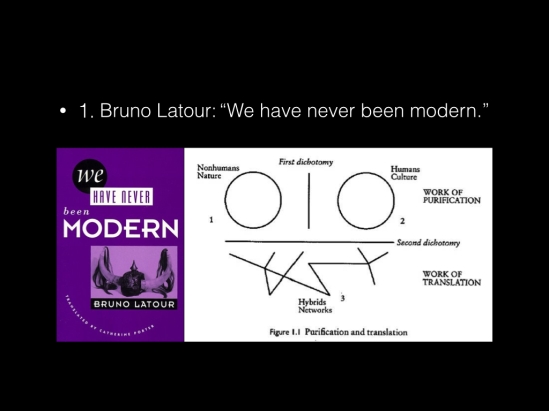
First, in response to debates over the alleged postmodernity of (Western) societies at the end of the twentieth century, French sociologist and science studies pioneer Bruno Latour, most famous for his association with so-called actor-network theory, claimed in his 1991 book of the same title that “We have never been modern.” What he meant, centrally, was that the division of nature and culture, nonhuman and human, that had structured the idea of modernity (and of scientific progress), could not only be seen crumbling in contemporary phenomena such as global warming and biotechnology – humanly created phenomena that become forces of nature in their own right – but that the division was in fact an illusion all along. We have never been modern, accordingly, because modern scientific instruments like the air pump, for example, were simultaneously natural, social, and discursive phenomena. The idea of modernity, according to Latour, depends upon acts of purification that reinforce the nature/culture divide, but an array of hybrids constantly mix these realms. In terms of a philosophy of media, one of the most important conceptual contributions made by Latour in this context is the distinction between “intermediaries” and “mediators.” The former are seen as neutral carriers of information and intentionalities: instruments that expand the cognitive and practical reach of humans in the natural world while leaving the essence of the human untouched. Mediators, on the other hand, are seen to decenter subjectivities and to unsettle the human/nonhuman divide itself as they participate in an uncertain negotiation of these boundaries.

Phil-Sci-Denaturalized.012

The NRA, with their slogan “guns don’t kill people, people kill people,” would have us believe that handguns are mere intermediaries, neutral tools for good or evil; Latour, on the other hand, argues that the handgun, as a non-neutral mediator, transforms the very agency of the human who wields it. That person takes up a very different sort of comportment towards the world, and the transformation is at once social, discursive, phenomenological, and material in nature.
Phil-Sci-Denaturalized.014

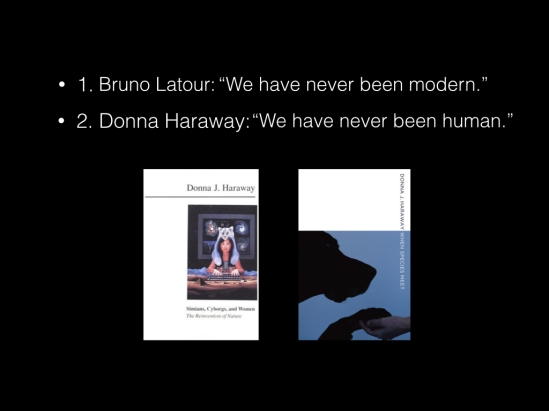
With Donna Haraway, we could say that the human + handgun configuration describes something on the order of a cyborg, neither purely human nor nonhuman. And Haraway, building on Latour’s “we have never been modern,” ups the ante and provides us with the second slogan: “We have never been human.” In other words, it’s not just in the age of prosthetics, implants, biotech, and “smart” computational devices that the integrity of the human breaks down, but already at the proverbial dawn of humankind – for the human has co-evolved with other organisms (like the dog, who domesticated the human just as much as the other way around). From an ecological as much as an ideological perspective, the human fails to describe anything like a stable, well-defined, or self-sufficient category.
Phil-Sci-Denaturalized.016

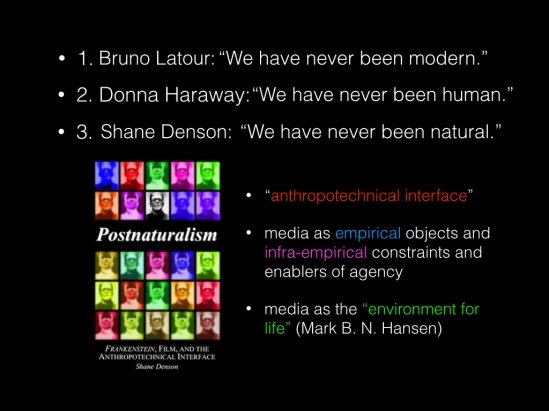
Now the third slogan, which is my own, doesn’t so much try to outdo Latour and Haraway as to refocus some of the themes that are inherent in these discussions. Postnaturalism, in a nutshell, is the idea not that we are now living beyond nature, whatever that might mean, but that “we have never been natural” (and neither has nature, for that matter). Human and nonhuman, natural and unnatural agencies are products of mediations and symbioses from the very start, I contend. In order to argue for these claims I take a broadly ecological view and focus not on discrete individuals but on what I call the anthropotechnical interface (the phenomenal and sub-phenomenal realm of mediation between human and technical agencies, where each impinges upon and defines the other in a broad space or ecology of material interaction). This view, which I develop at length in my book, allows us to see media not only as empirical objects, but as infra-empirical constraints and enablers of agency such that media may be described, following Mark Hansen, as the “environment for life” itself. Accordingly, media-technical innovation translates into ecological change, transforming the parameters of life in a way that outstrips our ability to think about or capture such change cognitively – for at stake in such change is the very infrastructural basis of cognition and subjective being. So postnaturalism, as a philosophy of media and mediation, tries to think about the conditions of anthropotechnical evolution, conceived as the process that links transformations in the realm of concrete, apparatic media (such as film and TV) with more global transformations at a quasi-transcendental level. Operating on both empirical and infra-empirical levels, media might be seen, on this view, as something like articulators of the phenomenal-noumenal interface itself.

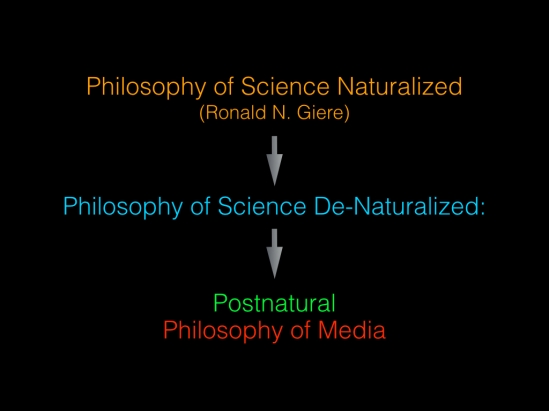
So the more I unpack this thing, the weirder it gets, right? Well, let me approach it from a different angle. Here’s where the first part of my title comes into play: “Philosophy of Science De-Naturalized.” Now, I mentioned before that postnaturalism does not postulate that we are living “after” nature; what I want to emphasize now is that it also remains largely continuous with naturalism, conceived broadly as the idea that the cosmos is governed by material principles which are the object, in turn, of natural science. And, more to the point, the first step in the derivation of a properly postnatural theory, which never breaks with the idea of a materially evolving nature, is to work through a naturalized epistemology, in the sense famously articulated by Willard V. O. Quine, but to locate within it the problematic role of technological mediation. By proceeding in this manner, I want to avoid the impression that a postnatural theory is based on a merely discursive “deconstruction” of nature as a concept. Against the general thrust of broadly postmodernist philosophies, which might show that our ideas of nature and its opposites are incoherent, mine is meant to be a thoroughly materialist account of mediation as a transformative force. So the “Philosophy of Science De-Naturalized,” as I put it here, marks a particular trajectory that takes off from what Ronald Giere has called “Philosophy of Science Naturalized” and works its way towards a properly postnatural philosophy of media.
Phil-Sci-Denaturalized.019

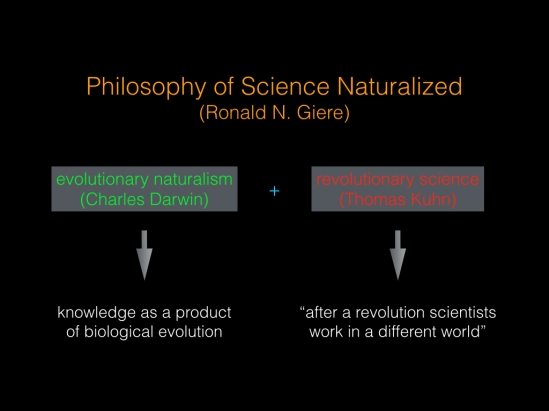
Giere’s naturalized philosophy of science is of interest to me because it aims to coordinate evolutionary naturalism (in the sense of Darwin) with revolutionary science (in the sense of Thomas Kuhn). In other words, it aims to reconcile the materialism of naturalized epistemology with the possibility of radical transformation, which Kuhn sees taking place with scientific paradigm shifts, and which I want to attribute to media-technical changes. Taking empirical science as its model, and taking it seriously as an engagement with a mind-independent reality, an “evolutionary epistemology” posits a strong, causal link between the material world and our beliefs about it, seeing knowledge as the product of our biological evolution. Knowledge (and, at the limit, science) is accordingly both instrumental or praxis-oriented and firmly anchored in “the real world.” As a means of survival, it is inherently instrumental, but in order for this instrumentality to be effective – and/or as the simplest explanation of such effectivity – the majority of our beliefs must actually correspond to the reality of which they form part. But, according to Kuhn’s view of paradigm shifts, “after a revolution scientists work in a different world” (Structure of Scientific Revolutions 135). This implies a strong incommensurability thesis that, according to critics like Donald Davidson, falls into the trap of idealism, along with its attendant consequences; i.e. if paradigms structure our experience, revolution implies radical relativism or else skepticism. So how can revolutionary transformation be squared with the evolutionary perspective?
Phil-Sci-Denaturalized.020

Convinced that it contains important cues for a theory of media qua anthropotechnical interfacing, I would like to look at Giere’s answer in some detail. Asserting that “[h]uman perceptual and other cognitive capacities have evolved along with human bodies” (384), Giere’s is a starkly biology-based naturalism. Evolutionary theory posits mind-independent matter as the source of a matter-dependent mind, and unless epistemologists follow suit, according to Giere, they remain open to global arguments from theory underdetermination and phenomenal equivalence: since the world would appear the same to us whether it were really made of matter or of mind-stuff, how do we know that idealism is not correct? And because idealism contradicts the materialist bias of physical science, how do we know that scientific knowledge is sound? According to Giere, we can confidently ignore these questions once the philosophy of science has itself opted for a scientific worldview. Of course, the skeptic will counter that naturalism’s methodologically self-reflexive relation to empirical science renders its argumentation circular at root, but Giere turns the tables on skeptical challenges, arguing that they are “equally question-begging” (385). Given the compelling explanatory power and track record of modern science and evolutionary biology in particular, it is merely a feigned doubt that would question the thesis that “our capacities for operating in the world are highly adapted to that world” (385); knowledge of the world is necessary for the survival of complex biological organisms such as we are. But because this is essentially a transcendental argument, it does not break the circle in which the skeptic sees the naturalist moving; instead, it asserts that circularity is an inescapable consequence of our place in nature. In large part, this is because “we possess built-in mechanisms for quite direct interaction with aspects of our environment. The operations of these mechanisms largely bypass our conscious experience and linguistic or conceptual abilities” (385).

Phil-Sci-Denaturalized.024

So much for the evolutionary perspective, but where does revolutionary science fit into the picture? To answer this question, Giere turns to the case of the geophysical revolution of the 1960s, when a long established model of the earth as a once much warmer body that had cooled and contracted, leaving the oceans and continents more or less fixed in their present positions, was rapidly overturned by the continental drift model that set the stage for the now prevalent plate tectonics theory (391-94). The matching coastlines of Africa and South America had long suggested the possibility of movement, and drift models had been developed in the early twentieth century but were left, by and large, unpursued; it was not just academic protectionism that preserved the old model but a lack of hard evidence capable of challenging accepted wisdom – accepted because it “worked” well enough to explain a large range of phenomena.
Phil-Sci-Denaturalized.025

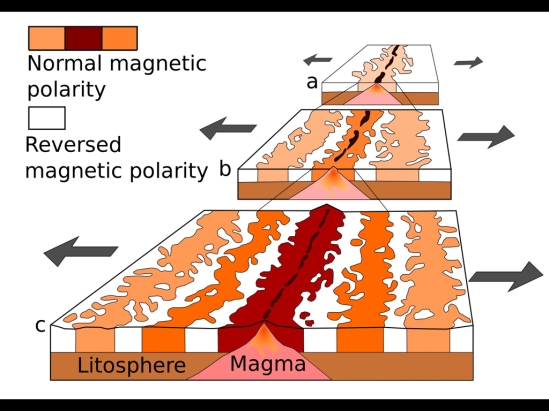
The discovery in the 1950s of north-south ocean ridges suggested, however, a plausible mechanism for continental drift: if the ridges were formed, as Harry Hess suggested, by volcanism, then “sea floor spreading” should be the result, and the continents would be gradually pushed apart by its action. The discovery, also in the 1950s, of large-scale magnetic field reversals provided the model with empirically testable consequences (the Vine-Matthews-Morley hypothesis): if the field reversals were indeed global and if the sea floor was spreading, then irregularly patterned stripes running parallel to the ridges should match the patterns observed in geological formations on land. Until this prediction was corroborated, there was still little impetus to overthrow the dominant theory, but magnetic soundings of the Pacific-Antarctic Ridge in 1966, along with sea-floor core samples, revealed the expected polarity patterns and led, within the space of a year, to a near complete acceptance of drift hypotheses among earth scientists.

According to Giere, naturalism can avoid idealistic talk of researchers living “in different worlds” and explain the sudden revolution in geology by appealing only to a few very plausible assumptions about human psychology and social interaction – assumptions that are fully compatible with physicalism. These concern what he calls the “payoff matrix” for accepting one of the competing theories (393). Abandoning a pet theory is seldom satisfying, and the rejection of a widely held model is likely to upset many researchers, revealing their previous work as no longer relevant. Resistance to change is all too easily explained. However, humans also take satisfaction in being right, and scientists hope to be objectively right about those aspects of the world they investigate. This interest, as Giere points out, does not have to be considered “an intrinsic positive value” among scientists, for it is tempered by psychosocial considerations (393) such as the fear of being ostracized and the promise of rewards. The geo-theoretical options became clear – or emerged as vital rather than merely logical alternatives – with the articulation of a drift model with clearly testable consequences. We may surmise that researchers began weighing their options at this time, though it is not necessary to consider this a transparently conscious act of deliberation. What was essential was the wide agreement among researchers that the predictions regarding magnetic profiles, if verified, would be extremely difficult to square with a static earth model and compellingly simple to explain if drift really occurred. Sharing this basic assumption, the choice was easy when the relevant data came in (394).
Phil-Sci-Denaturalized.026

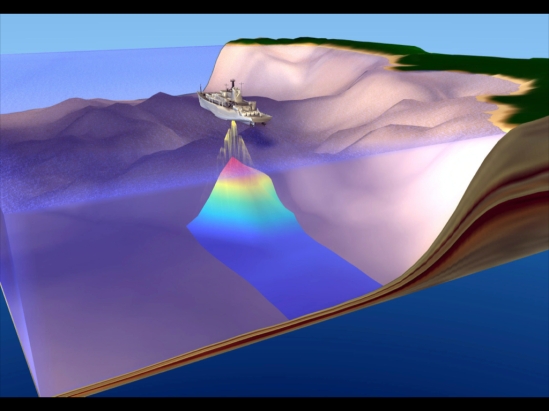
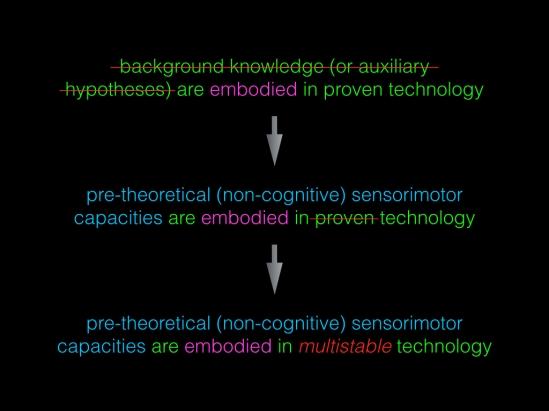
But the really interesting thing about this case, in my opinion, is the central role that technology played in structuring theoretical options and forcing a decision, which Giere notes but only in passing. The developing model first became truly relevant through the availability of technologies capable of confirming its predictions: technologies for conducting magnetic soundings of the ocean floor and for retrieving core samples from the deep. Indeed, the Vine-Matthews-Morley hypothesis depended on technology not only for its verification, but for its initial formulation as well: ocean ridges could not have been discovered without instruments capable of sounding the ocean floor, and the discovery of magnetic field reversals depended on a similarly advanced technological infrastructure. A reliance on mediating technologies is central to the practice of science, and Giere suggests that an appreciation of this fact helps distinguish naturalism from “methodological foundationism” or the notion that justified beliefs must recur ultimately to a firm basis in immediate experience (394). His account of the geological paradigm shift therefore “assumes agreement that the technology for measuring magnetic profiles is reliable. The Duhem-Quine problem [i.e. the problem that it is logically possible to salvage empirically disconfirmed theories by ad hoc augmentation] is set aside by the fact that one can build, or often purchase commercially, the relevant measuring technology. The background knowledge (or auxiliary hypotheses) are embodied in proven technology” (394). In other words, the actual practice of science (or technoscience) does not require ultimate justificational grounding, and the agreement on technological reliability ensures, according to Giere and contra Kuhn, that disagreeing parties still operate in the same world.

But while I agree that Giere’s description of the way technology is implemented by scientists is a plausible account of actual practice and its underlying assumptions, I question his extrapolation from the practical to the theoretical plane. With regard to technology, I contend, the circle problem resurfaces with a vengeance. As posed by the skeptic, Giere is right, in my opinion, to reject the circle argument as invalidating naturalism’s methodologically self-reflexive application of scientific theories to the theory of science. Our evolutionary history, I agree, genuinely militates against the skeptic’s requirement that we be able to provide grounds for all our beliefs; our survival depends upon an embodied knowledge that is presupposed by, and therefore not wholly explicatable to, our conscious selves. But as extensions of embodiment, the workings of our technologies are equally opaque to subjective experience, even – or especially – when they seem perfectly transparent channels of contact with the world. Indeed, Giere seems to recognize this when he says that “background knowledge (or auxiliary hypotheses) are embodied by proven technology” (394, emphasis added). In other words, scientists invest technology with a range of assumptions concerning “reliability” or, more generally, about the relations of a technological infrastructure to the natural world; their agreement on these assumptions is the enabling condition for technology to yield clear-cut decision-making consequences. Appearing neutral to all parties involved, the technology is in fact loaded, subordinated to human aims as a tool. Some such subordinating process seems, from a naturalistic perspective, unavoidable for embodied humans. However, agreement on technological utility – on both whether and how a technology is useful – is not guaranteed in every case. Moreover, it is not just a set of cognitive, theoretical assumptions (“auxiliary hypotheses”) with which scientists entrust technologies, but also aspects of their pre-theoretically embodied, sensorimotor competencies. Especially at this level, mediating technologies are open to what Don Ihde calls an experiential “multistability” – capable, that is, of instantiating to differently situated subjectivities radically divergent ways of relating to the world. But it is precisely the consensual stability of technologies that is the key to Giere’s contextualist rebuttal of “foundationism.”
Phil-Sci-Denaturalized.030

Downplaying multistability is the condition for a general avoidance of the circle argument, for a pragmatic avoidance of idealism and/or skepticism. This, I believe, is most certainly the way things work in actual practice; (psycho)social-institutional pressures work to ensure consensus on technological utility. But does naturalism, self-reflexively endorsing science as the basis of its own theorization, then necessarily reproduce these pressures? Feminists in particular may protest on these grounds that the “nature” in naturalism in fact encodes the white male perspective historically privileged by science because embodied by the majority of practicing scientists. What I am suggesting is that the tacit, largely unquestioned processes by which technological multistability is tamed in practice form a locus for the inscription of social norms directly into the physical world; for in making technologies the material bearers of consensual values (whether political, epistemic, psychological, or even the animalistically basic preferability of pleasure over pain) scientific practice encourages certain modes of embodied relations to the world – not just psychic but material relations themselves embodied in technologies. It goes without saying that this can only occur at the expense of other modes of being-embodied.

More generally stated, the real problem with naturalism’s self-reflexivity is not that it fails to take skeptical challenges seriously or that it provides a false picture of actual scientific practice, but that in extrapolating from practice it locks certain assumptions about technological reliability into theory, embracing them as its own. While it is contextually – indeed physically – necessary that assumptions be made, and that they be embodied or exteriorized in technologies, the particular assumptions are contingent and non-neutral. This may be seen as a political problem, which it is, but it also more than that. It is, moreover, an ontological problem of the instability of nature itself – not just of nature as a construct but of the material co-constitution of real, flesh-and-blood organisms and their environments. Once we enter the naturalist circle – and I believe we have good reason to do so – we accept that evolution dislodges the primacy of place traditionally accorded human beings. At the same time, we accept that the technologies with which science has demonstrated the non-essentiality of human/animal boundaries are reliable, that they show us what reality is really, objectively like. This step depends, however, on a bracketing of technological multistability. If we question this bracketing, as I do, we seem to lose our footing in material objectivity. Nevertheless convinced that it would be wrong to concede defeat to the skeptic, we point out that adaptive knowledge’s circularity or contextualist holism is a necessary requirement of human survival, that it follows directly from embodiment and the fact that the underlying biological mechanisms “largely bypass our conscious experience and linguistic or conceptual abilities” (Giere 385). But if we admit that technological multistability really obtains as a fact of our phenomenal relations to the world, this holism seems to lead us back precisely to Kuhn’s idealist suggestion that researchers (or humans generally) may occupy incommensurably “different worlds.” If we don’t want to abandon materialism, then we have to find an interpretation of this idea that is compatible with physicalism.

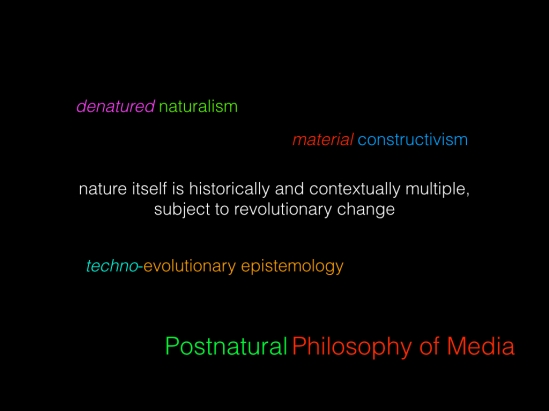
Indeed, it is the great merit of naturalism that it provides us with the means for doing so; however, it is the great failure of the theory that it neglects these resources. The failure, which consists in reproducing science’s subordination of technology to thought – in fact compounding the reduction, as contextually practiced, by subordinating it to an overarching (i.e. supra-contextual) theory of science – is truly necessary for naturalism, for to rectify its oversight of multistability is to admit the breakdown of a continuous nature itself. To consistently acknowledge the indeterminacy of human-technology-world relations and simultaneously maintain materialism requires, to begin with, that we extend Giere’s insight about biological mechanisms to specifically technological mechanisms of embodied relation to the world: they too “bypass our conscious experience and linguistic or conceptual abilities.” If we take the implications seriously, this means that technologies resist full conceptualization and are therefore potentially non-compliant with human (or scientific) aims; reliance on technology is not categorically different in kind from reliance on our bodies: both ground our practice and knowledge in the material world, but neither is fully recuperable to thought. Extending naturalism in this way means recognizing that not only human/animal but also human/technology distinctions are porous and non-absolute. But whereas naturalism tacitly assumes that the investment of technology with cognitive aims is only “natural” and therefore beyond question, the multistability of non-cognitive investments of corporeal capacities implies that there is more to the idea of “different worlds” than naturalism is willing or able to admit: on a materialistic reading, it is nature itself, and not just human thought or science, that is historically and contextually multiple, non-coherently splintered, and subject to revolutionary change. Serious consideration of technology leads us, that is, to embrace a denatured naturalism, a techno-evolutionary epistemology, and a material rather than social constructivism. This, then, is the basis for a postnatural philosophy of media.
Phil-Sci-Denaturalized.033

Philosophy of Science De-Naturalized: Notes towards a Postnatural Philosophy of Media

010406-N-0000X-002

I am very honored to have been invited to hold a keynote address at the Texas State University Philosophy Department’s annual philosophy symposium on April 4, 2014. Having studied as an undergraduate at Texas State (which back then was known as Southwest Texas State University, or SWT for short), this will be something of a homecoming for me, and I’m very excited about it!

In fact, one of the first talks I ever delivered was at the 1997 philosophy symposium — the very first year it was held. My talk back then, titled “Skepticism and the Cultural Critical Project,” sought to bridge the divide between, on the one hand, the analytical epistemology and philosophy of science that I was studying under the supervision of Prof. Peter Hutcheson and, on the other hand, the Continental-inspired literary and cultural theory to which I was being exposed by a young assistant professor of English, Mark B. N. Hansen (before he went off to Princeton, then University of Chicago, and now Duke University).

In a way, my effort back then to mediate between these two very different traditions has proved emblematic for my further academic career. For example, my dissertation looked at Frankenstein films as an index for ongoing changes in the human-technological relations that, I contend, continually shape and re-fashion us at a deeply material, pre-subjective, and extra-discursive level of our being. The cultural realm of monster movies was therefore linked to the metaphysical realm of what I call the anthropotechnical interface, and my argument was mounted by way of a lengthy “techno-scientific interlude” in which I revisited many of the topics in Anglo-American epistemology and philosophy of science that I had first thought about as an undergrad in Texas.

Thus, without my knowing it (and it’s really only now becoming clear to me), my talk back in 1997 marked out a trajectory that it seems I’ve been following ever since. And now it feels like a lot of things are coming full circle: A book based upon my dissertation, for which Mark Hansen served as reader, is set to appear later this year (but more on that and a proper announcement later…). In addition, as I announced here recently, I will be moving to North Carolina this summer to commence a 2-year postdoctoral fellowship at Duke, where I will be working closely with Hansen. Now, before that project gets underway, I have the honor to return to the philosophy symposium in San Marcos, Texas and, in a sense, to revisit the place where it all started.

I thought it would be appropriate, therefore, if I delivered a talk that continued along the trajectory I embarked upon there 17 years ago (wow, that makes me feel old…). My talk, titled “Philosophy of Science De-Naturalized: Notes towards a Postnatural Philosophy of Media,” takes a cue from Ronald N. Giere’s “Philosophy of Science Naturalized” — which sought to reconcile Thomas Kuhn’s idea of revolutionary paradigm shifts in the history of science with W. V. O. Quine’s notion of “Epistemology Naturalized,” i.e. a theory of knowledge based more in the material practice and findings of natural science (especially evolutionary biology) than in the “rational reconstruction” of ideal grounds for justified true belief. As I will show, my own “postnaturalism” — which is ultimately a philosophy of media rather than of knowledge or science — represents not so much a break with such naturalism as a particular manner of thinking through issues of technological mediation that emerge in that context, issues that I then subject to phenomenological scrutiny and ultimately post-phenomenological transformations in order to arrive at a theory of anthropotechnical interfacing and change.

Metabolic Images

Upstream_Color_Metabolism

This Saturday, February 1, 2014, I’ll be taking another stab at the notion of “metabolic images,” which I’ve started developing in recent talks. My talk will take place at the University of Cologne in the context of a series of workshops titled (after Isabelle Stengers) “Ecologies of Practice: Media, Art, Literature,” organized by Reinhold Görling (Heinrich-Heine-Universität Düsseldorf), Marie-Luise Angerer (Kunsthochschule Medien Köln), and Hanjo Berressem (Universität zu Köln). Here is the abstract for the talk:

Metabolic Images

Shane Denson, Leibniz Universität Hannover

With the shift to a digital and more broadly post-cinematic media environment, moving images have undergone what I term their “discorrelation” from human embodied subjectivities and (phenomenological, narrative, and visual) perspectives. Clearly, we still look at – and we still perceive – images that in many ways resemble those of a properly cinematic age; yet many of these images are mediated in ways that subtly (or imperceptibly) undermine the distance of perspective, i.e. the spatial or quasi-spatial distance and relation between phenomenological subjects and the objects of their perception. At the center of these transformations are a set of strangely volatile mediators: post-cinema’s screens and cameras, above all, which serve not as mere “intermediaries” (in Latour’s terms) that would relay images neutrally between relatively fixed subjects and objects but which act instead as transformative, transductive “mediators” of the subject-object relation itself. In other words, digital and post-cinematic media technologies do not just produce a new type of image; they establish entirely new configurations and parameters of perception and agency, placing spectators in an unprecedented relation to images and the infrastructure of their mediation.

The transformation at stake here pertains to a level of being that is therefore logically prior to perception, as it concerns the establishment of a new material basis upon which images are produced and made available to perception. Accordingly, a phenomenological and post-phenomenological analysis of post-cinematic images and their mediating cameras points to a break with human perceptibility as such and to the rise of a fundamentally post-perceptual media regime. In an age of computational image production and networked distribution channels, media “contents” and our “perspectives” on them are rendered ancillary to algorithmic functions and become enmeshed in an expanded, indiscriminately articulated plenum of images that exceed capture in the form of photographic or perceptual “objects.” That is, post-cinematic images are thoroughly processual in nature, from their digital inception and delivery to their real-time processing in computational playback apparatuses; furthermore, and more importantly, this basic processuality explodes the image’s ontological status as a discrete packaged unit, and it insinuates itself – as I will argue – into our own microtemporal processing of perceptual information, thereby unsettling the relative fixity of the perceiving human subject. Post-cinema’s cameras thus mediate a radically nonhuman ontology of the image, where these images’ discorrelation from human perceptibility signals an expansion of the field of material affect: beyond the visual or even the perceptual, the images of post-cinematic media operate and impinge upon us at what might be called a “metabolic” level.