Patricia Pisters, “The Filmmaker as Metallurgist: Post-Cinema’s Commitment to Radical Contingency” #SCMS15

brain-scan

[UPDATE: Full video of the complete panel is now online: here.]

Here is the abstract for Patricia Pisters’s paper on the panel “Post-Cinema and/as Speculative Media Theory” at the 2015 SCMS conference in Montréal:

The Filmmaker as Metallurgist: Post-Cinema’s Commitment to Radical Contingency

Patricia Pisters (University of Amsterdam)

Contemporary film, television series, and visual arts have a particular temporal and narrative aesthetics that show how the future, always speculative and multiple, has become the dominant time for thinking. I propose calling this aesthetic mode of the digital age “the neuro-image” (Pisters 2012). Following Gilles Deleuze’s movement-images and time-images, neuro-images increasingly present us time as multiple feedback loops from possible futures, parallel worlds, and complex narrations where subtle differences can cause a world of (micropolitical) variations, different pasts for different futures.

This presentation will look at the ways in which contemporary artists and filmmakers are committed to the radical contingency of the audio-visual archive – committed to revealing hidden dimensions of history and/in our collective audio-visual archive, in order to revive new perspectives and reveal new versions of the past that seem necessary for the future of “a people to come.” In her project The Archival Fourth Dimension, for example, artist Sarah Pierce revisits newsreel archives and proposes to uncover “a different past” in Irish and colonial history. In his installation homage to Stuart Hall, The Unfinished Conversation (2012), John Akomfrah shows how personal and collective archival footage are in a perpetual dialogue where poetry and politics form an intractable bond and history becomes a speculative world of alternative histories. Silvia Kolbowski resurrects Ulrike Meinhoff in A Few Howls Again (2010) and speaks up for her corps, giving a voice to haunting questions of war, violence, and terrorism. And in Zandj Revolution (2013), filmmaker Tariq Teguia makes a journey from Algeria, to Lebanon, Palestine, Iraq, and Greece to find inspiration not only in a past revolution – the ninth-century revolution of the Zandj slaves in Iraq – but also in a rebellious and migratory cinematographic style that captures and foreshadows the spirit of the Arab revolution.

Looking at examples such as these, the presentation aims to show how filmmakers become “metallurgists” (Deleuze and Guattari 1994) following the matter-flows of the archive, bending it in concrete forms that can escape from the mnemonic depths and take on a new life, an afterlife. As a politics and a cinematic aesthetics, this undertaking becomes a never-ending story of “trying again, failing again, failing better” with a radical and speculative commitment to the contingencies of history.

Bibliography:

Deleuze, Gilles, and Felix Guatttari. A Thousand Plateaus. London: The Athlone Press, 1994.

Eisenstein, Sergei. The Film Sense. Trans. Jay Leyda. San Diego, New York & London: Harcourt Brace & Company, 1947.

Shaviro, Steven. Post Cinematic Affect. Winchester, UK: Zero Books, 2010.

Pisters, Patricia. The Neuro-Image: A Deleuzian Film-Philosophy for Digital Screen Culture. Stanford: Stanford University Press, 2012.

Author Bio:

Patricia Pisters is professor of film studies in the department of Media Studies at the University of Amsterdam. She is one of the founding editors of Necsus: European Journal of Media Studies. Publications include The Matrix of Visual Culture: Working with Deleuze in Film Theory (Stanford University Press, 2003) and The Neuro-Image: A Deleuzian Film-Philosophy of Digital Screen Culture (Stanford University Press, 2012).

Adrian Ivakhiv, “Speculative Ecologies of (Post-)Cinema” #SCMS15

nasa-environment

[UPDATE: Full video of the complete panel is now online: here.]

Here is the abstract for Adrian Ivakhiv’s paper on the panel “Post-Cinema and/as Speculative Media Theory” at the 2015 SCMS conference in Montréal:

Speculative Ecologies of (Post-)Cinema

Adrian Ivakhiv (University of Vermont)

Three sets of intellectual developments frame this paper: (1) debates over the “end of cinema” (and rise of “post-cinema”) in the wake of digital media; (2) recognition across diverse fields that global ecological change—especially, though not solely, impending climate change—is forcing a rearticulation of disciplinary goals and broad societal values; and (3) an upsurge in speculative philosophy, including film and media philosophy, that reconceptualizes sociality, materiality, and relationality in diverse and mutually imbricated ways.

This paper sets out to articulate these three developments together. The emergence of cinema as the “eye of the [twentieth] century” (Cassetti 2008) and its subsequent mutation into something different at the beginning of the twenty-first, and the emergence of ecology as a dominant way of understanding the human-Earth relationship, have not yet been brought and thought together in a sustained way. To do this, I propose a speculative model of cinema, technology, and reality—a process-relational, semiotic-machinic, and “morphogenetic” model rooted in Whitehead, Peirce, and Deleuze/Guattari—to make sense of the ways in which digital cinema reaffirms the lively, kinematic animacy of all things cinematic and extra-cinematic.

Articulating the connections between cinema, semiosis, and materiality makes it possible to conceive of cinema (including digital cinema) as a particular political-ecological articulation of carbon-based life (or biosemiosis). But life, or the semiotic (in Peirce’s terms), exceeds the living. It is machinic (in Deleuzo-Guattarian terms), networked (in Bruno Latour’s), morphogenetic and perpetually differentiating (Deleuze/DeLanda). In this light, I consider what a “post-carbon” cinematic materiality, a materiality beyond the era of petrochemicals—the Capitalocene—might look like, and how digitality, with its proliferation of new forms and its shift to technologies of “the cloud,” affects the possibilities for reclaiming a semiotic commons.

Bibliography:

Bozak, Nadia. The Cinematic Footprint: Lights, Camera, Natural Resources. New Brunswick, NJ: Rutgers University Press, 2011.

Cassetti, Francesco. Eye of the Century: Film, Experience, Modernity. Tr. E. Larkin with J Pranolo. New York: Columbia University Press, 2008.

Ivakhiv, Adrian, Ecologies of the Moving Image: Cinema, Affect, Nature. Waterloo, Ontario, Canada: Wilfrid Laurier University Press, 2013.

Mullarkey, John, Refractions of Reality: Philosophy and the Moving Image. Basingstoke, Hampshire: Palgrave Macmillan, 2009.

Shaviro, Steven, Post-Cinematic Affect. Winchester: Zero Books, 2010.

Author Bio:

Adrian Ivakhiv is Professor of Environmental Thought and Culture at the University of Vermont. His research focuses at the intersections between ecology, culture, media, affect, and identity. His books include Ecologies of the Moving Image: Cinema, Affect, Nature (2013) and the forthcoming Why Objects Fly Out the Window: An Eventology Manifesto, in the Whiff of its Passing. He blogs at Immanence: EcoCulture, GeoPhilosophy, MediaPolitics.

Mark B. N. Hansen, “Speculative Protention, or, Are 21st Century Media Agents of Futurity?” #SCMS15

feedback

[UPDATE: Full video of the complete panel is now online: here.]

Here is the abstract for Mark Hansen’s paper on the panel “Post Cinema and/as Speculative Media Theory” at the 2015 SCMS conference in Montréal:

Speculative Protention, or, Are 21st Century Media Agents of Futurity?

Mark B. N. Hansen (Duke University)

In his effort to develop a philosophical account of time-consciousness in the media age, Bernard Stiegler has invoked cinema (as a stand-in for global, realtime, audiovisual fluxes) as the media object par excellence, the technical temporal object that brokers, models, and operates as surrogate for the temporalization responsible for conscious life. Since the publication of the first volume of Stiegler’s Technics and Time, critics have responded to Stiegler’s project with a mix of enthusiasm and skepticism: enthusiasm for the reworking of seemingly moribund themes of deconstruction into a powerful engagement with contemporary media technologies; skepticism concerning the focus on consciousness and representation as the privileged agent and domain of media’s operationality. One particularly striking consequence of Stiegler’s focus on cinema as temporal technical object is a certain temporal bias toward the past, and a recapitulation of the impasse of protention that plagued Husserl’s account of time-consciousness. So long as protention (the “just-to-come’” futurity that is part of the sensory present on the Husserlian model) is taken to be symmetrical to, and indeed is modelled on or derived from retention (the “just-past” of the sensory present), it cannot but be restricted to something that (1) is already possible from the standpoint of the present, is a mode of possibility belonging to the present, and (2) is representational in the sense of being a “content” of consciousness.

The wide-ranging proliferation of so-called “new media” technologies (what I have called 21st century media in my recent work) affords the opportunity to expand the technical off-loading of time-consciousness that informs the core of Stiegler’s neo-Husserlian thought. Most crucially, 21st century media technologies break the correlation of media with conscious cognition, and thus expand the domain of conjunction to what I have called “worldly sensibility” (the meeting of embodied sensibility and worldly impressionality). In my paper, I shall explore two key aspects of this expansion that directly concern the operationality of “speculative media theory”: 1) how the shift from consciousness to sensibility liberates protentionality from its twin restrictions (possibility of the present and representation of consciousness); and 2) how this shift requires a speculative mode of theorization that is an immediate function of the uncertainty and unrepresentatibility of the future.

Bibliography:

Hansen, Mark B. N. Feed-Forward: On the Future of Twenty-First-Century Media. Chicago: U of Chicago P, 2014.

Stiegler, Bernard. Technics and Time, Vol. 3: Cinematic Time and the Question of Malaise. Stanford: Stanford UP, 2010.

Whitehead, Alfred North. Process and Reality: An Essay on Cosmology. New York: The Free Press, 1978.

Author Bio:

Mark Hansen teaches in the Literature Program and in Media Arts & Sciences at Duke University. He is author of Embodying Technesis: Technology Beyond Writing, New Philosophy for New Media, and Bodies in Code, and has co-edited The Cambridge Companion to Merleau-Ponty, Emergence and Embodiment: New Essays on Second-Order Systems Theory, and Critical Terms for Media Studies. His book Feed-Forward: the Future of 21st Century Media will be published by Chicago in Fall 2014.

Comics as Mediator of the Print/Digital Divide

o-BEST-AMERICAN-COMICS-6-570

Over at Huffington Post, Bill Kartalopoulos has an interesting article on “Why Comics are More Important than Ever” (from whence the image above is taken). I highly recommend reading the piece in full, as it offers a clear, concise, and nicely illustrated exposition of some of the core medial properties of comics, along with an argument about comics’ liminal or transitional position between print and digital media.

The upshot of Kartalopoulos’s argument, which I find quite convincing, is that comics can (or do) serve us as mediators in negotiating some of the shifts and uncertainties we experience in a world that is still undergoing large-scale digitalization — but which is not destined to become digital-only. In other words, pre-digital forms are not going away; there is no “manifest destiny” of the digital, and so we must learn to navigate between medial forms that exhibit very different affordances and demands. Comics marry aspects of both forms, so that they might be seen as privileged mediators of the contemporary (and future) media landscape. As Kartalopoulos puts it:

For more than a century, comics have demonstrated a form of communication that marries the linear sequence of typography with the global perception of an internet-like matrix of simultaneous parts. […]. As we struggle within the cognitive tug of war of our new media landscape, comics offer a useful model for a new type of reading: one that might help resolve the tensions of the current media age to move us toward new productive modes of expression and understanding.

This resonates with an argument I have made regarding the serial properties of the medium — particularly with respect to what Thierry Groensteen calls the “restrained” and “general arthrology” of the comics form: the articulations or linkages that, respectively, work to unite elements in either a linear, sequential dynamics of panel-to-panel transitions or through nonlinear, networked relations between distant panels.

I have touched on these topics in “Framing, Unframing, Reframing,” my afterword to Transnational Perspectives on Graphic Narratives. What I don’t explore in that piece, but which I had in mind when writing it, was the transitional and mediating position between digital and print forms that Kartalopoulos ascribes to comics. In the hopes that it adds something useful to the discussion, and since I’ve never published it anywhere, I offer here the concluding paragraph of a talk, called “Multistable Frames: Notes Towards a (Post-)Phenomenological Approach to Comics,” which I gave in October 2011 at a conference in Bern, Switzerland:

So effectively, what I am proposing here, in the name of a phenomenological approach, is an expansion of the general arthrology developed by Groensteen, who notes that the narrative operations of comics take root in linear sequences of contiguous panels but give rise to braidings or translinear series that establish themselves between distant panels. By following these braided networks beyond the diegesis, beyond the work, and into a plurimedial field of connectivities and the lifeworld it structures, we can appreciate the truth of a remark that Groensteen makes in the conclusion of his book. There, he writes: “comics, which marries the visual and the verbal, demonstrates a discontinuity, a staggering, and the effects of networks, and finally constitutes a sort of image bank, appear to be situated not far from the turning point between the civilization of the book and that of multimedia” (160). We can say, then, that comics are transitional between old and new media due to the emergent seriality that proliferates as a result of comics’ nested multistabilites, a seriality that Groensteen describes as a “supplementary relation” that is “inscribed like an addition that the text secretes beyond its surface” (146-147). Always vacillating between the linear narrative sequence and the translinear network, comics define their seriality as a space of the in-between: between self-enclosed books on the one hand and the total network of hypertext and convergent digital media on the other. As this in-between space of serial proliferation, comics are not assimilable to the monomedial narration of the book, and they resist as well the higher-level closure of transmedial storytelling while upsetting the exhaustive cataloguing projects of digital databases and wikis. With their plurimedial seriality, comics remain squarely in-between. With their techniques of retcon and reboot, for example, and more generally the fact of multistable framing at every level, proliferating in an unruly seriality, comics can be said to have set the stage for a consideration of the experiential gaps between old and new media. As a truly transitional medium, comics inherently confound every attempt at closure or totalization—both the self-contained book and the encyclopedic database depend on discrete categories that are incapable of accommodating the ambiguity and plurality of the multistable frame. And so, despite appearances that they might settle down, let themselves be tamed according to book-centric categories of “respectable” literature—as graphic novels—or captured and rendered coherent and manageable in the convergent space of the digital, comics remain elusive, on the move, and productive of a self-serializing dynamics of the transition. In this respect, they may be useful for understanding the parameters of a rapidly changing visual culture.

Shane Carruth’s Whiteheadian Metaphysics of Post-Cinema #SLSA14

SLSA-2014-Stengers-Carruth-Upstream-Color.001

Above, the final slide from my presentation on “Metabolic Media,” which I delivered today at the Society for Literature, Science, and the Arts conference in Dallas. I post it here because it includes one of my favorite recent discoveries: a quotation from Isabelle Stengers’s book Thinking with Whitehead that, in a discussion of Whitehead’s attempts to avoid the “bifurcation of nature” into primary and secondary qualities (as the early moderns put it) or into scientific and manifest images (in Wilfrid Sellars’s terms from the 1960s), comes surprisingly close to naming independent filmmaker Shane Carruth’s 2013 film Upstream Color — thereby unexpectedly helping us to understand the strange, post-cinematic experience of this film, which in its own way seems to reject the clear separation of subjective viewing positions and perceptual objects. Who knows? Maybe Carruth even took the title for his film from Stengers’s book. I have no evidence for this whatsoever, of course, but the resonance between the Whiteheadian project and what I call the “metabolic images” of Carruth’s film is so compelling, in my opinion, that the discovery of this quote makes it fun to speculate (idly) about the possibility…

Nonhuman Media Theories and Their Human Relevance #Flow14

Photo-Synthesizers

As I wrote here recently, I will be taking part in a roundtable discussion on media theory at this year’s FLOW Conference at the University of Texas (September 11-13, 2014). My panel — which will take place on Friday, September 12 at 1:45-3:00 pm (the full conference schedule is now online here) — consists of Drew Ayers (Northeastern University), Hunter Hargraves (Brown University), Philip Scepanski (Vassar College), Ted Friedman (Georgia State University), and myself.

In preparation for the panel, which is organized as a roundtable discussion rather than a series of paper presentations, each of us is asked to formulate a short position paper outlining our answer to an overarching discussion question. Clearly, the positions put forward in such papers are not intended to be definitive answers but provocations for further discussion. Below, I am posting my position paper, and I would be happy to receive any feedback on it that readers of the blog might care to offer.

Nonhuman Media Theories and their Human Relevance

Response to the FLOW 2014 roundtable discussion question “Theory: How Can Media Studies Make ‘The T Word’ More User-Friendly?”

Shane Denson (Leibniz Universität Hannover, Germany / Duke University)

1. Theory Between the Human and the Nonhuman

Rejecting the excesses of deconstructive “high theory,” approaches like cultural studies promised to be more down-to-earth and “user-friendly.” While hardly non-theoretical, this was “theory with a human face”; against poststructuralism’s anti-humanistic tendencies, human interaction (direct or mediated) returned to the center of inquiry. Today, however, we are faced with (medial) realities that exceed or bypass human perspectives and interests: from the microtemporal scale of computation to the global scale of climate change, our world challenges us to think beyond the human and embrace the nonhuman as an irreducible element in our experience and agency. Without returning to the old high theory, it therefore behooves us to reconcile the human and the nonhuman. Actor-network theory, affect theory, media archaeology, “German media theory,” and ecological media theory all highlight the role of the nonhuman, while their political (and hence human) relevance asserts itself in the face of very palpable crises – e.g. ecological disaster, which makes our own extinction thinkable (and generates a great variety of media activity), but also the inhuman scale and scope of global surveillance apparatuses.

2. With Friends Like These…

The roundtable discussion question asks how theory can be made more “user-friendly”; but first we should ask what this term suggests for the study of media. Significantly, the term “user-friendly” itself originates in the context of media – specifically computer systems, interfaces, and software – as late as the 1970s or early 1980s. Its appearance in that context can be seen as a response to the rapidly increasing complexity of a type of media – digital computational media – that function algorithmically rather than indexically, in a register that, unlike cinema and other analogue media, is not tuned to the sense-ratios of human perception but is designed precisely to outstrip human faculties in terms of speed and efficiency. The idea of user-friendliness implies a layer of easy, ergonomic interface that would tame these burgeoning powers and put them in the user’s control, hence empowering rather than overwhelming. As consumers, we expect our media technologies to empower us thus: they should enable rather than obstruct our purposes. But should we expect this as students of media? Should we not instead question the ideology of transparency, and the disciplining of agency it involves? Hackers have long complained about the excesses of “user-obsequious” interfaces, about “menuitis” and the paradoxical disempowerment of users through the narrow bandwidth interfaces of WIMP systems (so-called because of their reliance on “windows, icons, menus/mice, pointers”). Such criticisms challenge us to rethink our role as users – both of media and of media theory – and to adopt a more experimental attitude towards media, which are capable of shaping as much as accommodating human interests.

3. Media as Mediators

The give and take between empowerment and disempowerment highlights the situational, relational, and ultimately transformational power of media. And while cultural studies countenanced such phenomena in terms of hegemony, subversion, and resistance, the very agency of the would-be “user” of media might be open to more radical destabilization – particularly against the background of media’s digital revision, which “discorrelates” media contents (images, sounds, etc.) from human perception and calls into question the validity of a stable human perspective. More generally, it makes sense to think about media in terms of agencies and affordances rather than mere channels between pre-existing subjects and objects – to see media, in Bruno Latour’s terms, not as mere “intermediaries” but as “mediators” that generate specific, historically contingent differences between subject and object, nature and culture, human and nonhuman. Recognizing this non-neutral, lively and unpredictable, dimension of media invites an experimental attitude that not only taps creative uses of contemporary media (as in media art) but also privileges a sort of hacktivist approach to media history as non-linear, non-teleological, and non-deterministic (as in media archaeology) – and that ultimately rethinks what media are.

4. Speculative Media Theory

By expanding the notion of mediation beyond the field of discrete media apparatuses, and beyond their communicative and representational functions, approaches like Latour’s actor-network theory gesture towards a nonhuman and ultimately speculative media theory concerned with an alterior realm, beyond the phenomenology of the human (as we know it). This sort of theory accords with the aims of speculative realism, a loose philosophical orientation defined primarily by its insistence on the need to break with “correlationism,” or the anthropocentric idea according to which being (or reality) is necessarily correlated with the categories of human thought, perception, and signification. Contemporary media in particular – including the machinic automatisms of facial recognition, acoustic fingerprinting, geotracking, and related systems, as well as the aesthetic deformations of what Steven Shaviro describes as “post-cinematic” moving images – similarly problematize the correlation of media with the forms (and norms) of human perception. More generally, a speculative and non-anthropocentric perspective equips us to think about the way in which media have always served not as neutral tools but, as Mark B. N. Hansen argues, as the very “environment for life” itself.

5. Media Theory for the End of the World

Perhaps most concretely, the appeal of this perspective lies in its appropriateness to an age of heightened awareness of ecological fragility. As we begin reimagining our era under the heading of the Anthropocene – as an age in which the large-scale environmental effects of human intervention are appallingly evident but in which the extinction of the human becomes thinkable as something more than a science-fiction fantasy – our media are caught up in a myriad of relations to the nonhuman world: they mediate between representational, metabolic, geological, and philosophical dimensions of an “environment for life” undergoing life-threatening climate change. Like never before, students of media are called upon to correlate content-level messages (such as representations of extinction events) with the material infrastructures of media (like their environmental situation and impact). The Anthropocene, in short, not only elicits but demands a nonhuman media theory.

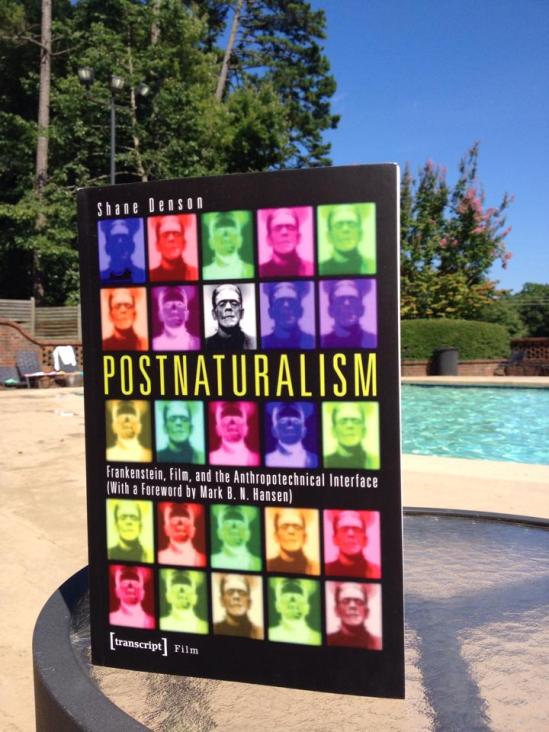
Out Now: Postnaturalism

postnaturalism-at-the-pool

My new book, Postnaturalism: Frankenstein, Film, and the Anthropotechnical Interface, has been out for about a month now — in Germany, at least. The American, British, French, and Japanese iterations of amazon list the book as appearing next week, on August 22 (but available for pre-order), and it may be September by the time the American distributor, Columbia University Press, gets it listed on their website. Meanwhile, living somewhere between these worlds, I was able to get my hands on a physical copy of the book yesterday, and I’m very happy with the job Transcript Verlag did!

For more information about the book, as well as a preview that includes Mark Hansen’s foreword and my introduction, see here or click the image above (the preview can be accessed by clicking “PDF,” just beneath the cover image, on the publisher’s page). Also, if you are in any position to do so, please consider requesting a copy for your university library.

Thanks to everyone who helped me get this out there! And now, once again, I bid my hideous progeny go forth and prosper. I have an affection for it, for it is the offspring of happy days…

Preview of Two Talks in Texas

wing-and-trees

My family and I are just about to relocate from Texas (where we’ve been based for the past couple of months) to North Carolina, where I will embark on a 2-year DAAD postdoctoral fellowship at Duke University beginning August 1. It turns out, however, that two conferences will have me returning to the Lone Star State this fall: first, the Flow Conference 2014, which will take place from September 11-13 at the University of Texas at Austin, and then the annual conference of the Society for Literature, Science, and the Arts (SLSA) the following month, October 9-12, hosted this year by Southern Methodist University in Dallas.

At the Flow Conference, I will be participating in a roundtable discussion on “Theory.” By way of preparation, participants are asked to prepare a short position paper, and I will post mine here in due time. For now, the ground I wish to cover is outlined in this brief answer to the discussion question “How can media studies make theory more user-friendly?”

Nonhuman Media Theories and their Human Relevance

Shane Denson

Rejecting the excesses of deconstructive “high theory,” approaches like cultural studies promised to be more down-to-earth and “user friendly.” While hardly non-theoretical, this was “theory with a human face”; against poststructuralism’s anti-humanistic tendencies, human interaction (direct or mediated) returned to the center of inquiry. Today, however, we are faced with (medial) realities that exceed or bypass human perspectives and interests: from the microtemporal scale of computation to the global scale of climate change, our world challenges us to think beyond the human and embrace the nonhuman as an irreducible element in our experience and agency. Without returning to the old high theory, it behooves us to reconcile the human and the nonhuman. Actor-network theory, affect theory, media archaeology, “German media theory,” and ecological media theory all highlight the role of the nonhuman, while their political (and hence human) relevance asserts itself in the face of very palpable crises – e.g. ecological disaster, which makes our own extinction thinkable (and generates a great variety of media activity), but also the inhuman scale and scope of global surveillance apparatuses.

Then, at SLSA, which revolves this year around the concept of “Fluid,” I’ll be returning to post-cinema, metabolism, and the films of Shane Carruth. Here’s my abstract for that one:

Metabolic Media: On the Fluid Images and Ecologies of Post-Cinema

In an age of computational image production and networked distribution channels, media “contents” and our “perspectives” on them are rendered ancillary to algorithmic functions and become enmeshed in an expanded, indiscriminately articulated plenum of images that exceed capture in the form of photographic or perceptual “objects.” That is, post-cinematic images are thoroughly processual or fluid in nature, from their digital inception and delivery to their real-time processing in computational playback apparatuses; furthermore, and more importantly, this basic processuality explodes the image’s ontological status as a discrete packaged unit, and it insinuates itself – as I will argue – into our own microtemporal processing of perceptual information, thereby unsettling the relative fixity of the perceiving human subject. Post-cinema’s cameras thus mediate a radically nonhuman ontology of the image, where these images’ discorrelation from human perceptibility signals an expansion of the field of material affect: beyond the visual or even the perceptual, the images of post-cinematic media operate and impinge upon us at what might be called a “metabolic” level, modulating the flow of lived duration itself.

Building upon Steven Shaviro’s theorization of “post-cinematic affect,” Maurizio Lazzarato’s Marxist-Bergsonist “video philosophy,” and Mark B. N. Hansen’s post-phenomenological analyses of “21st-century media,” this presentation focuses especially on the work of independent filmmaker Shane Carruth (Primer, 2004; Upstream Color, 2013) in an attempt to theorize the emerging interface forms through which contemporary moving-image media transductively generate experiences of a decidedly postnatural environment.

Postnaturalism, with a Foreword by Mark B. N. Hansen: Forthcoming 2014

postnatural

Having hinted at it before, I am pleased now to announce officially that my book Postnaturalism: Frankenstein, Film, and the Anthropotechnical Interface will be appearing later this year (around Fall 2014) with the excellent German publisher Transcript, with US distribution through Columbia University Press.

I am also very excited that Mark B. N. Hansen has contributed a wonderful foreword to the book. Here is a blurb-worthy excerpt in which he identifies the philosophical and media-philosophical stakes of the book:

Shane Denson’s Postnaturalism develops [an] ambitious, wide-ranging, and deeply compelling argument concerning the originary operation of media in a way that sketches out a much-needed alternative to destructive developments which, expanding the darker strains of poststructuralist anti-humanism, have pitted the human against the material in some kind of cosmological endgame. Postnaturalism will provide a very powerful and timely addition to the literature on posthuman, cosmological technogenesis. Perhaps more clearly than any other account, it reconciles the irreducibility of phenomenality and the imperative to move beyond anthropocentrism as we seek to fathom the postnatural techno-material “revolutions” that have repeatedly remade – and that will no doubt continue to remake – the environments from which we emerge and to which “we” belong before we become and as a condition of becoming human subjects.

Now, as I put the finishing touches on the manuscript and prepare for it to leave my control — to go forth, monstrously, and (who knows?) prosper — I can only hope that the book will live up to Hansen’s estimation of it and, above all, that it will make a worthy contribution to the debates over nonhuman agency and human-technological co-evolution that have recently defined some of the more exciting strands in media theory, science studies, and speculative realism, among others.

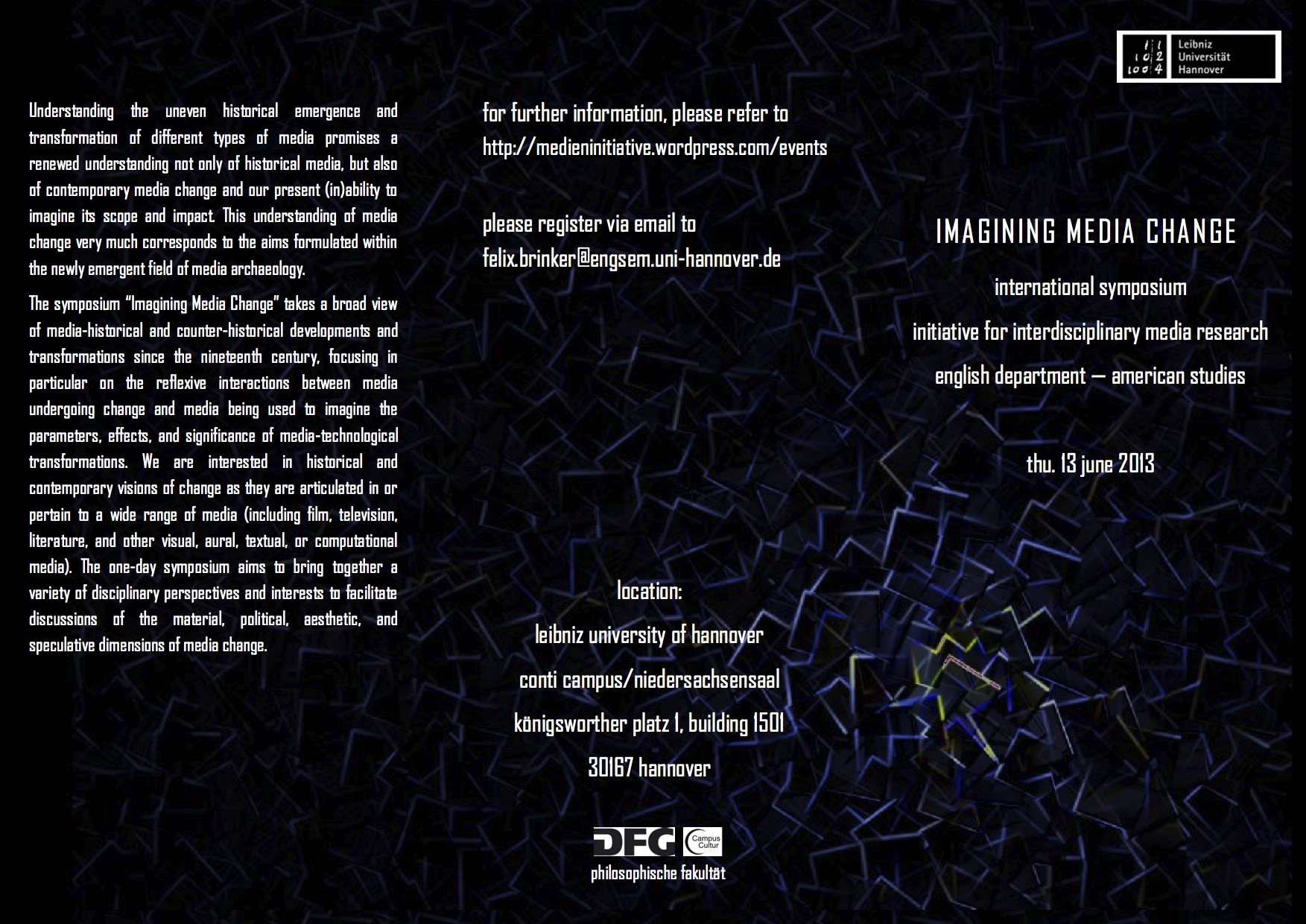
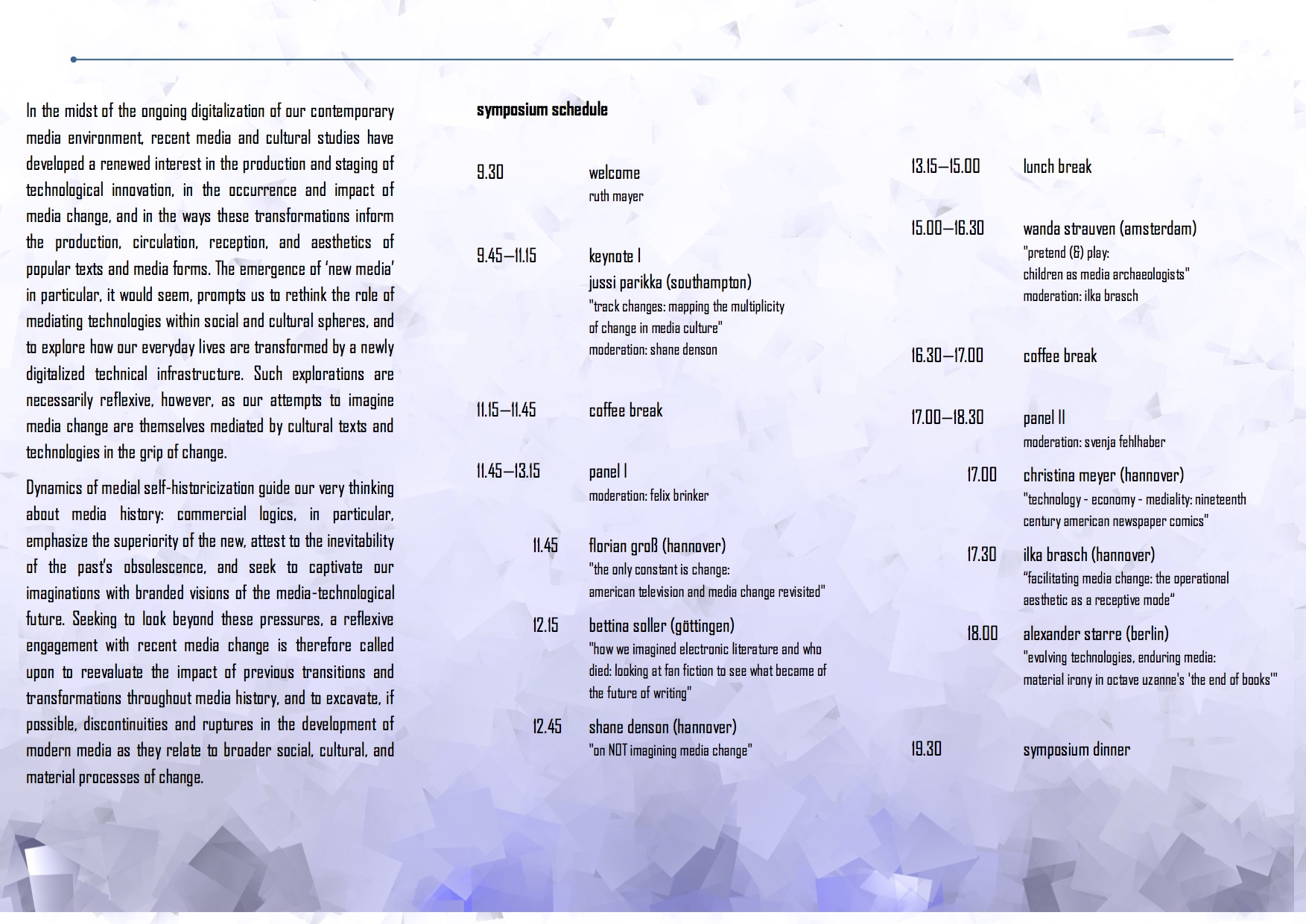
Symposium Program: “Imagining Media Change”

Imagining_Media_Change_Program Imagining_Media_Change_Program-2

Here is the final program for our symposium “Imagining Media Change” (print version above, and links to each speaker’s abstract below):

Imagining Media Change — June 13, 2013, Leibniz Universität Hannover

9:30 — Welcome, Ruth Mayer (Chair of American Studies, Hannover)

9:45 – 11:15 — Keynote I, Jussi Parikka (Southampton): “Cultural Techniques of Cognitive Capitalism: On Change and Recurrence”

11:15 – 11:45 — coffee break

11:45 – 13:15 — Panel I:

11:45 — Florian Groß (Hannover): “The Only Constant is Change: American Television and Media Change Revisited”

12:15 — Bettina Soller (Göttingen): “How We Imagined Electronic Literature and Who Died: Looking at Fan Fiction to See What Became of the Future of Writing”

12:45 — Shane Denson (Hannover): “On NOT Imagining Media Change”

13:15 – 15:00 — lunch break

15:00 – 16:30 — Keynote II, Wanda Strauven (Amsterdam): “Pretend (&) Play: Children as Media Archaeologists”

16:30 – 17:00 — coffee break

17:00 – 18:30 — Panel II:

17:00 — Christina Meyer (Hannover): “Technology – Economy – Mediality: Nineteenth Century American Newspaper Comics”

17:30 — Ilka Brasch (Hannover): “Facilitating Media Change: The Operational Aesthetic as a Receptive Mode”

18:00 — Alexander Starre (Berlin): “Evolving Technologies, Enduring Media: Material Irony in Octave Uzanne’s ‘The End of Books'”

19:30 — symposium dinner