On Wednesday, April 25, 2012, the Film & TV Reading Group will meet at 6:00 pm in room 615 (Conti-Hochhaus) to discuss Mark Hansen’s article “Media Theory,” (from Theory, Culture & Society 23.2-3 (2006): 297-306). In this piece, Hansen importantly rethinks media beyond their apparatic, empirical determinations (devices, machines, storage media, etc.), instead conceiving media as “the environment for life.” The argument behind this approach is outlined in the paper’s abstract:
Poised on the cusp between phenomenology and materiality, media institute a theoretical oscillation that promises to displace the empirical-transcendental divide that has structured western meditation on thinking, including the thinking of technics. Because media give the infrastructure conditioning thought without ceasing to be empirical (i.e. without functioning as a transcendental condition), they form the basis for a complex hermeneutics that cannot avoid the task of accounting for its unthematizable infrastructural condition. Tracing the oscillation constitutive of such a hermeneutics as it serves variously to constitute media theory in the work of critics from McLuhan to Kittler, from Leroi-Gourhan to Stiegler, my interrogation ultimately conceptualizes the medium as an environment for life: by giving concrete form to ‘epiphylogenesis’ (the exteriorization of human evolution), concrete media find their most ‘originary’ function not as artifacts but via their participation in human technogenesis (our co-evolution with technics).
Hansen’s reconceptualization of media has been a key point of reference in my own attempts to theorize the ecology of “postnaturalism,” which turns on the notion of a constantly evolving “anthropotechnical interface.” One of the things that I tried to do in my engagement with Hansen’s thought was to expand it and to push the notion of media as environment beyond the qualification “for life,” arguing that media constitute the environment for agency in a broader sense, both living and non-living. One could say, in fact, that this is equivalent to saying that media constitute the environment period. And, interestingly, in the video above (from the transmediale 2011), we find Hansen working towards precisely this type of expanded approach: a non-anthropocentric, non-biocentric, positively cosmological notion of media.
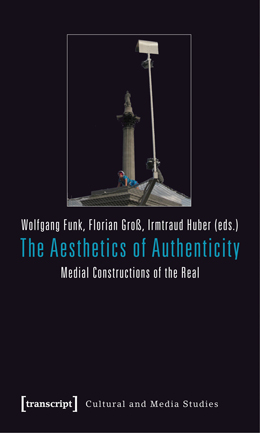
“As a concept that increasingly gains importance in contemporary cultural discourse, authenticity emerges as a site of tearing tensions between the fictional and the real, original and fake, margin and centre, the same and the other.
The essays collected in this volume explore this paradoxical nature of authenticity in the context of various media. They give ample proof of the fact that authenticity, which depends on giving the impression of being inherent or natural, found not created, frequently turns out to be the result of a careful aesthetic construction that depends on the use of identifiable techniques with the aim of achieving certain effects for certain reasons.”
And here is the Table of Contents:
“Exploring the Empty Plinth. The Aesthetics of Authenticity” (Wolfgang Funk, Florian Groß, and Irmtraud Huber)
FRAGMENTATIONS
“Authenticity as an Aesthetic Notion. Normative and Non-Normative Concepts in Modern and Contemporary Poetics” (Susanne Knaller)
“Found Objects. Narrative (as) Reconstruction in Jennifer Egan’s A Visit from the Goon Squad” (Wolfgang Funk)
“Monolithic Authenticity and Fake News. Stephen Colbert’s Megalomania” (Seth Hulse)
“Authentic Bodies. Genome(s) vs. Gender Norms in Oryx and Crake, The Year of the Flood, and BioShock” (Sven Schmalfuß)
CONTESTATIONS
“‘The Real Thing.’ Authenticating Strategies in Hemingway’s Fiction” (Melanie Eis)
“Real Lives – Living Wild. Authenticity, Wilderness, and the Postmodern Robinsonade in James Hawes’s Speak for England and Jeanette Winterson’s The Stone Gods (Francesca Nadja Palitzsch)
“Monica Ali and the Suspension of Disbelief” (Melanie Mettler)
PERFORMANCES
“Poet and the Roots. Authenticity in the Works of Linton Kwesi Johnson and Benjamin Zephaniah” (David Bousquet)
“The Dilettantish Construction of the Extraordinary and the Authenticity of the Artificial. Tracing Strategies for Success in German Popular Entertainment Shows” (Antonius Weixler)
“‘Brooklyn Zack is Real’: Irony and Sincere Authenticity in 30 Rock” (Florian Groß)
“Authentic Simulacra or the Aura of Repetition. Experiencing Authenticity in Tom McCarthy’s Remainder” (Irmtraud Huber and Sophie Seita)
As Sharon Begley puts it in her article for Reuters (“This is Dan. Dan is a Baboon. Read, Dan, Read”): “No one is exactly using the words ‘reading’ and ‘baboons’ in the same sentence, but a study published Thursday comes close.”
In a sense, though, the temptation to describe the implications of that study (summarized in the video above) as a demonstration that “baboons can read” is just another iteration of a familiar tendency to anthropomorphize nonhuman primates rather than to draw the converse and much more interesting sorts of conclusions suggested by observing these animals’ behavior: Rather than humanizing apes, I suggest, we should be led by studies like this one to relax our anthropocentric perspectives and to appreciate the nonhuman aspects of those activities and skills, such as language-use, that are typically seen to distinguish us most centrally as human.
While the implications of the experiment shown here are interesting from a wide variety of scientific and philosophical perspectives, they are of especial interest from a media-theoretical perspective, especially one (like mine) that’s interested in pre-, sub-, or non-discursive interactions between bodies and things.
To quote again from Begley’s article:
The study was intended less to probe animal intelligence than to explore how a brain might learn to read. It suggests that, contrary to prevailing theory, a brain can take the first steps toward reading without having language, since baboons don’t.
“Their results suggest that the basic biological mechanisms required for reading have deeper evolutionary roots than anyone thought,” said neuroscientist Michael Platt of Duke University, who co-authored an analysis of the study. “That suggests that reading draws on much older neurological mechanisms” and that apes or monkeys are the place to look for them.
Reading has long puzzled neuroscientists. Once some humans started doing it (about 5,000 years ago in the Middle East), reading spread across the ancient world so quickly that it cannot have required genetic changes and entirely new brain circuitry. Those don’t evolve quickly enough. Instead, its rapid spread suggests that reading co-opted existing neural structures.
Furthermore, as this article at BBC Nature succinctly puts it: “The results suggest the ability to recognise words could more closely relate to object identification than linguistic skill.”
Dr Grainger [one of the scientists responsible for the study] told BBC Nature that recognising letter sequences – previously considered a fundamental “building block” of language – could be related to a more simple skill.
“The baboons use information about letters and the relations between letters in order to perform our task… This is based on a very basic ability to identify everyday objects in the environment,” he said.
Of course, it’s not like this settles things, but it does suggest some interesting correlations between eyes, hands, and objects — embodied, techno-material correlations of a straightforwardly nonhuman sort — that would seem to be basic to the constitution of discursive (human) subjectivities, and not vice versa. Thus, rather than bringing the apes into the citadel of humanity, perhaps we should let them lead us out of the prison-house of language!
10,000: As of today, the number of page views on this blog since its inception in May 2011.
Today, sometime between 1:00 and 3:30 p.m., this blog had its 10,000th page view, when a visitor from either Spain, Canada, or Germany (in which case it was very possibly my wife) clicked on this site, either deliberately or (as I’m told happens occasionally on the interwebs) by chance.
Admittedly, 10,000 hits over the course of 11 months is not a whole lot in comparison with the kind of traffic that corporate sites, media outlets, universities, or even some of the more popular academic bloggers get, but it’s nevertheless not an altogether insignificant milestone for a fledgling media initiative at a German university posting largely on local events, niche-interest topics like seriality or posthumanism, or whatever happens to interest me at the time.
I thought I’d take the opportunity, therefore, to review and take stock of things. Luckily, WordPress provides a range of interesting statistics that are perfect for this kind of occasion.
To start with, 122 posts (this one included) have been made since I set up the blog on May 5, 2011. There were only 2 visitors to the blog that May (I didn’t go public with the blog until June, so who knows what led those two poor souls here then), roughly 200 hits in June, and since November 2011 the blog’s been averaging about 1500 monthly page views.
Lately we’ve seen more and more people landing here deliberately (as evidenced by these referrals and the increasing number of people searching for terms like “medieninitiative hannover” or “denson postnaturalism”), but the list of top search terms evidences a mixed audience of intentional and accidental readers. The all-time top five search terms are: 1. television, 2. cheezburger 🙂 , 3. bollywood background, 4. human metabolism, 5. traffic. (In the past four months, “human metabolism” and “traffic” have dropped out, while “cheezburger” has remained strong and a new term has climbed the charts: “lost” — a term that might contain a touch of self-reflexive irony with respect to the way those people end up here…)
And finally, WordPress has recently started providing statistics on the countries where the blog’s visitors (or at least their IP addresses) are located. Statistics are only available since February 25, but since then the top five countries have been: 1. United States (454 hits), 2. Germany (437), 3. United Kingdom and Canada (tied at 177 each), 4. India (103), and 5. Australia (69).
So that’s where we’ve been, but where is the blog heading? What does the future hold? To be sure, only time will tell, but a number of things are in the works right now: the Media Initiative continues to develop, and a number of media-related events are being planned in Hannover (and elsewhere), so be on the lookout, and consider subscribing to the blog via e-mail (you can sign up on the right), an RSS reader of your choice, or your WordPress account, for example. Additionally, spread the word via your favorite social network, blog, or other modern mode of communicative being. And if that’s not enough, don’t forget: we’ve got plenty of cheezburgers, traffic, and metabolism for all your spambots!
“During the first decade of the 21st century, film style changed profoundly.”
This, at least, is the thesis put forward by Matthias Stork in a series of highly controversial video essays that have circulated recently on the Internet. According to Stork, “Contemporary blockbusters, particularly action movies, trade visual intelligibility for sensory overload, and the result is a film style marked by excess, exaggeration and overindulgence: chaos cinema.”
In a series of film screenings, we would like to engage critically with Stork’s notion of chaos cinema. We shall begin by viewing Stork’s video essays themselves, before moving on to some of the films he discusses and others that exemplify and/or challenge the paradigm of chaos cinema.
For those interested, here are some links to useful background and discussion:
First, Stork’s thesis must be seen against the background of David Bordwell’s notion of “intensified continuity,” which is seen to mark a change from the classical Hollywood style that dominated American cinema from around 1920 until (at least) the 1960s. Chaos cinema, according to Stork, goes further in effecting a radical break with continuity principles, whether classical or intensified.
Another important context is Steven Shaviro’s book Post-Cinematic Affect, which introduced the term “post-continuity.” (A Google Books preview can be found here, but note that approximately two-thirds of the book appeared in the open access journal Film-Philosophy under the title “Post-Cinematic Affect: On Grace Jones, Boarding Gate and Southland Tales“.) More recently, Shaviro has returned to the topic and reflected explicitly on Stork’s notion of chaos cinema in a talk given at the 2012 annual conference of the Society for Cinema and Media Studies, reprinted in full on his blog The Pinocchio Theory.
And here, finally, is the schedule of screenings (note that all screenings will be held in room 615 of the Conti-Hochhaus, at 6:00 pm):
April 26, 2012: “Chaos Cinema” (Matthias Stork, 2011)
May 24, 2012: Gladiator (Ridley Scott, 2000)
June 21, 2012: Transformers (Michael Bay, 2007)
July 5, 2012: Scott Pilgrim vs. the World (Edgar Wright, 2010)
July 19, 2012: WALL-E (Andrew Stanton, 2008)
Films will be shown in English original with subtitles where available. Screenings are open to all, so feel free to spread the word!
The conference organizers for the upcoming “Nonhuman Turn” conference in Milwaukee (where I’ll be giving a talk called “Object-Oriented Gaga”) have posted a “Curricular Guide,” which includes all the abstracts for the conference. As with the preliminary schedule before, I am embedding it here for convenience.
Over at Figure/Ground Communication, there is a new interview up with Dylan Trigg (whose blog Side Effects you’ll find linked in the sidebar here). The whole interview is well worth your time, but especially interesting (and relevant to the focus of this blog) is the following question and answer:
Is phenomenology still relevant in this age of information and digital interactive media?
Phenomenology is especially relevant in an age of information and digital media. Despite the current post-humanist “turn” in the humanities, we remain for better or worse bodily subjects. This does not mean that we cannot think beyond the body or that the body is unchallenged in phenomenology. Phenomenology does not set a limit on our field of experience, nor is it incompatible with the age of information, less even speculative thinking about non-bodily entities and worlds. Instead, phenomenology reminds us of what we already know, though perhaps unconsciously: that our philosophical voyages begin with and are shaped by our bodily subjectivity.
It’s important to note here that phenomenology’s treatment of the body is varied and complex. It can refer to the physical materiality of the body, to the lived experience of the body, or to enigmatic way in which the body is both personal and anonymous simultaneously. In each case, the body provides the basis for how digital media, information, and post-humanity are experienced in the first place. Phenomenology’s heightened relevance, I’d say, is grounded in the sense that these contemporary artefacts of human life tend to take for granted our bodily constitution.
But phenomenology’s relevance goes beyond its privileging of the body. It has become quite fashionable to critique phenomenology as providing a solely human-centric access to the world. This, I think, is wrong. One of the reasons why I’m passionately committed to phenomenology is because it can reveal to us the fundamentally weird and strange facets of the world that we ordinarily take to be clothed in a familiar and human light. Phenomenology’s gesture of returning to things, of attending to things in their brute facticity, is an extremely powerful move. Merleau-Ponty will speak of a “hostile and alien…resolutely silent Other” lurking within with the non-human appearance of things. For me, the lure of this non-human Other is a motivational force in my own work. It reminds us that no matter how much we affiliate ourselves with the familiar human world, in the act of returning to the things themselves, those same things stand ready to alienate us.
(The image at the top of this post, by the way — and lest there be any confusion about the matter — is not a picture of Dylan Trigg but of body-augmentor extraordinaire, performance artist Stelarc.)
Several weeks ago, my family and I were able to catch a performance of the touring stadium show Batman Live (English site here, German here) in Hamburg. All in all, it was lots of fun. And it also happens to tie in with my current research on plurimedial serial figures. I had planned, therefore, to write a sort of review of the show, but as I can’t foresee finding the time to do so anytime soon, here are a few scattered thoughts.
As the title Batman Live indicates, the show is all about “liveness,” but the cultivation of the latter, which might be said to constitute the show’s main conceit, involves the performance in all sorts of paradoxes. One might, of course, say (with reference to Derrida, perhaps) that all performance, insofar as it involves the iteration of a script, renders “liveness” problematic, as the present is bound up in the pastness of the patterns and discourses that it repeats. But the paradoxes of Batman Live are much more concrete than all that…
By what means does Batman Live contrive to make Batman live? Naturally, by employing a live actor to embody the figure on a physical stage. “Live” is here contrasted with “recorded,” and it would seem that film, which also employs live actors (at least sometimes) but preserves their actions for later playback, is the particular medium of reference here. (Incidentally, film serves a double role here, as the show undoubtedly seeks to profit from the popularity of Christopher Nolan’s Batman films, while defining itself against them with the implicit claim that “more live” = “more real” or more spectacular.) But, at least, in the German-language version I saw, this claim to liveness is undermined with the very first words uttered on stage, as the actors quite clearly lip sync a pre-recorded soundtrack.
Furthermore, the stage/screen dichotomy as a basis for the claim to liveness is unsettled by the presence of a gigantic digital display behind the stage. We’re used to this, of course, from big-budget musicals and, increasingly, even smaller-budget theater productions, but the backdrop in this case is used to make constant reference to other media (especially to comics and video games), the pre-existence of which must be seen to complicate the purported “liveness” of the performance.
For example, when Batman and Robin race away in the Batmobile, exiting the stage through one of the many discreet passageways that open up when necessary to allow traffic onto or off of the stage, their high-speed journey to Arkham Asylum is continued onscreen, framed quite obviously in the visual forms typical of digital racing games. (The layout of Arkham Island and the interior of the asylum, as depicted on the screen, in fact seemed to be pulled directly from the console game Batman: Arkham Asylum; an uncanny sense of recognition, an identification of the digital backdrop with my own TV screen hooked up to a PS3, transported me momentarily out of the arena and into my own living room.) The backdrop is also used for the purpose of narrative ellipsis, as a means of summarizing the events that occur between on-stage scenes; significantly, this takes place in the idiom of graphic narrative: we see digitally animated comic book pages flipping, the virtual camera zooming from panel to panel, revealing what happens “in the meantime.” Indeed, one might claim that the “meanwhile” is the temporal register that superhero comics in particular have perfected more than any other medium; such direct recourse to it, though, radically unsettles the here and now of the “live.”
On the other hand, though, we might say that these intermedial references are not so much at odds with, but in fact an integral part of the performance’s cultivation of “liveness,” which consists not only in the present-ness of the actors and their actions in a physical space shared by us, but precisely in the act of “bringing to life” the places and events depicted in film, video games, and comics — effectively imbuing these media with life by expanding them onto the stage, where Batman, Robin, the Joker, and others relate to the (intermedially determined) screen as part of their (diegetic) world.
Furthermore, this permeability of the screen, which alternates between embodying an expansion of diegetic space and an extra-diegetic, specifically narrative function (with concrete references to the narrative/representational techniques of other media) is caught up in paradoxes much like those informing the deployment of 3D techniques and technologies: they, too, oscillate between a) claims of establishing an intensified immersive experience that would bring represented characters and events to life for us in an unprecedented manner, and b) an emphasis on the unprecedented nature of the whole affair, a celebration of the technological infrastructure that enables such spectacles, and hence a foregrounding of the event itself in a manner that is radically at odds with the notion of “immersion.”
Indeed, the discourse of “immersive experience” is referenced in the video clip embedded here, where the “physicality of the stage” plus the awe-inspiring technology are foregrounded, but purportedly “wrapped up” in an immersive “package.” I am inclined to believe that this kind of equation never adds up — and that it’s never in fact meant to: from the “sensational melodrama” of nineteenth century stages and early-twentieth century screens (as explored by Ben Singer) to 3D techniques and “immersive” video games today, the attraction of all such spectacles consists in the maintenance of tensions between realism and a feeling of awe at the sight or spectacle of realism (itself no longer beholden to the impression of realistic-ness), for example, or between immersion and amazement at the power of a medium to involve us (recognition of which takes place outside the space of immersion). Batman Live is above all a spectacle of this sort, and the paradox of its “liveness” is — for those who take pleasure in such paradox, at least — not so much a shortcoming as a productive element of the attraction, which itself is inextricably bound up with the fragmented dispersal and plurimedial lack of coherence that characterizes Batman qua serial figure.
An interview with me on the subject of memes, conducted by Manuel Behrens, appears in today’s Hannoversche Allgemeine Zeitung as part of a full-page spread on Boromir, Philosoraptor, Admiral Ackbar, and Rage Comics. True story! Check it out here: Was sind eigentlich Memes? (The interview, “Jeder kann mitmachen,” is at the bottom of the page.)