What is the Zwergenproblem, or the problem of the gnome? Though this looks and sounds like one of those classic German words destined for import into the English of intellectuals (think of Zeitgeist, Weltanschauung, or Fahrvergnügen…), you won’t find the term “Zwergenproblem” in any dictionary. And yet it’s a widely shared opinion in Germany (at least in left-leaning circles) that garden gnomes — themselves typically Deutsch — are somewhat (how should I say?) problematic creatures. Their nation-based typicality is one of the problems, and they are aligned with a range of conservative political values as symbols of a bourgeois Sesshaftigkeit that finds its natural expression in the carefully mowed lawn and Garten of the proud homeowner/Dorfbewohner. This is by no means to say that gnomeownership, any more than homeownership, is a clear indication of one’s politics. Still, the associations and stereotypes are there — so much so, in fact, that garden gnomes have come to embody a downright cliché for a certain sort of lifestyle. Of course, the existence of a cliché always invites ironic appropriation as a response, and so recent times have seen the appearance of black-leather biker-gnomes, pot-smoking gnomes, and gnomes doing gnaughty things. Trying to dissociate gnomes from notions and practices of bürgerliche Spießigkeit, these have been attempts to solve what I am calling the Zwergenproblem. But none of them, it seems to me, has yet provided an adequate response, one suited to the true gravity of the situation.
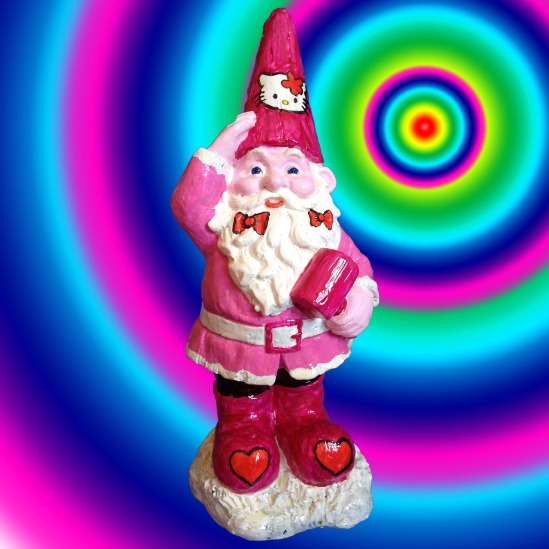
Meanwhile, beyond and outside of Germany, the garden gnome has come to represent a mostly white, middle-class, suburban existence in a depoliticized any-space-whatever. Garden gnome liberationism has emerged in response — an international effort to free the gnomic proletariat from their servitude, to return gnomes to the wild, and more generally to draw attention to their plight. And yet the political edge wears thin when these efforts devolve into “pranks.” The travelling gnome prank — in which mostly white, middle-class, suburban kids steal their neighbors’ gnomes and take them on vacation, photographing them in front of famous tourist attractions — is all good fun, as far as it goes, but it doesn’t really address the core of the Zwergenproblem. Clearly, this is because the prank is situated within the same space of possibility as the “straight” form of gnomeownership that it ostensibly questions: the space of material affluence, leisure, and the freedom to travel, where the suburban home materially anchors and spiritually secures the traveller’s foray “out into the world” like the warmth of Heidegger’s Hütte accompanied him along his Holzwege. Besides, any last drop of radical potential was drained when a major Internet travel company appropriated the prank for its marketing campaign, thus transforming the “liberated” garden gnome into a symbol for digitally enabled neo-liberal capital and the transnational flows of money, bits, and bodies. Behold: the neo-liberated gnome.
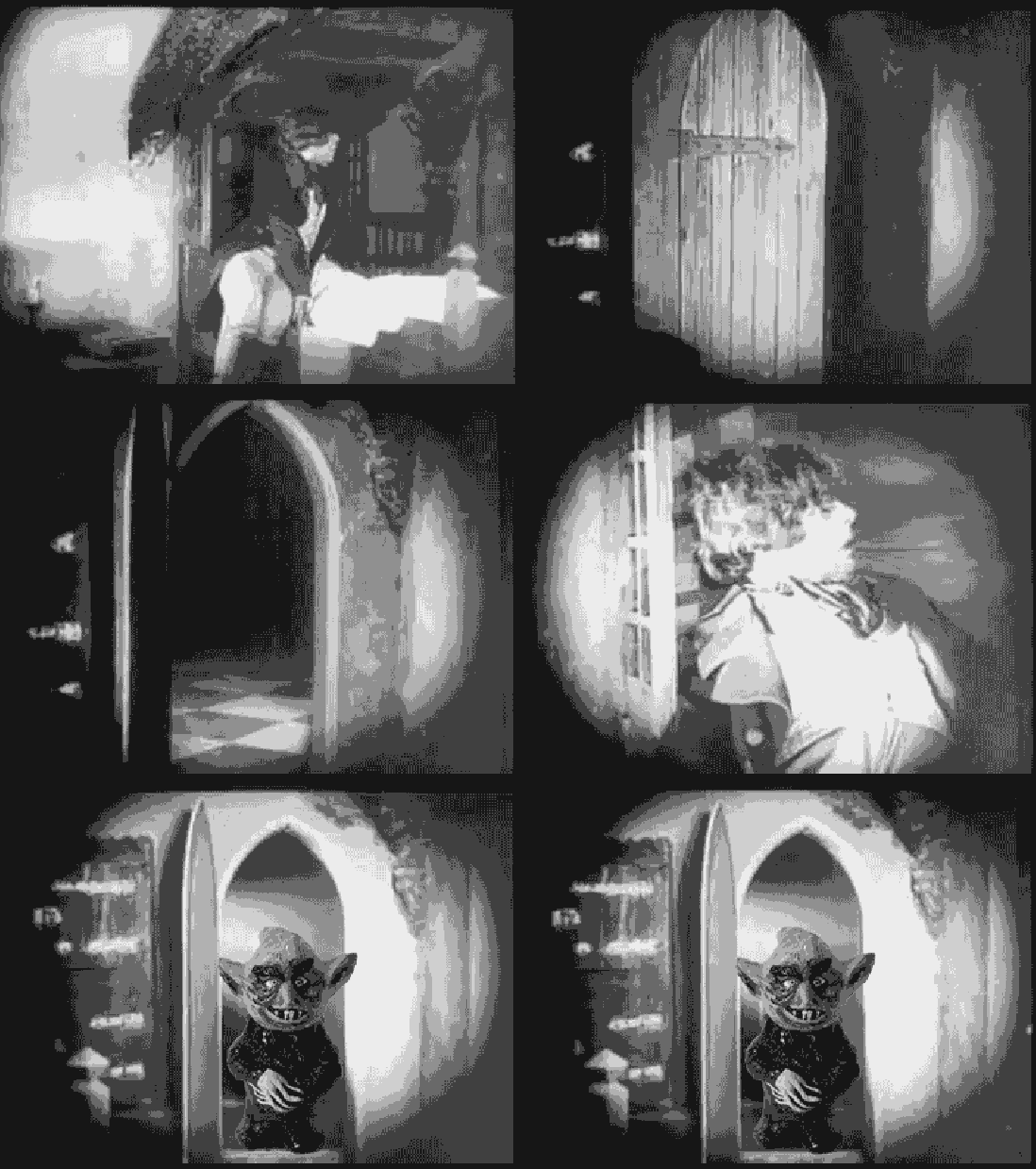
This is where things get interesting, I think, and where a space for artistic intervention into the Zwergenproblem begins to disclose itself. The example of Internet-based travel, which of course depends on real money (hence real labor) and ideally gets real bodies to real places, places the garden gnome squarely in the realm of the so-called “new aesthetic” — which James Bridle describes as “a series of artefacts of the heterogeneous network, which recognises differences, the gaps in our overlapping but distant realities,” especially as concerns the intersection of material and digital realms. The neo-liberated gnome embodies capital as it flows within the control society, and it both emulates and encourages the “participatory culture” of viral marketing, whereby the unpaid immaterial labor done on social networks is appropriated and a surplus value is extracted by algorithmic means. What better mascot than the neo-liberated gnome, which bears witness to the wonders of the world, makes us hungry for travel (and for good-natured pranks), and even tempts us to donate our labor by posting pictures to Facebook et al that will serve as further advertisement for that travel company with the funny garden gnome…
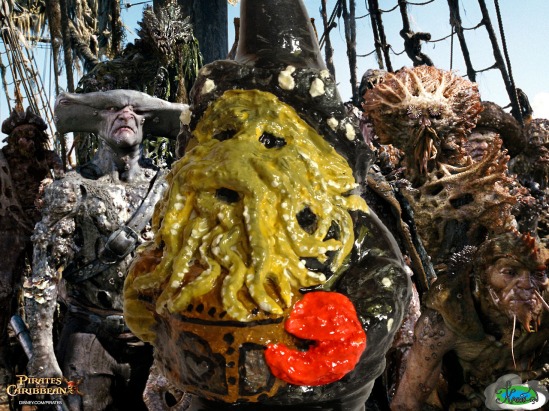
The association with the “new aesthetic” is even clearer in the context of 3D printing and scanning technologies, where the garden gnome has become a symbol for that magical intersection of materially unique objects rendered digitally reproducible, as in MakerBot’s extensive use of the gnome to demonstrate their machines. There should be no doubt about it: 3D printing really does involve a revolutionary sort of realignment of the physical and the ideal, but why should the garden gnome become the symbol for this transformation? The answer, I think, has to do with the fact that before it became the mascot for the new aesthetic, the garden gnome was a mascot for a putatively “old aesthetic” that itself was secretly bound up in the appearance of industrial modernity and its “aesthetic of the new.” The garden gnome’s origins are in nineteenth-century Germany; accordingly, the creatures must be seen as an essentially modern phenomenon, and as a part of the popular culture that begins to emerge in Europe alongside industrial technologies of production and communication. And yet they feign resistance to that culture, pretending to belong to a romanticized folk culture that is pitted against the emerging commercial popular culture. The gnome, in other words, claims allegiance to the oral culture and local tradition that bequeaths to us the fairy-tale, and it aims to distinguish itself from the mass-produced industrial culture of the modern world — to which, nevertheless, it essentially and materially belongs! Now, with the advent of 3D printing and design, the possibility of digital reproduction calls the gnomes’ bluff, makes their mass and serialized nature apparent, and reveals that they have been subject from the start to the same iterative principles as the serial figures of popular culture. What’s more: the digital infrastructure democratizes the production process, putting the means of production in the hands of the many (or at least in the hands of the growing number who have access to the technology). The gnome becomes shareable across time and space, and subject to a serial process of modification. But again there is the danger that the material and immaterial labor of this “participatory culture” is subject to appropriation and exploitation.
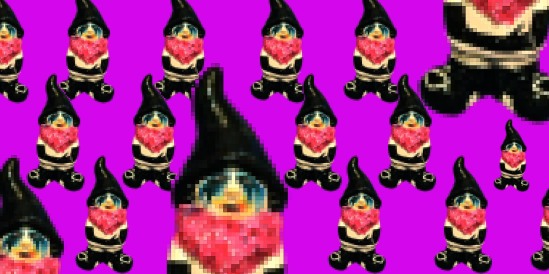
Besides, there’s nothing very subversive about printing born-digital gnomes in order to repeat the pranks of their more earthy forebears. If we’re really going to do something about the Zwergenproblem — i.e. if we are going to address the problematic politics of the garden gnome as it exists in our transitional moment — we will have to do so with a historical consciousness, one cognizant of the gnomes’ troubled history, their relation to modern production processes, material and immaterial labor, class consciousness, nationalism, popular and high-art cultural formations, and the role of seriality in all of these constellations.

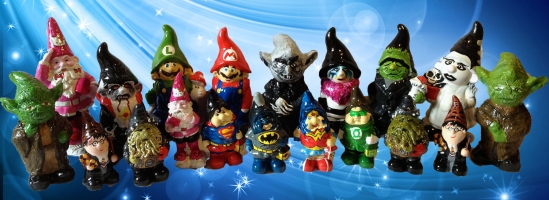
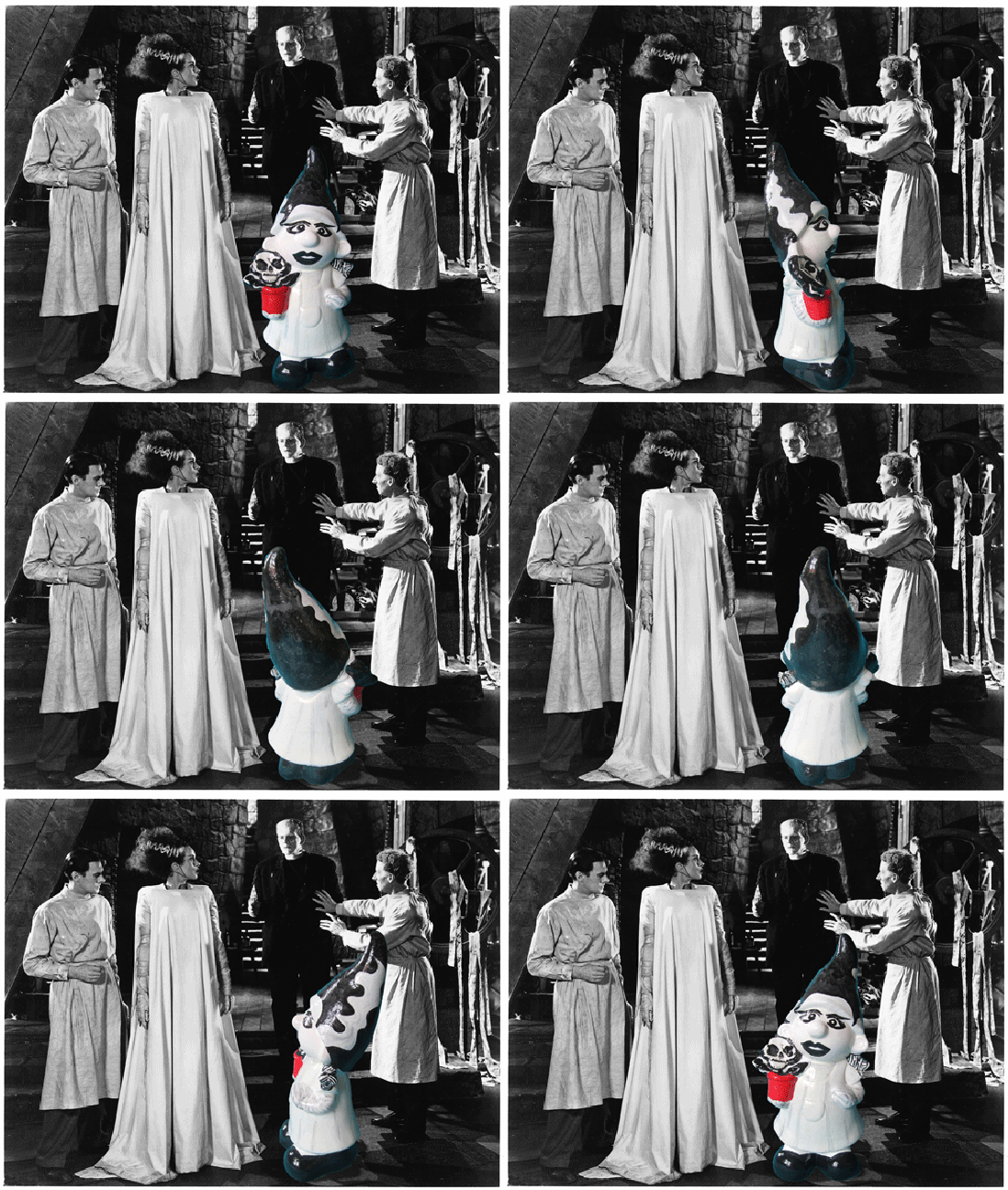
From an artistic perspective, no one is doing a better job of this at present, I think, than Karin Denson, with her “Krass People” series of gnomes, which are featured throughout this post. (Full disclosure: Karin is my wife. I’m biased. So what? No one’s got better gnomes than her!) Based on iconic figures from popular culture and modern art, her gnomes call into question the boundaries between industrial mass production, pre-modern handcraft, and modern and postmodern artistry. Half ready-made, half carefully crafted objects, the gnomes are collected from flea markets, outlet stores, garage sales, eBay, and wherever else they might be found, before they are hand painted and occasionally re-sculpted to resemble superheroes like Superman or Batman, creatures such as Nosferatu or Frankenstein’s monster, pop stars like Lady Gaga or David Bowie, figures from Star Wars or Pirates of the Caribbean, or re-imaginings of artworks by Duchamp, Miró, or Dalí. The result is a set of unique physical objects that retain strong conceptual and material links to the cultures of seriality that, since the nineteenth century, have increasingly and irrevocably problematized any notion of uniqueness or (artistic) authenticity. Finally, the objects are digitized and their images subjected to various further transformations: placed in Photoshop collages, set in motion in animated gifs, and displayed in a growing virtual gallery on tumblr. And that’s just the beginning: video, generative, and other works are in planning.
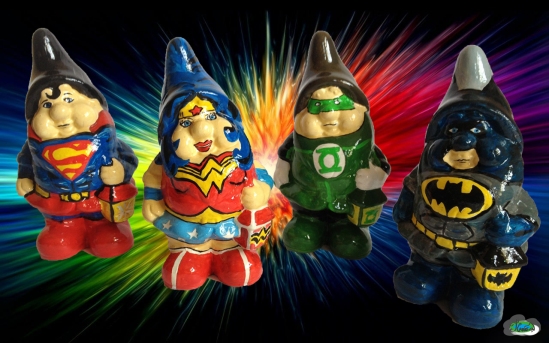
So does this answer the Zwergenproblem? Perhaps not completely. After all, can there be a truly final answer to a problem that is so thoroughly serial in both its historical genesis and its structural formation? Any answer, it would seem, would itself have to be serial rather than static. And that’s precisely what we have here: an ongoing, serially unfolding, plurimedial and mixed-reality approach that may not answer, but which first succeeds in formulating or addressing, that central problem of the modern world: das Zwergenproblem.
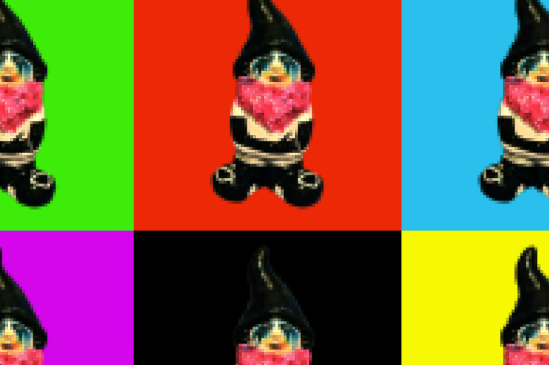
Finally, in case you’re interested: Karin’s gnomes are available for purchase, but there is only a very limited supply of these (problematically) unique and labor-intensive objects. Karin will be exhibiting and selling them this coming Sunday, November 3, 2013, at the Kunsthandwerkermarkt at the Kulturzentrum Faust (from 11am to 5 pm in the “Warenannahme”).
[UPDATE: There’s now an Etsy store where the gnomes can be purchased online: https://www.etsy.com/shop/KrassStuff]
 On April 20, 2015, Karin and I will present our collaborative art project Making Mining Networking at the opening of the Network Ecologies exhibition at The Edge at Duke University. Also participating will be Rebecca Norton, whose work will make up the other half of the exhibition, which will be on display from April 20 until August 2015. We are very excited to show our work in this venue! (Stay tuned for the program of events on the 20th.) Above, our exhibit statement (scan the QR code for a brief video “user’s guide” that will give you a taste of what you can expect at the exhibit). Finally, here is the info about the exhibition posted on the Duke Libraries + Digital Scholarship website: