NON/PHENOMENALITIES — a show that I am co-curating with artist Brett Amory at Gallery 120710 in Berkeley — opens July 26 with an amazing lineup of artists.
The title of this exhibition plays on the multiple senses of the “phenomenal.” On the one hand, the phenomenal is equated with spectacle and the spectacular, the exceptional appearance that dazzles its audience, like a pop phenomenon. On the other hand, phenomenality refers to the way anything whatsoever appears to our embodied senses; this less extravagant sense of the word “phenomenon” is at the heart of phenomenology and Kantian philosophy (where it is opposed to the noumenal, which can never appear to sensation).
Both senses of the phenomenal are contested and reconfigured in the contemporary networks of computational media and machine-learning algorithms. For example, AI produces a steady stream of spectacles, each more spectacular than the last, but the underlying operations are immune to human perception. In this interplay, not only the objects of perception but also the very conditions of experience are up for grabs. The phenomenal itself is conditioned by a new realm of nonphenomenality, which poses a special challenge for artists working with these new technologies.
As a way of approaching this new situation, we look to works that stage multiple aesthetic inversions of the phenomenal, ranging from the subtle or understated to the invisible. What comes to the fore when vision encounters computation’s resistance to consciousness, its “discorrelation” from the phenomenology of embodied experience? How can we perceive what artist Trevor Paglen has dubbed the “invisible images” that populate our world? And how can these inversions connect with or be illuminated by other traditions of the non/ phenomenal—for example Buddhist ideas of appearance as illusion, the Lacanian notion of the unperceived Real, or neuroscientific theories of consciousness as a nonsubstantial epiphenomenon?
Looking beyond the spectacles of contemporary technology, Non/phenomenalities asks us to imagine an aesthetics of the subtle, the muted, the “barely perceptible difference,” maybe even the boring.
The title of the piece plays on, and the article draws substantially on, Donald Davidson’s “On the Very Idea of a Conceptual Scheme.” By way of this classic text, I engage closely with M. Beatrice Fazi’s provocative article “The Computational Search for Unity: Synthesis in Generative AI.” I agree with Fazi that we have to take the outputs of LLMs as genuine language (contra the “stochastic parrots” crew), and that the best way to account for their operations is in terms of a kind of philosophical “synthesis.” But whereas Fazi sees LLMs synthesizing their own individual “worlds within,” I argue that the genuineness of their linguistic outputs (i.e. the fact that they produce real language) instead suggests that they refer to a world shared in common with human language-users (which commonality should not, however, detract from their alterity or alienness to our embodied Lebensform, or form of life).
In the same issue of Philosophy & Digitality, Fazi has a response to my article, titled “A Transcendental Philosophy of Large Language Models,” which I also highly recommend, and which brings our differences—as well as agreements—into sharper relief. I have the feeling this is the beginning of a longer exchange!
I’d like to thank Sybille Krämer and Christoph Durt for inviting my participation in the special issue and shepherding it toward publication–and for soliciting Fazi’s response. And thanks, above all, to Beatrice Fazi for producing such thought-provoking work in the philosophy of AI and computation!
I am happy to have a short piece on the “Digital” among the 101 keywords in this exciting new volume, Power Shift: Keywords for a New Politics of Energy, edited by Imre Szeman and Jennifer Wenzel. The book brings together scholars, artists, and activists, and it provides a robustly multifaceted approach to questions of energy, the environment, climate change, and much, much more — including some pieces that will be of great interest to scholars of media, infrastructure, networks, etc.
Right now you can get 20% off with code SZEMAN20 at wvupress.com
In a recent article for The Metropolitan Review, novelist Mesha Maren reads Dan Sinykin’s Big Fiction: How Conglomeration Changed the Publishing Industry and American Literature together with my article “The New Seriality” (Qui Parle 32.2, Dec 2023). Maren’s essay, which is concerned primarily with literary publishing but illuminating for contemporary culture more generally, is worth your time!
This Tuesday, June 17, I’ll be giving my first talk on my forthcoming book on Bride of Frankenstein at Leibniz Universität Hannover — where I first started thinking about Frankenstein films about 20 years ago!
I’m excited to be speaking, alongside an amazing lineup of scholars, at a conference this week (May 29-31, 2025) on Dimensional Vision in Flux: The Stereo-Aesthetics and Politics of 3D Cinema and Media, hosted by the Department of Film & Media at UC Berkeley. I’ll be giving a talk on “Dimensionality, Perspective, and Imagination in Computational Media.”
The complete program can be found here. And here’s my abstract:
Dimensionality, Perspective, and Imagination in Computational Media
Dimensional vision finds itself in flux, as the title of this symposium would have it. The flux in question has to do with recent and contemporary transformations in visual media: witness the many booms and busts of 3D cinema, recall the short-lived push to put 3D televisions in our living rooms, and consider the rapidly changing landscape of VR, AR, MR, XR, whatever-R. In order to get a handle on the flux of dimensional vision in relation to such media-technological changes, however, I would like to take a step back and observe that dimensional vision has always and only ever been in flux. I mean this, first, in the sense that dimensionality is given to human experience immediately and inseparably from the spatiotemporal flux of embodied existence; this “microperceptual” dimension (in Don Ihde’s terms) is epitomized in Edmund Husserl’s descriptions of the flux of “adumbrations” as he walks around a tree, whereby a multidimensional model of “the tree,” never wholly seen, takes shape in his mind. In a second, more historical sense, dimensional vision has always been in flux in a way that is more closely attuned to the media changes described above; rather than exceptional, however, such flux is a constant because there is no natural or neutral state apart from mediation: the “microperceptual” level of embodied experience can never be thought apart from what Ihde calls the “macroperceptual” level of cultural and technological conditioning (and vice versa).
Taken seriously, this means that dimensionality and perspectival vision are inherently contingent and deeply political—not just perspectival representation, but the embodied experience of perceptual perspective and spatial orientation itself. And while I argue that this has always been the case for humans as an essentially biotechnical species, the political stakes are heightened in an era of computational media. The latter, including VR and similar media of 3D visuality, operate faster than and bypass human perception, opening dimensional vision to fine-grained reengineering. In order to make this argument, I turn to Kant’s notion of the productive imagination (Einbildungskraft) and the stereotyping operation of the “schematism” that connects visual stimuli to concepts of the understanding. Following philosophers Wilfrid Sellars and Alan Thomas, schemata are perspectivally indeterminate but determinable, and through them the Kantian imagination is responsible for our empirical experience of things as having depth and unseen backsides—responsible, that is, for our sense of the world as a dimensional, volumetric space within which I am positioned. Meanwhile, computational media are constructing their own spatial models of the world (or worlds), models that exceed and resist human perceptual access while positioning us both virtually and physically. In this way, they assume functions of the imagination and modulate the flux of dimensional vision at both microperceptual and macroperceptual scales.
Next week, May 23-24, I’ll be giving the keynote at the 5th Spiral Film and Philosophy Conference in Toronto. My talk is titled “AI and the Automated Imagination.”
On May 20, 2025, the Digital Aesthetics Workshop will hold our final event for the year: a roundtable on AI and Media featuring Sun-ha Hong (UNC-Chapel Hill), Johan Fredrikzon (KTH Royal Institute of Technology in Stockholm), Julia Irwin (Stanford University), and Hank Gerba (University of Southern California).
The event will take place from 5:00-7:00pm PT in the Stanford Humanities Center Board Room. Zoom link for those unable to join in-person: tinyurl.com/5n8mdpbb
Schedule :
5:00-5:15: Sun-ha Hong | Ruins of the Technofuture
5:15-5:30: Johan Fredrikzon | Prompting the Dead: Technological Spiritualism in the Age of Machine Learning
5:30-5:45: Julia Irwin | William James’s Neural Network, Fringe Consciousness, and Historical Time
5:45-6:00: Hank Gerba | The Generative Image
6:00-7:00: Q&A
Sun-ha Hong | Ruins of the Technofuture
Where are the ruins of artificial intelligence and the data-driven future, and what do they have to tell us? While abandoned data centres, electronics waste landfills, and vast mineral mining operations already cover large swathes of the planet in material destruction, we must also think of technofutures’ gleaming monuments as ruin: the litany of prototypes never to be built, the construction lots of AI-fuelled smart cities and utopian colonies (Neom), the loudly announced then quietly shriveled infrastructure projects (Stargate).
I will suggest three distinct genres of ruin, and the different theories of technological futures they prescribe: (1) the disavowed ruin, and contemporary AI futures’ total denial of decay and historicity, exemplified by the Bezos-funded 10,000 Year Clock; (2) the manufactured ruin, theorised by Albert Speer, the chief architect of the Third Reich; (3) the redemptory ruin in which, Walter Benjamin tells us, ruins provide a progressive alternative for articulating future visions.
Sun-ha Hong examines forms of uncertainty, doubt, speculation and (dis)belief aroundsurveillance, smart machines & AI. He is Associate Professor in Data Science andCommunication at UNC-Chapel Hill, and previous haunts include Stanford, Simon FraserUniversity, MIT and Penn. Sun-ha once wrote Technologies of Speculation (2020), and will oneday complete Predictions Without Futures.
Johan Fredrikzon | Prompting the Dead: Technological Spiritualism in the Age of MachineLearning
Technical media of recording and playback have, since the 19th century at least, been employed in attempts to contact the spirits of the dead. In these histories of technological spiritualism, humans themselves have often played the role of “media.” In this talk, I compare the mid 20th century phenomenon of Electronic Voice Phenomena (EVP) where tape recorders allegedly picked up messages from “the other side” with so called deadbots: machine learning systems trained to simulate deceased people. In particular, the talk will note the significance of error and labor in these practices and how they distribute the effort of interpretation between user and machine.
Johan Fredrikzon is a researcher at the Division of History of Science, Technology andEnvironment at KTH Royal Institute of Technology in Stockholm. He is currently a visitingscholar at Stanford University. In 2022–2024 he was a visiting postdoc fellow at The Universityof California, Berkeley. Fredrikzon holds a Master of Computer Science from StockholmUniversity where he also received his Ph.D. in the History of Ideas in 2021. In his research,Fredrikzon has been interested in problems of erasure, disappearance, waste, and decay asconditioned by processes of data management, office work, and archival practices. During2018–19 he was a research affiliate at Yale University. Fredrikzon’s current research project is athree-year study of the history of artificial intelligence (AI) from the perspective of errors andmistakes in humans and machines respectively, funded by the Swedish Research Council.
Julia Irwin | William James’s Neural Network, Fringe Consciousness, and Historical Time
This talk situates philosopher-psychologist William James as an originator of the neural network concept. I recover his ideas about the human mind and brain’s “fringe” qualities, which I argue are a precedent condition for human reason and creativity. Fringe consciousness is an ambiguous sensation—like the contents of one’s peripheral vision—that opens up the habituating nervous system to the possibility of novelty. It is also the very element within the mind and brain that cyberneticians overlooked; indeed, the electromechanical replication of the nervous system was possible because of the elision of fringe consciousness.
Contemporary discourse on AI either takes the position that statistically driven AI can merely rearrange past phenomena in the dataset or that deep-learning systems’ capacity to re-write their own objectives will bring about unprecedented calamity. History is either frozen or marked by an imminent radical break. Yet neither stance helps us understand what it means to be an agent of history in the age of artificial intelligence. In re-animating James’s concept, I articulate a new path for thinking with and against today’s intelligent machines, one that pushes us beyond replacement vs. augmentation narratives.
Julia Irwin is currently a postdoctoral fellow in the Department of Art and Art History and theInstitute for Human-Centered AI at Stanford University. She researches the history andphilosophy of artificial intelligence, with a focus on the relationship between theories ofintelligence and automation. Her writing has appeared in Grey Room, Film History, and Ki (QuiParle). She holds a PhD in Film & Media from UC Berkeley.
Hank Gerba | The Generative Image
What does artificial intelligence signal about the nature of images? This talk investigates the way in which AI externalizes and operationalizes the imaginative capacities which influence the genetic process of image-formation.
Hank Gerba holds a Ph.D from Stanford’s Film & Media Program within the Art & Art HistoryDepartment. Their work focuses on media aesthetics and AI. Currently, Hank is a researcher atthe University of Southern California, combining narrative theory with generative AI.
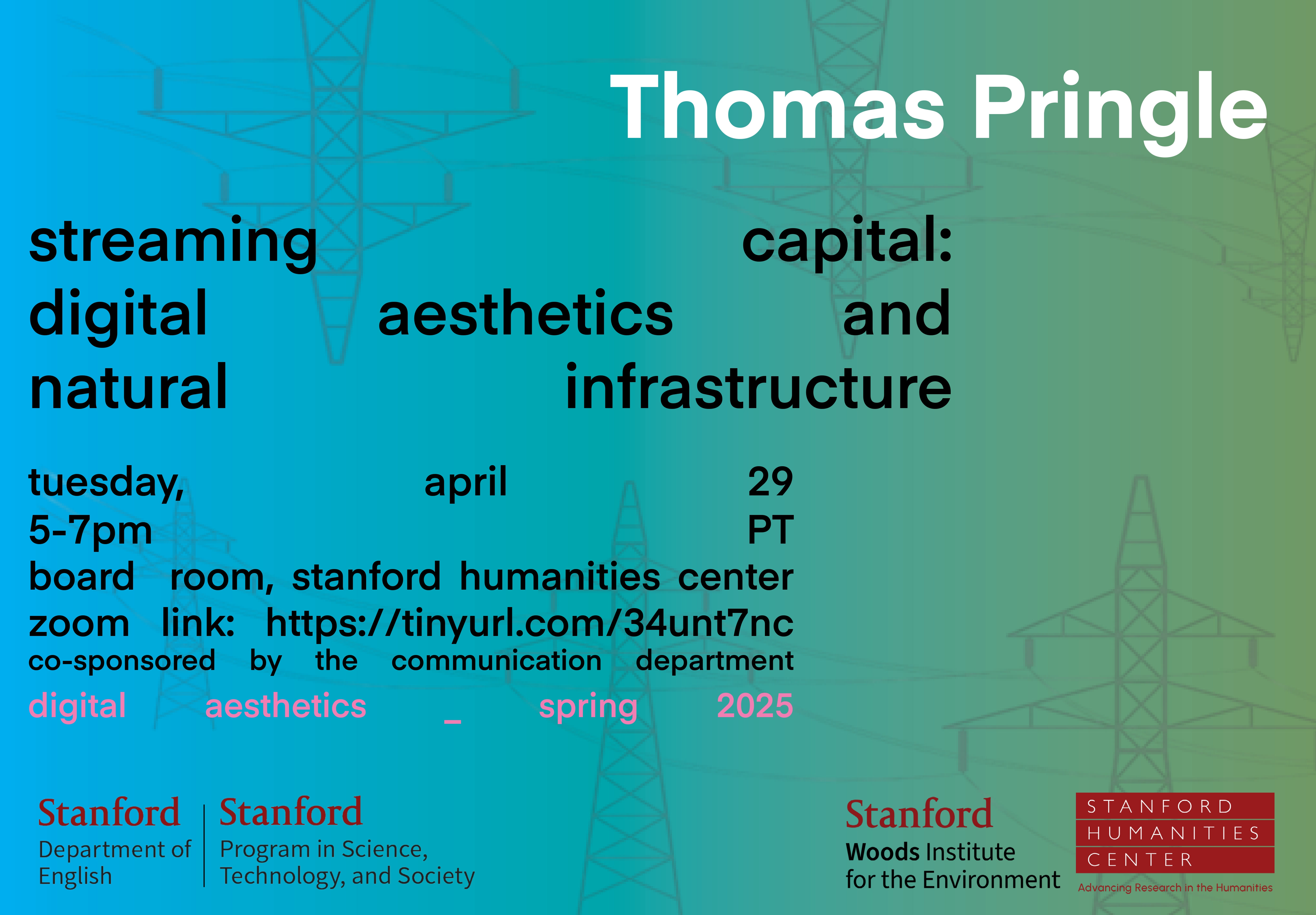
Please join the Digital Aesthetics Workshop in welcoming Thomas Pringle, who will present “Streaming Capital: Digital Aesthetics and Natural Infrastructure” on Tuesday, April 29, from 5:00-7:00pm PT. The event will take place in the Board Room at the Stanford Humanities Center. We look forward to seeing you there!
In 2022, Netflix launched “Net Zero + Nature,” a program offsetting the streaming giant through purchase of carbon credits generated by the Wildlife Works Kasigau Corridor REDD+ Project. Promotional materials assert that trees growing in Kenya are an infrastructure supporting resource-intensive streaming media. Recent digital media have been critiqued as industrial, environmentally destructive processes. Yet this project suggests that the isomorphic relationships between an image and its ecological impact are aesthetic, with the Netflix offset program indexing a broader media-historical rationality linking digital representation to economically conditioned forms of physical change. What media-historical a priori lend legibility to the statement: environments are media infrastructure?
In the late 1950s, cybernetic ecologist Howard Odum studied Corpus Christi Bay during his tenure at the Marine Institute at the University of Texas. Concerned with how ongoing petroleum logistical development threatened the turtle grass beds crucial to the estuary ecosystem, Odum drew on images of electrical circuitry to analogize seagrass to the local hay market, estimating that the work performed by the bay’s photosynthesis was worth $97.46 per acre per year. Turtle grass conservation would thus support various modes of production: fishing, tourism, natural gas electricity generation, and the ecological metabolism of industrial sludge. This humble act of labor-free monetization is among the first recorded arguments that conserved environments serve as infrastructure, or in Odum’s words as “life support functions supporting the economy without much conscious recognition.” In the context of recent degrowth advocacy, this case initiates a media historical narration of the aesthetic forms signifying the productivity of “natural infrastructures.”
Bio:
Thomas Patrick Pringle is Assistant Professor of Cinema and Media Studies at the University of Southern California. With Gertrud Koch and Bernard Stiegler, he is the co-author of Machine (Meson and University of Minnesota Press, 2019). Pringle’s research on environmental media appears in NECSUS: European Journal of Media Studies, Journal of Film and Video, Media-N, and New Media and Society, as well as the volumes Toxic Immanence: Decolonizing Nuclear Legacies and Futures (2022) and Power Shift: Keywords for a New Politics of Energy (2025).
This event has been generously co-sponsored by the Woods Institute for the Environment, the Department of English, the Department of Communication, and the Program in Science, Technology, and Society.
The Critical Making Collaborative at Stanford invites you to our Spring event — an evening of sharing and discussion with two recipients of the Critical Making Award, Lemon Guo and J. Makary, who will present their ongoing work in music and performance on Friday, May 16 (6PM) at the CCRMA Stage (3rd floor).
Lemon Guo — where do old sounds go to die?
Since 2017, I have been visiting the Kam villages in Guizhou, China to work with the elder women singers. In my recent trips, I noticed that a sound that used to pulse through the village in all waking hours had disappeared. To make textile for clothing, many women used to spend months at a time hammering cotton outdoors. I made several field recordings of this practice, when it seemed commonplace and quotidian. As cultural tourism transformed the village soundscape, I started to listen to these files in my hard drive. In this piece, the performers were only allowed to listen to these recordings in the first rehearsal. They were not told that the field recordings would be taken away from them. This performance is made from what they can remember.
J. Makary — murnau model
For murnau model, I used a machine learning model trained on still frames from F. W. Murnau’s 1924 silent film The Last Laugh/Der letzte Mann to generate new hypothetical images that emerge from its lengthy dream sequence. After subsequent interventions to guide image generation and alter their evolution, the images were “married” back to the film through photographic capture of individual frames of the physical filmstrip. By embedding these digital apparitions into the material substrate of celluloid, I intended to create a dialogue between analog and digital dreams, from film to data and back again. The resulting work becomes a reflection on cinema’s dual nature as both technological process and dream machine.