“Dimensionality, Perspective, and Imagination in Computational Media” — Talk at UC Berkeley conference on Dimensional Vision in Flux, May 29-31, 2025

I’m excited to be speaking, alongside an amazing lineup of scholars, at a conference this week (May 29-31, 2025) on Dimensional Vision in Flux: The Stereo-Aesthetics and Politics of 3D Cinema and Media, hosted by the Department of Film & Media at UC Berkeley. I’ll be giving a talk on “Dimensionality, Perspective, and Imagination in Computational Media.”

The complete program can be found here. And here’s my abstract:

Dimensionality, Perspective, and Imagination in Computational Media

Dimensional vision finds itself in flux, as the title of this symposium would have it. The flux in question has to do with recent and contemporary transformations in visual media: witness the many booms and busts of 3D cinema, recall the short-lived push to put 3D televisions in our living rooms, and consider the rapidly changing landscape of VR, AR, MR, XR, whatever-R. In order to get a handle on the flux of dimensional vision in relation to such media-technological changes, however, I would like to take a step back and observe that dimensional vision has always and only ever been in flux. I mean this, first, in the sense that dimensionality is given to human experience immediately and inseparably from the spatiotemporal flux of embodied existence; this “microperceptual” dimension (in Don Ihde’s terms) is epitomized in Edmund Husserl’s descriptions of the flux of “adumbrations” as he walks around a tree, whereby a multidimensional model of “the tree,” never wholly seen, takes shape in his mind. In a second, more historical sense, dimensional vision has always been in flux in a way that is more closely attuned to the media changes described above; rather than exceptional, however, such flux is a constant because there is no natural or neutral state apart from mediation: the “microperceptual” level of embodied experience can never be thought apart from what Ihde calls the “macroperceptual” level of cultural and technological conditioning (and vice versa).

Taken seriously, this means that dimensionality and perspectival vision are inherently contingent and deeply political—not just perspectival representation, but the embodied experience of perceptual perspective and spatial orientation itself. And while I argue that this has always been the case for humans as an essentially biotechnical species, the political stakes are heightened in an era of computational media. The latter, including VR and similar media of 3D visuality, operate faster than and bypass human perception, opening dimensional vision to fine-grained reengineering. In order to make this argument, I turn to Kant’s notion of the productive imagination (Einbildungskraft) and the stereotyping operation of the “schematism” that connects visual stimuli to concepts of the understanding. Following philosophers Wilfrid Sellars and Alan Thomas, schemata are perspectivally indeterminate but determinable, and through them the Kantian imagination is responsible for our empirical experience of things as having depth and unseen backsides—responsible, that is, for our sense of the world as a dimensional, volumetric space within which I am positioned. Meanwhile, computational media are constructing their own spatial models of the world (or worlds), models that exceed and resist human perceptual access while positioning us both virtually and physically. In this way, they assume functions of the imagination and modulate the flux of dimensional vision at both microperceptual and macroperceptual scales. 
Nicolas Roeg’s Perversion of Suture

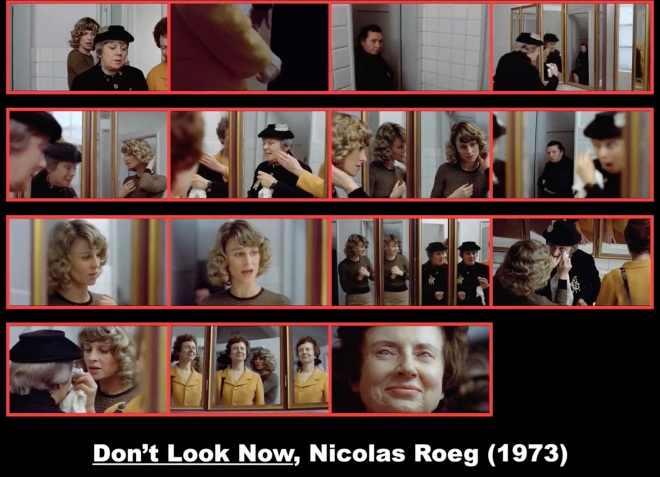
Nicolas Roeg has died at the age of 90. People will remember him for a striking form of vision embodied in the many films that he directed or filmed as cinematographer. For me, this vision is nowhere more poignantly indicated than in his uncannily self-reflexive masterpiece Don’t Look Now (1973), in which he undermines conventions of cinematic sight through subtly shocking POV shots that align the camera and our eyes with the perspectives of inanimate objects (such as the doll above) or sightless characters (the blind woman whose vision structures a crucial scene in the film, as I argue in my interactive video essay on it: “Don’t Look Now: Paradoxes of Suture”).

dln


Nonhuman Perspectives and Discorrelated Images in Post-Cinema

paranormal_activity_4-kinect

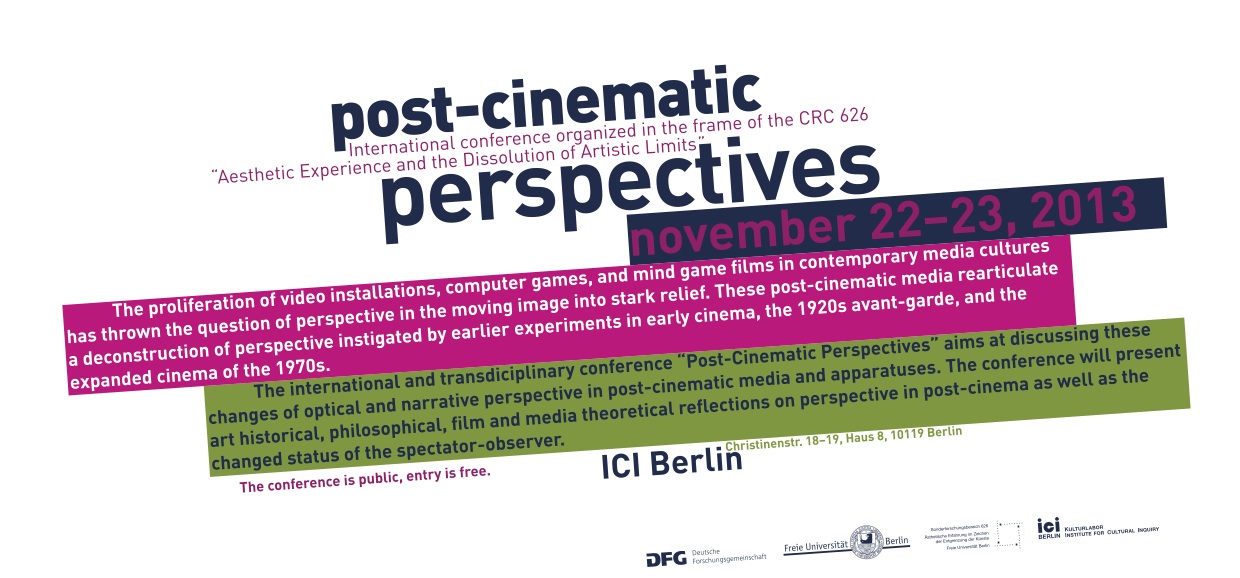
As I mentioned recently, I will be speaking next week at the Post-Cinematic Perspectives conference taking place November 22-23, 2013 at the Free University Berlin. Below you’ll find the abstract for my talk:

Nonhuman Perspectives and Discorrelated Images in Post-Cinema

Shane Denson

With the shift to a digital and more generally post-cinematic media environment, moving images have undergone what I term their “discorrelation” from human embodied subjectivities and (phenomenological, narrative, and visual) perspectives. Clearly, we still look at – and we still perceive – images that in many ways resemble those of a properly cinematic age; yet many of these images are mediated in ways that subtly (or imperceptibly) undermine the distance of perspective, i.e. the quasi-spatial distance and relation between phenomenological subjects and the objects of their perception. At the center of these transformations are a set of strangely irrational mediators and “crazy” cameras – physical and virtual imaging apparatuses that seem not to know their place with respect to diegetic and nondiegetic realities, and that therefore fail to situate viewers in a coherently designated spectating-position. A phenomenological and post-phenomenological analysis of such mediating apparatuses points to the rise of a fundamentally post-perceptual media regime, in which “contents” and “perspectives” are ancillary to algorithmic functions and enmeshed in an expanded, indiscriminately articulated plenum of images that exceed capture in the form of photographic or perceptual “objects.” Post-cinema’s cameras thus mediate a nonhuman ontology of computational image production, processing, and circulation, where these images’ discorrelation from human perceptibility signals an expansion of the field of material affect: beyond the visual or even the perceptual, the images of post-cinematic media operate and impinge upon us at what might be called a “metabolic” level.

Post-Cinematic Perspectives

Programm_PerspectivesPostCinemaProgramm_PerspectivesPostCinema-2

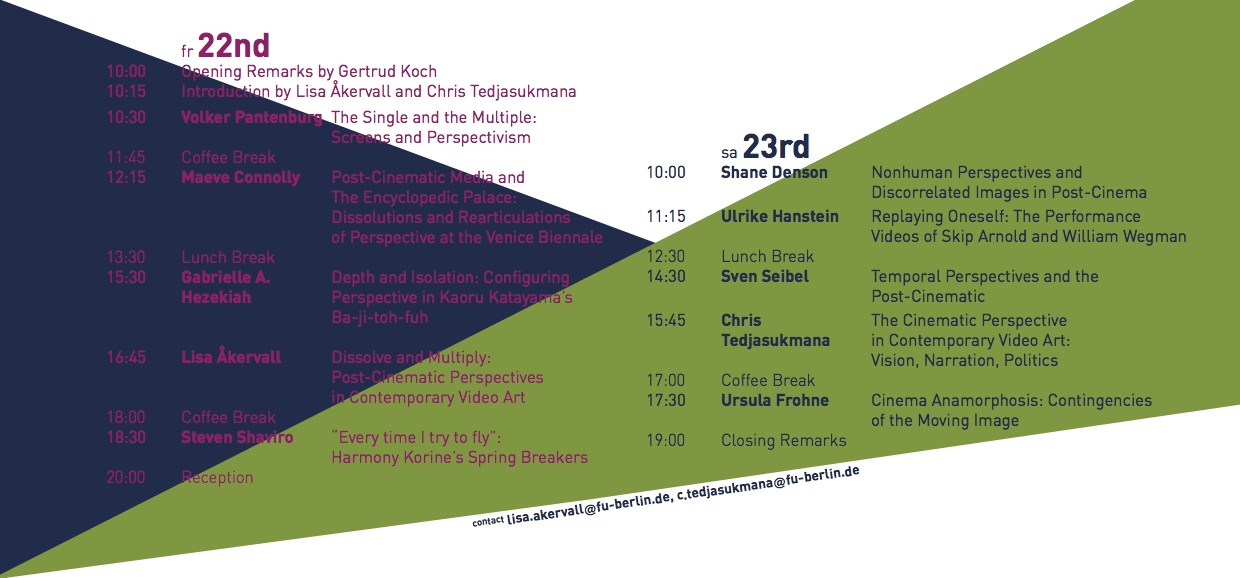
On November 22-23, 2013, I will be participating in the conference “Post-Cinematic Perspectives,” which is being organized by Lisa Åkervall and Chris Tedjasukmana at the Freie Universität Berlin. There’s a great line-up, as you’ll see on the conference program above. I look forward to seeing Steven Shaviro again (and hearing his talk on Spring Breakers), and to meeting all the other speakers. My talk, on the morning of the 23rd, is entitled “Nonhuman Perspectives and Discorrelated Images in Post-Cinema.” The conference is open to the public, and attendance is free.