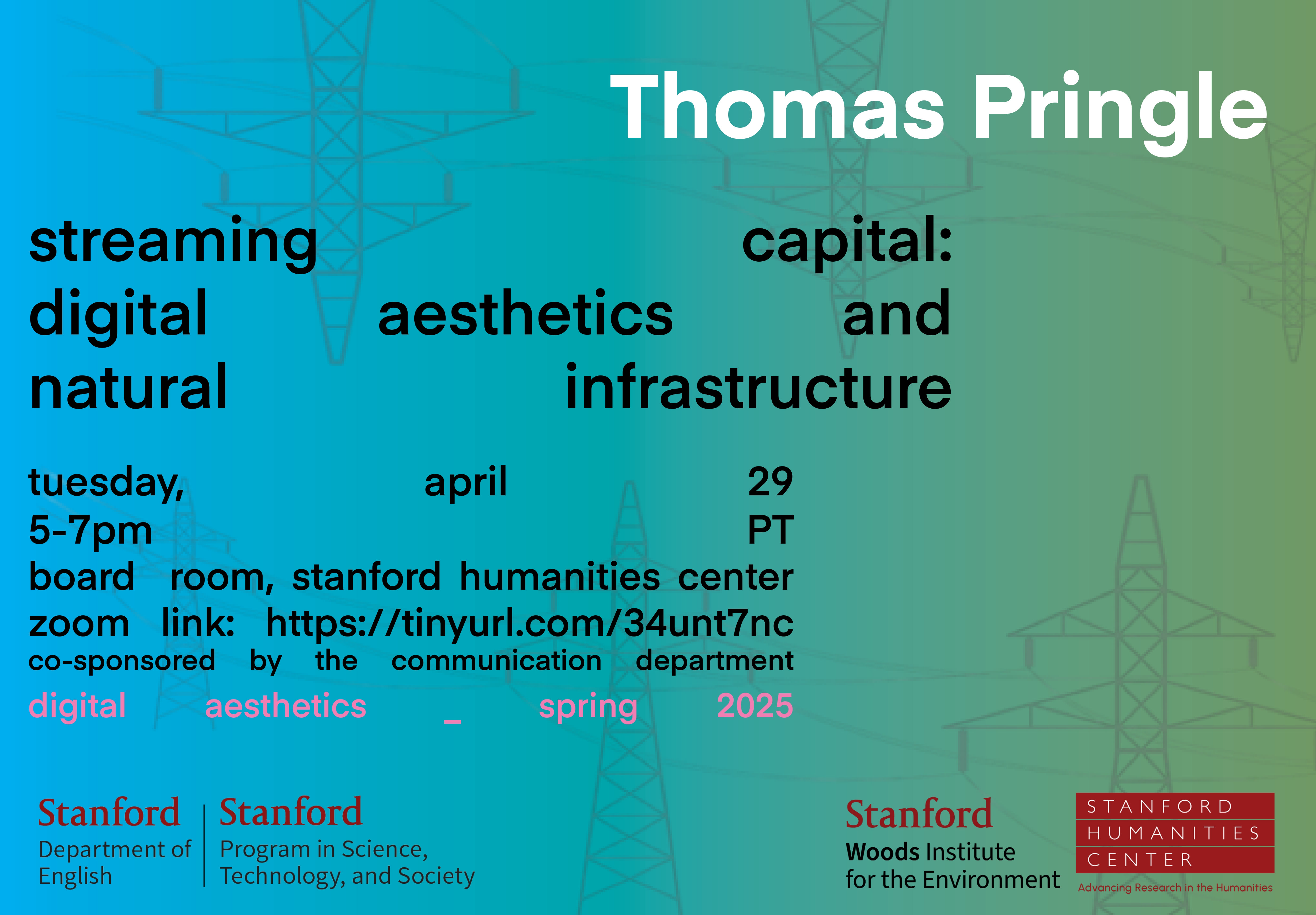
Please join the Digital Aesthetics Workshop in welcoming Thomas Pringle, who will present “Streaming Capital: Digital Aesthetics and Natural Infrastructure” on Tuesday, April 29, from 5:00-7:00pm PT. The event will take place in the Board Room at the Stanford Humanities Center. We look forward to seeing you there!
Zoom link for those unable to join in-person: https://tinyurl.com/34unt7nc
Abstract:
In 2022, Netflix launched “Net Zero + Nature,” a program offsetting the streaming giant through purchase of carbon credits generated by the Wildlife Works Kasigau Corridor REDD+ Project. Promotional materials assert that trees growing in Kenya are an infrastructure supporting resource-intensive streaming media. Recent digital media have been critiqued as industrial, environmentally destructive processes. Yet this project suggests that the isomorphic relationships between an image and its ecological impact are aesthetic, with the Netflix offset program indexing a broader media-historical rationality linking digital representation to economically conditioned forms of physical change. What media-historical a priori lend legibility to the statement: environments are media infrastructure?
In the late 1950s, cybernetic ecologist Howard Odum studied Corpus Christi Bay during his tenure at the Marine Institute at the University of Texas. Concerned with how ongoing petroleum logistical development threatened the turtle grass beds crucial to the estuary ecosystem, Odum drew on images of electrical circuitry to analogize seagrass to the local hay market, estimating that the work performed by the bay’s photosynthesis was worth $97.46 per acre per year. Turtle grass conservation would thus support various modes of production: fishing, tourism, natural gas electricity generation, and the ecological metabolism of industrial sludge. This humble act of labor-free monetization is among the first recorded arguments that conserved environments serve as infrastructure, or in Odum’s words as “life support functions supporting the economy without much conscious recognition.” In the context of recent degrowth advocacy, this case initiates a media historical narration of the aesthetic forms signifying the productivity of “natural infrastructures.”
Bio:
Thomas Patrick Pringle is Assistant Professor of Cinema and Media Studies at the University of Southern California. With Gertrud Koch and Bernard Stiegler, he is the co-author of Machine (Meson and University of Minnesota Press, 2019). Pringle’s research on environmental media appears in NECSUS: European Journal of Media Studies, Journal of Film and Video, Media-N, and New Media and Society, as well as the volumes Toxic Immanence: Decolonizing Nuclear Legacies and Futures (2022) and Power Shift: Keywords for a New Politics of Energy (2025).
This event has been generously co-sponsored by the Woods Institute for the Environment, the Department of English, the Department of Communication, and the Program in Science, Technology, and Society.
