Alexander Starre, “Evolving Technologies, Enduring Media”

uzanne_end_of_books

Abstract for Alexander Starre’s talk at the symposium “Imagining Media Change” (June 13, 2013, Leibniz Universität Hannover):

Evolving Technologies, Enduring Media: Material Irony in Octave Uzanne’s “The End of Books”

Alexander Starre

In the electric shockwaves sent through the United States by the World’s Columbian Exhibition of 1893, the French writer and publisher Octave Uzanne appeared to have lost his belief in the future of the book. As a reporter for Le Figaro, Uzanne spent three months touring the country, meeting President Grover Cleveland and inventor Thomas Edison, besides strolling the fairgrounds in Chicago. After his visit, he published the short story “The End of Books” in Scribner’s Magazine in 1894, which depicts a future in which books have been replaced by the phonograph. In the seminal volume Rethinking Media Change (ed. David Thorburn and Henry Jenkins), Priscilla Coit Murphy reads “The End of Books” as an exuberant embrace of new media. This paper aims to complicate Murphy’s analysis through a materialist perspective on Uzanne’s text as a historical artifact. “The End of Books” does not unfold its full complexity in the English text printed in Scribner’s. The French version “La fin des livres”, which forms part of the collection Contes pour les bibliophiles (1895), exposes the material irony embedded in the text. Octave Uzanne’s relationship to technology was strikingly ambivalent and manifested larger shifts in networks of communication and cultural distinction. While he was fascinated by new electro-mechanical inventions, his ultimate goal was to improve the quality of printed artifacts. From this peculiar case, my paper will extract several theoretical implications for current debates in media studies and book history.

Felix Brinker, “On Popular Seriality, Operational Aesthetics, and Audience Productivity”

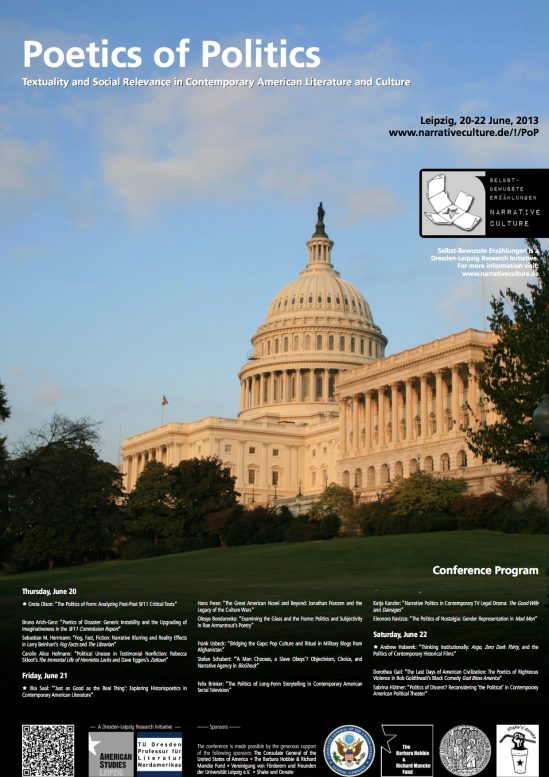
poetics_of_politics_poster

On Friday, June 21, 2013, Felix Brinker will be speaking about “The Politics of Long-Form Storytelling in Contemporary American Serial Television” at the “Poetics of Politics” conference in Leipzig. Felix’s talk builds upon recent work he’s been doing in the context of his dissertation project and related talks (for example, at the recent “It’s Not Television” conference in Frankfurt). Here is a preview of the upcoming talk:

The Politics of Long-Form Storytelling in Contemporary American Serial Television: On Popular Seriality, Operational Aesthetics, and Audience Productivity

Felix Brinker

The turn of American prime-time television dramas towards increasingly serialized storytelling during the last two decades seems to have coincided with an explicit politicization of their content. Especially shows discussed under the label of ‘Quality TV’ have been repeatedly celebrated and/or dismissed for their openly political agenda – be it for their engagement with the anxieties connected to the ‘War on Terror’ and the nebulous practices of intelligence agencies (as on Rubicon, Homeland and 24), or for attempts to tackle the social ills of contemporary urban America (as on The Wire or Breaking Bad). At the same time, other popular programs that at first glance seem to background political concerns in favor of more ‘escapist’ content (e.g. mystery-centric science-fiction or fantasy shows like Battlestar Galactica, Fringe, or Heroes) increasingly engage with matters of power, politics, and political intrigue and develop these motifs in ongoing storylines. While recent cultural and media studies publications on these phenomena have easily connected this renewed interest in political subject matters to the emergence of what Jason Mittell has termed ‘narratively complex television’ – that is, a (by now pervasive) shift in emphasis away from episodically contained storylines towards an ongoing serial narration that allows contemporary programming to construct richly furnished, expansive storyworlds and thus (among other things) opens up new possibilities for representing the complexities and intricacies of political systems and processes – less attention has so far been paid to the political dimensions of the increasingly active audience practices invited by such programming, and to the social aspects of popular seriality itself.

Located firmly within the competitive media environment of the convergence era, complex television series seek to engage their audiences in practices that extend well beyond ‘passive’ reception, and encourage them to become culturally and textually productive by participating in the discussion, interpretation and analysis of their favorite programs in dedicated online forums. Therefore, my paper argues that the political significance of narratively complex serial television manifests itself less on the level of content than on the level of form: By inviting their viewers to parse the complicated unfoldings of  narratives across longer periods of time, as well as across different media formats and paratexts, contemporary prime-time dramas ask their audiences to dedicate a considerable amount of their time to the engagement with a serially expanding text. By doing so, narratively complex serials not only ask their viewers to engage in cognitively challenging and time-consuming reception practices, but also inspire them to engage in the laborious creation of unofficial paratexts (such as wikis, blogs, and fansites) which chart the developments of storylines and characters – paratexts that serve both to render the increasingly complicated narratives accessible and as ‘free’ promotional materials that ensure the cultural visibility of these programs. These shows therefore thrive on the ‘free’ (i.e. unpaid) work of their viewers and employ it to secure their own continued serial proliferation. Drawing on recent conceptualizations of popular seriality that understand the active participation of audiences as an activity that is integral to the economic viability serial storytelling in general, as well as on post-operaist takes on immaterial labor as the predominant form of work in post-industrial societies, my paper argues that the contemporary centrality of such ‘participatory’ practices marks a profound shift in the relationship between work and leisure (or between recreational activity and professional media use) that coincides with the digitalization of our media environment.

To make its argument, my paper will take a closer look at contemporary serial dramas like HomelandThe Wire, and House of Cards, and identify the textual strategies by which these shows encourage a particularly active audience behavior. Drawing on Neil Harris’s concept of the ‘operational aesthetic’, I argue that especially moments of formal/medial and thematic self-reflexivity – that is, moments in which these series thematize, demonstrate, and comment both on the operations of the serial text and on the logics of the diegetic events it narrates – constitute central fulcra for facilitating the audiences’ ongoing and sustained engagement with serial television narratives. By repeatedly producing such moments of non-alienating self-reflexivity – for example in scenes in which a show asks their viewers to ‘recall’ events from earlier episodes and visualizes this by having its characters use diegetic media technologies – complex television dramas manage to call attention to the logics of their own narrative operations and suggest a particular, preferred way of engaging with the text without detracting from the story that is being being told. At the same time, I argue, these moments become productive for the representations of political systems and processes, since they usually also serve to thematize diegetic logics, processes, and chains of cause and effect. Such instances of formal and thematic self-reflexivity thus constitute moments in which the serial logics of narratively complex televisions shows are on display, and from which one could trace out the relationships between their representational politics and the politics of popular serial formats themselves.

Popular Seriality: June 6 – 8, 2013

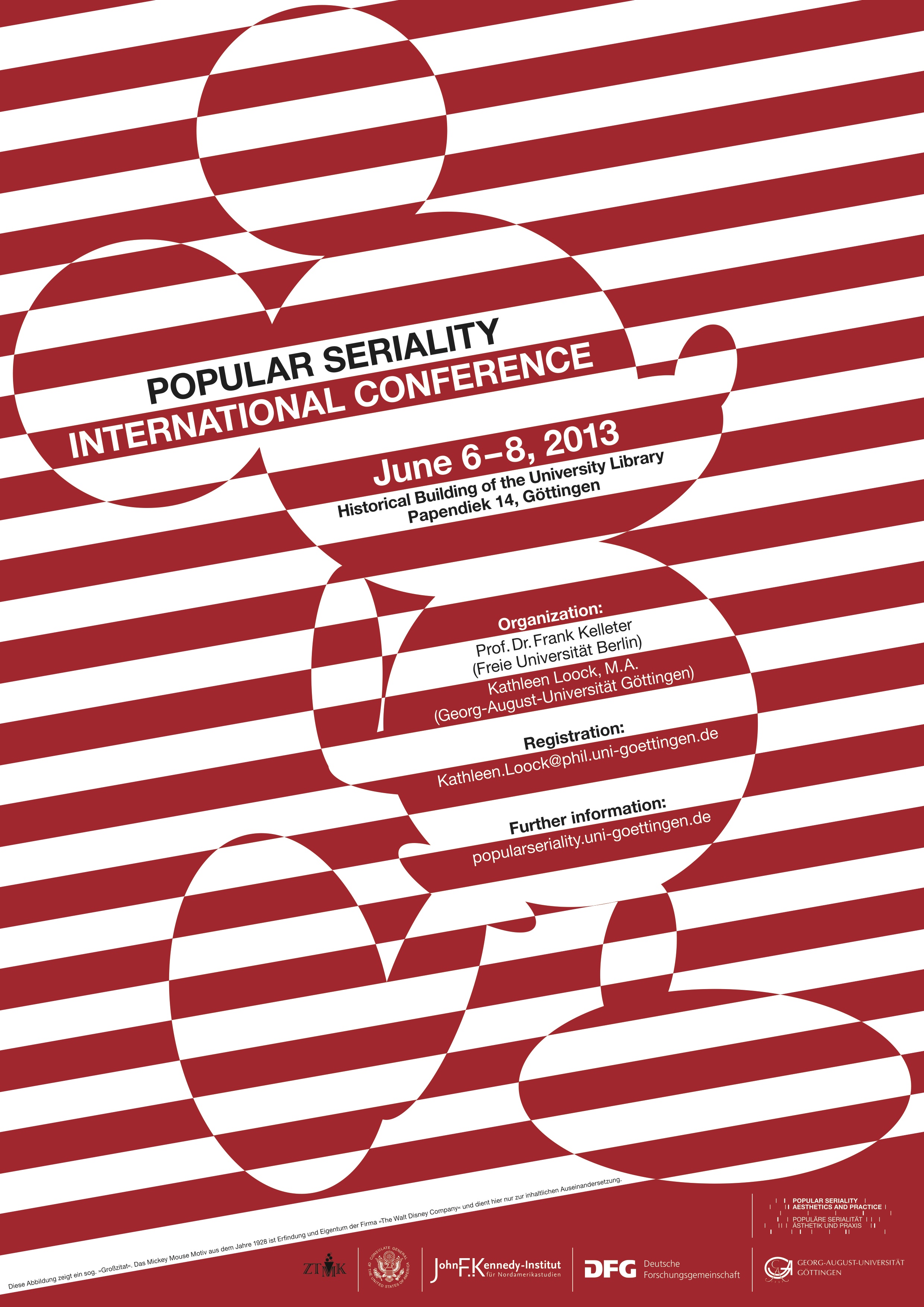
Popular_Seriality_Conference_Poster

Above, the wonderful poster for the upcoming “Popular Seriality” conference in Göttingen (June 6-8). Below, the final program.

More info about the conference can be found on the homepage of the DFG Research Unit “Popular Seriality: Aesthetics and Practice,” here.

[scribd id=143912998 key=key-1yli3a1asrohkfauh9xv mode=scroll]

Techno-Phenomenology, Medium as Interface, and the Metaphysics of Change

Reno_1902_escalator_patent

On June 17, 2013, I will be presenting a paper at the conference “Conditions of Mediation: Phenomenological Approaches to Media, Technology and Communication” at Birkbeck, University of London. There’s a diverse and interesting group of keynote speakers, including David Berry, Nick Couldry, Graham Harman, Shaun Moores, Lisa Parks, and Paddy Scannell, and a list of other presenters — among whom I am proud to be counted — has also gone online now.

Below is the abstract for my modest contribution:

Techno-Phenomenology, Medium as Interface, and the Metaphysics of Change

Shane Denson, Leibniz Universität Hannover

Walter Benjamin famously argued that the emergence of modern media of technical reproducibility (photography, film) corresponded to sweeping changes in the organization of what he calls the “medium” of sense perception. To a skeptic like film scholar David Bordwell, Benjamin’s “modernity thesis” (along with Tom Gunning’s related arguments about the “culture of shock”) is pure hyperbole, for cognitive structures are subject to the slow processes of biological evolution while impervious to rapid technological change. The debate has tended to reach impasses over questions of the causal agencies and effects of media change—e.g. whether they concern the broad cultural domain of discourse and signification or the “hard-wiring” of the brain itself. In this presentation, I argue that a “techno-phenomenological” approach—which (following cues from Heidegger, Merleau-Ponty, and Don Ihde, among others) focuses on the embodied interfaces in which human intentionalities are variously mediated by technologies—enables us to see media change as involving experiential transformations that are at once robustly material, and hence not restricted to cultural or psycho-semiotic domains, while still compatible with the long durations of biological evolution. An “anthropotechnical interface,” based in proprioceptive and visceral sensibilities, will be shown to constitute the primary site of media change.

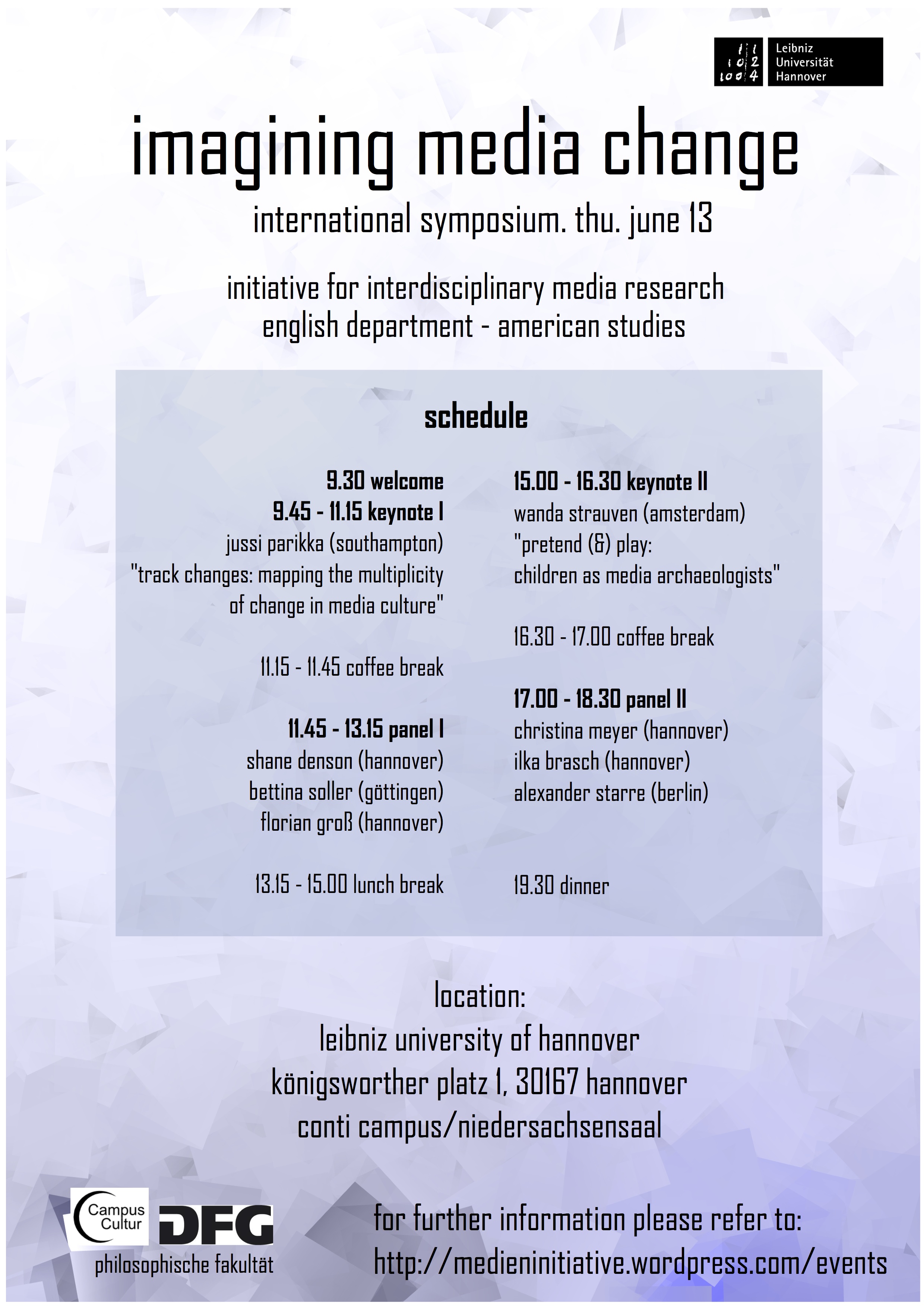
Imagining Media Change — Symposium Poster

Symposium - Imagining Media Change - poster

[UPDATE: See here for the complete symposium program and abstracts.]

Recently, I posted the description for the symposium on “Imagining Media Change” that we’re organizing this June, with keynote speakers Jussi Parikka and Wanda Strauven — part of this semester’s larger series of events. Now I am proud to present the poster for the symposium (designed by Ilka Brasch and Svenja Fehlhaber), which includes an overview of the schedule and speakers. A more detailed schedule, including the titles of talks, will be made available soon.

International Conference: “Popular Seriality”

[scribd id=133357756 key=key-1070paqvhijzf8pcaxme mode=scroll]
International Conference: “Popular Seriality”
June 6-8, 2013 // University of Göttingen

Above, the preliminary program for the upcoming conference of the seriality research group that several of my colleagues and I are involved with.

Most readers of this blog will already be familiar with the seriality group, but in case you’re not: The Research Unit “Popular Seriality—Aesthetics and Practice,” funded by the German Research Foundation (DFG), brings together 15 researchers from the fields of American Studies, German Philology, Cultural Anthropology/European Ethnology, Empirical Cultural Studies, and Media Studies. Since 201o, six sub-projects have been investigating a narrative format that has become a defining feature of popular aesthetics: the series. The Research Unit addresses questions concerning the wide distribution and broad appeal of series since the 19th century and asks which new narrative formats have emerged through serialization. Further questions are: How do series influence the way we perceive and structure social reality? How are serial characters revised when they undergo one or more media shifts? How can we explain the progressively shrinking boundaries between producers and recipients in long running series? Which transformations in the field of cultural distinctions are produced by complex serial narratives, which are increasingly embedded in highbrow lifestyles and canonization practices?

From June 6 to 8, 2013, towards the end of the first funding period, the Research Unit will hold an International Conference in Göttingen. Talks will be given by members of the Research Unit and well-known researchers in the field of popular seriality. Among the scholars presenting at the conference are Sudeep Dasgupta, Jared Gardner, Julika Griem, Scott Higgins, Judith Keilbach, Lothar Mikos, Sean O’Sullivan, Patricia Okker, Irmela Schneider, Sabine Sielke, Ben Singer, William Uricchio, Constantine Verevis, Tanja Weber und Christian Junklewitz. Jason Mittell will give the keynote lecture.

For more information about the research unit, and to stay up to date on the conference and other activities, please refer to the group’s homepage: http://popularseriality.uni-goettingen.de/

Symposium: Imagining Media Change

imagining_media_change

[UPDATE: See here for the complete symposium program and abstracts.]

Imagining Media Change

Symposium of the Initiative for Interdisciplinary Media Research and the American Studies department at the Leibniz University of Hannover, 13 June 2013 (Niedersachsensaal, Conti-Campus)

In the midst of the ongoing digitalization of our contemporary media environment, recent media and cultural studies have developed a renewed interest in the production and staging of technological innovation, in the occurrence and impact of media change, and in the ways these transformations inform the production, circulation, reception, and aesthetics of popular texts and media forms. The emergence of ‘new media’ in particular, it would seem, prompts us to rethink the role of mediating technologies within social and cultural spheres, and to explore how our everyday lives are transformed by a newly digitalized technical infrastructure. Such explorations are necessarily reflexive, however, as our attempts to imagine media change are themselves mediated by cultural texts and technologies in the grip of change. Dynamics of medial self-historicization guide our very thinking about media history: commercial logics, in particular, emphasize the superiority of the new, attest to the inevitability of the past’s obsolescence, and seek to captivate our imaginations with branded visions of the media-technological future. Seeking to look beyond these pressures, a reflexive engagement with recent media change is therefore called upon to reevaluate the impact of previous transitions and transformations throughout media history, and to excavate, if possible, discontinuities and ruptures in the development of modern media as they relate to broader social, cultural, and material processes of change. From a media-archaeological perspective, the history of media emerges not as a straightforward, linear process of technological innovation and implementation, but rather as a discontinuous series of media crises and negotiations of change. Understanding the uneven historical emergence and transformation of different types of media thus promises a renewed understanding not only of historical media, but also of contemporary media change and our present (in)ability to imagine its scope and impact. Crucial to this enterprise is an appreciation of reflexivity itself – a recognition of the fact that when media change, they also change our imaginations, including our imagination of media change. In the face of corporate and other interests that seek to capitalize on this logic and to steer our imaginations of the digital transition for their own benefit, what’s ultimately at stake in a media-archaeological excavation of our medial past and present is therefore nothing less than a political question: Will we be the subjects or merely the objects of “imagining media change”?

The symposium “Imagining Media Change” takes a broad view of media-historical and counter-historical developments and transformations since the nineteenth century, focusing in particular on the reflexive interactions between media undergoing change and media being used to imagine the parameters, effects, and significance of media-technological transformations. We are interested in historical and contemporary visions of change as they are articulated in or pertain to a wide range of media (including film, television, literature, and other visual, aural, textual, or computational media). The one-day symposium aims to bring together a variety of disciplinary perspectives and interests and to facilitate discussion of the material, political, aesthetic, and speculative dimensions of media change. Keynote lectures will be held by Jussi Parikka (University of Southampton, UK) and Wanda Strauven (University of Amsterdam, NL).

For more information about the symposium “Imagining Media Change,” please contact felix.brinker@engsem.uni-hannover.de or refer to the events page (http://medieninitiative.wordpress.com/events/).

Imagining Media Change

imagining_media_change

This coming semester, the Initiative for Interdisciplinary Media Research is proud to present a series of events organized around the topic “Imagining Media Change.” The flyer above (click for a larger view) details these events, which include a series of film screenings, thematically focused discussion groups, and a symposium featuring keynotes by Jussi Parikka and Wanda Strauven!

More details to follow soon…

Crazy Cameras, Discorrelated Images, and the Post-Perceptual Mediation of Post-Cinematic Affect — #SCMS13

Below you’ll find the full text of the talk I just gave at the Society for Cinema and Media Studies conference in Chicago, as part of a panel on “Post-Cinematic Affect: Theorizing Digital Movies Now” along with Therese Grisham, Steven Shaviro, and Julia Leyda — all of whom I’d like to thank for their great contributions! As always, comments are more than welcome!

SCMS_Crazy_Cameras_Title.001

Crazy Cameras, Discorrelated Images, and the Post-Perceptual Mediation of Post-Cinematic Affect

Shane Denson

I’m going to talk about crazy cameras, discorrelated images, and post-perceptual mediation as three interlinked facets of the medial ontology of post-cinematic affect. I’ll connect my observations to empirical and phenomenological developments surrounding contemporary image production and reception, but my primary interest lies in a more basic determination of affect and its mediation today. Following Bergson, affect pertains to a domain of material and “spiritual” existence constituted precisely in a gap between empirically determinate actions and reactions (or, with some modification, between the production and reception of images); affect subsists, furthermore, below the threshold of conscious experience and the intentionalities of phenomenological subjects (including the producers and viewers of media images). It is my contention that the infrastructure of life in our properly post-cinematic era has been subject to radical transformations at this level of molecular or pre-personal affect, and following Steven Shaviro I suggest that something of the nature and the stakes of these transformations can be glimpsed in our contemporary visual media.

My argument revolves around what I’m calling the “crazy cameras” of post-cinematic media, following comments by Therese Grisham in our roundtable discussion in La Furia Umana (alternatively, here): Seeking to account for the changed “function of cameras […] in the post-cinematic episteme,” Therese notes that whereas “in classical and post-classical cinema, the camera is subjective, objective, or functions to align us with a subjectivity which may lie outside the film,” there would seem to be “something altogether different” in recent movies. “For instance, it is established that in [District 9], a digital camera has shot footage broadcast as news reportage. A similar camera ‘appears’ intermittently in the film as a ‘character.’ In the scenes in which it appears, it is patently impossible in the diegesis for anyone to be there to shoot the footage. Yet, we see that camera by means of blood splattered on it, or we become aware of watching the action through a hand-held camera that intrudes suddenly without any rationale either diegetically or aesthetically. Similarly, but differently as well, in Melancholia, we suddenly begin to view the action through a ‘crazy’ hand-held camera, at once something other than just an intrusive exercise in belated Dogme 95 aesthetics and more than any character’s POV […].”

What it is, precisely, that makes these cameras “crazy,” or opaque to rational thought? My answer, in short, is that post-cinematic cameras – by which I mean a range of imaging apparatuses, both physical and virtual – seem not to know their place with respect to the separation of diegetic and nondiegetic planes of reality; these cameras therefore fail to situate viewers in a consistently and coherently designated spectating-position. More generally, they deviate from the perceptual norms established by human embodiment – the baseline physics engine, if you will, at the root of classical continuity principles, which in order to integrate or suture psychical subjectivities into diegetic/narrative constructs had to respect above all the spatial parameters of embodied orientation and locomotion (even if they did so in an abstract, normalizing form distinct from the real diversity of concrete body instantiations). Breaking with these norms results in what I call the discorrelation of post-cinematic images from human perception.

With the idea of discorrelation, I aim to describe an event that first announces itself negatively, as a phenomenological disconnect between viewing subjects and the object-images they view. In her now-classic phenomenology of filmic experience, The Address of the Eye, Vivian Sobchack theorized a correlation – or structural homology – between spectators’ embodied perceptual capacities and those of film’s own apparatic “body,” which engages viewers in a dialogical exploration of perceptual exchange; cinematic expression or communication, accordingly, was seen to be predicated on an analogical basis according to which the subject and object positions of film and viewer are dialectically transposable.

sobchack_film-viewer-relations

But, according to Sobchack, this basic perceptual correlation is endangered by new, or “postcinematic” media (as she was already calling them in 1992), which disrupt the commutative interchanges of perspective upon which filmic experience depends for its meaningfulness. With the tools Sobchack borrows from philosopher of technology Don Ihde, we can make a first approach to the “crazy” quality of post-cinematic cameras and the discorrelation of their images.

lens_flare_2

Take the example of the digitally simulated lens flare, featured ostentatiously in recent superhero films like Green Lantern or the Ghost Rider sequel directed by Neveldine and Taylor, who brag that their use of it breaks all the rules of what you can and can’t do in 3D. Beyond the stylistically questionable matter of this excess, a phenomenological analysis reveals significant paradoxes at the heart of the CGI lens flare. On the one hand, the lens flare encourages what Ihde calls an “embodiment relation” to the virtual camera: by simulating the material interplay of a lens and a light source, the lens flare emphasizes the plastic reality of “pro-filmic” CGI objects; the virtual camera itself is to this extent grafted onto the subjective pole of the intentional relation, “embodied” in a sort of phenomenological symbiosis that channels perception towards the objects of our visual attention. On the other hand, however, the lens flare draws attention to itself and highlights the images’ artificiality by emulating (and foregrounding the emulation of) the material presence of a camera. To this extent, the camera is rendered quasi-objective, and it instantiates what Ihde calls a “hermeneutic relation”: we look at the camera rather than just through it, and we interpret it as a sign or token of “realisticness.” The paradox here, which consists in the realism-constituting and -problematizing undecidability of the virtual camera’s relation to the diegesis – where the “reality” of this realism is conceived as thoroughly mediated, the product of a simulated physical camera rather than defined as the hallmark of embodied perceptual immediacy – points to a more basic problem: namely, to a transformation of mediation itself in the post-cinematic era. That is, the undecidable place of the mediating apparatus, the camera’s apparently simultaneous occupation of both subjective and objective positions within the noetic relation that it enables between viewers and the film, is symptomatic of a more general destabilization of phenomenological subject- and object-positions in relation to the expanded affective realm of post-cinematic mediation. Computational, ergodic, and processual in nature, media in this mode operate on a level that is categorically beyond the purview of perception, perspective, or intentionality. Phenomenological analysis can therefore provide only a negative determination “from the outside”: it can help us to identify moments of dysfunction or disconnection, but it can offer no positive characterization of the “molecular” changes occasioning them. Thus, for example, CGI and digital cameras do not just sever the ties of indexicality that characterized analogue cinematography (an epistemological or phenomenological claim); they also render images themselves fundamentally processual, thus displacing the film-as-object-of-perception and uprooting the spectator-as-perceiving-subject – in effect, enveloping both in an epistemologically indeterminate but materially quite real and concrete field of affective relation. Mediation, I suggest, can no longer be situated neatly between the poles of subject and object, as it swells with processual affectivity to engulf both.

dilation_of_affect_2

Compare, in this connection, film critic Jim Emerson’s statement in response to the debates over so-called “chaos cinema”: “It seems to me that these movies are attempting a kind of shortcut to the viewer’s autonomic nervous system, providing direct stimulus to generate excitement rather than simulate any comprehensible experience. In that sense, they’re more like drugs that (ostensibly) trigger the release of adrenaline or dopamine while bypassing the middleman, that part of the brain that interprets real or imagined situations and then generates appropriate emotional/physiological responses to them. The reason they don’t work for many of us is because, in reality, they give us nothing to respond to – just a blur of incomprehensible images and sounds, without spatial context or allowing for emotional investment.” Now, I want to distance myself from what appears to be a blanket disapproval of such stimulation, but I quote Emerson’s statement here because I think it neatly identifies the link between a direct affective appeal and the essentially post-phenomenological dissolution of perceptual objects. Taken seriously, though, this link marks the crux of a transformation in the ontology of media, the point of passage from cinematic to post-cinematic media. Whereas the former operate on the “molar” scale of perceptual intentionality, the latter operate on the “molecular” scale of sub-perceptual and pre-personal embodiment, potentially transforming the material basis of subjectivity in a way that’s unaccountable for in traditional phenomenological terms. But how do we account for this transformative power of post-cinematic media, short of simply reducing it (as it would appear Emerson tends to do) to a narrowly positivistic conception of physiological impact? It is helpful here to turn to Maurizio Lazzarato’s reflections on the affective dimension of video and to Mark Hansen’s expansions of these ideas with respect to computational and what he calls “atmospheric” media.

According to Lazzarato, the video camera captures time itself, the splitting of time at every instant, hence opening the gap between perception and action where affect (in Bergson’s metaphysics) resides. Because it no longer merely traces objects mechanically and fixes them as discrete photographic entities, but instead generates its images directly out of the flux of sub-perceptual matter, which it processes on the fly in the space of a microtemporal duration, the video camera marks a revolutionary transformation in the technical organization of time. The mediating technology itself becomes an active locus of molecular change: a Bergsonian body qua center of indetermination, a gap of affectivity between passive receptivity and its passage into action. The camera imitates the process by which our own pre-personal bodies synthesize the passage from molecular to molar, replicating the very process by which signal patterns are selected from the flux and made to coalesce into determinate images that can be incorporated into an emergent subjectivity. This dilation of affect, which characterizes not only video but also computational processes like the rendering of digital images (which is always done on the fly), marks the basic condition of the post-cinematic camera, the positive underside of what presents itself externally as a discorrelating incommensurability with respect to molar perception. As Mark Hansen has argued, the microtemporal scale at which computational media operate enables them to modulate the temporal and affective flows of life and to affect us directly at the level of our pre-personal embodiment. In this respect, properly post-cinematic cameras, which include video and digital imaging devices of all sorts, have a direct line to our innermost processes of becoming-in-time, and they are therefore capable of informing the political life of the collective by flowing into the “general intellect” at the heart of immaterial or affective labor.

The Paranormal Activity series makes these claims palpable through its experimentation with various modes and dimensions of post-perceptual, affective mediation. After using hand-held video cameras in PA1 and closed-circuit home-surveillance cameras in PA2, and following a flashback by way of old VHS tapes in PA3, the latest installment intensifies its predecessors’ estrangement of the camera from cinematic and ultimately human perceptual norms by implementing computational imaging processes for its strategic manipulations of spectatorial affect. In particular, PA4 uses laptop- and smartphone-based video chat and the Xbox’s Kinect motion control system to mediate between diegetic and spectatorial shocks and to regulate the corporeal rhythms and intensities of suspenseful contraction and release that define the temporal/affective quality of the movie. Especially the Kinect technology, itself a crazy binocular camera that emits a matrix of infrared dots to map bodies and spaces and integrate them algorithmically into computational/ergodic game spaces, marks the discorrelation of computational from human perception: the dot matrix, which is featured extensively in the film, is invisible to the human eye; the effect is only made possible through a video camera’s night vision mode – part of the post-perceptual sensibility of the video camera that distinguishes it from the cinema camera. The film (and the series more generally) is thus a perfect illustration for the affective impact and bypassing of cognitive (and narrative) interest through video and computational imaging devices. In an interview, (co)director Henry Joost says the use of the Kinect, inspired by a YouTube video demonstrating the effect, was a logical choice for the series, commenting: “I think it’s very ‘Paranormal Activity’ because it’s like, there’s this stuff going on in the house that you can’t see.” Indeed, the effect highlights all the computational and video-sensory activity going on around us all the time, completely discorrelated from human perception, but very much involved in the temporal and affective vicissitudes of our daily lives through the many cameras and screens surrounding us and involved in every aspect of the progressively indistinct realms of our work and play. Ultimately, PA4 points toward the uncanny qualities of contemporary media, which following Mark Hansen have ceased to be contained in discrete apparatic packages and have become diffusely “atmospheric.”

PA1-4

This goes in particular for the post-cinematic camera, which has shed the perceptually commensurate “body” that ensured communication on Sobchack’s model and which, beyond video, is no longer even required to have a material lens. This does not mean the camera has become somehow immaterial, but today the conception of the camera should perhaps be expanded: consider how all processes of digital image rendering, whether in digital film production or simply in computer-based playback, are involved in the same on-the-fly molecular processes through which the video camera can be seen to trace the affective synthesis of images from flux. Unhinged from traditional conceptions and instantiations, post-cinematic cameras are defined precisely by the confusion or indistinction of recording, rendering, and screening devices or instances. In this respect, the “smart TV” becomes the exemplary post-cinematic camera (an uncanny domestic “room” composed of smooth, computational space): it executes microtemporal processes ranging from compression/decompression, artifact suppression, resolution upscaling, aspect-ratio transformation, motion-smoothing image interpolation, and on-the-fly 2D to 3D conversion. Marking a further expansion of the video camera’s artificial affect-gap, the smart TV and the computational processes of image modulation that it performs bring the perceptual and actional capacities of cinema – its receptive camera and projective screening apparatuses – back together in a post-cinematic counterpart to the early Cinématographe, equipped now with an affective density that uncannily parallels our own. We don’t usually think of our screens as cameras, but that’s precisely what smart TVs and computational display devices in fact are: each screening of a (digital or digitized) “film” becomes in fact a re-filming of it, as the smart TV generates millions of original images, more than the original film itself – images unanticipated by the filmmaker and not contained in the source material. To “render” the film computationally is in fact to offer an original rendition of it, never before performed, and hence to re-produce the film through a decidedly post-cinematic camera. This production of unanticipated and unanticipatable images renders such devices strangely vibrant, uncanny – very much in the sense exploited by Paranormal Activity. The dilation of affect, which introduces a temporal gap of hesitation or delay between perception (or recording) and action (or playback), amounts to a modeling or enactment of the indetermination of bodily affect through which time is generated, and by which (in Bergson’s system) life is defined. A negative view sees only the severing of the images’ indexical relations to world, hence turning all digital image production and screening into animation, not categorically different from the virtual lens flares discussed earlier. But in the end, the ubiquity of “animation” that is introduced through digital rendering processes should perhaps be taken literally, as the artificial creation of (something like) life, itself equivalent with the gap of affectivity, or the production of duration through the delay of causal-mechanical stimulus-response circuits; the interruption of photographic indexicality through digital processing is thus the introduction of duration = affect = life. Discorrelated images, in this respect, are autonomous, quasi-living images in Bergson’s sense, having transcended the mechanicity that previously kept them subservient to human perception. Like the unmotivated cameras of D9 and Melancholia, post-cinematic cameras generally have become “something altogether different,” as Therese put it: apparently crazy, because discorrelated from the molar perspectives of phenomenal subjects and objects, cameras now mediate post-perceptual flows and confront us everywhere with their own affective indeterminacy.

Logics of Conspiracy and the Interpretive Labors of Active Audiences

Following my talk on affective seriality in contemporary television, I am pleased now to present the text of my colleague Felix Brinker’s talk, also delivered last weekend at the “It’s Not Television” conference in Frankfurt. Like much of Felix’s work, this piece on conspiracy as a mode of narrative complexity brings perspectives from critical theory and new materialism to bear on recent discussions in cultural media studies and television studies, thus opening a space for an important dialogical and critical intervention.
Conspiracy1

Narratively Complex Television Series and the Logics of Conspiracy – On the Politics of Long-Form Serial Storytelling and the Interpretive Labors of Active Audiences

Felix Brinker

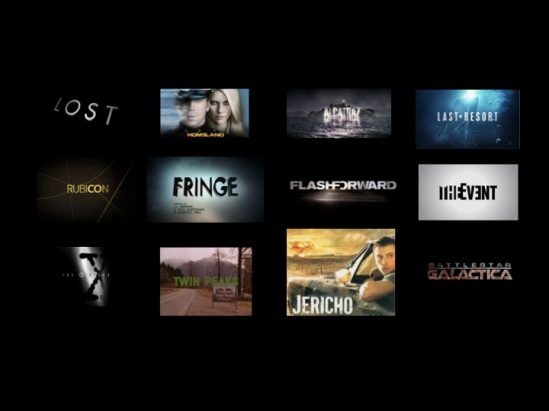
Operating within a television landscape that is characterized by the increasing competition between different media formats, American prime-time dramas of the last 15 years have relied strongly on complex strategies of serialized story-telling in order to ensure viewers’ sustained and ongoing investment in their narratives. Assessing this shift away from earlier norms of episodic closure, media scholar Jason Mittell has labeled the last two decades of American television an era of “narrative complexity” (cf. 29). Narratively complex shows, he argues, capitalize on the possibilities of the serial format and emphasize continuous, serial narration over episodically contained plots; over time, these shows therefore tend to amass complicated webs of backstories and character relationships and thus ask their audiences to engage in, as he puts it, “an active and attentive process of comprehension” (Mittell, 32). Today, I would like to focus on a particular subset of narratively complex shows, namely those that present their over-arching story-lines as an investigation into a central mystery, and that develop this motif as a framing narrative over the course of several seasons, if not the entirety of their runs. Shows like Lost, 24, Rubicon, Homeland, or Fringe all similarly rely on series-spanning story-lines about far-flung intrigues and enticing mysteries. By doing so, these shows adapt the formula that turned earlier series like The X-Files or Twin Peaks into fan-favorites: As Jeffrey Sconce puts it, the ongoing story-lines of these shows “cultivate a central narrative enigma” (107) – like the alien invasion slash government cover-up on The X-Files or the murder of Laura Palmer on Twin Peaks, the mysterious events of Lost’s island, or the uncertain loyalties and motivations Homeland’s prisoner-of-war-cum-terrorist Brody – and use it as a central narrative hook to transform casual viewers into committed loyals. Due to their focus on long-running storylines, these shows exhibit a tendency to become more and more complex over time; despite (or maybe because of) this increasing complexity, many of the shows that follow this model of storytelling have become critical and commercial successes.

Unsurprisingly, then, a considerable number of recent programs have sought to replicate the storytelling strategies of hit shows like Lost – and mystery-centric series can by now be considered a mainstay of American television. In this paper, I would like to take a closer look at the narrative strategies shared by these programs and outline the specific audience practices such shows invite. I argue that the narrative logics of these series are best understood if we conceptualize them as conspiracy narratives – that is, as series that tell stories that center on their protagonists attempts to expose and put a stop to the nefarious workings of mysterious, hidden powers. By adhering to the logics of the conspiracy narrative, these shows aim to provoke a particular way of watching television, an active and attentive audience behavior that entails the readiness to engage in speculations about the unfolding narrative, and to pay close, almost obsessive attention to details. These shows can thus be understood as sharing a specific “narrational mode,” as David Bordwell puts it, with “a historically distinct, [shared] set of norms of narrational construction and comprehension” and can be considered a distinct subset of narratively complex programs (Bordwell 150, cf. Mittell, “Narrative Complexity” 29).
 Conspiracy2

Shows that adhere to such a ‘conspiratorial mode of storytelling’, as I call it, are crime fictions of a grand (or, at times, even cosmic) scope: in them, the story-world has been thrown into chaos and turmoil by the actions of a vast conspiracy, and the story unfolds as the protagonists seek to reconstitute order and attempt to thwart the evil plans of the conspirators. The overarching story-arcs of these shows proceed from the investigation of an initial, isolated event – a puzzling murder or an unexplained plane crash, for example – and promise to eventually offer resolutions for this mystery. Over the course of the series, however, this promise is invariably left unfulfilled, as the protagonists’ further adventures soon reveal that the initial event is only one in a larger chain of mysterious occurrences that are all orchestrated by powerful hidden forces. As the protagonists of these series with each episode venture further into the heart of the mystery, final resolutions or explanations never materialize, as the greater scheme or master-plan turns out to be too vast and to intricate to be fully explored. The ongoing storylines of these shows thus adhere to what scholars of conspiracy like Michael Barkun or Mark Fenster have described as the organizational logic of the conspiracy narrative: as these series progress, their protagonists gain insight into the hidden plans of their scheming opponents, but, by doing so, the number of unexplained mysteries and unanswered plot questions perpetually multiplies as more and more sinister plots come to light  (cf. Barkun 101ff.). Shows like these thus exhibit the same narrative dynamic that Fenster has described for the ongoing storyline of Chris Carter’s The X-Files: the series-spanning story-arcs of such programs move “ineluctably toward[s] closure while continually forestalling it” (150).

These shows’ tendency to continuously evoke a central mystery while perpetually refusing to unveil the truth behind it is therefore the result of their reliance on a potentially open-ended, infinitely expandable narrative structure that lends itself ideally to the needs of serial formats like that of the contemporary prime-time television drama. In general, the protagonists of conspiracy narratives in any medium invariably encounter not an isolated mysterious event, but a whole series of puzzling phenomena that are all somehow connected. Conspiracy fictions therefore always cover more than the events of a singular plot; instead they present themselves as collections of several smaller narratives that are loosely connected and that can hardly be contained within standalone formats like the novel or the movie (cf. Cole 37, Fenster 140). Conspiracy-themed films like Alan Pakula’s The Parallax View or Oliver Stone’s JFK therefore usually offer only limited closure and conclude with ‘open’ endings that leave the guilty unpunished.  The format of the narratively complex television series, however, allows the narrative logic of conspiracy to unleash its serial potential, as it privileges open-ended narrative trajectories – simply because television shows become profitable the longer their remain on air. Shows that make use of such a conspiratorial narrative construction, however, also inherit another, more problematic aspect of conspiracy fictions, namely their tendency to “careen towards incoherence” (Fenster 122). As the conspiratorial storyline unfolds over several seasons, the number of mysteries multiplies and the web of interconnected subplots becomes more and more complex – up to a point were it becomes difficult if not impossible to consistently resolve all the open questions. Once the end of a series approaches, conspiratorial television shows thus face the challenge to offer a convincing conclusion and to  “resolve the excesses of [its] narrative elements,” (as Fenster has put it with reference to conspiracy narratives in general). Especially for long-running series, this poses a considerable problem – and this circumstance might explain the mixed reactions of viewers to the final episodes of conspiratorial shows like Lost and Battlestar Galactica, for example, which were criticized for precisely such a lack of closure (cf. Anders, cf. Newitz). This phenomenon, however, is less a result of ‘poor’ plotting on the parts of television writers and also not due to a lack of advanced planning or foresight – it rather points us to the basic principles of serial storytelling in general, which, as an unashamedly commercial format, has always been more interested in securing long-term revenue streams than in a classical norms of textual unity, plausibility and coherence (and this, of course, goes back to serial figures like Sherlock Holmes, who had to return from the dead after Conan Doyle had run out of money).

As long as conspiratorial television series are in full swing, however, their refusal to offer definitive and final explanations usually turns out to be to their advantage, as such an openness fosters audience speculation. Since these texts never really reveal what’s behind the conspirators’ schemes, they encourage their audiences to connect the dots, and to come up with explanations for the mysteries that the serial narrative leaves unexplained. These tendencies make the structure of conspiracy narrative ideally suited for the goals of contemporary television authors, as they align well with broader trends within what Henry Jenkins has dubbed convergence culture. Arguing that pop-cultural texts of the convergence era seek to establish long-term relationships with their audiences, Jenkins has noted that contemporary programming aims to capture viewers’ attention beyond the narrow-time frame of the television hour. Contemporary television authors, he argues, seek to attract viewers that “give themselves fully over to [their favorite programs]; [who] tape them and may watch them more than one time; [and who] spend [a considerable amount] of their social time talking about them“ (Convergence Culture 74). By inviting their audiences to get to the bottom of their narrative enigmas, conspiratorial television shows encourage precisely such a behavior – and user activity in online forums dedicated to the discussion of shows like Lost, 24, Fringe, or Homeland attests to the validity of this claim.

These developments are far from being new; even in the early 1990s, fans of Twin Peaks and The X-Files took their speculations about these programs to Usenet discussion boards and mailing lists (cf. Jenkins “Do You Enjoy;” as well as Clerc). With the increasing availability of digital video formats, time-shifting devices, and widespread Internet access, however, such audience practices have arguably become more mainstream, and by now play an important part in the considerations of television producers and authors. More recent shows therefore take great care to keep fan speculations going; Lost and Fringe, for example, notoriously disperse plot-relevant clues and hints about their mysteries throughout their narratives (as well as across associated official paratexts like video games, alternate-reality games, or websites that accompany the series). A prominent example of this practice is Lost’s infamous “Blast Door Map” that appeared in “Lockdown,” the 17th episode of the show’s second season. This episode features a brief scene in which John Locke gets pinned down by a closing blast door after things go wrong in the mysterious ‘hatch.’ While waiting for help, the hatch’s lights suddenly go out and black light lamps flicker on instead – the scene then briefly offers the viewers a glimpse of a mysterious map painted on the door with fluorescent colors. In the episode itself this map is visible for barely 6 seconds, but on Lostpedia, fans soon engaged in detailed analyses of what they saw as an intriguing clue to the show’s mysteries. Based on enlarged screen captures from the episode, users soon deciphered the barely legible notes written on the map and parsed out references to earlier events. As it turned out, viewers who paid no attention to this scene did not miss anything important, as the map did not achieve greater relevance for the show’s ongoing narrative – nonetheless, the blast door map presented itself as a riddle to be solved, and the activity of Lostpedia users was not deterred by the fact that this event did not have a deeper meaning after all.
 Conspiracy3

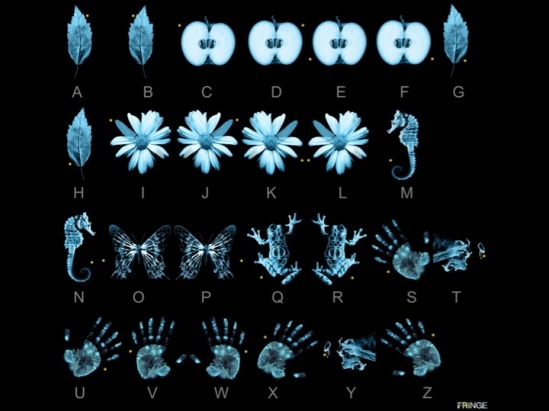
Other shows follow similar strategies to encourage fan speculations: each episode of Fringe, for example, features barely noticeable clues about the events of future episodes in the background of the mise-en-scène. Virtually every episode of this series features subtle links to future adventures of the protagonists, usually directly referring to events that will play out in the coming week: the logo of a plot-relevant bio-tech company emblazoned on a coffee cup and visible for little more than the blink of an eye, for example, or graffiti in the background of street scenes that allude to the plot of the following episode. Fringe, however, does not limit its dissemination of clues to its diegesis: every episode features several symbol-bearing title cards that appear before commercial breaks. These symbols, as enterprising viewers have since discovered, correspond to letters of the alphabet and, once deciphered, spell out a word that resonates with the theme of each week’s episode. Obviously, not all of the shows that subscribe to the logics of the conspiracy narrative rely on similarly baroque strategies to encourage audience speculation (although Christian Junklewitz has shown yesterday that his happens on Doctor Who as well) – in fact, more down-to-earth series like Homeland or Rubicon rather rely on more conventional means to further their mysteries and include relevant bits and pieces of information in snippets of dialogue or have their characters act out suspicious behavior. What these shows nonetheless share is the awareness that the evocation of a narrative enigma is a key element in the attempt to ‘activate’ audiences and foster their commitment to the series.

Perhaps the most baffling aspect of such committed audience practices is the amount of work and time that dedicated viewers invest to unearth and analyze the hidden clues presented by conspiratorial television series. As my examples from Fringe and Lost suggest, spotting the clues and hints hidden within these television texts requires a meticulous, almost obsessive attention to detail and the readiness to engage in time-consuming and laborious close readings of scenes and even individual frames. In his book on Convergence Culture, Henry Jenkins has famously argued that such online fan practices should be considered as examples of a ‘collective intelligence’ at work, i.e. as fundamentally democratic, communal problem-solving processes that might “be preparing the way for a more meaningful public culture” (Convergence Culture 228, cf. also 206-239). Participating in such collective processes of interpretation and communication – themselves made possible through the participatory character of social media – could ultimately, Jenkins argues, “create new kinds of political power” and also foster democratic decision-making processes offline. While Jenkins might have a point when it comes to the collaborative practices in online forums, I think such a view of the political significance of these phenomena is all too optimistic and essentially unfounded. As Steven Shaviro notes in his Post-Cinematic Affect, “aesthetics does not translate easily or obviously into politics“ (138) – and neither do specific ways of engaging with a text somehow directly translate into political engagement. While the thematic preoccupations of conspiratorial television series with issues of power and corruption might invite politicizing readings, the claim that political engagement emerges directly from online fan practices can hardly be backed by empirical evidence. The existence of time-consuming and work-intensive audience activities, I argue, rather points us to the character and social function of recreational leisure activities under the regime of contemporary capitalism in general. In an essay titled “Free Time”, Theodor W. Adorno argued that recreational activities, like the consumption of mass or pop-cultural texts, serve the important function of re-constituting the individual’s capacity to work and to take part in social life in general. “Free time,” he points out, is “shackled to its opposite”; recreational activities should therefore not be conceptualized as radically opposed to and separate from work but as an area of social life whose function is always defined in relation to the sphere of labor (187, cf. 187-190). Leisure activities like watching a movie or reading a novel promise a temporary escape from the toils and troubles of the daily routine, he argues, but at the same time, the character of these practices are determined and delimited by their potential to contribute to the reproduction of the individual’s labor-power (or “Arbeitskraft”). Viewed from this perspective, the time-consuming and cognitively challenging audience practices inspired by narratively complex television series take on a political significance that is quite different from the one attested by Jenkins. In this context, American Studies scholar Frank Kelleter has recently pointed to the overlap between the cognitive demands of contemporary popular culture and the professional skills required in the working environments of our present: By inviting active and sustained interpretive practices, Kelleter argues, contemporary television series

call up precisely those skills which characterize the neoliberal labor routines in the age of digitalization: network-thinking, situational feedback, dispersed processing of information, multitasking and, last but not least, the readiness to no longer differentiate between work and leisure. (Kelleter,“Serien als Stresstest” – my translation)

The interpretive practices of committed television viewers thus point us to the fact that engaging with contemporary popular culture has become more and more like work – a particular kind of work, to be exact, namely one that consists chiefly of the production, handling, and interpretation of information (and Jason Mittell’s claim that active viewers might now approach shows as ‘amateur narratologists’ also seems to point us to this). Maurizio Lazzarato has labeled this kind of work “immaterial labor” and argued that it has replaced manual and industrial labor as the predominant form of work in post-industrial societies. Increasingly geared toward producing the “informational and cultural content” of commodities rather than the material production of things, immaterial labor blurs the boundaries between labor and leisure and coincides with the emergence of increasingly automated, computerized, and networked working environments (Lazzarato 1996, 132, cf. 136-137). Active viewers who engage in the detailed analysis and online discussion of their favorite shows perform precisely such a labor, which productively contributes to the popularity and the accessibility of television texts – but they do so unpaid, without any financial compensation for their work.

Instead of too rashly celebrating such practices as fundamentally democratic or even politically subversive, as cultural studies scholars at times tend to do, I argue, we should consider their emergence as indicators of an increasing permeability of the borders between labor and leisure under the regime of contemporary capitalism.

Works Cited:

Adorno, Theodor W. “Free Time.” The Culture Industry. Selected Essays On Mass Culture. J.M. Bernstein, ed. London and New York: Routledge, 2001. 187-197.

Anders, Charlie Jane. “Lost Was the Ultimate Long Con.” io9.com. 23 May 2010. Web. 28 Oct. 2012. <http://io9.com/5545911/lost-was-the-ultimate-long-con>.

Barkun, Michael. A Culture of Conspiracy. Apocalyptic Visions in Contemporary America. Berkeley: Unviersity of California Press, 2003.

“Blast Door Map.” Lostpedia. The Lost Encyclopedia. Wikia. Web. 22 Feb. 2013. <http://lostpedia. wikia.com/wiki/Blast_door_map>.

Bordwell, David. Narration in the Fiction Film. Madison: University of Wisconsin Press, 1985.

Clerc, Susan J. “DDEB, GATB and Ratboy. The X-Files’s Media Fandom Online and Off.” Reading the X-Files. David Lavery, Angela Hague, and Marla Cartwright, eds. Syracruse: UP, 1996. 36-51.

Cole, Samuel Chase. Paradigms of Paranoia. The Culture of Conspiracy in Contemporary American Fiction. Tuscaloosa: University of Alabama Press, 2005.

Fenster, Mark. Conspiracy Theories. Secrecy and Power in American Culture. Revised and updated edition. Minneapolis: University of Minnesota Press, 2008.

Hagedorn, Roger. “Technology and Economic Exploitation: The Serial as a Form of Narrative Presentation.” Wide Angle 10:4 (1988): 4-12.

Jenkins, Henry. Convergence Culture. Where Old and New Media Collide. New York: UP, 2006.

—. “‘Do You Enjoy Making the Rest of Us Feel Stupid?’ alt.tv.twinpeaks, the Trickster Author, and Viewer Mastery.” Fans, Gamers, and Bloggers: Exploring Participatory Culture. New York: UP, 2006. 115-133.

Junklewitz, Christian. “Doctor Who: Entertain Behind the Sofa.” Paper presented at conference “It’s Not Television.” Institut für England- und Amerikastudien, Goethe University of Frankfurt. 22-23 February 2013.

Kelleter, Frank. “Serien als Stresstest.” Frankfurter Allgemeine Zeitung. 4 Feb. 2012. 31. Print.

Lazzarato, Maurizio. “Immaterial Labour.” Radical Thought in Italy. Eds. Paolo Virno and Michael Hardt. Minneapolis: University of Minnesota Press, 1996. 132-146.

Mittell, Jason. “Narrative Complexity in Contemporary American Television.” The Velvet Light Trap 58 (Fall 2006): 29-40.

Newitz, Annalee. “As Battlestar Ends, God Is in the Details.” io9.com. 21 Mar. 2009. Web. 28 Oct. 2012. <http://io9.com/5178522/as-battlestar-ends-god-is-in-the-details>.

“Next Episode Clue.” Fringepedia. The Extensive Encyclopedia of Fringe Knowledge. Web. 22 Feb. 2013. <http://fringepedia.net/wiki/Next_Episode_Clue>.

Sconce, Jeffrey. “What If?: Charting Television’s New Textual Boundaries.” Television after TV: Essays on a Medium in Transition. Eds. Lynn Spigel and Jan Olsson. Durham: Duke UP, 2004.

Shaviro, Steven. Post-Cinematic Affect. Winchester: Zero Books, 2010.