Jussi Parikka, “Cultural Techniques of Cognitive Capitalism”

software_interface_labor

Abstract for Jussi Parikka’s keynote talk at the symposium “Imagining Media Change” (June 13, 2013, Leibniz Universität Hannover):

Cultural Techniques of Cognitive Capitalism: On Change and Recurrence

Jussi Parikka

This talk has primarily two functions and aims. Firstly, it discusses the concept of cognitive capitalism from the perspective of its constituent cultural techniques. It proposes the ever so slightly unholy wedding together of post-fordist political theory with some currents in German media theory. This is done in order to discuss some of the mediatic aspects of the notion of cognitive capitalism (Yann Moulier Boutang). Secondly, the talk discusses media cultural change and the temporalities in which such notions like cognitive capitalism are distributed. By discussing software culture it argues for the various temporalities of change that are always at play in media cultural perspective.

Shane Denson, “On NOT Imagining Media Change”

ames_escalator_patent

Abstract for Shane Denson’s talk at the symposium “Imagining Media Change” (June 13, 2013, Leibniz Universität Hannover):

On NOT Imagining Media Change

Shane Denson

There are many ways in which we imagine media change and technological transformation; foremost among them, in the modern era, are popular and commercial visions of the future – from science-fiction narratives to advertisements for the latest gadget guaranteed to change your life. However, if we suppose that human agencies are inextricably tied to, and in part enabled by, the material infrastructure of a media-technological environment, then our imaginations – as they are focused, reflected, or courted in representational media – must be seen to lag behind infrastructural shifts, which would sweep our imagining subjectivities along with them. If, that is, our capacity to imagine media change is itself mediated through a changing media-technological environment, then certain aspects of media change must be categorically immune to imagination.

In this presentation, I will focus on this phenomenon of NOT imagining media change. I will outline a theoretical model according to which media change pertains not only to empirically determinate transformations in media-technical apparatuses and systems, but more broadly to the environmental substrate of discursive and phenomenological subjectivities. I will argue that a pre-reflective “anthropotechnical interface,” based in proprioceptive and visceral sensibilities, constitutes the primary site of media change. Accordingly, the embodied parameters of our imaginative faculties are themselves subject to radical transformation, such that both spectacular and unobtrusive changes in the media environment can occasion deep changes in our experiential frameworks – changes that elude representation and imagination.

Wanda Strauven, “Children as Media Archaeologists”

kids_playing

Abstract for Wanda Strauven’s keynote talk at the symposium “Imagining Media Change” (June 13, 2013, Leibniz Universität Hannover):

Pretend (&) Play: Children as Media Archaeologists

Wanda Strauven

In this talk, I will present a series of concrete situations where children make, very intuitively, connections between the past, the present and the future of media. In their play, children often “imagine” future media applications by actually applying them. Their imagination is therefore more than just a fantasy or mental fabrication; it is instead a practice or “form of activity” (Tätigkeit), to use Siegfried Zielinski’s definition of media archaeology. Especially in their act of “repurposing” media and other devices, children become true media archaeologists. In other words, I will offer some thoughts about the child’s play as a media-archaeological laboratory. For this purpose, I will also take into account some general theories about play, game, object lesson, optical toys and language.

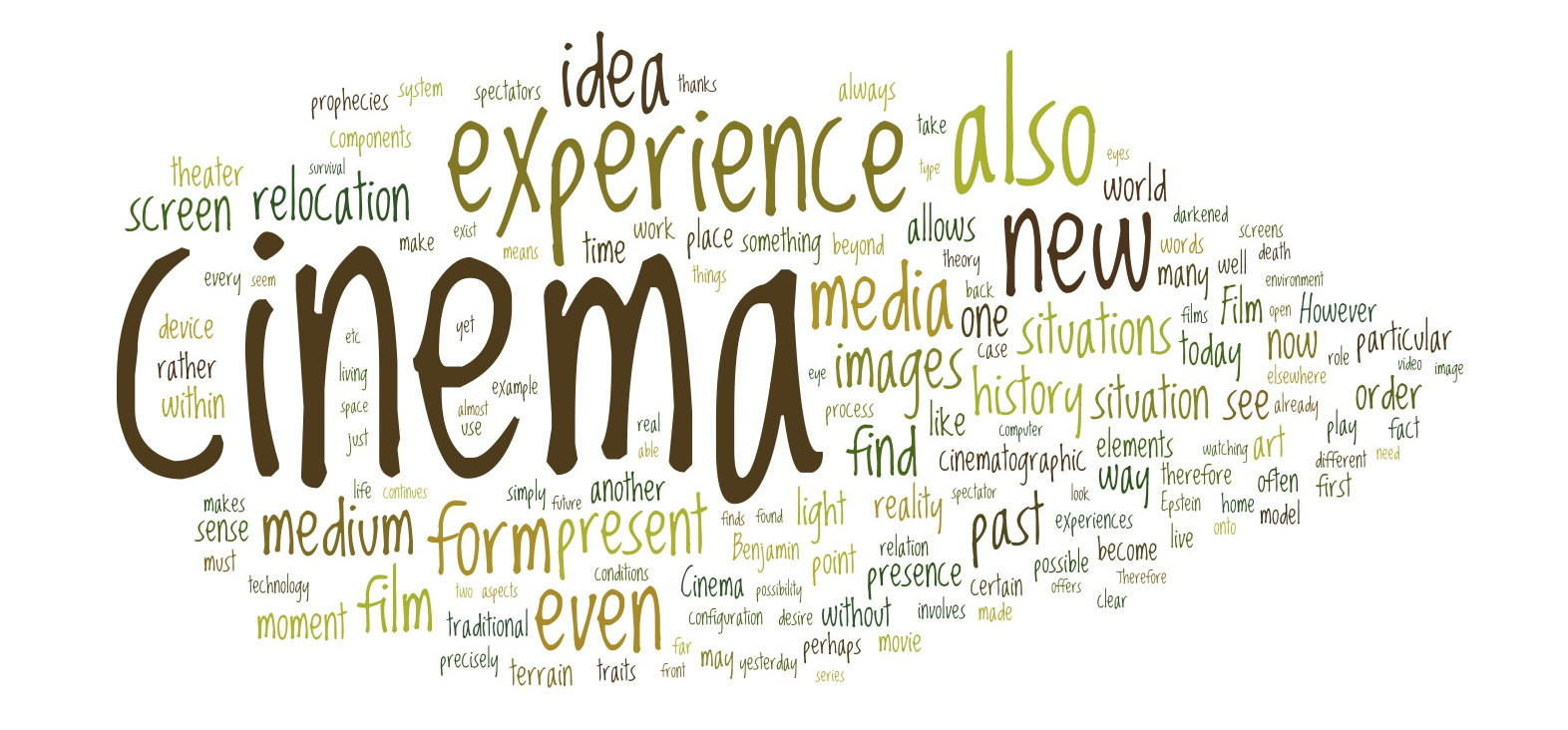
Imagining Cinematic Transformation

relocation_of_cinema_wordle

On Wednesday, May 8, 2013 (at 6:00 pm in room 608 in the Conti-Hochhaus), the Film & TV Reading Group will meet to discuss two texts relevant to the larger theme of “Imagining Cinematic Transformation” (part of a semester-long series of events detailed here). The texts are:

1) Francesco Casetti, “The Relocation of Cinema,” _NECSUS_ 2 (2012): online at http://www.necsus-ejms.org/the-relocation-of-cinema/

2) Thomas Elsaesser and Malte Hagener, “Conclusion: digital cinema — the body and the senses refigured?”, in: _Film Theory: An Introduction through the Senses_. New York and London: Routledge, 2010. 170-187.

We are always happy to welcome new participants to our informal discussion group! For more information, please contact Felix Brinker.

Symposium: Imagining Media Change

imagining_media_change

[UPDATE: See here for the complete symposium program and abstracts.]

Imagining Media Change

Symposium of the Initiative for Interdisciplinary Media Research and the American Studies department at the Leibniz University of Hannover, 13 June 2013 (Niedersachsensaal, Conti-Campus)

In the midst of the ongoing digitalization of our contemporary media environment, recent media and cultural studies have developed a renewed interest in the production and staging of technological innovation, in the occurrence and impact of media change, and in the ways these transformations inform the production, circulation, reception, and aesthetics of popular texts and media forms. The emergence of ‘new media’ in particular, it would seem, prompts us to rethink the role of mediating technologies within social and cultural spheres, and to explore how our everyday lives are transformed by a newly digitalized technical infrastructure. Such explorations are necessarily reflexive, however, as our attempts to imagine media change are themselves mediated by cultural texts and technologies in the grip of change. Dynamics of medial self-historicization guide our very thinking about media history: commercial logics, in particular, emphasize the superiority of the new, attest to the inevitability of the past’s obsolescence, and seek to captivate our imaginations with branded visions of the media-technological future. Seeking to look beyond these pressures, a reflexive engagement with recent media change is therefore called upon to reevaluate the impact of previous transitions and transformations throughout media history, and to excavate, if possible, discontinuities and ruptures in the development of modern media as they relate to broader social, cultural, and material processes of change. From a media-archaeological perspective, the history of media emerges not as a straightforward, linear process of technological innovation and implementation, but rather as a discontinuous series of media crises and negotiations of change. Understanding the uneven historical emergence and transformation of different types of media thus promises a renewed understanding not only of historical media, but also of contemporary media change and our present (in)ability to imagine its scope and impact. Crucial to this enterprise is an appreciation of reflexivity itself – a recognition of the fact that when media change, they also change our imaginations, including our imagination of media change. In the face of corporate and other interests that seek to capitalize on this logic and to steer our imaginations of the digital transition for their own benefit, what’s ultimately at stake in a media-archaeological excavation of our medial past and present is therefore nothing less than a political question: Will we be the subjects or merely the objects of “imagining media change”?

The symposium “Imagining Media Change” takes a broad view of media-historical and counter-historical developments and transformations since the nineteenth century, focusing in particular on the reflexive interactions between media undergoing change and media being used to imagine the parameters, effects, and significance of media-technological transformations. We are interested in historical and contemporary visions of change as they are articulated in or pertain to a wide range of media (including film, television, literature, and other visual, aural, textual, or computational media). The one-day symposium aims to bring together a variety of disciplinary perspectives and interests and to facilitate discussion of the material, political, aesthetic, and speculative dimensions of media change. Keynote lectures will be held by Jussi Parikka (University of Southampton, UK) and Wanda Strauven (University of Amsterdam, NL).

For more information about the symposium “Imagining Media Change,” please contact felix.brinker@engsem.uni-hannover.de or refer to the events page (http://medieninitiative.wordpress.com/events/).

Batman and the “Parergodic” Work of Seriality in Interactive Digital Environments

wayne-tech

On Saturday, December 15 (11:30 am, 6th floor of the Conti-Hochhaus, room TBA) — in the context of a research colloquium of the American studies department — I will be presenting some work in progress from my “Habilitation” project Figuring Serial Trajectories (more info about my project here; also, more info about the larger collaborative project with Ruth Mayer on serial figures here, and the website of the overarching research group on popular seriality here).

The topic of my talk will be Batman, computer games, and digital media environments. I will be expanding on, and trying to make somewhat more concrete, the idea of “parergodicity” which I presented at the recent FLOW conference (see here for my position paper).

Here is the abstract for my talk:

Batman and the “Parergodic” Work of Seriality in Interactive Digital Environments

Shane Denson

In the twentieth century, serial figures like Tarzan, Frankenstein’s monster, and Sherlock Holmes enacted a broadly “parergonal” logic; that is, in their plurimedial instantiations (in print, film, radio, TV, etc.), they continually crossed the boundaries marked by these specific media, slipped in and out of their frames, and showed them – in accordance with the logic of the parergon as described by Jacques Derrida – to be reversible. Through such oscillations, serial figures were able to transcend the particularity of any single iteration, and more importantly they were able to constitute themselves as higher-order frames or media, within which the transformations of first-order (i.e. apparatically concrete) media could be traced in the manner of an ongoing – though not altogether linear – series.

In the twenty-first century, many classic serial figures have declined in popularity, while the basic functions and medial logics of those that remain have been transformed in conjunction with the rise of interactive, networked, and convergent digital media environments. As I will argue in this presentation, the figure of Batman exemplifies this shift as the transition from a broadly “parergonal” to a specifically “parergodic” logic; the latter term builds upon Espen Aarseth’s notion of the “ergodic” situation of gameplay – where ergodics combines the Greek ergon (work) and hodos (path), thus positing nontrivial labor as the aesthetic mode of players’ engagement with games. Expanded beyond narrowly ludological frames of reference to include a wider variety of interactive and participatory potentials in contemporary culture, ergodic media give rise to new forms of seriality that accompany, probe, and trace the developmental trajectories of the new media environment. These new forms and functions of seriality, as embodied by a figure like Batman, raise questions about the blurring of relations between work and play, between paid labor and the incidental work or “immaterial labor” culled from our leisure activities and entertainment practices, in the age of the “control society” (Deleuze) or of “post-cinematic affect” (Shaviro). Following Batman’s transitions from comics to graphic novels, to the films of Tim Burton and Christopher Nolan, and on to the popular and critically acclaimed videogames Arkham Asylum and Arkham City, I will demonstrate that the dynamics of border-crossing which characterized earlier serial figures has now been re-functionalized in accordance with the ergodic work of navigating computational networks – in accordance, that is, with work and network forms that frame all aspects of contemporary life.

Film & TV Reading Group: Baudrillard, The Ecstasy of Communication

baudrillard

On December 5, 2013, the Film & TV Reading Group will meet (at 4 pm in room 613, Conti-Hochhaus) to discuss “The Ecstasy of Communication” by Jean Baudrillard (pp. 126 – 134 in The Anti-Aesthetic: Essays on Postmodern Culture, ed. Hal Foster). Julia Schmedes will moderate the discussion. As always, all are welcome to join us! (Feel free to contact me for more info — email address can be found on the “About” page.)

WALL-E vs. Chaos (Cinema)

Tonight was the last night of our film series, “Chaos Cinema?” Here are the notes for my presentation on WALL-E:

WALL-E vs. Chaos (Cinema)

Shane Denson, 19 July 2012

Not long ago, I argued for a reconceptualization of recent cinema in terms of the rise of what I called “discorrelated images”—images that announce a certain amount of autonomy from human perceptual consciousness and that therefore resist being yoked or, to speak in the terms of the speculative realists, “correlated” completely to the subject of classical phenomenology.

My argument, which took Michael Bay’s Transformers (2007) as its central case study, was directed against Matthias Stork’s intriguing but ultimately limited conception of “chaos cinema,” which tends to see the frenetic filmmaking of the type that Bay is known for as basically sloppy in its disregard for the rules of classical continuity editing. Following the lead of Steven Shaviro, with his conception of “post-continuity” as an aspect of a broader regime of “post-cinematic affect,” I argued that the breaks with continuity singled out by Stork as the hallmark of chaos cinema are in fact merely symptomatic of a much larger shift in our media culture—signs, in fact, of an uncertain transition that we are still undergoing and that concerns a major overhaul of the place of the human in the cosmos, of our affective interface with material reality, or of our sensorium as a historically conditioned aspect of our embodied contact with the environment.

Concretely, I argued that the “operational aesthetic” expressed or elicited in scenes of Transformers’ transformations demonstrate that there’s more at stake than a simple break with continuity; for these images need not involve any violation of the 180° rule, the 30° rule, or any other convention regulating the editing practices of classical Hollywood film. Clearly, the chase scenes highlighted by Stork do involve such violations, but it seems somewhat arbitrary to single out such phenomena as definitive of a style or even an entire era of cinema, while the transformation scenes are clearly the centerpiece visual spectacles of the Transformers films and must therefore be accorded a central position in the aesthetic appeal of these particular films (if not in the aesthetic appeal of post-millennial popular cinema as a whole).

Taken together, a very different image emerges: we find then not just continuity violations but a more general discorrelation of images from the spatial and temporal parameters of “normal” human subjectivity. The transformation scenes, with their incredibly detailed displays of minutely articulated and perfectly synchronized processes, embody a sort of information overload: they are too much for us to take in at once, too fast for our eyes or even our perceptual imaginations. This fact is of course related to the digital technologies that are responsible for their production; computational processing divorces images in their materiality from the hitherto reigning analogies between eye and camera. More centrally still, these images are severed from the historical correlation between the perceptual subject of vision and the medial apparatuses that cater to (and condition) that subjectivity. The result of discorrelation must indeed seem like “chaos,” because it signals a certain superfluousness of consciousness, a displacement of the constituted subject and of the properly human—a displacement that we feel today in the face of semi-autonomous finance markets and, crucially, the chaos of environmental change and catastrophe as well.

WALL-E, I want to suggest, displays an acute awareness of these displacements. Its very medium, digital animation, is implicated materially in the discorrelation of human perception, as it is in this medium that, following arguments made by Mark Hansen, the image ceases to be an object (of either a perceiving subject or of an apparatic analog medium) and instead becomes fully processual (both with respect to the microtemporal processes of its technical, i.e. computational, generation, and with respect to its microtemporal neural processing, which in bypassing conscious awareness must be regarded as a completely affective form of sensory reception). Digital animation is therefore the pinnacle of what, in an effort to further specify the conditions of contemporary cinema and to move beyond the simplifying label of “chaos” cinema, I would like to call “hyper-informatic cinema.”

This label is meant to highlight two related aspects of contemporary cinema, or of an important tendency in recent film: 1) Hyper-informatic cinema is based on a profusion of informatic (i.e. digital) technologies, both diegetic and non-diegetic—an overabundance of computers in the production of contemporary films (which rely heavily on CGI and digital compositing techniques), and of computational agencies in the films so produced (which feature robots, transformers, and cybernetically enhanced aliens, but also humans seeking to master or simply navigate the computational environments in which we already live today). 2) Such films are hyper-informatic in the sense I referenced above: they exploit scenarios of information overload, either as spectacle or as (at once narrative and affective) dilemma. In these scenarios, there is simply too much information, thrown at us far too fast for us to process it in full. The “intensification” of continuity that Bordwell speaks of can in large measure be traced back to this aspect of hyper-informatic speed, and the breakdowns that Stork labels “chaos” result from the mismatch between computational microtemporalities and the macrotemporality of the consciousnesses they challenge.

But rather than exacerbating the perceptual mismatch of digital discorrelation, WALL-E instead effects a reduction of informational content, without thereby denying its self-awareness of the fascinations of its informatic medium. There is a lack of talk, and a lack of speed, but there is no lack of visual spectacle and of inter-medial comparisons that highlight (and historicize) the film’s own digital substrate: thus, WALL-E is a fan of the film Hello, Dolly!, a relic of a bygone (human) era which he consumes through an assemblage of antiquated technologies, including cassette recorders, iPods, and magnifying glasses. WALL-E marks, indeed embodies, a discorrelation of the image from human perception, but the film need not flaunt it in the style of Michael Bay. Instead, WALL-E would seem to offer a measured response to it, one that places it in close connection to the “chaos” that characterizes not only our cinema at present but our estrangement from an environment marked by post-industrial carelessness, pollution, and e-waste. Reading the hopeful story of ecological recovery in medially self-reflexive terms, perhaps we could say that WALL-E’s quest to clean up the earth is less a battle to restore the human to a position of centrality, autonomy, and mastery over nature, as instead a far more limited, but also far less utopian, struggle to accept discorrelation and to effect a cinematic recalibration: an attunement of sensory capacities and images qua informatic processes.

Mediate. Discorrelate. Recalibrate.

Besides giving lectures and workshops, Mark Hansen has been taking his visit here as an opportunity to see a good deal of art. Last week I accompanied him to the documenta in Kassel, which is really excellent this time around. Lots of opportunities to aesthetically discorrelate and recalibrate — which happens to have been the subject of my “response” (partly synoptic, partly associative, and certainly highly inconclusive) to an article called “Ubiquitous Sensation” that we discussed at the workshop last Friday. Here are the notes I was working with:

Mediate. Discorrelate. Recalibrate. Or: How to Enjoy Impersonal Sensation. Or Yet Again: Having the Time of Your Life and Then Some.

A Response to Mark B. N. Hansen.

Shane Denson, Hannover, 6 July 2012

Mark Hansen’s “Ubiquitous Sensation or the Autonomy of the Peripheral” (forthcoming in Ulrik Ekman’s edited volume, Throughout: Art and Culture Emerging with Ubiquitous Computing) seeks to make sense of the sensory impacts occasioned by computational technologies operating on microtemporal scales – and thus outside the scales proper to subjective perception. Ubiquitous computing, or ubicomp, materially articulates this question, as it is by design “invisible” – which is to say, phenomenally and physically removed from the field of our perceptual attention. And yet, as Hansen shows by way of an exploratory engagement with several artworks, such technologies continue to exert an influence from a position that is radically and resolutely peripheral to perception. Against the claims of early ubicomp visionaries, who imagined this peripherality and invisibility as always ultimately serving the centered (perceptual) subjectivity of deliberate human action, Hansen maintains that because the microtemporal operations enacted by these technologies are categorically beyond or below the threshold of our perception, ubicomp must be seen as instantiating a level of material autonomy, the “autonomy of the peripheral,” that requires us to rethink media and their relation to human experience.

At stake, then, on one level, is a new conception of media, one that breaks with a long-standing tendency to correlate media with human sensory ratios, and to see media as vehicles for storing and reproducing human perceptual experience. Centrally, this tendency is related to Western thought’s privileging of the visual register, which itself can be seen as an exemplary means of constituting media as objects, locating them squarely in the purview of our subjective gazes, and thereby neutralizing any fundamental transformative potential that they might have if accorded autonomy from our perceptual control. It might be helpful here to recall Bruno Latour’s distinction between “intermediaries” and “mediators.” Intermediaries serve as channels that more or less transparently relay information or experiential content from point A to point B. Assuming that those points are people, or subjects, media as intermediaries offer perceptual objects that, because their contents are isomorphic with the contents of natural perception, can circulate in such a way as to expand the power (and life-span or historical longevity) of visual or other perceptual experience without thereby challenging or undermining the foundational stability and centrality of the subject. Mediators, on the other hand, are radically transformative; unlike intermediaries, they are not objects that pass neutrally between subjects but are instead what Latour calls hybrid “quasi-objects,” which articulate the very distinctions and relations obtaining between subjects and objects. By asserting the autonomy of the peripheral, by disconnecting ubicomp and related technologies from the narrow bandwidth of subjectively defined instrumentality, and more generally by discorrelating media from human perception, Hansen similarly breaks with the view of media as intermediaries, and – by positioning media as environmental factors – he shows them to be like Latour’s mediators in their ability to impact us materially, impersonally, and prior to the articulation of subjectivity.

This only works, though, if the discorrelation of media from perception does not imply their complete removal from the domain of sensation. In other words, sensation itself must be seen as occurring outside of perceptual subjectivity, and this impersonal sensation will be the site of our primary, pre-personal interaction with technics. Through discorrelation, in other words, the impact of media is not at all diminished; on the contrary, its directness in fact becomes apparent for the first time. Moreover, perceptually discorrelated media do not remain disconnected but operate precisely by effecting various means and forms of recalibration. Thus, the central experiential impact of invisible computing is constituted by its capacity to recalibrate our microsensory (and thus sub-personal, unconscious) capacities with an environment transformed by the introduction of technologies operating on microtemporal scales – and indeed embodying, operationally, microsensations of their own. In comparison to Hansen’s insistence, in earlier writings, on the relative privilege of the human, here we see a flattening of the difference between humans and computational technics: not, certainly, the crude sort of flattening that posits our brains are “like” computers or, even more extremely, that proposes uploading consciousness into computer networks and leaving our bodies behind. Instead, the analogy between the microtemporal processing of the brain and the microtemporal processing of digital technologies is based, somewhat paradoxically, on a radical naturalization of sensation, one which corresponds to a recognition of our material existence and evolution as embodied organisms in the world, prior to our development of subjectivity. Quite simply put, this priority of the physical – which is both a logical and a temporal priority – requires a radical revision of subject-centered phenomenological accounts of time-constitution. If we are to take seriously the idea of a natural continuum that links the human with nonhuman animals and inanimate materiality as a fact of our embodiment, we must assume that time is in the world before it is in us. Temporal experience therefore arises from a domain of impersonal sensation, and it is here that brains and processors interface directly, materially, and microtemporally, to generate new forms of macroconscious experience, reflecting a new correlation of media and sensation.

It is only on the basis of seeing ourselves as part of the broader – independently temporal and impersonally sensory – world that we are able to appreciate the radical impact of technics outside our subjective experience. More difficult, though, than the theoretical grounding of such an appreciation is the question of how such impersonal sensation can be opened to experience in practice; or, as Hansen puts it more precisely, “how embodied human mind-bodies can enjoy such impersonal sensation” (81). I highlight this formulation because I want to pursue briefly the double meaning of our enjoyment of the impersonal and the microtemporal – not just how we partake of it and participate in it, but how we enjoy it in the sense of our contemporary entertainment industries, which are all highly dependent on the microtemporal processes of digital technologies. Contemporary cinema utilizes CGI both invisibly and spectacularly, and at times it seems to produce “discorrelated images” – images that insist on their excess with respect to viewers’ capacities to capture and process them perceptually. Perhaps more radically, the processual temporality of video games completely resists assimilation to Stiegler’s model of the industrial temporal object, as the medium’s defining interactivity works to ensure a future-oriented openness that is the very antithesis of media as tertiary memory. Moreover, as Andreas Jahn-Sudmann and I have begun to explore, practical and formal experimentation with temporal processes in video games – ranging from user-initiated speedruns to computationally anchored phenomena like the ability to switch to a “bullet time” perspective – might offer a form of aesthetic mediation of impersonal, microtemporal sensation not unlike the artworks that Hansen mentions in his paper. As a popular negotiation of digital microtemporality, it would seem that this is how we “enjoy” impersonal sensation today.

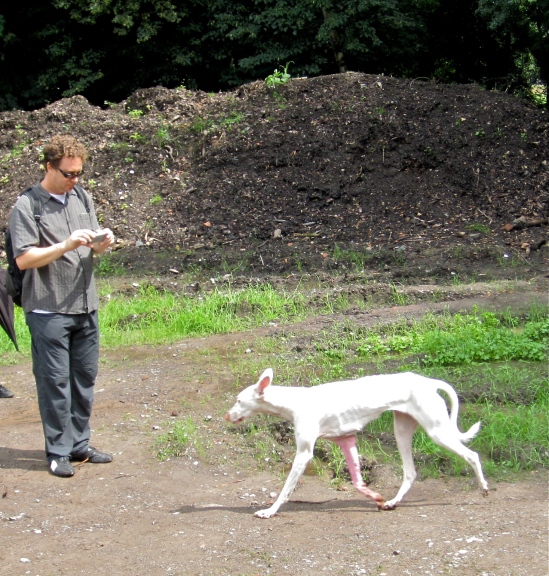
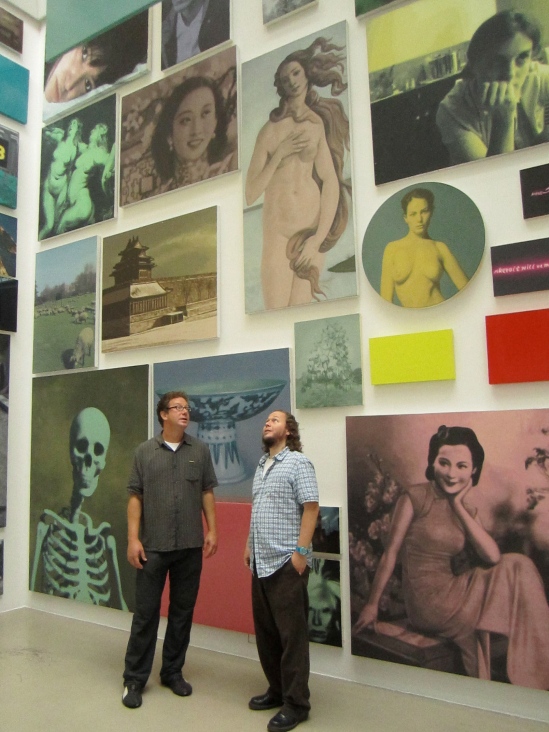
And finally, here are some more (discorrelated/discorrelating) pictures from the documenta, featuring bees as sculpture and painted dogs. Enjoy!

Mark Hansen in Hannover

Here are a few images from Mark Hansen’s talks on July 2 and 3.

The first two were taken Monday, at a very inspiring talk called “Feed-Forward, or the ‘Future’ of 21st Century Media.”

Above, a picture taken Tuesday, at the talk given in the context of my media theory seminar: “The End of Pharmacology?: Historicizing 21st Century Media.”

And a picture taken over the weekend, during an exciting game of “Vikinger-Schach”!

Finally, here is the text of my introduction to the Monday night talk:

First of all, I’d like to say that I am very honored, and I am very happy, to introduce Mark Hansen to you today. Mark is Professor in the Literature Program at Duke University, where he is also affiliated with a range of departments, programs, and interdisciplinary centers, including the department of Art, Art History, and Visual Studies, the Program in the Arts of the Moving Image, the Visual Studies Initiative, and the Program in Information Science + Information Studies. Before going to Duke in 2008, Mark served as Professor of English, Visual Arts, and Cinema and Media Studies at the University of Chicago, prior to which he held positions in the English Department at Princeton. Over the past decade or so, he has established himself as one of the leading media theorists in America and the world, a reputation built on a steady stream of equally demanding and rewarding publications, including three monographs to date. His book Embodying Technesis: Technology Beyond Writing, which was published in 2000, set the stage for much of his subsequent work by arguing for a robustly material conception of technologies and their relations to and impacts on experiencing bodies. Identifying the ways that many of the master thinkers of twentieth century high theory, including Freud, Heidegger, Derrida, Deleuze and Guattari, had struggled with but ultimately perpetuated a reduction of the technical to the narrow frames of discourse and subjective thought, thus obscuring technology’s more diffuse impacts and its role as infrastructure for thought and experience, the book cleared the ground for a more positive engagement with changes in this infrastructure, especially as occasioned by the advent of computational media. Thus, New Philosophy for New Media, published in 2004, undertook a careful analysis of the digital image, which was shown with the help of resources updated from Henri Bergson to be far less fixed and visually concentrated than one might assume; instead, digital images turned out to be highly processual and dispersed across a network of materially embodied agents — processors, flickering pixels, and above all human bodies that filter and select the relevant forms, providing the very frame for computationally generated images. Mark’s next book, Bodies in Code: Interfaces with New Media, from 2006, continued this focus on our affective engagement with the world, and on the modulation of that engagement through media that articulate an ongoing coevolution of humans and technics. Mark has also co-edited several important volumes, including The Cambridge Companion to Merleau-Ponty (co-edited with Taylor Carman), Emergence and Embodiment: New Essays on Second-Order Systems Theory (with Bruce Clarke), and Critical Terms for Media Studies (with William J. T. Mitchell). He is currently wrapping up a book project entitled Feed-Forward: The “Future” of 21st Century Media, and this, I presume, is the basis of what he’ll be talking about today.

So, conventionally, this is where I would say “and now, without further ado,” but in fact I do want to subject you to just a little bit more “ado.” If the list of professorships, books, and ideas that I’ve been recounting here can be said to constitute an official “text” of Mark Hansen’s career as a world-class media theorist, there’s also a little-known subtext, or perhaps paratext, through which he has been connected with Hannover and exerted here a subtle but definite influence over the years. Most recently, I have had my students reading his thoughts on “New Media” this semester, while our Film & TV Reading Group also met to discuss an important article called, simply, “Media Theory.” These are texts that have been very important to me personally, and they played a key role in challenging me to articulate some of the foundational ideas in my dissertation. As some of you may know, Mark served as the second examiner for that project, and some of the people here today were also present at my thesis defense in December 2010, when Mark joined us, quite fittingly, as a digital image, by way of video-conferencing technology. But the intellectual and personal connections with Hannover run deeper and are older than that. What many people don’t know is that this is Mark’s second — real-life, corporeal — visit to the English Department at the University of Hannover. The first one was exactly 15 years ago, in the summer of 1997. Few people know this, because it was before most of the current faculty, staff, and students had ever set foot in this building. Well, not to brag or anything, but: I was there. In fact, it was my very first trip to Germany, an exchange trip headed by Mark, who in those almost prehistoric days — prior to Duke, Chicago, and Princeton — was employed at a place called Southwest Texas State University (which, incidentally, is a name that has since lost its power of designation, as that university is now called something else). Anyway, it was there, and here (back then), that Mark planted many of the seeds that would come to fruition much later in my own work, and that have quietly informed my teaching practice here for over a decade. I am grateful, then, to the Fulbright Program and to our university’s Gastwissenschaftler-Programm for making it possible to bring Mark back once again after all these years. Above all, though, and this is what I’ve been trying to get at with this excavation of a “Hannover connection,” I wish to express my gratitude to Mark both as a mentor and as a friend. Thank you. And now, I am very proud to present to you Mark Hansen.