Matthew Wilson Smith: The Nostalgia of VR

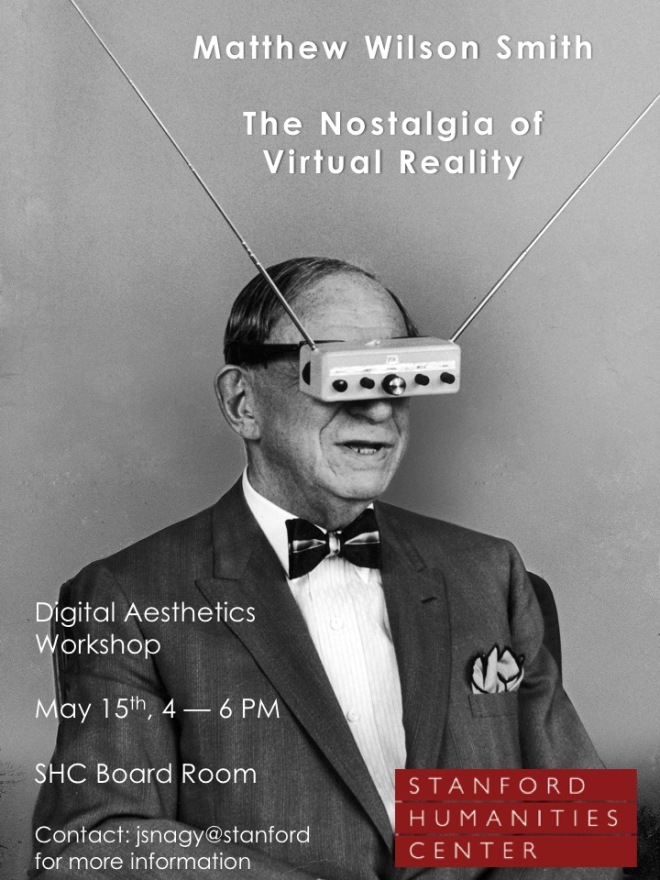
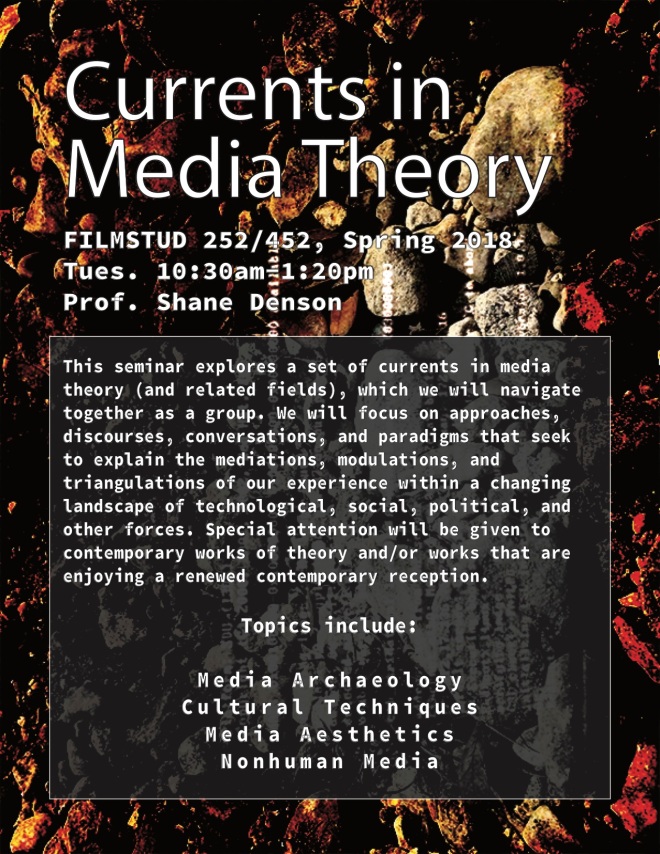
Smith poster DAW 2018

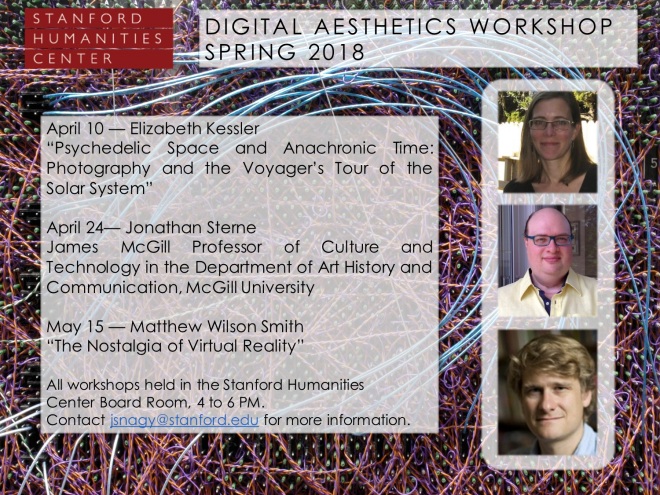
On Tuesday, May 15th, we’ll have our fourth and final Digital Aesthetics Workshop of the Spring quarter, “The Nostalgia of Virtual Reality” with Matthew Wilson Smith, at 4 PM in the Stanford Humanities Center Board Room. In this workshop, we will discuss the degree to which emergent technologies of virtual reality are indebted to longstanding concepts of presence and disembodied consciousness.

Matthew Wilson Smith is an Associate Professor of German Studies and Theatre and Performance Studies at Stanford University. His  interests include modern theatre; modernism and media; and relations between technology, science, and the arts. His book The Nervous Stage: 19th-century Neuroscience and the Birth of Modern Theatre explores historical intersections between the performing arts and the neurological sciences and traces the construction of a “neural subject” over the course of the nineteenth century. It was published by Oxford University Press in 2017. His previous book, The Total Work of Art: From Bayreuth to Cyberspace (Routledge, 2007), presents a history and theory of modern artistic synthesis, placing such diverse figures as Wagner, Moholy-Nagy, Brecht, Riefenstahl, Disney, Warhol, and contemporary cyber-artists within a genealogy of totalizing performance.

Syllabus: Let’s Make a Monster! Critical Making (Stanford, Spring 2018)


Somehow I forgot to post the syllabus for “Let’s Make A Monster! Critical Making,” which Paul DeMarinis and I are currently teaching as a hybrid Film & Media Studies and Art Practice class in the Department of Art & Art History at Stanford. The main focus of the course, as the title indicates, is the production of monsters in a variety of media and informed by reading literary, philosophical, and other critical texts on making and monstrosity. Students have been making some truly astounding work, and I look forward to being able to present some of it later in the quarter. We will be organizing an exhibition of works on campus, and I will post images here.

Jonathan Sterne: Machine Learning, ‘AI,’ and the Politics of Media Aesthetics

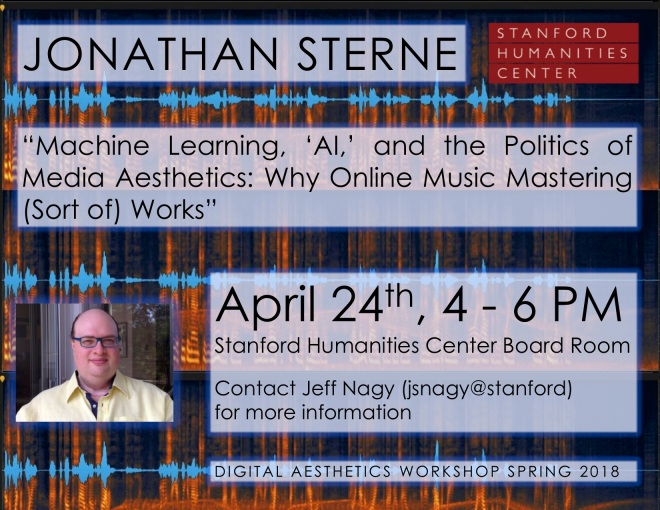
Sterne poster DAW

On April 24, 2018 (4-6pm in the Stanford Humanities Center Board Room), Jonathan Sterne will be speaking at the Digital Aesthetics Workshop. The title of his talk is: “Machine Learning, ‘AI,’ and the Politics of Media Aesthetics: Why Online Music Mastering (Sort of) Works.”

Jonathan Sterne is Professor and James McGill Chair in Culture and Technology in the Department of Art History & Communication Studies at McGill University. His work is concerned with the cultural dimensions of communication technologies, especially their form and role in large-scale societies. One of his major ongoing projects has involved developing the history and theory of sound in the modern west. Beyond the work on sound and music, he has published over fifty articles and book chapters that cover a wide range of topics in media history, new media, cultural theory and disability studies. He has also written on the politics of academic labor and maintains an interest in the future of the university. His new projects consider instruments and instrumentalities; histories of signal processing; and the intersections of disability, technology and perception.

Frankenstein@200: International Health Humanities Consortium Conference

Screen Shot 2018-04-06 at 11.40.10 AM

The 2018 International Health Humanities Consortium Conference will be held at Stanford University from April 20-22, 2018. The keynote speakers are:

Alexander Nemerov
Professor, Art and Art History at Stanford University

Lester Friedman
Professor, Media and Society at Hobart and William Smith Colleges

Alvan Ikoku
Assistant Professor, Comparative Literature and Medicine at Stanford University

Catherine Belling
Associate Professor, Feinberg School of Medicine at Northwestern University

In addition, there will be a number of great events around campus. You can find more information here.

I will be participating in the conference in two ways:

First, on Friday, April 20 (2:30-3:30pm in McMurtry 115) I will be presenting a screening session of videographic works related to “Frankenstein & Film.” I will be showing a few of my own pieces (which you can see here and here), as well as works by video essayists like Allison de Fren, alongside commercial “making of” videos, art film reimaginations, and other moving-image forms that treat the history of Frankenstein films from Thomas Edison’s 1910 production up to the present day.

Screen Shot 2018-04-06 at 12.09.56 PM

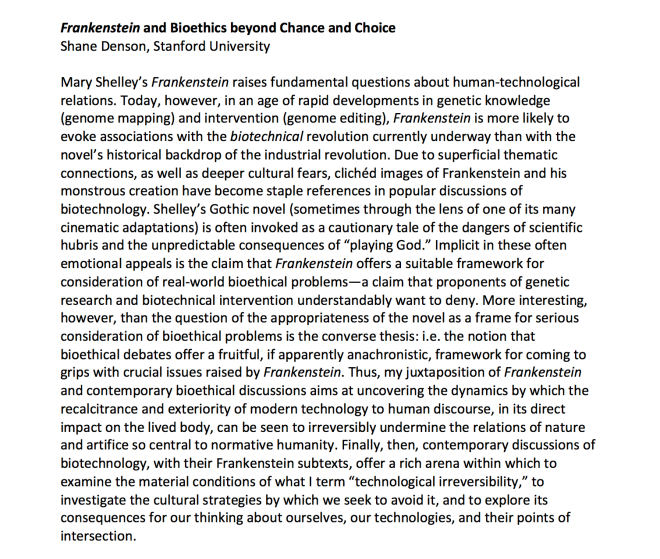
Second, on Sunday, April 22 (11:15am), I will be presenting a paper titled “Frankenstein and Bioethics Beyond Chance and Choice.” The paper draws upon and rethinks ideas that I put forward in one of my very first publications: “Frankenstein, Bioethics, and Technological Irreversibility.” That paper, published in 2007, can be found here.

Psychedelic Space and Anachronic Time: Elizabeth Kessler at Digital Aesthetics Workshop

DAW Kessler poster

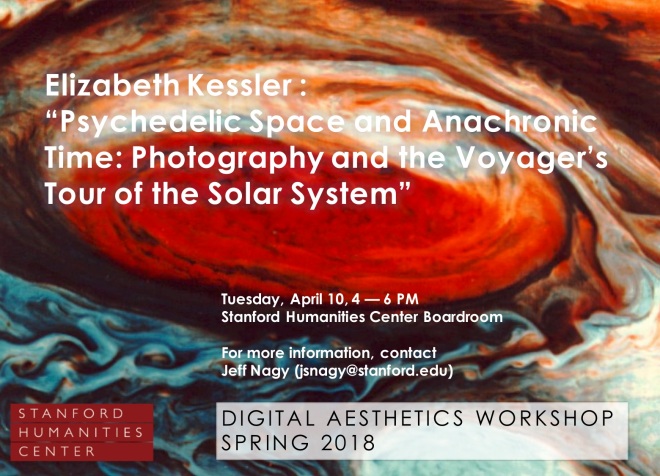
On Tuesday, April 10 (4-6pm in the Board Room of the Stanford Humanities Center), Elizabeth Kessler (Stanford, American Studies) will deliver a talk, titled “Psychedelic Space and Anachronic Time: Photography and the Voyager’s Tour of the Solar System,” in the context of the Digital Aesthetics Workshop.

Elizabeth Kessler’s research and teaching focus on 20th and 21st century American visual culture. Her diverse interests include: the role of aesthetics, visual culture, and media in modern and contemporary science, especially astronomy; the interchange between technology and ways of seeing and representing; the history of photography; and the representation of fashion in different media. Her first book, Picturing the Cosmos: Hubble Space Telescope Images and the Astronomical Sublime, on the aesthetics of deep space images, was published in 2012. She’s currently writing on book on extraterrestrial time capsules, as well as developing a new project on fashion photography.

See here for more information.

Discorrelated Images — Digital Aesthetics Workshop, April 3

DAW-poster copy

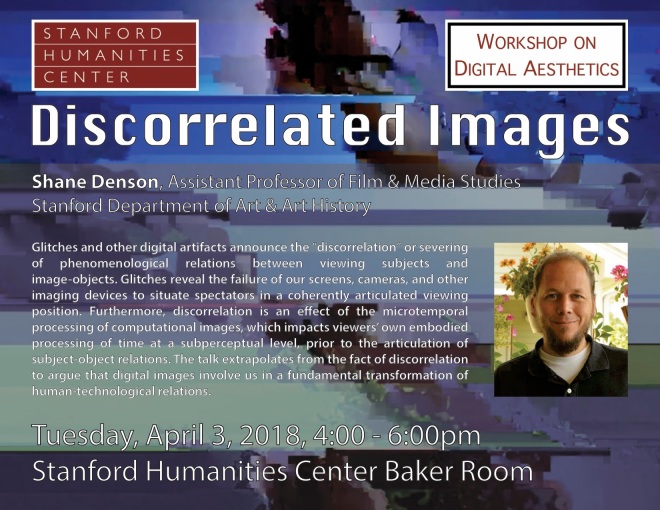
On Tuesday, April 3, 2018 (4:00-6:00pm), I will be giving a talk titled “Discorrelated Images” in the context of the Digital Aesthetics Workshop at the Stanford Humanities Center. The talk draws on my current book project of the same title and will address primarily temporal and affective relations and transformations occasioned by digital images.

Participants are encouraged (but not required) to read my chapter “Crazy Cameras, Discorrelated Images, and the Post-Perceptual Mediation of Post-Cinematic Affect” prior to the event.

Stanford Film & Media Studies 2018 Symposium: “Pieces”

Pieces-FMS-Symposium-sm

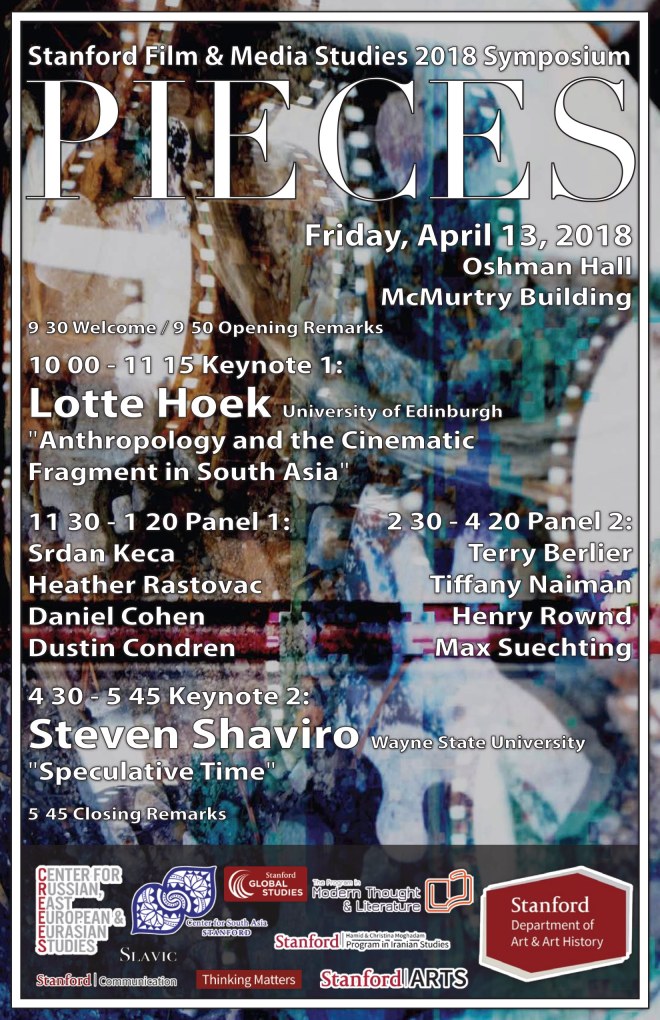
The inaugural Stanford Film and Media Studies Symposium takes place on Friday April 13, 2018 in Oshman Hall. The theme of the conference is “Pieces” and talks will address questions concerning how bits of film and media make us rethink the relation of part to whole and what methods artists use to make discrete pieces—temporal, spatial, material, performative—that may or may not fit into larger collaborative works.

The keynote speakers are Lotte Hoek (University of Edinburgh) on “Anthropology and the Cinematic Fragment in South Asia” and Steven Shaviro (Wayne State University) on “Speculative Time.” In addition, there will be two panels. The first will feature an artist’s talk by Srdan Keca (Documentary Film and Video); Daniel Cohen (Art & Art History) on “Chinese Comedy and the Postsocialist Art of Deflation”; Heather Rastovac Akbarzadeh (Dance Studies) on “Sensorial Performativity of the ‘Veil’ in Aisan Hoss’s Dance-Theater The Pleasant Pain”; and Dustin Condren (Slavic) on Sergei Eisenstein’s film scenario MMM. Terry Berlier (Art Practice) will deliver an artist’s talk on the second panel, followed by Tiffany Naiman (Thinking Matters) on “Memory, Meaning, and Fragmentation in David Bowie’s ‘Blackstar’; Henry Rownd (Art & Art History) on the marked disjuncture between widescreen and pan-and-scan in Otto Preminger’s late work Skidoo (1968); and Max Suechting (Modern Thought and Literature) on “Fragments and Wholes in J Dilla’s Donuts.”

9:30am – Welcome
9:50am – Opening Remarks
10:00am – Keynote Speaker
11:30am – Panel 1
2:30pm – Panel 2
4:30pm – Keynote Speaker
5:45 pm – Closing Remarks

Department of Art & Art History, Film & Media Studies, thanks their sponsors: Center for South Asia, Office of the Vice President for the Arts, CREEES Center for Russian, East European & Eurasian Studies, Stanford Global Studies Division, Department of Slavic Languages and Literatures, Iranian Studies, The Program in Modern Thought & Literature, Department of Communication, Thinking Matters.

See also the official announcement here: https://art.stanford.edu/events/stanford-film-and-media-studies-symposium-pieces

Let’s Make a Monster! Critical Making (Stanford, Spring 2018)

LetsMakeAMonster

Ever since Frankenstein unleashed his monster onto the world in Mary Shelley’s novel from 1818, the notion of “technology-out-of-control” has been a constant worry of modern societies, plaguing more optimistic visions of progress and innovation with fears that modern machines harbor potentials that, once set in motion, can no longer be tamed by their human makers. In this characteristically modern myth, the act of making — and especially technological making — gives rise to monsters. As a cautionary tale, we are therefore entreated to look before we leap, to go slow and think critically about the possible consequences of invention before we attempt to make something radically new. However, this means of approaching the issue of human-technological relations implies a fundamental opposition between thinking and making, suggesting a split between cognition as the specifically human capacity for reflection versus a causal determinism-without-reflection that characterizes the machinic or the technical. Nevertheless, recent media theory questions this dichotomy by asserting that technologies are inseparable from humans’ abilities to think and to act in the world, while artistic practices undo the thinking/making split more directly and materially, by taking materials — including technologies — as the very medium of their critical engagement with the world. Drawing on impulses from both media theory and art practice, “critical making” names a counterpart to “critical thinking” — one that utilizes technologies to think about humans’ constitutive entanglements with technology, while recognizing that insight often comes from errors, glitches, malfunctions, or even monsters. Co-taught by a practicing artist and a media theorist, this course will engage students in hands-on critical practices involving both theories and technologies. Let’s make a monster!

ARTSTUDI 233, FILMSTUD 233/433 — Spring 2018 — Profs. Paul DeMarinis & Shane Denson — Thursdays 3:00-5:50pm