#SCMS15 — Post-Cinema, Digital Seriality, and a Book Giveaway!

2015-03-10 06.03.52 pm

Only two weeks until the 2015 Society for Cinema and Media Studies annual conference (March 25-29 in Montreal)! In case you haven’t seen it already, the official program is now up here (warning: opens as a PDF).

As I have posted before, I will be participating in two panels this year:

First, I will be serving as chair on the “Post-Cinema and/as Speculative Media Theory” panel (Session K7: Friday, March 27, 9:00 – 10:45am), for which I feel extremely lucky to have secured an all-star lineup of panelists: Steven Shaviro, Patricia Pisters, Adrian Ivakhiv, and Mark B. N. Hansen (click on each name to read the panelists’ abstracts). I also feel very honored that the Media and the Environment Special Interest Group has chosen this panel for official sponsorship!

Second, I will be co-presenting a paper on “Hardware Seriality” with my colleague Andreas Jahn-Sudmann in the “Digital Seriality” panel (Session Q20: Saturday, March 28, 3:00 – 4:45pm). Other panelists include Scott Higgins and Dominik Maeder (click for their abstracts). (Unfortunately, Daniela Wentz will not be able to attend the conference.)

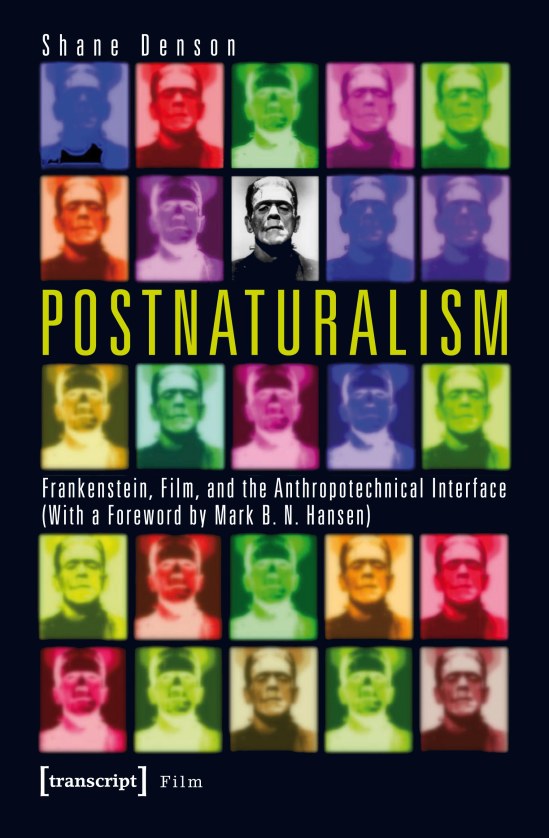
Finally, just for fun: A BOOK GIVEAWAY! The first person to ask me (in person, during the conference) about my book Postnaturalism: Frankenstein, Film, and the Anthropotechnical Interface (excerpt here) will get a free copy! So be on the lookout!

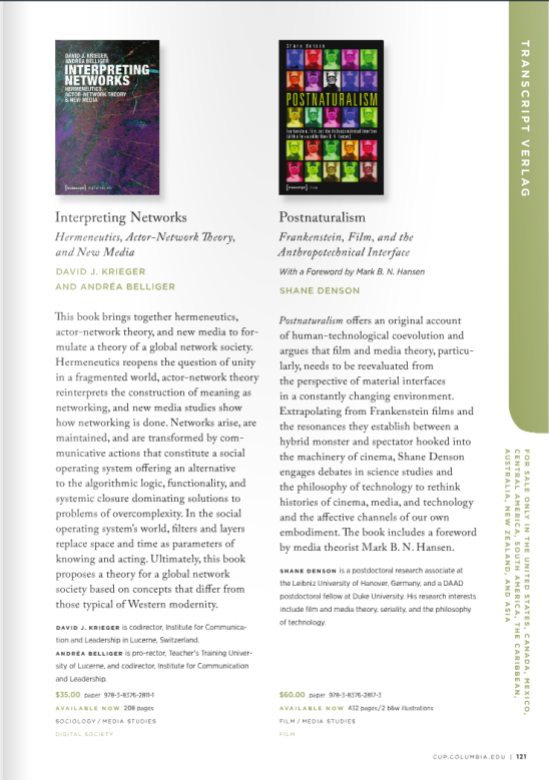
Postnaturalism in CUP Spring 2015 Catalog

2015-01-08 07.52.21 am

Some time ago, I posted that my book Postnaturalism: Frankenstein, Film, and the Anthropotechnical Interface had officially been made available by Columbia University Press, which serves as distributor in North and South America and Australasia. Shortly thereafter, massive restructuring of the CUP website led to the book’s temporary disappearance, but it is now back up here, and it has just appeared in CUP’s Spring 2015 Catalog (pictured above) as well.

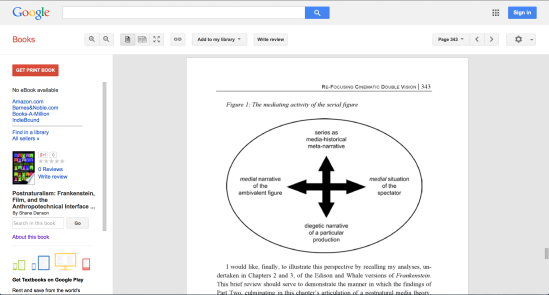
If you’d like to preview the book, the best places to look are either at the Transcript-Verlag website (here; click “Excerpt” or “PDF” below the cover image) or the Google Books preview for the book (here).

Finally, it’s worth noting that you can get the book much cheaper than its official $60 price tag if you look for it on amazon or other outlets.

SCMS 2015 Preliminary Schedule Online — #SCMS15

montreat2015

The preliminary schedule for the Society of Cinema and Media Studies 2015 conference in Montreal is now online (here). As I posted recently, I will be involved in two separate panels:

First, I will be chairing the panel on “Post-Cinema and/as Speculative Media Theory” (panel K7, Friday, March 27, 2015, 9:00-10:45am) — with presenters Steven Shaviro, Patricia Pisters, Adrian Ivakhiv, and Mark B. N. Hansen. You can find the complete panel description, as well as individual abstracts, here. Note also that all participants on this panel are contributors to the forthcoming Post-Cinema: Theorizing 21st-Century Film, which I am co-editing with Julia Leyda.

Second, I will be participating in a panel on “Digital Seriality” (panel Q20, Saturday, March 28, 2015, 3:00-4:45pm) — along with Andreas Jahn-Sudmann, Scott Higgins, Dominik Maeder, and Daniela Wentz. Panel description and abstracts can be found here. And, as with the other panel, this one too has a tie-in with a publication: all the participants on this panel were contributors to the special issue of Eludamos: Journal for Computer Game Culture that Andreas Jahn-Sudmann and I edited on the topic of “Digital Seriality.”

Now Out in Paperback: Transnational Perspectives on Graphic Narratives

transnational_perspectives_on_graphic_narratives

Transnational Perspectives on Graphic Narratives: Comics at the Crossroads (Bloomsbury, 2013), which I co-edited with Christina Meyer and Daniel Stein, is now out in a paperback edition: see here for details. It is available now through all the major outlets (e.g. amazon, Barnes & Noble, etc.), and there is a Google Books preview as well. Check it out!

Postnaturalism now available through Columbia University Press and on Google Books


2014-11-06 10.09.26 am

My book Postnaturalism has been out since July, but there was a slight delay with US distribution. Now, however, the book is officially available for order through Columbia University Press.

This is probably more important for university libraries, who might want to order directly from CUP (if your library doesn’t have a copy yet and you’re in any position to do so, please do consider requesting they order one). For everyone else, you can currently get a copy much cheaper through marketplace sellers on amazon.com (right now, around $38 for a new copy, rather than the $60 list price at CUP).

Finally, a preview of the book has gone up at Google Books. Check it out here.

2014-11-06 10.00.27 am

Short review of Postnaturalism

postnaturalism-review-hammer

A short review of my book Postnaturalism: Frankenstein, Film, and the Anthropotechnical Interface has just appeared in fiph journal 24 (October 2014) — the journal of the Forschungsinstitut für Philosophie Hannover (the Research Institute for Philosophy Hannover, or “fiph” for short). The review, in German, was written by Dominik Hammer of the fiph, and it includes a brief summary and a nice endorsement of the book, part of which I translate here for those who don’t read German:

Postnaturalism is not only the product of a technicization that denatures embodiment (p. 230); rather, it designates the position that the human, but also nature itself, was never natural (p. 24). Nevertheless, the theory remains beholden to the naturalism from which it takes off and sets itself apart [sich abhebt]. Setting out from this “postnaturalism,” the media theorist investigates the connection between Frankenstein films and the development of the “anthropotechnical interface.”

Denson’s book […] is no light fare. For Postnaturalism you have to take your time, but it’s definitely worth it. The work is especially to be recommended for those interested in the philosophy of technology, media theory, and anyone who wants to engage with a postnaturalistic metaphysics.

Diagramming Media as the Environment for Life

WeHaveNeverBeenHuman

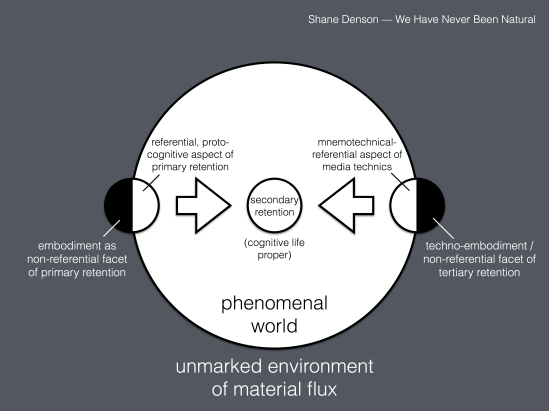
Both aesthetically and conceptually, the diagram above is imperfect in many ways. It is, necessarily, an oversimplification; I hope that it might nevertheless serve a positive purpose by giving visible form to an otherwise somewhat abstract argument. Developed for my talk at the upcoming “Philosophy After Nature” conference in Utrecht (you can find my abstract here), the diagram could also serve as an emblem for the argument I make in Chapter 6 of Postnaturalism. In that chapter, I look at (among other things) Mark Hansen’s concept of “the medium as an environment for life” (as introduced in his paper “Media Theory,” which appeared in Theory, Culture & Society); this concept, developed in conversation with Bernard Stiegler’s philosophy of technics, has been very important for my work, and grappling with it was central for me in the process of arguing that “we have never been natural.”

In the course of developing his concept, Hansen argues that there is an asymmetrical priority of human embodiment in the transductive relation between technics and the human. In Hansen’s engagement with Stiegler, this prerogative of embodiment is seen to be at odds, to a certain extent, with Stiegler’s argument about the synchronization or industrialization of experience through the action of recording technologies. The latter embody “tertiary retentions” of experience, beyond the primary and secondary retentions that Husserl theorized as the operations, respectively, of immediate temporal experience and of recollection or memory. According to Stiegler, in a complex argument that I will not try to summarize here, tertiary retention (technical recording) injects secondary retention (memory) into primary retention (the immediate experience of the “adherent present,” from which flows also the future) — effectively instituting a pre-formatted future on a mass scale (especially in the age of live television and real-time media).

Following an objection raised by Jean-Michel Salanskis, who sees a paradox or split in Husserl’s notion of primary retention — a split between the referential aspect that aligns primary retention with conscious experience, on the one hand, and a non-referential aspect that is wholly unconscious, on the other — Hansen argues that Stiegler’s argument diminishes the robust role of embodiment in the production of temporal experience. The synchronization envisioned by Stiegler is dependent, according to Hansen, on a bracketing of embodied agency; the “mnemotechnical constitution of time” prioritized by Stiegler is thus secondary to the “corporo-technical constitution of time” that Hansen identifies as an infra-empirical condition of experience. Hence the asymmetrical privileging of human embodiment in the medial transduction of human and technical agencies.

The diagram above summarizes my own intervention in the context of these debates. Rather than reinstituting the priority of the human within the anthropotechnical transduction, my suggestion is that we conceive tertiary retention (and media technics more generally) as similarly split between a referential (“mnemotechnical” or broadly representational) and a non-referential (materially embodied) aspect. With memory flanked on both sides by a non-discrete, smooth space of matter, cognitive life is then situated squarely in a realm staked out between robustly material agencies—between the subpersonal operation of the body, on the one hand, and the subphenomenal, infra-empirical material agency of technics on the other. As the diagram tries to indicate, a certain symmetry is restored in the anthropotechnical interface, which on this model describes the joint production of empirical reality — the distributed (human and nonhuman) agency by which the phenomenal realm is demarcated from out of the unmarked environment of material flux.

Out Now: Postnaturalism

postnaturalism-at-the-pool

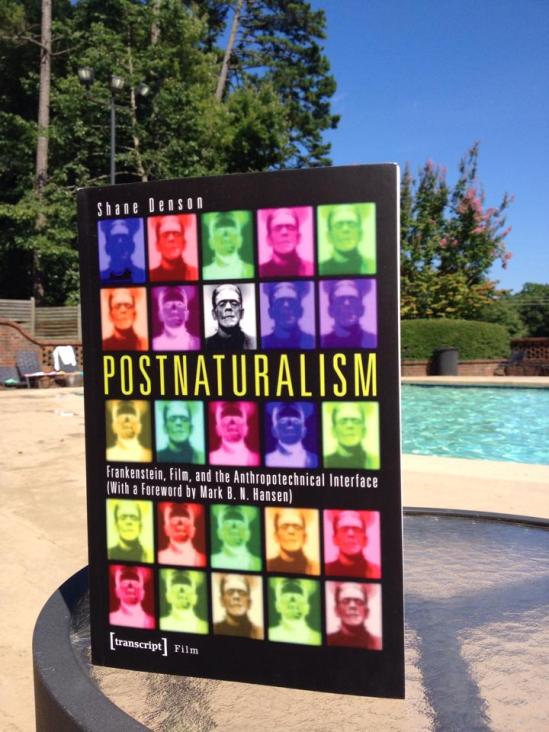
My new book, Postnaturalism: Frankenstein, Film, and the Anthropotechnical Interface, has been out for about a month now — in Germany, at least. The American, British, French, and Japanese iterations of amazon list the book as appearing next week, on August 22 (but available for pre-order), and it may be September by the time the American distributor, Columbia University Press, gets it listed on their website. Meanwhile, living somewhere between these worlds, I was able to get my hands on a physical copy of the book yesterday, and I’m very happy with the job Transcript Verlag did!

For more information about the book, as well as a preview that includes Mark Hansen’s foreword and my introduction, see here or click the image above (the preview can be accessed by clicking “PDF,” just beneath the cover image, on the publisher’s page). Also, if you are in any position to do so, please consider requesting a copy for your university library.

Thanks to everyone who helped me get this out there! And now, once again, I bid my hideous progeny go forth and prosper. I have an affection for it, for it is the offspring of happy days…

Out Now: Serialization in Popular Culture

serialization in pop culture

Just back from a trip abroad, I was happy to find this in the mailbox: my copy of Serialization in Popular Culture, edited by Rob Allen and Thijs van den Berg. The volume goes back to an excellent conference that took place in Amsterdam in 2011, organized by the editors of the book, where I presented a paper on film serials of the 1910s: “Rethinking the Serial-Queen Melodrama: Serial Narration and Medial Self-Reflexivity in Transitional-Era Cinema.” Now much expanded, my paper appears here as “The Logic of the Line Segment: Continuity and Discontinuity in the Serial-Queen Melodrama.” The book contains a number of wonderful contributions by Mark W. Turner, Joyce Goggin, Dan Hassler-Forest, Sean O’Sullivan, Jason Dittmer, and more:

TOC-Serialization-in-pop-culture-1

TOC-Serialization-in-pop-culture-2

Also, I’ve posted this before, but I can’t resist posting once more my colleague and collaborator Ruth Mayer’s high praise for the volume:

“This collection presents an ambitious and original intervention in the field of seriality studies. It captures the workings of serialization as a core principle of modernity by taking stock of a wide range of medial formats and narrative and non-narrative configurations from the nineteenth century to the present time.” – Ruth Mayer, University of Hanover, Germany

Finally, the book is, unfortunately, quite expensive in the hardcover version that is now available, and it is to be hoped that a paperback edition will appear at some point. In the meantime, if you are in a position to do so, please request a university library or other institution to order a copy, and in this way support the editors and contributors and increase the chances for an affordable paperback/ebook edition.