Out Now: Network Ecologies

NetworkEcologies

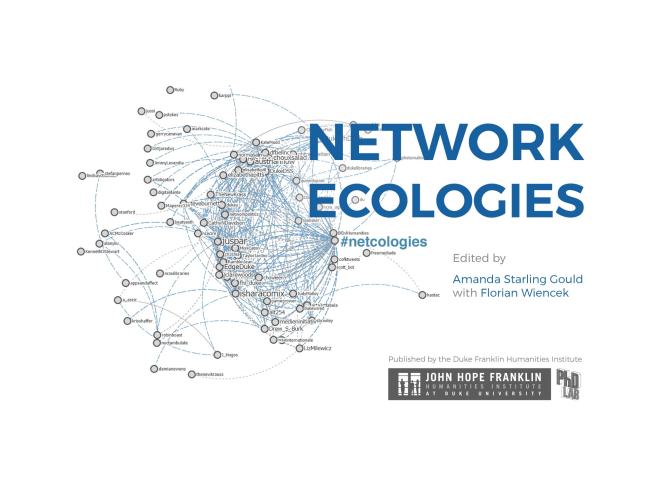
Network Ecologies is a great new open-access collection edited by Amanda Starling Gould and Florian Wiencek and published by the Duke Franklin Humanities Institute. The collection takes advantage of the Scalar publishing platform to include a variety of media alongside scholarly texts. Among other things, it includes a collection of artworks by Karin Denson and myself, which we developed for an exhibit at Duke in 2015 (also organized by Amanda Starling Gould) and which grew out of a collaboration with the Duke S-1: Speculative Sensation Lab. There is also an archive of videos from a 2013 symposium, including contributions from Jussi Parikka, Mark Hansen, Stephanie Boluk, Patrick LeMieux, and many others. Lots of great things to discover here–check it out!


Post-Cinema (Book Trailer)

Here is a short “book trailer” for the open-access collection Post-Cinema: Theorizing 21st-Century Film, edited by Shane Denson and Julia Leyda (REFRAME Books, 2016).

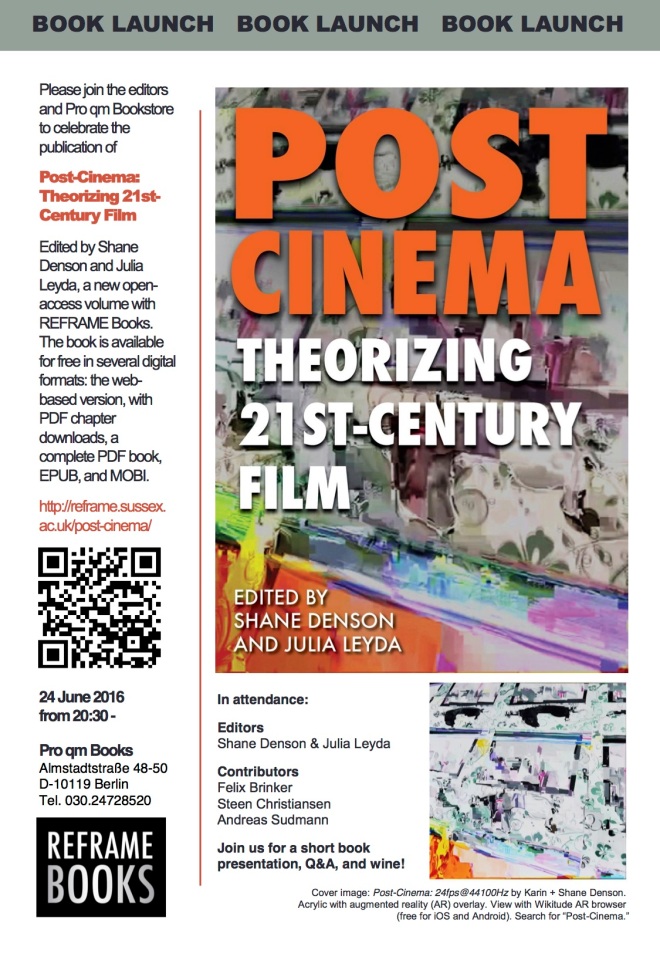
Also, don’t forget that we’ll be having a book launch party at Pro qm Books in Berlin this coming Friday, June 24. See here for more info and a flyer.

Post-Cinema Book Launch Party

book-launch-150dpi

On June 24, 2016, Julia Leyda and I will be celebrating the launch of our co-edited book Post-Cinema: Theorizing 21st-Century Film at Pro qm Books in Berlin. Several contributors will be on hand as well for a short book presentation, Q&A, and wine!

See the flyer above for details, and come out if you’re in the neighborhood!

Hyperdistractions

2016-05-31 06.54.19 am

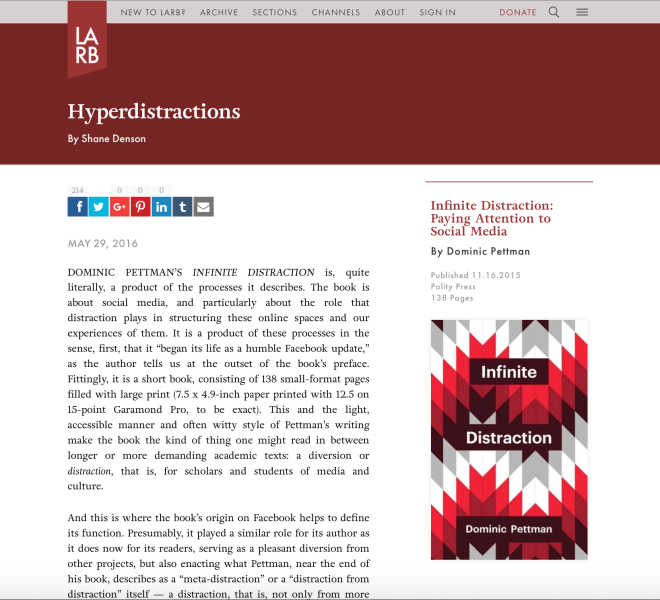
My review of Dominic Pettman’s short book Infinite Distraction: Looking at Social Media is up now at the Los Angeles Review of Books (LARB). In the review, I explore particularly the stakes of “distraction,” which Pettman borrows from Kracauer and Benjamin, and the way that their concept of Zerstreuung might help us to understand our age of “scatterbrained” multitasking and develop an appropriate response. With a nod to Marshall McLuhan and his notions of “hot” and “cool” media, I try to understand Pettman’s politics of distraction, which itself responds to Bernard Stiegler’s phenomenology of mediated temporality: “In the face of ultra-cool media, we have to learn to be ice cold. In the face of the always already ‘meta’ relation of social media to our divided, distracted attentions, we have to learn to be infinitely more distracted. Hypersynchronization and hypermodulation call for nothing less than hyperdistraction.” In the end, I am critical of what I refer to as the book’s “humanistic vision” and its “communicational bias,” but I certainly recommend engaging with Pettman’s thought-provoking and in many ways open-ended book, which I see sowing seeds for future thinking and action in the realm of social media.

Read the whole review here.

Out Now — Post-Cinema: Theorizing 21st-Century Film

Post_cinema_cover_NEW

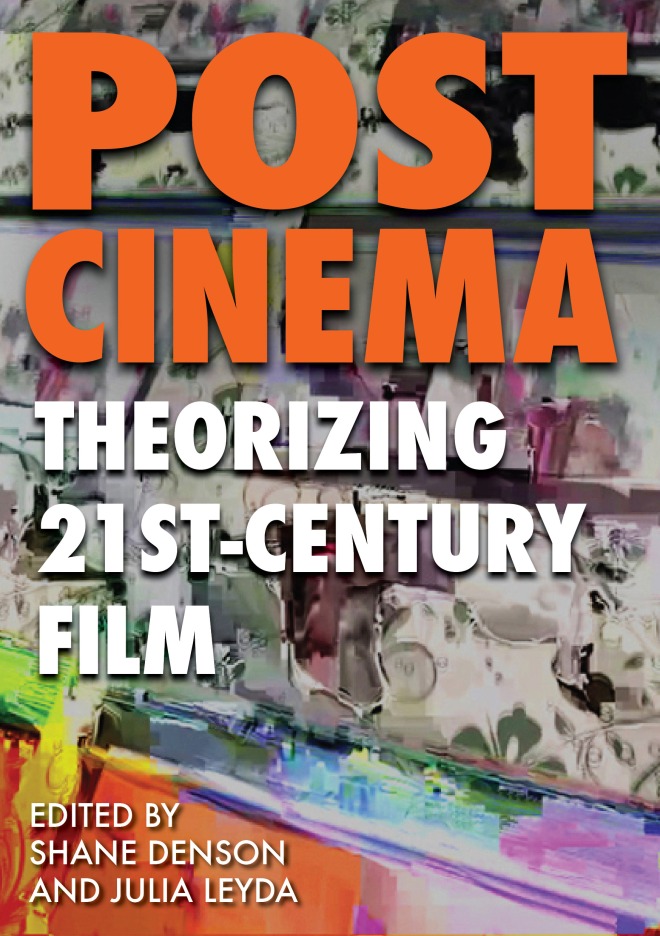
I am happy to announce, at long last, the publication of Post-Cinema: Theorizing 21st-Century Film, edited by Shane Denson and Julia Leyda, which is out today as a completely free and open-access volume with REFRAME Books.

If cinema and television, as the dominant media of the 20th century, shaped and reflected our cultural sensibilities, how do new digital media in the 21st century help to shape and reflect new forms of sensibility? In this collection, editors Shane Denson and Julia Leyda have gathered a range of essays that approach this question by way of a critical engagement with the notion of “post-cinema.” Contributors explore key experiential, technological, political, historical, and ecological aspects of the transition from a cinematic to a post-cinematic media regime and articulate both continuities and disjunctures between film’s first and second centuries.

The book will appear in several digital formats: the web-based version is online today, and several ebook formats will be appearing soon.

The book brings together foundational texts by some of the key voices in the discussion of post-cinema and places them next to a range of brand-new chapters, as well as a series of roundtable discussions.

The long list of contributors includes:

Caitlin Benson-Allott, Paul Bowman, Felix Brinker, Kristopher L. Cannon, Francesco Casetti, Steen Christiansen, Elena del Río, Shane Denson, Rosalind Galt, Therese Grisham, Richard Grusin, Leon Gurevitch, Mark B. N. Hansen, Bruce Isaacs, Adrian Ivakhiv, Kylie Jarrett, Selmin Kara, ​Julia Leyda, Patricia MacCormack, Lev Manovich, Ruth Mayer, Michael O’Rourke, Patricia Pisters, Alessandra Raengo, David Rambo, Nicholas Rombes, Sergi Sánchez, Karin Sellberg, Steven Shaviro, Michael Loren Siegel, Vivian Sobchack, Billy Stevenson, Andreas Sudmann

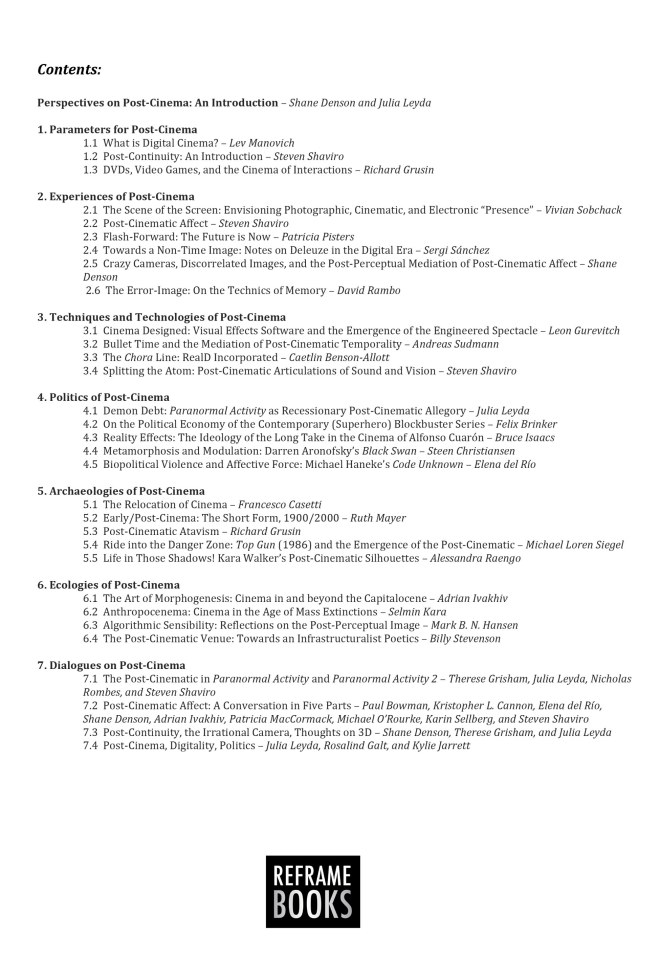
Here is the table of contents:

Post-Cinema-TOC

A brief “press release” with a description of the book and the complete table of contents is available here (opens as a PDF): POST-CINEMA-Press-Release

Reframe_Books_black

After.Video at Libre Graphics 2016 in London

banner_glitch_1

Recently, I posted about a project called after.video, which contains an augmented (AR) glitch/video/image-based theory piece that Karin Denson and I collaborated on. It has now been announced that the official launch of after.video, Volume 1: Assemblages — a “video book” consisting of a paperback book and video elements stored on a Raspberry Pi computer packaged in a VHS case, which will also be available online — will take place at the Libre Graphics Meeting 2016 in London (Sunday, April 17th at 4:20pm).

Postnaturalism reviewed in MEDIENwissenschaft

medienwissenschaft-review

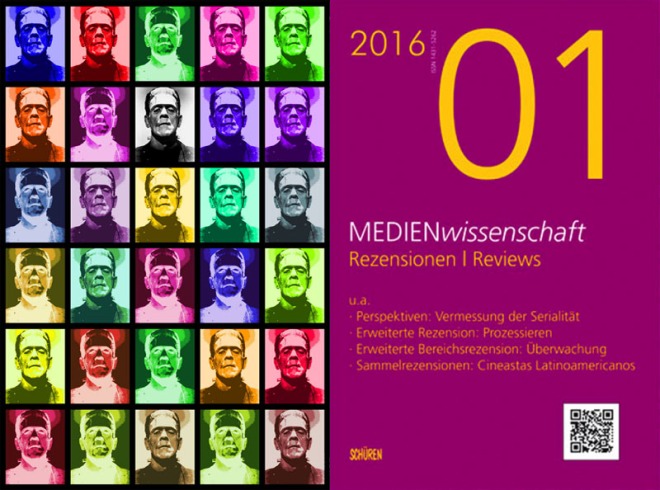
The latest issue of MEDIENwissenschaft: Rezensionen/Reviews includes a nice review of my book Postnaturalism: Frankenstein, Film, and the Anthropotechnical Interface. 

For those of you who read German, you can find the entire text of the review, by Anya Heise-von der Lippe (Tübingen/Berlin), here. For everyone else, here is a (rough) translation of the reviewer’s summary statement:

Postnaturalism offers a philosophical approach and an engagement with fundamental ontological and phenomenological questions of human and nonhuman materiality, which is indispensable especially for a post-postmodernity characterized by resource scarcity, climate change, and species extinctions, as well as the threat of a return to essentialist positions in politics and popular culture. Adapting a phrase from Bruno Latour, Denson counters the latter with a postnatural position: “We have never been natural” (24). Furthermore, Denson’s detailed examination — at the level of content, reception, and production — of Frankenstein adaptations is an asset for the analytical and production-aesthetic [produktionsästhetische] investigation of a central text (or modern myth) and its many adaptations in a wide range of text-critical disciplines: from media studies to literary to cultural studies.”

(Again, the translation is rough. Tweaks are more than welcome! Especially if you have suggestions for produktionsästhetisch or for making that first sentence more readable, drop me a line in the comments below…)

Finally, make sure you check out the entire issue of MEDIENwissenschaft, which is chock full of great stuff. Of particular interest to readers of this blog, among other things: the “Perspectives” section contains a longer piece on seriality and television series’ interrelations by Tanja Weber and Christian Junklewitz.

Check out the full contents of the issue here.
Postnaturalism reviewed in LWU

lwu-postnaturalismThe latest issue of Literatur in Wissenschaft und Unterricht, a special (English-language) issue on Serial Narratives edited by Kathleen Loock (a fellow member of the DFG research unit on “Popular Seriality”), includes a review of my book Postnaturalism: Frankenstein, Film, and the Anthropotechnical Interface. 

The review, by Dennis Büscher-Ulbrich of the University of Kiel, is mostly positive, though hardly uncritical. You can read the entire review here, but my favorite part must be a certain characterization of the book that appears in the midst of exposing what Büscher-Ulbrich takes as “the book’s theoretical Achilles’ heel” (namely, my lack of engagement with overtly political revolutions and with “recent post-Marxist political ontologies and metaphysics” in particular). In this context, Büscher-Ulbrich nonetheless flatteringly praises my “extraordinary powers of theoretical synthesis” and claims that

“[Postnaturalism] is one of the rare enough scholarly monographs whose collected footnotes alone provide an excellent education.”

Now, I recognize that it’s not for everyone (I have been criticized before for including “an entire second essay within an essay”) — and while I’m not sure I’d recommend taking your kids out of school and making Postnaturalism the primary textbook for their homeschooling (though you might do worse…) — I’m glad to see the footnotes getting some attention here from a reader who can appreciate the value of a page of text “below the line.”

footnote

In any case, if Postnaturalism ever sees a second edition, I’ll certainly suggest this as a fitting blurb!

Check out the entire review:

And check out the entire special issue of LWU on Serial Narratives!

ImageText Review: Transnational Perspectives on Graphic Narratives

cover8_1

The most recent issue of ImageText: Interdisciplinary Comics Studies (Vol. 8, No. 1) has a nice review, by Kate Polak, of Transnational Perspectives on Graphic Narratives: Comics at the Crossroads, which I co-edited with Christina Meyer and Daniel Stein. Here’s a little taste of it:

Transnational Perspectives on Graphic Narratives is an essential volume for both comics scholars and scholars of literature in general, because it places the most popular emerging medium in conversation with cutting-edge contemporary scholarship, and makes a strong case for the ways in which comics are necessary in considerations of a transnational, cosmopolitan 21st century world.

Check out the full review, titled “Playing at the Margins,” here.