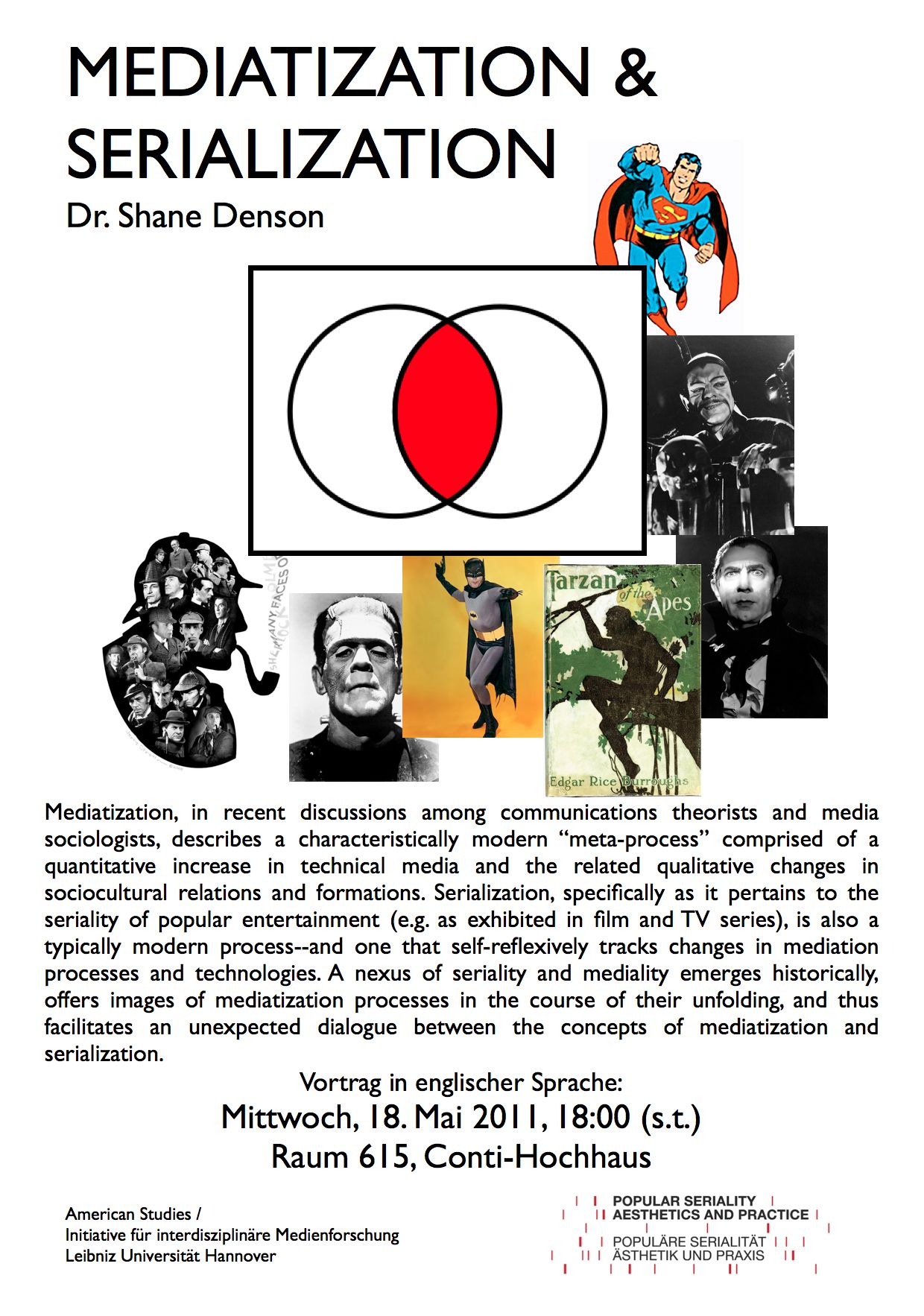
The very first thing I posted on this blog (in May 2011) was the above flyer, announcing a talk I was giving on the connections between “mediatization” and “serialization.” While sorting through some papers, I came across the text of the talk again and realized I still haven’t gotten around to doing anything with it. In the end, I have to admit that the concept of mediatization, as defined by the media sociologists and communications theorists I discuss in the talk, doesn’t really appeal to me that much. For one thing, I am much less concerned than they are to guard against charges of technological determinism; mediatization theory often seems preoccupied with keeping the human, or the social, in control (on some general problems with this preoccupation, see McKenzie Wark’s recent essay “Against Social Determinism”). However, a large part of the theoretical appeal of the notion of mediatization — as a process of change closely linked with processes like modernization and globalization — lies in its description of an apparent loss of autonomy, a ceding of human agency to the technical. And I think there’s something to be said for this: the past two-hundred some-odd years have witnessed an explosion of technical actants, placing us in ever more complex and opaque feedback loops with them and the environment they mediate to us: welcome to the anthropocene…
So this is not my problem with mediatization theory. Rather, my problem is with the insinuation that human agency was free of the taint of media or technics some two or three hundred (or however many) years ago, and that it only gradually became “mediatized.” My own notion of postnaturalism, summed up in the Latourian paraphrase that “we have never been natural,” is based on the idea of an essential and indissoluble (though by no means static) “anthropotechnical interface” that connects human and technical agencies in a transductive relation — there simply is no human agency without technical agencies, and vice versa. Still, it is necessary to take note of the empirical changes that take place against this cosmological horizon, and perhaps the notion of mediatization can be of service in this regard after all. If we set aside the worries over determinism, that is, and train our focus at a medium level of abstraction — somewhere between the cosmological and the phenomenologically/technically concrete and individual: at the level of supra-personal but not quite geological temporality or history — perhaps then an engagement with the concept of “mediatization” can help us think through the qualitative changes in agency that have taken place with the advent of the steam press, photography, film, radio, television, and digital media.
My talk on “Mediatization & Serialization” certainly does no more than scratch the surface in this regard, but in the hopes that it at least manages to do that, I have decided to reproduce the text here. As always, I am grateful for any comments!
Mediatization & Serialization
Shane Denson
(Note: This is a rough script of the talk I held at Leibniz Universität Hannover on May 18, 2011. Bibliographical info is missing, and footnotes are just placeholders.)
[Intro]
What I hope to do is to bring the concept of mediatization, which I’ll explain shortly, into dialogue with that of serialization, especially as it pertains to the seriality of modern popular entertainment (as exhibited in film and television series, for example). Most generally, the basis for this dialogue derives from the fact that both mediatization and serialization are, or so I contend, characteristically modern processes, perhaps even central to modernity itself. Mediatization, according to the term’s usage in recent communications theory and media sociology, is related to the fact that the modern world is witness to a consistent increase in the sheer number of technical media. These, in turn, are seen to be increasingly central to the shape and structure of sociocultural reality, so that it becomes increasingly untenable to think of media as a separate institution, exerting pressure on the others from outside. Instead, the situation shifts to one in which we find genuinely “mediatized” institutions, institutions transformed by media as an increasingly integral framing structure. So it no longer makes sense to speak of “the media and education” or “the media and the family,” as in traditional mass communications studies, but instead of thoroughly mediatized education, family, and so forth. Mediatization, according to Friedrich Krotz, is a “meta-process,” not itself empirically observable but, like the meta-processes of individualization, commercialization, and globalization, marking a real trajectory in the modern world and a force that qualitatively conditions the realm of empirically observable phenomena. In some respects, this view of mediatization as a meta-process might be compared to Friedrich Kittler’s idea of “media a priori,” but (against this association) it is constantly emphasized in these discussions that mediatization is to be seen as a non-deterministic process. As for serialization, this refers, like I said, to the popular seriality that explodes onto the scene in the nineteenth century with the advent of new media technologies (like the steam press, which enabled the rapid production of printed periodicals, including story papers, penny dreadfuls, and dime novels). Since then, serialized narrative forms have continued to proliferate alongside and in the media that would seem to have changed our worlds into properly mediatized worlds: in film, radio, television, and now digital media. The serialization of entertainment cannot, it would seem, be thought in isolation from the processes described by the concept of mediatization, and serialization may be thought of as a special case of the mediatization of leisure time, specifically as relates to media-inflected transformations of popular narrative. On the other hand, though, serialization is a truly special case of mediatization, in that it is a highly self-reflexive process: serial narratives observe changes in mediation, track them over time, and thus offer images of mediatization processes as they unfold—in “real time,” so to speak. Careful attention to serialization promises therefore to shed light on mediatization—and vice versa. What I call “techno-phenomenology,” and which I will come back to shortly, will help uncover the bidirectional communication between the two processes.
[Framing mediatization through serialization]
But first, to start making these connections concrete, I turn to some ideas and observations put forward by Frank Kelleter in a recent issue of Psychologie Heute. Kelleter notes that the evolution of TV sitcoms from the 1950s to today displays a continuous movement from the intact family as the site and occasion for humor, by way of the dysfunctional units of All in the Family or Married…with Children, to more recent sitcoms that revolve around a group of unrelated friends (as in Seinfeld, Friends, or Sex and the City). As Kelleter remarks, this development can be seen as a result of, and a reflection of, the increasing individualization of modern Western societies. Individualization, you recall, is one of the central meta-processes that, according to Friedrich Krotz, define modernity, along with the interrelated meta-processes of commercialization, globalization, and mediatization. And surely we can see these other processes reflected just as clearly in the globally syndicated, made-for-profit series that dominate TV screens today. But, as Kelleter recognizes, the reflection of social reality is only the beginning, and it would be shortsighted to reduce the link between serialization and mediatization to a passive commentary function that series can assume with respect to social developments.
On the contrary, serialized television actively frames our experience of the world: the week is punctuated at regular intervals by our favorite series, and our relations at home and on the job are perceived—though not uncritically—through the lenses of television drama, sitcoms, soaps, news, and police procedurals. Just as we judge series as either realistic or unrealistic, we inevitably compare reality and the people we encounter in the “real world” with the models we have met and occasionally become intimate with in the serialized world of television. In this respect, we can speak of a relatively direct (though hardly simple[1]) link between serialization and mediatization, as the serialized entertainment of TV transformatively reframes our interpersonal relations and behavioral expectations. Moreover, this activity of framing and reframing is itself increasingly the object of serial entertainment. The serial production and distribution of still incomplete narrative constructs opens a space for what Henry Jenkins calls “participatory culture,” and new social relations are created in the feedback loops between producers and consumers—social relations that are not only transformed but in fact generated through mediatization. And the media processes upon which these novel relations depend are increasingly the topic not only of fans’ discourses with one another but also of the serial productions themselves, which in the era of so-called Quality TV are aware of the existence of a well-informed, highly networked, and hardly passive fan base. Fans know how series are structured, and series’ producers know that fans know how they’re structured, and so the series themselves become increasingly complex and self-reflexive in response. The result is that the serialized communication that takes place in the inherently mediatized networks of producers and consumers of serial forms continues to proliferate in the manner of a self-serialization that takes as its object the serial maintenance of mediatized relations and communications in and through series. (And that only approximates the complex self-reflexive processes set in motion by a series like Lost.)
But while I’ve concentrated on recent television here, the link between serialization and mediatization is much broader. A moment ago, I invoked the figure of the frame to describe the work of regularly consumed TV series in organizing and transforming our experience, and I want to extend this to serial forms in other media as well. The figure of the frame has cropped up before in discussions of mediatization, often in connection with the idea of an overarching “media logic” (as the “orientation frame” or “processual framework” that increasingly structures social action).[2] But whereas this notion of media logic raises worries of determinism and is seen by some to cast mediatization as an implausibly linear process,[3] the sort of framing I have in mind is inherently reversible, volatile, and polyvocal—expressive of the non-neutral Prägkraft or “moulding forces” that communications scholar Andreas Hepp sees at work in media, while also compatible with his call (following David Morley) for a non-media-centric media theory capable of countenancing a central paradox of mediatization: capable, namely, of accounting for the increasingly central role of media in shaping our experience without thereby attributing the central or determinative causal agency of this development to media as a unified force. Divorced from the idea of a singular, teleological media logic, the figure of the frame illustrates what I call a process of “de/centering,” which Derrida exposes in a text ostensibly about painting. As he shows, frames are never simple or singular but highly unstable and phenomenally reversible entities. On the one hand, they stand outside the work, providing a background against which the framed content can emerge as a figure. On the other hand, though, the frame becomes part of the figure when seen against the background of the wall. Oscillating between ground and figure, the frame as margin or passepartout both centers and decenters the work: it enacts the multistable logic of de/centering that I propose explains the non-passive but non-deterministic framing function of media as revealed by a techno-phenomenological take on mediatization and serialization.
[Techno-phenomenology]
Techno-phenomenology is my term for an approach developed by American philosopher Don Ihde, following leads from the early Heidegger and Merleau-Ponty, among others. Generally speaking, techno-phenomenology looks at technologies neither as passive artifacts nor as determinative global systems, but instead as constituent parts of the relations that human agents maintain with their environments in concretely embodied, practical situations. What Ihde calls “mediating technologies” may occupy a variety of positions within the intentional relations of subjects to objects. For example, when one looks through a telescope, the device itself ideally disappears; it is, so to speak, “absorbed” into the perceiving subject’s sensorial apparatus to reveal far-away objects that couldn’t be seen with the naked eye. Prosthetically extending the embodied subject, the telescope occupies what Ihde calls an “embodiment relation.” In contrast to this, a radio telescope cannot be looked through in this direct manner; instead, its output must be looked at and interpreted, “read” as a sign of an objective reality that cannot be perceived directly. This type of technology instantiates a “hermeneutic relation”—occupying a semi-objective position as something to be looked at rather than through. But it is important to note that technologies, on this view, do not inevitably and irrevocably instantiate one or the other type of relation. As Heidegger’s famous hammer illustrates, an embodiment relation can always break down. And Don Ihde goes further to illustrate that breakage is not the only source of such reversal. Decontextualization, simple inexperience, or intentional aesthetic estrangement, for example, can all cause transformation, because techno-phenomenal relations are embedded in contexts of practice, which are in turn conditioned by social and cultural forces. The fact remains, though, that a “telic inclination,” as Ihde puts it, may inhere in a technology, predisposing a given technology to certain means of use and relation and not to others. Material factors exert pressures on praxis that push optical and radio telescopes, for example, to opposite ends of the spectrum of subject-object relations, while still allowing for non-typical forms of use or appropriation.
What goes for Ihde’s “mediating technologies” applies to media in a narrower sense as well. On a very general level, for example, we might say that textual media tend, for obvious reasons, towards hermeneutic relations, while the television screen tends to be looked through, rather than at, as a quasi-transparent window on the world. These are telic inclinations of the media—differential media logics in the plural, if you like—quite comparable to the non-absolute “tendencies” or “pressures” that Hepp terms the “moulding forces” of media. These forces, looked at from a techno-phenomenological perspective, can be seen to frame the perceptual and actional agencies of media users, but never in a univocal, absolute, or determinative manner. Significantly, contextual reversals remain a live possibility, as is demonstrated by the paradigmatic difference between early and so-called classical film. In the early years of the cinema, which Tom Gunning has defined as a “cinema of attractions” (1895-1905), the cinema itself was the main attraction; people went to see projection apparatuses, not films. But the display of cinematic magic and trick effects for their own sake came to be subordinated to narration, and the classical Hollywood style, which took shape by around 1917, worked to ensure the invisibility of narrative construction, rendering the apparatus of film a transparent window onto fictional worlds. Importantly, though, narrative serialization—in the form of film serials such as The Perils of Pauline, The Hazards of Helen, or The Exploits of Elaine—arose in the 1910s as a means of navigating the uncertain transitional phase between the early and classical paradigms. Staging neither the pure media spectacles of early attractions-style cinema nor the self-enclosed diegetic universes of classical film, these serialized story films vacillated between medial transparency and opacity, between narrative closure and an openness onto the non-diegetic conditions of their storytelling—both due to the incompleteness of the weekly episodes, which were segmented by cliffhangers and interrupted by the rhythms of the work week, and due to self-reflexive tendencies by which the serials ostentatiously demonstrated the medial means of an emerging form of narrative construction.[4]
[The nexus]
This brings me to the nexus that, as I see it, binds popular seriality and mediality. By mediality, I mean the fact and specific character or quality of a given process of mediation. Roger Hagedorn points to a special relation between seriality and mediality when he observes that serial narratives often “serve to promote the medium in which they appear” (5). Medial self-reflexivity is, then, in a sense a natural facet of the serial form’s role in helping “to develop the commercial exploitation of a specific medium” (5). The serialized novels of the nineteenth century feuilleton helped sell newspapers, and color comic strips advertised newly developed four-color printing processes. Early radio and television series served to attract consumers to the new media, to induce them to purchase expensive devices, and then to hook them with ongoing stories and recurring entertainments. Popular seriality is thus closely linked with the development of modern media, or with a media modernity characterized by constant pressure towards media-technological innovation. Serialization is correlated, that is, with the quantitative and qualitative changes which lay the very groundwork for the meta-process of mediatization. Concerned with their own medial forms, as well as the transformation of the media landscape implied by the emergence of new, competing media, series probe, expose, demonstrate, and experiment with their own mediality and compare various media with one another; moreover, because series unfold over time, they are capable of tracking the medial processes and changes upon which the meta-process of mediatization depends or supervenes.
Especially at transitional moments of media change, a techno-phenomenological perspective on seriality reveals a privileged view of the processes that are basic to mediatization; conversely, the concept of mediatization illuminates the lower-level work of serialization in the broader perspective of modernity. For example, late nineteenth century dime novels can be approached as medially inconspicuous channels through which simple, formulaic stories of frontier heroes, urban detectives, and young inventors were told; but when we see these tales in relation to the innovations in print technologies that made their production possible, to the transcontinental rail systems upon which their distribution relied, and to the increasingly urbanized settings in which their readers lived and worked, then the serially implemented locomotives, telegraphs, and other communication and transportation technologies that fill the pages of these stories seem to belong less to their narrative worlds than to the extra-diegetic machinery of their mediation and consumption. In techno-phenomenological terms, we find here a radical ambivalence between the transparency of embodiment relations and the medial opacity of hermeneutic relations. The serial form, which oscillates formally between repetition and variation, stages lifeworld changes in this unstable or “de/centered” manner and discloses thereby the underlying mechanics of mediatization in the process of its occurrence.
And because the specific periodicity of serialized forms can vary widely, ranging from daily to weekly to longer-term intervals, the perspective that series offer on mediatization varies accordingly. In addition to linear or episodic series that unfold within a single medium over a short period of time, there are also plurimedial series that may be staged over the course of decades. A serially staged figure such as Frankenstein’s monster constitutes such a series: originating in a novel, appearing numerous times on theater stages, achieving iconic form on film, and continuing to proliferate in comics, on TV, and in video games, the monster tracks virtually the entire course of modern media history. And it thrives particularly at moments of media change, such as the sound-film transition that ironically gave birth to Karloff’s mute monster. Robbed of the articulate speech acquired by the monster of the novel, the monster of the movies briefly served to highlight the fact and the eerie quality of sound film’s novel mediality, exemplifying the reversible logic of the frame by foregrounding the medial infrastructure over the mediated narrative. This reversal of figure and ground operated on the basis of the monster’s serial staging, on the basis of a preexisting familiarity and recognizability rendered strange in the new medium. With the habituation of sound film, the strangeness wore off and the iconic monster came to serve as the baseline for an ongoing serialization process. Here, if we look carefully, we can see the procession of major and minor media transformations that have made our world a properly mediatized one.
Finally, we might recognize here a meta-serial development, a historical shift in the constitution of serial forms, which provides a sort of wide-angle view of mediatization, as if through the wrong end of a telescope. In the procession from linear storytelling in a single medium, to the serialized proliferation of narratives repeated and varied in a fragmented plurimedial frame (such as is embodied by Frankenstein’s monster), to the recent advent of transmedial storytelling in the wake of a digitally induced media convergence, we see a long-term transformation of serial forms that speaks to an experience of progressive deterritorialization. Serially recurrent characters became dislodged from their material ecospheres, i.e. from the media in which they were born, through the proliferation of competing medial forms that vie for our attention. Likewise, we have been uprooted or liberated (depending on your perspective) from our immediate surroundings and, through these very media, been put in touch with distant, spatially nonlocal, communities. But a de/centered view of this development is neither linear nor certain in its assessment of the outcome. Transmedial storytelling continues the trend of displacement with respect to a singular or stable medial framework, but it reverses the diegetic fragmentation exemplified by Frankenstein’s monster and other serial icons of the twentieth century. Today, in series that span the media of television, film, print, and digital media, we find new tendencies toward reterritorialization, staged, though, as a complex and hardly straightforward affair. There is a renewed interest in creating unified diegetic worlds, in spite of or precisely because of the multiplicity of medial frames somewhat euphemistically united in talk of convergence. It is unclear what this says about us and our contemporary serialized experience of mediatization, but I think we can rule out the idea that today’s transmedial series simply “reflect” social reality. Instead, they frame our experience in a de/centered manner that both displays and enacts a central paradox of our mediatized worlds: media are increasingly central in structuring our experience, but there is a reversible margin from which these structures remain open to negotiation. As I have tried to show, this reversibility is essential to the process of serialization, thus ensuring the continued importance of popular seriality as a site of the non-deterministic production of a mediatized modernity.
[1] Indeed, complexification is central to Kelleter’s argument, which is also sensitive to the self-reflexive functions of serialization which I exploit in this paper. See also Jason Mittell on “narrative complexity.”
[2] The notion of the frame, popular of late in a variety of discourses and disciplines, also crops up regularly in discussions of mediatization, and I think a great deal hinges on our understanding and use of the concept. For example, in an essay that approaches mediatization in terms of the “institutionalization of media logic” (42), Andrea Schrott invokes the figure of the frame to explain this media logic, which she describes as an “orientation frame” (48) that is non-neutral with respect to content. This accords with Altheide and Snow’s own description of media logic, in their 1979 book of that title, as “a processual framework through which social action occurs” (15). Similarly, Norm Friesen and Theo Hug invoke the notion of “framing” to signal the “epistemological orientation” increasingly provided by media (80), or what they call “the role of the mediatic a priori” (79).
[3] Nick Couldry’s worry.
[4] Moreover, formal changes are coupled with social changes (gender, class), and these are highly relevant to a study of the mediatization of entertainment or of leisure time, as well as (and correlated with) a mediatization of identity or social identification. With respect to the specific example of transitional-era film serials (and serial-queen melodramas), see my “The Logic of the Line Segment: Continuity and Discontinuity in the Serial-Queen Melodrama” (forthcoming in Serialization in Popular Culture, edited by Robert Allen and Thijs van den Berg, New York: Routledge, 2014).