Syllabus for my grad seminar on Seriality (spring 2017).
Syllabus: Frankenstein and Film (Stanford University, Spring 2017)
Syllabus for “Frankenstein and Film” (Spring 2017).
Frankenstein@200
Happy to be on the steering committee for Frankenstein@200 — a year-long series of events taking place at Stanford in 2018. I’ll be participating in a number of ways, including talks and several courses related to Frankenstein, among other things. I’ll post details here in due time. Also be sure to check out the project website, which is still under construction, but which is already chock full of announcements and constantly being updated.
The year 2018 marks the 200th anniversary of the publishing of Mary Shelley’s novel Frankenstein. The novel is eerily relevant today as we face ethical dilemmas around appropriate use of stem cells, questions about organ donation and organ harvesting, as well as animal to human transplants. Additionally, the rise of artificial intelligence portends an uncertain future of the boundaries between machines and humans. Frankenstein@200, will be a year-long series of academic courses and programs including a film festival, a play, a lecture series and an international Health Humanities Conference that will examine the numerous moral, scientific, sociological, ethical and spiritual dimensions of the work, and why Dr. Frankenstein and his monster still capture the moral imagination today. This project will be sponsored by the Stanford Medicine & the Muse Program in partnership with the Stanford Humanities Center, the Stanford Arts Institute, the Office of Religious Life, the Vice Provost for Teaching and Learning, Stanford Continuing Studies, the Cantor Arts Center, the Department of Art & Art History, and the Center for Biomedical Ethics.
Out Now: [in]Transition 3.4
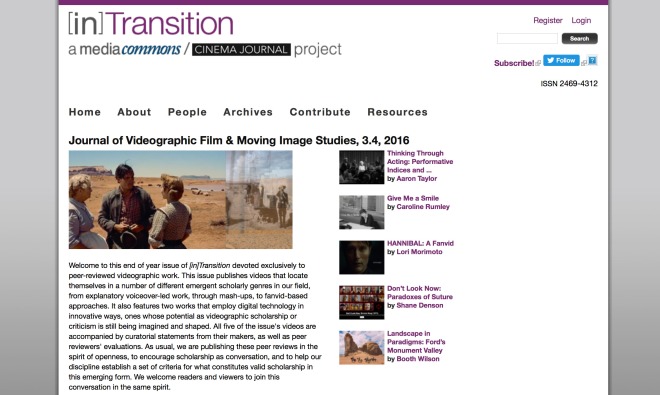
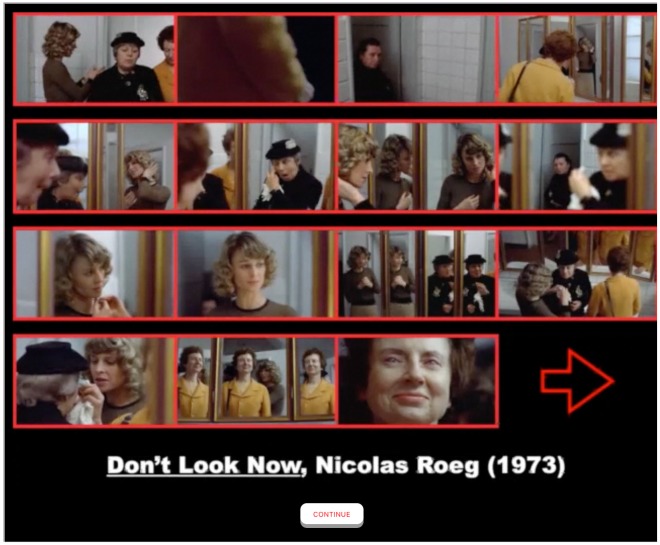
[in]Transition: Journal of Videographic Film & Moving Image Studies, issue 3.4 is out now. It includes a range of forms and genres, including voiceover-driven video essay, cross-textual mashup, fanvid-as-scholarship, and two experiments with the affordances of networked digital media: Booth Wilson’s “Landscape in Paradigms” (which places Westerns shot in Monument Valley back into that landscape as mediated by Google Earth) and my own “Don’t Look Now: Paradoxes of Suture” (which experiments with spatial configurations of shots and introduces some minimal interactivity to disrupt the linearity of the video and allow the user to dwell and progress at his or her own pace).
As usual, all contributions are accompanied by statements from their makers, as well as open peer reviews that situate the works in relation to emerging forms of videographic scholarship and research. Check it the full issue here.
Games and Interactive Media Series, Winter 2017
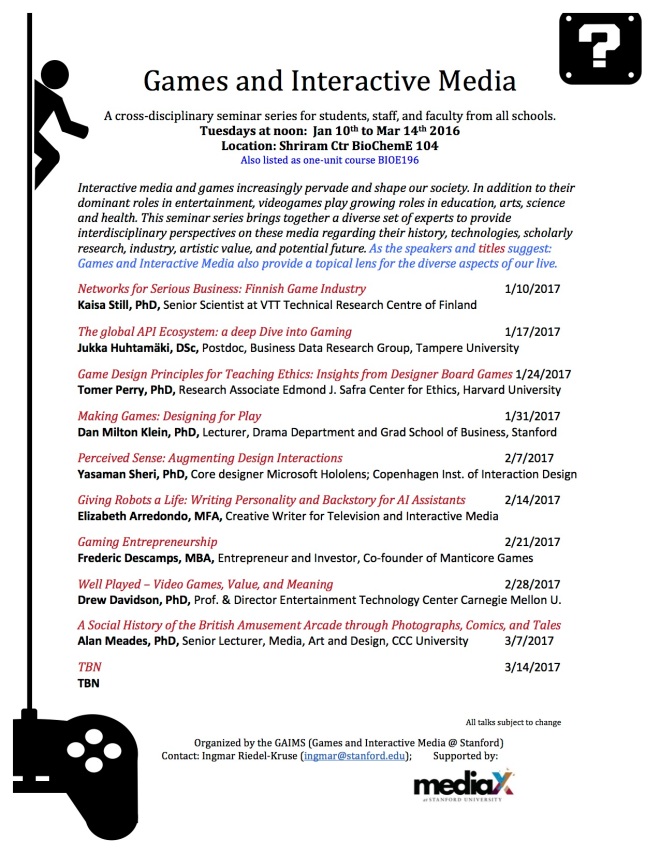
The Games and Interactive Media Series (GAIMS) at Stanford University meets every Tuesday at noon. Above, the list of speakers for Winter Quarter 2017.
Syllabus: Post-Cinema (Stanford University, Winter 2017)
Syllabus for the next iteration of my seminar “Post-Cinema” (senior capstone / graduate seminar), Department of Art & Art History, Winter 2017.
Animating Frankenstein (Stanford Graphic Narrative Project, Nov. 16, 2016)

This coming Wednesday (Nov. 16, 2016 at 6pm), I will be presenting a talk titled “Animating Frankenstein: Film, Comics, Visual Culture.” The event is organized by the Stanford Graphic Narrative Project (under the leadership of Mia Lewis and Scott Bukatman) and hosted by the Stanford Humanities Center. More info here.
Upstream Color (Art & Art History Cinematheque)
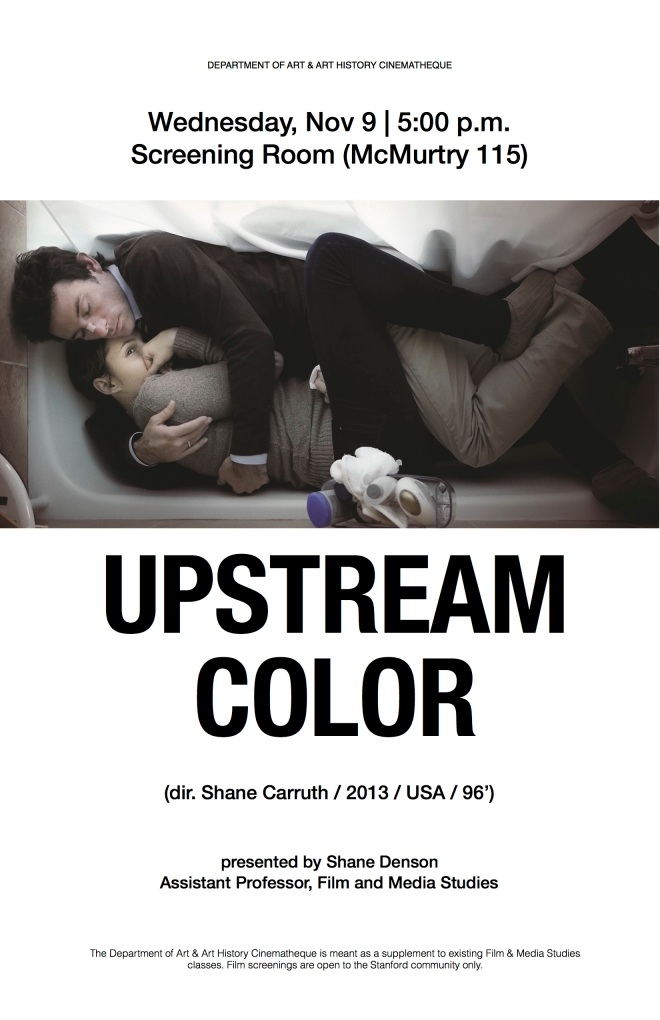
At this week’s Art & Art History Cinematheque, I will be presenting Shane Carruth’s Upstream Color (2013). Wednesday, Nov. 9, 2016 at 5pm (McMurtry Building 115).
Encoding the Future
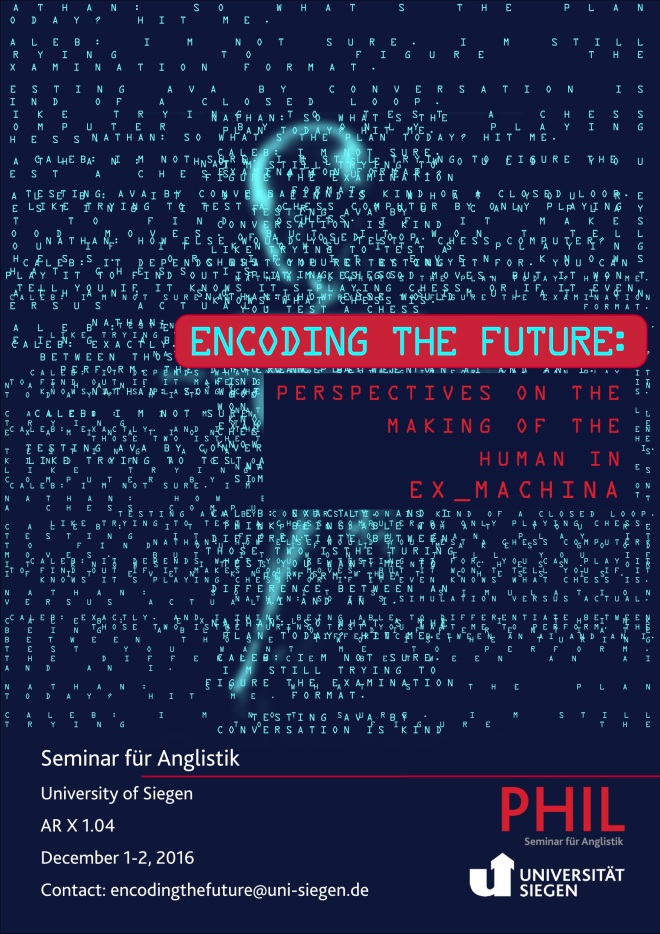
I am excited and honored to be delivering one of the keynote addresses at this conference on “Encoding the Future” at the University of Siegen, December 1-2, 2016. More info and program here.
Affect and Authority
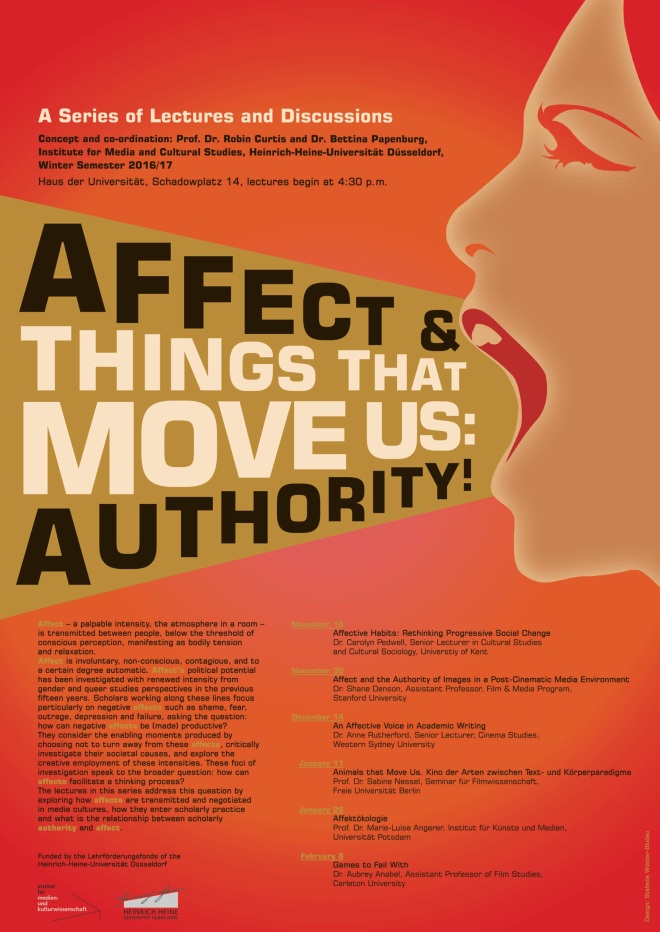
I am honored to be participating in this lecture series at the Heinrich-Heine-Universität Düsseldorf. My talk, titled “Affect and the Authority of Images in a Post-Cinematic Media Environment,” will take place on November 30.