Ends of Cinema: Center for 21st Century Studies 2018 Conference at UW Milwaukee

C21-Ends-of-Cinema-poster

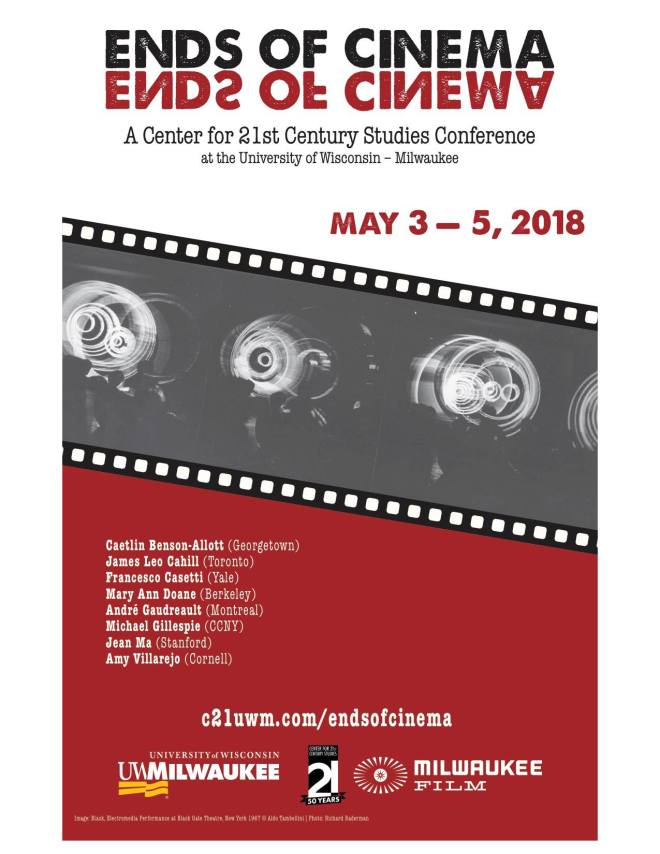
I am excited to be participating in the Ends of Cinema conference at the Center for 21st Century Studies, taking place May 3-5, 2018 at University of Wisconsin Milwaukee. There are some great keynote speakers, including my colleague Jean Ma and lots of other wonderful people. The C21, under the expert leadership of Richard Grusin (who is now back at the helm after a short hiatus), has put on some of my personal favorite conferences, and I expect this one to be no less exciting and thought-provoking.

My own contribution will be a paper titled “Post-Cinematic Realism” — work in progress for my current book project Discorrelated Images. Here is the abstract:

Post-Cinematic Realism

Shane Denson, Stanford University

In its classical formulation, cinematic realism is based in the photographic ontology of film, i.e. in the photograph’s indexical relation to the world, which grants to film its unique purchase on reality; upon this relation also hinged, for many realist filmmakers, the political promise of realism. Digital media, meanwhile, are widely credited with disrupting indexicality and instituting an alternative ontology of the image. David Rodowick, for example, argues that the interjection of digital code disrupts film’s “automatisms” and eradicates the index in favor of the symbolic. But while such arguments are in many respects compelling, I contend that the disruption of photographic indexicality might also be seen to open up spaces in which to explore new automatisms that communicate reality and/or realism with and through post-indexical technologies.

Whereas André Bazin privileged techniques like the long take and deep focus for their power to approximate our natural perception of time and space, theorists like Maurizio Lazzarato and Mark Hansen emphasize post-cinematic media’s ability to approximate the sub-perceptual processing of duration executed by our pre-personal bodies. The perceptual discorrelation of computational images gives way, in other words, to a more precise calibration of machinic and embodied temporalities; simultaneously, the perceptual richness of Bazin’s images becomes less important, while “poor images” (in Hito Steyerl’s term) communicate more directly the material and political realities of a post-cinematic environment. As I will demonstrate with reference to a variety of moving-image texts employing glitches, drones, and other computational objects, post-cinematic media might in fact be credited with a newly intensified political relevance through their institution of a new, post-cinematic realism.

Frankenstein@200: International Health Humanities Consortium Conference

Screen Shot 2018-04-06 at 11.40.10 AM

The 2018 International Health Humanities Consortium Conference will be held at Stanford University from April 20-22, 2018. The keynote speakers are:

Alexander Nemerov
Professor, Art and Art History at Stanford University

Lester Friedman
Professor, Media and Society at Hobart and William Smith Colleges

Alvan Ikoku
Assistant Professor, Comparative Literature and Medicine at Stanford University

Catherine Belling
Associate Professor, Feinberg School of Medicine at Northwestern University

In addition, there will be a number of great events around campus. You can find more information here.

I will be participating in the conference in two ways:

First, on Friday, April 20 (2:30-3:30pm in McMurtry 115) I will be presenting a screening session of videographic works related to “Frankenstein & Film.” I will be showing a few of my own pieces (which you can see here and here), as well as works by video essayists like Allison de Fren, alongside commercial “making of” videos, art film reimaginations, and other moving-image forms that treat the history of Frankenstein films from Thomas Edison’s 1910 production up to the present day.

Screen Shot 2018-04-06 at 12.09.56 PM

Second, on Sunday, April 22 (11:15am), I will be presenting a paper titled “Frankenstein and Bioethics Beyond Chance and Choice.” The paper draws upon and rethinks ideas that I put forward in one of my very first publications: “Frankenstein, Bioethics, and Technological Irreversibility.” That paper, published in 2007, can be found here.

Psychedelic Space and Anachronic Time: Elizabeth Kessler at Digital Aesthetics Workshop

DAW Kessler poster

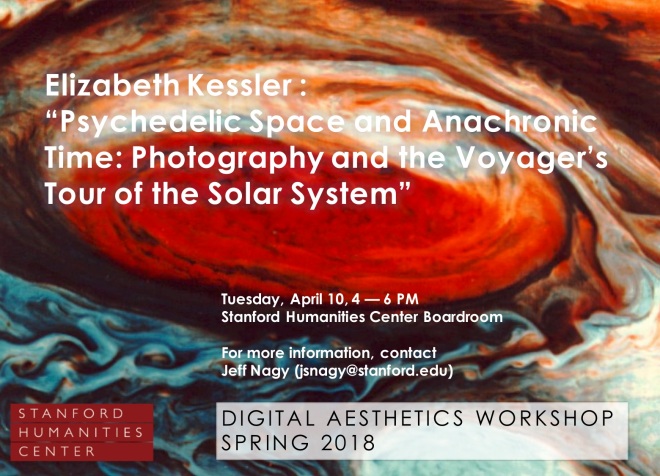
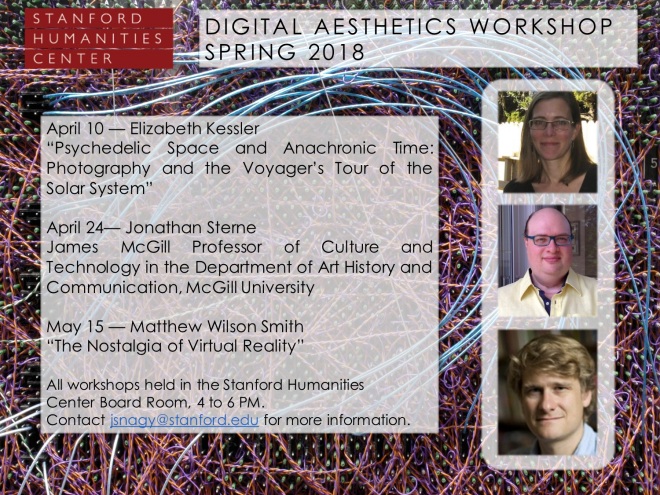
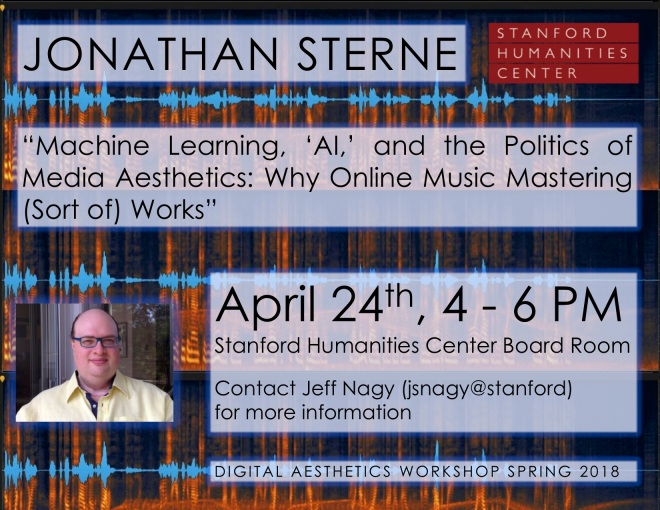
On Tuesday, April 10 (4-6pm in the Board Room of the Stanford Humanities Center), Elizabeth Kessler (Stanford, American Studies) will deliver a talk, titled “Psychedelic Space and Anachronic Time: Photography and the Voyager’s Tour of the Solar System,” in the context of the Digital Aesthetics Workshop.

Elizabeth Kessler’s research and teaching focus on 20th and 21st century American visual culture. Her diverse interests include: the role of aesthetics, visual culture, and media in modern and contemporary science, especially astronomy; the interchange between technology and ways of seeing and representing; the history of photography; and the representation of fashion in different media. Her first book, Picturing the Cosmos: Hubble Space Telescope Images and the Astronomical Sublime, on the aesthetics of deep space images, was published in 2012. She’s currently writing on book on extraterrestrial time capsules, as well as developing a new project on fashion photography.

See here for more information.

Discorrelated Images — Digital Aesthetics Workshop, April 3

DAW-poster copy

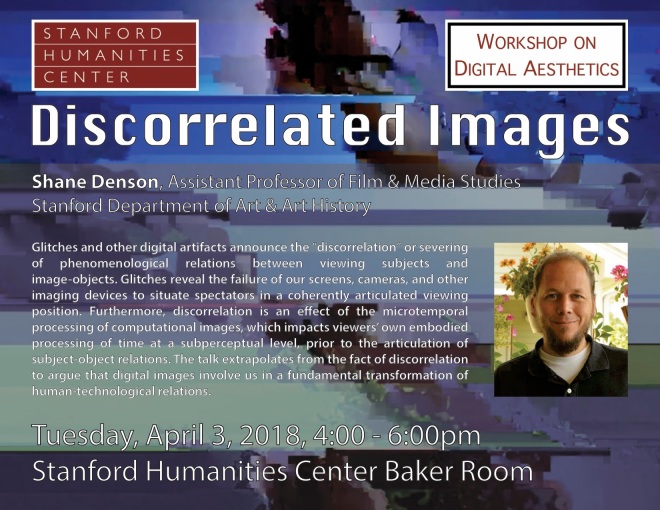
On Tuesday, April 3, 2018 (4:00-6:00pm), I will be giving a talk titled “Discorrelated Images” in the context of the Digital Aesthetics Workshop at the Stanford Humanities Center. The talk draws on my current book project of the same title and will address primarily temporal and affective relations and transformations occasioned by digital images.

Participants are encouraged (but not required) to read my chapter “Crazy Cameras, Discorrelated Images, and the Post-Perceptual Mediation of Post-Cinematic Affect” prior to the event.

Twenty-First Century Mediations of Subjectivity, ACLA 2018 #ACLA2018

acla-seminar

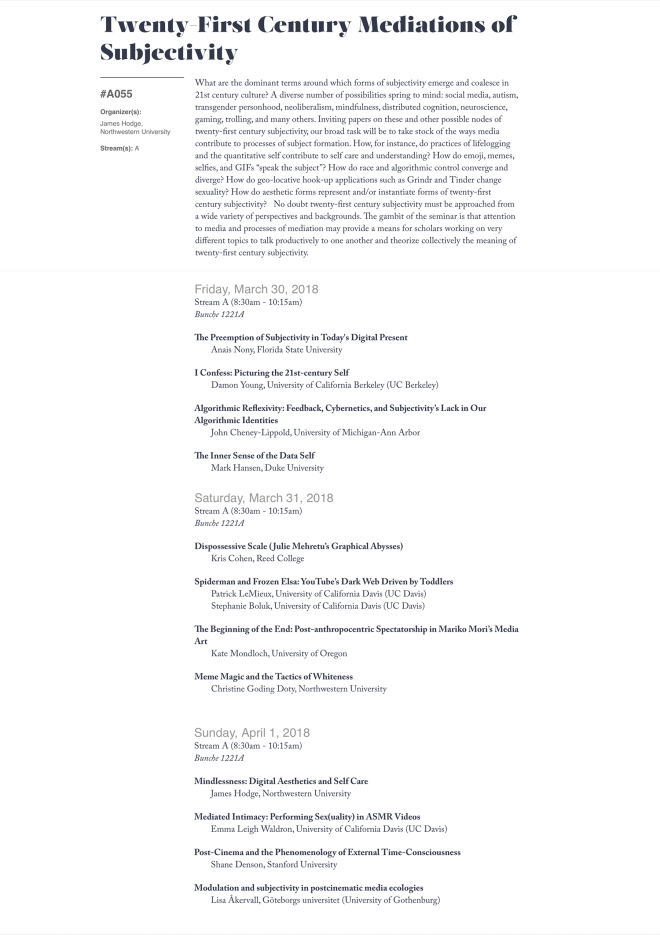
At this year’s conference of the American Comparative Literature Association, taking place March 29 – April 1, 2018 in Los Angeles, I will be participating in a great seminar/panel stream on “Twenty-First Century Mediations of Subjectivity,” organized by Jim Hodge of Northwestern University.

I’m looking forward to all of the talks, on such a rich set of topics. Here is the abstract for my talk:

Post-Cinema and the Phenomenology of External Time-Consciousness

Shane Denson

Something about the temporality of media has changed, and with it the relation of media to the temporality of subjective experience. In Technics and Time, Bernard Stiegler famously argued for just such a change, which he located in the advent of “tertiary memories” – externalized, reproducible experiences stored by industrial media objects. Using the term “cinema” to designate not only a specific apparatus but also the broad media regime or epoch instituted by recording technologies from photography and phonography to television and digital technologies, Stiegler identifies a threat to our subjective experience – exacerbated with the advent of live media in “the televisual epoch of cinema” – whereby media colonize consciousness by pre-formatting our immediate awareness (primary retention) with the images of tertiary retention. One thing Stiegler’s argument fails to account for, however, is the emergence of a protentional dimension that distinguishes computational media as decidedly “post-cinematic.” No longer simply memorial or mnemotechnical, post-cinema’s protentional images are generated on the fly according to compression algorithms rather than photochemical processes, thus disrupting the stability of tertiary memory while producing an external homologue to internal time-consciousness. This paper seeks to trace the impact of post-cinematic temporality on the production of subjective experience.

Stanford Film & Media Studies 2018 Symposium: “Pieces”

Pieces-FMS-Symposium-sm

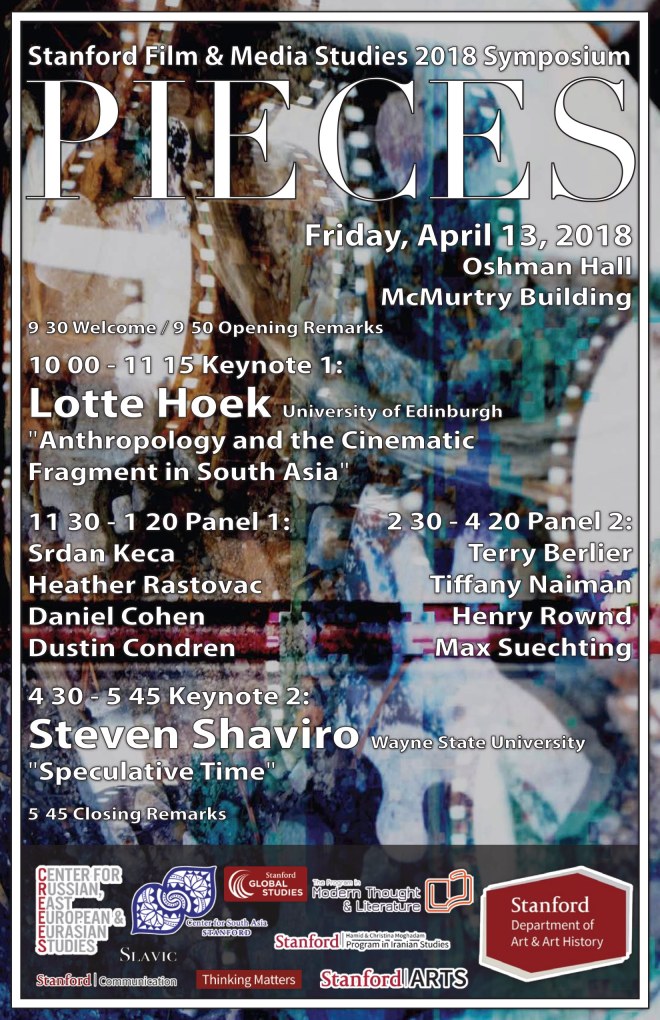
The inaugural Stanford Film and Media Studies Symposium takes place on Friday April 13, 2018 in Oshman Hall. The theme of the conference is “Pieces” and talks will address questions concerning how bits of film and media make us rethink the relation of part to whole and what methods artists use to make discrete pieces—temporal, spatial, material, performative—that may or may not fit into larger collaborative works.

The keynote speakers are Lotte Hoek (University of Edinburgh) on “Anthropology and the Cinematic Fragment in South Asia” and Steven Shaviro (Wayne State University) on “Speculative Time.” In addition, there will be two panels. The first will feature an artist’s talk by Srdan Keca (Documentary Film and Video); Daniel Cohen (Art & Art History) on “Chinese Comedy and the Postsocialist Art of Deflation”; Heather Rastovac Akbarzadeh (Dance Studies) on “Sensorial Performativity of the ‘Veil’ in Aisan Hoss’s Dance-Theater The Pleasant Pain”; and Dustin Condren (Slavic) on Sergei Eisenstein’s film scenario MMM. Terry Berlier (Art Practice) will deliver an artist’s talk on the second panel, followed by Tiffany Naiman (Thinking Matters) on “Memory, Meaning, and Fragmentation in David Bowie’s ‘Blackstar’; Henry Rownd (Art & Art History) on the marked disjuncture between widescreen and pan-and-scan in Otto Preminger’s late work Skidoo (1968); and Max Suechting (Modern Thought and Literature) on “Fragments and Wholes in J Dilla’s Donuts.”

9:30am – Welcome
9:50am – Opening Remarks
10:00am – Keynote Speaker
11:30am – Panel 1
2:30pm – Panel 2
4:30pm – Keynote Speaker
5:45 pm – Closing Remarks

Department of Art & Art History, Film & Media Studies, thanks their sponsors: Center for South Asia, Office of the Vice President for the Arts, CREEES Center for Russian, East European & Eurasian Studies, Stanford Global Studies Division, Department of Slavic Languages and Literatures, Iranian Studies, The Program in Modern Thought & Literature, Department of Communication, Thinking Matters.

See also the official announcement here: https://art.stanford.edu/events/stanford-film-and-media-studies-symposium-pieces

Review of Post-Cinema: Theorizing 21st-Century Film, Screen 59:1 (2018)

Screen Shot 2018-03-19 at 5.48.10 PM

Lisa Åkervall has a review out in the latest issue of Screen, covering three works on post-cinema: 1) the open-access volume that I edited with Julia Leyda, Post-Cinema: Theorizing 21st-Century Film; 2) the special issue of Cinéma & Cie (16:26-27, 2016), titled ‘Post-what? Post-when? Thinking moving images beyond the post-medium/post-cinema condition,’ edited by Miriam de Rosa and Vinzenz Hediger (which also includes my article on “Speculation, Transition, and the Passing of Post-Cinema”); and 3) Malte Hagener, Vinzenz Hediger, and Alena Strohmeier’s edited collection The State of Post-Cinema: Tracing the Moving Image in the Age of Digital Dissemination

About the collection I co-edited with Julia Leyda, Åkervall writes:

“Shane Denson and Julia Leyda’s comprehensive volume Post-Cinema: Theorizing 21st-Century Film, an open access online publication by Reframe Books, presents a multifaceted compendium. […] The editors’ framing in Post-Cinema is precise and penetrating, flexible enough to accommodate enduring themes in film and media studies while also making allowances for new questions associated with topics such as digital media aesthetics, media archaeology and environmental studies. Their volume rejects the idea that postcinema is merely a successor to cinema or a step in the teleological digitalization of all media, instead identifying it with competing perspectives on a changing media situation that bears on cinema as an institution, a practice and a medium. In this respect the volume admirably addresses our changing media landscape.”

Read the full review here.

Let’s Make a Monster! Critical Making (Stanford, Spring 2018)

LetsMakeAMonster

Ever since Frankenstein unleashed his monster onto the world in Mary Shelley’s novel from 1818, the notion of “technology-out-of-control” has been a constant worry of modern societies, plaguing more optimistic visions of progress and innovation with fears that modern machines harbor potentials that, once set in motion, can no longer be tamed by their human makers. In this characteristically modern myth, the act of making — and especially technological making — gives rise to monsters. As a cautionary tale, we are therefore entreated to look before we leap, to go slow and think critically about the possible consequences of invention before we attempt to make something radically new. However, this means of approaching the issue of human-technological relations implies a fundamental opposition between thinking and making, suggesting a split between cognition as the specifically human capacity for reflection versus a causal determinism-without-reflection that characterizes the machinic or the technical. Nevertheless, recent media theory questions this dichotomy by asserting that technologies are inseparable from humans’ abilities to think and to act in the world, while artistic practices undo the thinking/making split more directly and materially, by taking materials — including technologies — as the very medium of their critical engagement with the world. Drawing on impulses from both media theory and art practice, “critical making” names a counterpart to “critical thinking” — one that utilizes technologies to think about humans’ constitutive entanglements with technology, while recognizing that insight often comes from errors, glitches, malfunctions, or even monsters. Co-taught by a practicing artist and a media theorist, this course will engage students in hands-on critical practices involving both theories and technologies. Let’s make a monster!

ARTSTUDI 233, FILMSTUD 233/433 — Spring 2018 — Profs. Paul DeMarinis & Shane Denson — Thursdays 3:00-5:50pm