Ludic Serialities @ CUNY

ludic-serialities.001

On April 23-24, 2015, I will be participating in the conference “Thinking Serially: Repetition, Continuation, Adaptation,” hosted by the Department of Comparative Literature at the Graduate Center, CUNY. You can find the full program here, and here is the abstract for the talk I’ll be giving:

Ludic Serialities: Levels of Serialization in Digital Games and Gaming Communities

Shane Denson (Duke University, Program in Literature)

In this paper, I outline several layers of seriality that are operative in and around the medium of digital games. Some of these resemble pre-digital forms of popular seriality, as they have been articulated in commercial entertainments since the nineteenth century; others would seem to be unique to digital formats and the ludic forms of interactivity they facilitate. Thus, the “inter-ludic” seriality of sequels, remakes, and spinoffs that constitute popular game franchises are recognizable in terms of the (predominantly narrative) seriality that has characterized serialized novels, films serials, television series, cinematic remakes and blockbuster trilogies. But these franchises also give rise to “para-ludic” forms of seriality that are more squarely at home in the digital age: games form parts of larger transmedia franchises, which depend in many ways on the infrastructure of the Internet to support exchanges among fans. On the other hand, games also articulate low-level “intra-ludic” serialities through the patterns of repetition and variation that characterize game “levels” and game engines. These serialized patterns are often non-narrative in nature, manifesting themselves in the embodied rhythms instantiated as players interface with games; they therefore challenge the traction of pre-digital conceptions and point to what would appear an unprecedented form of “infra-ludic” serialization at the level of code and hardware. Interestingly, however, such ultra-low-level serialities remain imbricated with the high-level seriality of socio-cultural exchange; levels of code and community cross, for example, in highly serialized modding communities.

This presentation takes a comparative approach in order to identify historical, cultural, and medial specificities and overlaps between digital and pre-digital forms of seriality. Besides outlining the levels of seriality described above, I will also look at methodological challenges for studying these new forms, as well as several approaches (including both close and “distant” forms of reading) designed to meet these challenges.

Bibliography:

Boluk, Stephanie, and Patrick LeMieux. “Hundred Thousand Billion Fingers: Seriality and Critical Game Practices.” Leonardo Electronic Almanac 17.2 (2012): 10-31. http://www.leoalmanac.org/wp-content/uploads/2012/04/LEAVol17No2- BolukLemieux.pdf

Denson, Shane, and Andreas Jahn-Sudmann. “Digital Seriality: On the Serial Aesthetics and Practice of Digital Games.” Eludamos: Journal for Computer Game Culture 7.1 (2013): 1-32. http://www.eludamos.org/index.php/eludamos/article/view/vol7no1-1/7-1-1- pdf

Denson, Shane, and Andreas Jahn-Sudmann, eds. Digital Seriality. Special issue. Eludamos: Journal for Computer Game Culture 8.1 (2014). http://www.eludamos.org/index.php/eludamos/issue/view/vol8no1

Kelleter, Frank, ed. Populäre Serialität: Narration – Evolution – Distinktion. Zum seriellen Erzählen seit dem 19. Jahrhundert. Bielefeld: Transcript, 2012.

Mario Modding Madness

2015-02-03 09.24.30 pm

In case you missed it: you can watch a split-screen video presentation of my digital humanities-oriented talk, “Visualizing Digital Seriality,” which I gave last Friday, January 30, 2015, at Duke University — here (or click the image above).

More about the project can be found here.

Livestream: Visualizing Digital Seriality

2015-01-28 02.54.54 pm

According to the Duke Visualization Friday Forum website, my talk this Friday — “Visualizing Digital Seriality: Correlating Code and Community in the Super Mario Modding Scene” — will be streamed live: here.

The talk will take place at 12:00 Eastern time, Jan. 30, 2015.

Visualizing Digital Seriality / Duke Visualization Friday Forum

smb3-references

On January 30, 2015 (12:00-1:00pm), I will be speaking about visualization techniques and game-related serialization processes at the Duke Visualization Friday Forum. Organized by Eric Monson and Angela Zoss, this is a very exciting and robustly interdisciplinary venue, as the long list of sponsors for the weekly forum indicates: Information Science + Information Studies, the Duke immersive Virtual Environment (or DiVE), Media Arts + Sciences, Data and Visualization Services, the Department of Computer Science, Research Computing at the Office of Information Technology, and Visualization & Interactive Systems.

As this list indicates, the Visualization Friday Forum has the potential to take just about anyone — but especially humanities-types like me — out of their comfort zone; but it does so in the most comfortable way possible: the informal setting of a lunchtime chat fosters a type of exchange that is interdisciplinary in the best sense. Artists, computer scientists, media scholars, digital humanists, historians, literary critics, mathematicians, and researchers in the natural sciences, among others, make a genuine effort to understand one another. And, to judge from the times I have been present or watched a live-stream of the Forum, this effort is usually quite successful.

So here’s hoping that my own effort at interdisciplinary dialogue will be as successful! In my talk, I will discuss an ongoing project, some preliminary findings of which I posted not too long ago. Here’s the abstract:

Visualizing Digital Seriality: Correlating Code and Community in the Super Mario Modding Scene

Shane Denson (DAAD Postdoctoral Fellow, Duke Literature)

Seriality is a common feature of game franchises, with their various sequels, spin-offs, and other forms of continuation; such serialization informs social processes of community-building among fans, while it also takes place at much lower levels in the repetition and variation that characterizes a series of game levels, for example, or in the modularized and recycled code of game engines. This presentation considers how tools and methods of digital humanities – including “distant reading” and visualization techniques – can shed light on serialization processes in digital games and gaming communities. The vibrant “modding” scene that has arisen around the classic Nintendo game Super Mario Bros. (1985) serves as a case study. Automated “reading” techniques allow us to survey a large collection of fan-based game modifications, while visualization software such as Tableau and Palladio help to bridge the gap between code and community, revealing otherwise invisible connections and patterns of seriality.

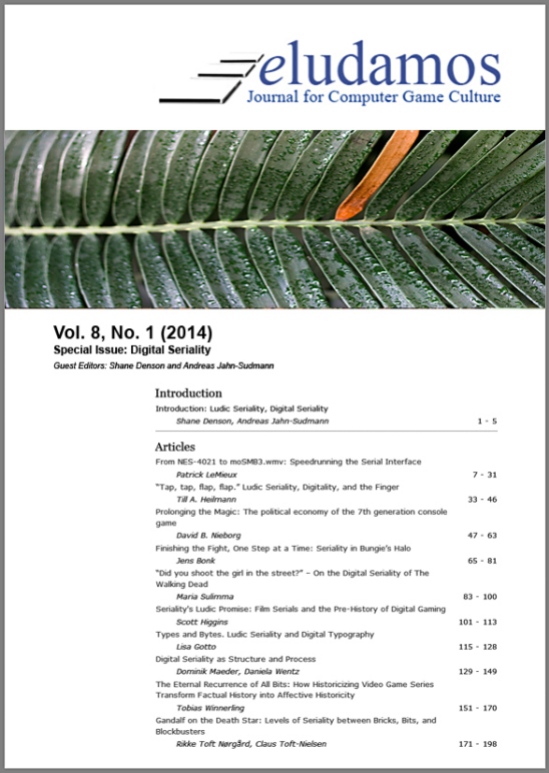
Out Now: Digital Seriality — Special Issue of Eludamos

eludamos-digital-seriality-cover

The latest issue of Eludamos: Journal for Computer Game Culture, a special issue devoted to the topic of “Digital Seriality” — edited by yours truly, together with Andreas Jahn-Sudmann — is now out! Weighing in at 198 pages, this is one of the fattest issues yet of the open-access journal, and it’s jam-packed with great stuff like:

  • Patrick LeMieux on the culture and technology of tool-assisted speedrunning
  • Jens Bonk on the serial structure of Halo
  • Scott Higgins on the ludic pre-history of gaming in serial films
  • Lisa Gotto on ludic seriality and digital typography
  • Tobias Winnerling on the serialization of history in “historical” games
  • Till Heilmann on Flappy Bird and the seriality of digits
  • David B. Nieborg on the political economy of blockbuster games
  • Rikke Toft Nørgård and Claus Toft-Nielsen on LEGO as an environment for serial play
  • Dominik Maeder and Daniela Wentz on serial interfaces and memes
  • Maria Sulimma on cross-medium serialities in The Walking Dead!

So what are you waiting for? Do yourself a favor and check out this issue now!

“Digital Seriality” — Panel at #SCMS15 in Montreal

giphy-digital-seriality

At the upcoming conference of the Society for Cinema and Media Studies (March 25-29, 2015 in Montréal), I will be participating in a panel on “Digital Seriality,” co-chaired by Andreas Jahn-Sudmann and Scott Higgins, along with Dominik Maeder and Daniela Wentz.

Here is our panel description, along with links (below) to the abstracts for the various papers:

Digital Seriality

Seriality and the digital are key concepts for an understanding of many current forms, texts, and technologies of media, and they are implicated in much broader media-historical trajectories as well. Beyond the forms and functions of specific cultural artifacts, they are central to our global media ecology. Surprisingly, though, relatively few attempts have been made at thinking the digital and the serial together, as intimately connected perspectives on media. This is precisely the task of the present panel. On the one hand, the papers interrogate the serial conditions, forms, and effects of digital culture; on the other hand, they question the role of the digital as technocultural embodiment, determinant, or matrix for serialized media aesthetics and practices. The panel thus brings together heretofore isolated perspectives from studies of new media culture (cf. Manovich 2001, Jenkins 2006) and emerging scholarship on seriality (cf. Kelleter 2012, Allen and van den Berg 2014).

Seriality and digitality are understood here in terms not only of their narrative/representational manifestations but also their technical-operational impacts on our media environments. Accordingly, Shane Denson and Andreas Jahn-Sudmann’s paper looks to the case of the Xbox One in order to show how computational platforms affect the serial forms and practices emerging within, among, and around digital games (“intra-,” “inter-,” and “para-ludic” serialities; cf. Denson and Jahn-Sudmann 2013), but also how these platforms inscribe themselves – as a serialized factor in their own right – into the parameters of computational expression. Whereas video games serve here to highlight the differences between digital and pre-digital serial forms, Dominik Maeder approaches things from the opposite direction, arguing that the interfaces of Netflix, Hulu, and other digital streaming services embody a form of spatio-temporal serialization that, already anticipated by TV series, is closely related to (pre-digital) televisual seriality. As a complementary perspective, Daniela Wentz’s paper shows how certain TV series anticipate their own digital afterlives in the form of fan-made gifs and memes. Finally, Scott Higgins provides an “archeological” perspective, exploring the ludic dimensions of the operational aesthetic, which anticipates computer games in pre-digital forms, thus offering a fruitful case for rethinking digital seriality from a media-comparative perspective.

Bibliography

Allen, Robert, and Thijs van den Berg, eds. Serialization in Popular Culture. London: Routledge, 2014.

Denson, Shane, and Andreas Jahn-Sudmann. “Digital Seriality: On the Serial Aesthetics and Practice of Digital Games.” Eludamos: Journal for Computer Game Culture 7.1 (2013): 1-32.

Jenkins, Henry. Convergence Culture: Where Old and New Media Collide. New York: New York UP, 2006.

Kelleter, Frank, ed. Populäre Serialität: Narration – Evolution – Distinktion. Zum seriellen Erzählen seit dem 19. Jahrhundert. Bielefeld: Transcript, 2012.

Manovich, Lev. The Language of New Media. Cambridge, MIT, 2001.

Finally, here are links to the individual abstracts:

Shane Denson and Andreas Jahn-Sudmann, “The Xbox One as Serial Hardware: A Technocultural Approach to the Seriality of Computational Platforms”

Dominik Maeder, “Serial Interfaces: Publishing and Programming Television on Digital Platforms”

Daniela Wentz, “The Infinite Gesture: The Serial Culture of the Gif”

Scott Higgins, “Ludic Operations: Play and the Serial Action Sequence”

Shane Denson and Andreas Jahn-Sudmann, “The Xbox One as Serial Hardware: A Technocultural Approach to the Seriality of Computational Platforms” #SCMS15

giphy-xbox-one

Here is the abstract for Shane Denson and Andreas Jahn-Sudmann’s paper on the panel “Digital Seriality” at the 2015 SCMS conference in Montréal:

The Xbox One as Serial Hardware: A Technocultural Approach to the Seriality of Computational Platforms

Shane Denson (Duke University) and Andreas Jahn-Sudmann (Free University Berlin)

In order to fully understand the serial aesthetics and practices of digital game culture, seriality must be addressed not only on the level of software or gameplay, but also as a hardware phenomenon. The (un)official numbering of console generations serves to mark innovations serially (e.g. PlayStation, PS2, PS3, PS4), and this accords generally with the way in which the technical, aesthetic, and economic evolution of game software and hardware follows a serial logic of “one-upmanship” (cf. Jahn-Sudmann and Kelleter 2012). However, some systems like the new Xbox One ostensibly refuse the additive logic of innovation (the would-be “Xbox 720”) and perform a symbolic reboot instead (cf. Denson and Jahn-Sudmann 2013). Yet this revolutionary rhetoric, along with its connotation of exclusivity, seems hardly compatible with the serial remake-logic of game engines, for instance. These engines function not only to allow games to be run on various platforms (PC, consoles, etc.) with only minor changes to their source code, but also serve to make the reusability of core software components easier and faster, thus increasing the economic viability of game series. Already against this backdrop, the technical development of consoles has to be conceptualized, almost inevitably, as a process of media evolution rather than of media revolution.

In our paper, we seek to explore how game consoles like the Xbox One not only enable and constrain aesthetic forms and practices of ludic seriality, but also how these platforms themselves emerge as serial factors of technocultural expression. The presentation focuses particularly on two questions: First, and more generally, how can the theoretical and historical perspective of “platform studies” (as advocated by Montfort and Bogost 2009) contribute to the study of digital seriality? Second, in how far can we think of the game console as a computational platform that mediates different levels of ludic seriality (forms of serialization within the game, between games, and “outside” the game) while also shaping the cultural forms of what we call “collective serialization” (i.e. processes of community-formation in connection with the consumption of serialized media) and “serial interfacing” (i.e. the temporal-serial experiences that transpire at the interface between humans and digital technologies) (Denson and Jahn-Sudmann 2013)?

Bibliography

Denson, Shane, and Andreas Jahn-Sudmann. “Digital Seriality: On the Serial Aesthetics and Practices of Digital Games.” Eludamos: Journal for Computer Game Culture 7.1 (2013): 1-32.

Jahn-Sudmann, Andreas, and Frank Kelleter. “Die Dynamik serieller Überbietung: Amerikanische Fernsehserien und das Konzept des Quality TV.” Populäre Serialität: Narration-Evolution-Distinktion. Zum seriellen Erzählen seit dem 19. Jahrhundert. Ed. Frank Kelleter. Bielefeld: Transcript Verlag, 2012. 205-224.

Montfort, Nick, and Ian Bogost. Racing the Beam. The Atari Video Computer System. Cambridge; London: The MIT Press, 2009.


Author Bios:

Shane Denson is a DAAD postdoctoral fellow at Duke University and a member of the research unit “Popular Seriality—Aesthetics and Practice.” He is the author of Postnaturalism: Frankenstein, Film, and the Anthropotechnical Interface (Transcript 2014) and co-editor of several collections: Transnational Perspectives on Graphic Narratives (Bloomsbury, 2013), Digital Seriality (special issue of Eludamos, forthcoming), and Post-Cinema: Theorizing 21st Century Film (REFRAME, forthcoming).

Andreas Jahn-Sudmann is assistant professor at the John F. Kennedy Institute for North American Studies (Freie Universität Berlin) and a member of the research unit “Popular Seriality—Aesthetics and Practice,” in which he co-directs the project “Digital Seriality.” He is the author of a book on American independent film, Der Widerspenstigen Zähmung? (Transcript, 2006), and co-editor of several anthologies, among them: Computer Games as a Sociocultural Phenomenon (Palgrave, 2008).

Daniela Wentz, “The Infinite Gesture: The Serial Culture of the Gif” #SCMS15

giphy-brando

Here is the abstract for Daniela Wentz’s paper on the panel “Digital Seriality” at the 2015 SCMS conference in Montréal:

The Infinite Gesture: The Serial Culture of the Gif

Daniela Wentz (Bauhaus University)

The looping digital moving image format of the animated gif enjoys an extremely high level of popularity at present within (digital) media culture. Although gifs are one of the oldest image formats on the web, they have established themselves as a dominant part of the aesthetics and image practices of today’s networked media. At the same time, these images challenge the conceptual frameworks within which we understand moving images, demanding in particular that they be accounted for in terms of a robust and multifacted notion of seriality.

This paper addresses the multiple dimensions in which seriality is crucial for the logics and functions of animated gifs: firstly, their occurrence as loops, repeating the same gesture or facial expression ad infinitum; secondly, the part they play in the production and spread of memes, which circulate on social networks and other platforms; and thirdly, their assemblage into “supercut” videos, fan-produced compilation videos that strive to collect a comprehensive set of recurring actions, phrases, camera angles, or other elements into a single montage. Memes are themselves processes which are based in a thoroughly serial processuality, in processes of coupling, doubling, replication, repetition, imitation, and more or less independent distribution (Shifman 2014). Supercut videos, for their part, can be understood as analytical tools to reveal patterns and notorious clichés also far beyond the borders of Internet culture. Serial repetition thus represents the heart of the aesthetic and analytical potential of the animated gif, as well as the larger media ecology of which it is a part; accordingly, these mechanisms of serialization must be taken into account in any analysis of the basic characteristics of networked, digital media.

Bibliography:

Fuller, Matthew: Media Ecologies: Materialist Energies in Art and Technoculture. Cambridge, Mass. and London: The MIT Press, 2007.

Hagman, Hampus: “The Digital Gesture: Rediscovering Cinematic Movement through Gifs.” Refractory 21 (2012), Special Issue on “Digital Cartography: Screening Space”: http://refractory.unimelb.edu.au/2012/12/29/hagman/ 6/9, 2012.

Shifman, Limor: Memes in Digital Culture. Cambridge, Mass. and London: The MIT Press, 2014.


Author Bio:

Daniela Wentz is a researcher and lecturer at the “Internationales Kolleg für Kulturtechnikforschung und Medienphilosophie (IKKM), Bauhaus-University Weimar. Her main fields of research are media philosophy, seriality, diagrammatics, and television studies. She is the author of Bilderfolgen: Diagrammatologie der Fernsehserie (Fink, forthcoming 2015) and co-editor of a special issue of Zeitschrift für Medienwissenschaft on “The Series.”

Scott Higgins, “Ludic Operations: Play and the Serial Action Sequence” #SCMS15

giphy-train

Here is the abstract for Scott Higgins’s paper on the panel “Digital Seriality” at the 2015 SCMS conference in Montréal:

Ludic Operations: Play and the Serial Action Sequence

Scott Higgins (Wesleyan University)

In “Digital Seriality: On the Serial Aesthetics and Practice of Digital Games,” Shane Denson and Andreas Jahn-Sudmann call for “a serious consideration of both the specificities of game-based serialities and the common ground they share with other media-cultural practices and aesthetic forms.” This essay heeds that call, albeit in reverse. If the concept of play can illuminate serial qualities of digital games, then perhaps analog serial forms should be regarded in terms of their ludic potentials. In particular, the concept of operational aesthetics connects the Hollywood sound serial and the contemporary action film to the kind of spatial, physical, problem solving basic to many digital games.

Tom Gunning brought the concept of “operational aesthetics” to film studies from Neil Harris’ study of P.T. Barnum. For Gunning, the term describes an essential fascination with seeing systems at work, “visualizing cause and effect through the image of the machine.” While Gunning traces this pleasure to early gag films and slapstick comedy, which he sees as at odds with studio-era plotting, the sound serial’s weekly death traps and infernal machines give pride of place to similar processes. Cliffhangers are physical traps with clear procedural boundaries: story potential is embedded within concrete mechanisms. The best cliffhangers achieved such visual and spatial clarity that viewers might feel something like a gamers’ agency, tracing out potential outcomes. In their design of narrative space, and their obsession with physical process, cliffhangers prefigure the fully ludic architectures of digital games. Similarly, Lisa Purse proposes that the contemporary action genre enacts a “fantasy of spatial mastery,” an embodied experience of overcoming physical constraints and boundaries. From Bond to Raiders to the Marvel franchises, action films have inherited the serial’s operational logic, placing inhabitable characters in diagrammatically vivid problem spaces.

My paper explores the operational action sequence as a form of ludic narrative, drawing examples from Captain Midnight, Raiders of the Lost Ark, and Guardians of the Galaxy. As transmedial action properties, both serials and blockbusters maintain a direct connection to the culture of play via seriality’s interrupted continuity. Operational aesthetics forms a bridge between story and game. I hope this research will help embolden the field to pursue the ludology of film narrative.

Bibliography:

Denson Shane, and Andreas Jahn-Sudmann. “Digital Seriality: On the Serial Aesthetics and Practice of Digital Games.” Eludamos: Journal for Computer Game Culture 7.1 (2013): 1-32..

Gunning, Tom. “Crazy Machines in the Garden of Forking Paths.” Classical Hollywood Comedy. Eds. Kristine Brunovska Karnick and Henry Jenkins. New York: Routledge, 1995. 87-105.

Juul, Jesper. Half-Real: Video Games between Real Rules and Fictional Worlds. Cambridge, MA: MIT Press, 2005.

Murray, Janet. “From Game-Story to Cyberdrama.” First Person: New Media as Story, Performance, and Game. Eds. Noah Wardrip-Fruin and Pat Harrigan. Cambridge MA: MIT Press, 2004. 2-11.

Purse, Lisa. Contemporary Action Cinema. Edinburgh: Edinburgh UP, 2011.


Author Bio:

Scott Higgins is associate professor and chair of film studies at Wesleyan University. His interests include genre, narrative theory, film aesthetics, and technology. His first book, entitled Harnessing the Technicolor Rainbow, is published by the University of Texas Press. His second is the edited volume Arnheim for Film and Media Studies, published by Routledge. He is working on a manuscript about sound serials of the 1930s-1950s.

DAAD Postdoctoral Fellowship at Duke University

Logo-DAAD-webDuke_logo

At long last, I am excited to announce that my application for a 2-year postdoctoral fellowship at Duke University has been approved for funding through the DAAD (German Academic Exchange Service). At Duke, I will be working closely with Mark B. N. Hansen and other scholars of media and culture to develop a media-archaeological perspective on serialization processes in video games and digital media culture more generally. The fellowship, which runs from August 2014 to July 2016, will allow me to conduct archival research in the US that will supplement and expand my work in the project “Digital Seriality” that I co-direct with Andreas Jahn-Sudmann in the context of the DFG Research Unit “Popular Seriality — Aesthetics and Practice.” Needless to say, I am very excited about this, and I will continue to post updates here! More soon…