Let’s Make a Monster! Critical Making (Stanford, Spring 2018)

LetsMakeAMonster

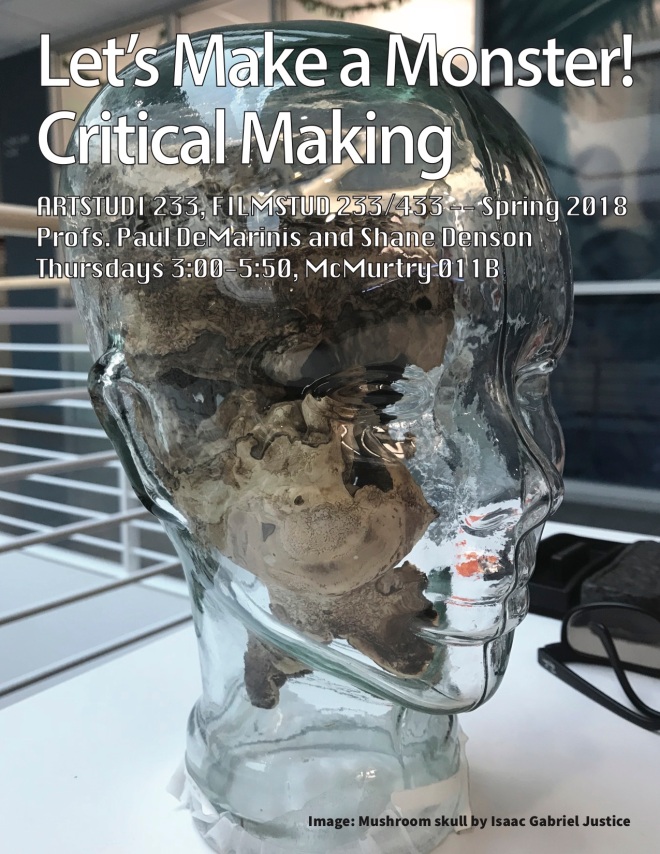
Ever since Frankenstein unleashed his monster onto the world in Mary Shelley’s novel from 1818, the notion of “technology-out-of-control” has been a constant worry of modern societies, plaguing more optimistic visions of progress and innovation with fears that modern machines harbor potentials that, once set in motion, can no longer be tamed by their human makers. In this characteristically modern myth, the act of making — and especially technological making — gives rise to monsters. As a cautionary tale, we are therefore entreated to look before we leap, to go slow and think critically about the possible consequences of invention before we attempt to make something radically new. However, this means of approaching the issue of human-technological relations implies a fundamental opposition between thinking and making, suggesting a split between cognition as the specifically human capacity for reflection versus a causal determinism-without-reflection that characterizes the machinic or the technical. Nevertheless, recent media theory questions this dichotomy by asserting that technologies are inseparable from humans’ abilities to think and to act in the world, while artistic practices undo the thinking/making split more directly and materially, by taking materials — including technologies — as the very medium of their critical engagement with the world. Drawing on impulses from both media theory and art practice, “critical making” names a counterpart to “critical thinking” — one that utilizes technologies to think about humans’ constitutive entanglements with technology, while recognizing that insight often comes from errors, glitches, malfunctions, or even monsters. Co-taught by a practicing artist and a media theorist, this course will engage students in hands-on critical practices involving both theories and technologies. Let’s make a monster!
ARTSTUDI 233, FILMSTUD 233/433 — Spring 2018 — Profs. Paul DeMarinis & Shane Denson — Thursdays 3:00-5:50pm

Out Now: ETC Media 110

etc_media_110

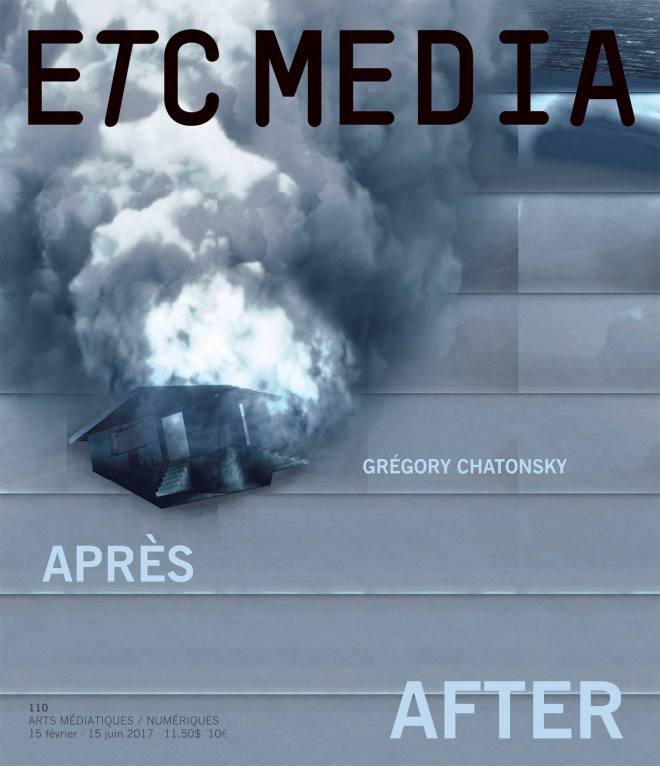
I am proud to have a piece on “Pre-Sponsive Gestures” and the work of French media artist Grégory Chatonsky included in the new issue of the Montreal-based ETC Media. Looks like a great issue, and happy to be in such good company!

CURRENT ISSUE // 110
GRÉGORY CHATONSKY: APRÈS LE RÉSEAU / AFTER THE NETWORK

Issue 110 of ETC MEDIA is dedicated to Grégory Chatonsky, who has curated the form and content of this special issue. A Montreal resident for the last ten years, the artist is a pioneer of net art, founding Incident.net in 1994, and an unflagging explorer of the relationships between technology and anonymous existence. In this issue, the artist and a few other friends, artists, philosophers, art historians, and art critics reconsider the last two decades of experimentation, a time in which the world drastically changed through the widespread use of the Internet to reach a digital omnipresence that heralds a near extinction. Divided into 3 sections—“infinitude,” “hyperproduction,” “without ourselves”—ETC MEDIA becomes a platform for navigating in our era and gaining a better understanding of a future whose portents remain deeply ambivalent—promising and threatening all at once. Rather than being reduced to trendy notions often misunderstood by the contemporary art milieu, the concepts of post-digital, accelerationism, and speculative materialism constellate a world in the process of perishing and being born.

Collaborators

Grégory Chatonsky
Eve K. Tremblay
Pau Waelder
Bertrand Gervais and Arnaud Regnauld
Shane Denson
DeForrest Brown Jr.
Goliath Dyèvre
Pierre Cassou-Noguès
Erik Bordeleau
Nora N. Khan
Dylan Trigg
Pierre-Alexandre Fradet
Jussi Parikka

Frankenstein@200

frankenstein-logo-no-border

Happy to be on the steering committee for Frankenstein@200 — a year-long series of events taking place at Stanford in 2018. I’ll be participating in a number of ways, including  talks and several courses related to Frankenstein, among other things. I’ll post details here in due time. Also be sure to check out the project website, which is still under construction, but which is already chock full of announcements and constantly being updated.

The year 2018 marks the 200th anniversary of the publishing of Mary Shelley’s novel Frankenstein. The novel is eerily relevant today as we face ethical dilemmas around appropriate use of stem cells, questions about organ donation and organ harvesting, as well as animal to human transplants. Additionally, the rise of artificial intelligence portends an uncertain future of the boundaries between machines and humans. Frankenstein@200, will be a year-long series of academic courses and programs including a film festival, a play, a lecture series and an international Health Humanities Conference that will examine the numerous moral, scientific, sociological, ethical and spiritual dimensions of the work, and why Dr. Frankenstein and his monster still capture the moral imagination today. This project will be sponsored by the Stanford Medicine & the Muse Program in partnership with the Stanford Humanities Center, the Stanford Arts Institute, the Office of Religious Life, the Vice Provost for Teaching and LearningStanford Continuing Studies, the Cantor Arts Center, the Department of Art & Art History, and the Center for Biomedical Ethics.

Post-Cinema AR

13122900_1733166986928333_1269794987351584805_o13131607_1733166983595000_88851548299674089_o

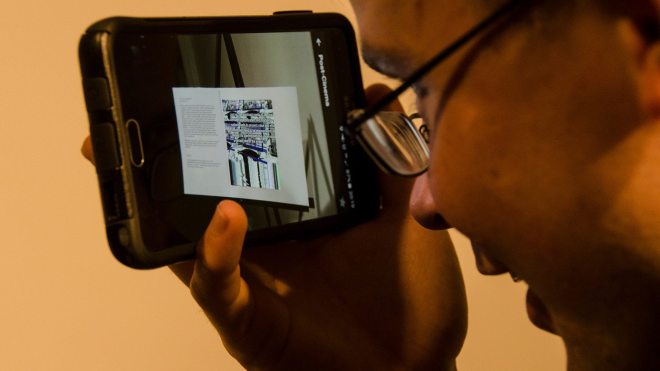
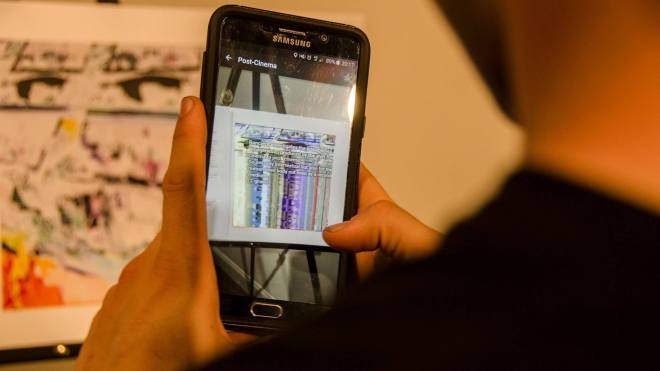
The augmented reality piece featured on the cover of Post-Cinema: Theorizing 21st-Century Film (http://reframe.sussex.ac.uk/post-cinema/), a collaborative piece made by Karin Denson and me, was displayed recently at a glitch-oriented gallery show organized by some nice people associated with Savannah College of Art and Design.

Try it out for yourself here: http://reframe.sussex.ac.uk/post-cinema/artwork/.

After.Video at Libre Graphics 2016 in London

banner_glitch_1

Recently, I posted about a project called after.video, which contains an augmented (AR) glitch/video/image-based theory piece that Karin Denson and I collaborated on. It has now been announced that the official launch of after.video, Volume 1: Assemblages — a “video book” consisting of a paperback book and video elements stored on a Raspberry Pi computer packaged in a VHS case, which will also be available online — will take place at the Libre Graphics Meeting 2016 in London (Sunday, April 17th at 4:20pm).

Making Mining Networking: Exhibition Extended, But Not For Long…

Tutorial_Level

Making Mining Networking went on display on April 20, 2015 at Duke University’s The Edge digital workspace. The show was originally scheduled to run until mid May, but it was extended several times until September 2015. After that, a few of the pieces are slated to be shown in Fall 2015 in an exhibit organized by the online journal Hyperrhiz: New Media Cultures and the Digital Studies Center at Rutgers University Camden.

In the meantime, however, it was reported in late May that the augmented reality platform we used to build the interactive components of our pieces had been sold – effectively putting an expiration date on our artworks. Metaio GmbH, makers of the popular Junaio AR browser and the underlying engine that allowed us to augment our QR-based paintings with videos, 3D objects, and HTML hyperlinks, were acquired by one of the biggest corporations in the business: Apple.

Even before the buyout was confirmed, rumors had started circulating after Metaio abruptly closed their community forums, cancelled their annual developers’ convention, and stopped selling their software and services. An ominous message went up on the Metaio website (metaio.com):

Metaio products and subscriptions are no longer available for purchase.

Downloads of your previous purchases will be available until December 15th, 2015, and active cloud subscriptions will be continued until expiration. Email support will continue until June 30th, 2015.

Thank you.

(No, thank you!) Lacking any explanation, users of the Metaio/Junaio AR platform were left to speculate about the future of their advertising campaigns, educational applications, and (as in our case) artworks.

Shortly thereafter, after the acquisition by Apple came to light, our worst fears were confirmed in the FAQs section on junaio.com. There we read:

Channel publishing to Junaio is no longer available. All existing channels will continue to be available until December 15th, 2015.

In other words, the pieces included in Making Mining Networking will no longer be functional at the end of the year. The QR codes painted on these canvases will no longer work; the pieces will then be flattened from the interactive physical/virtual assemblages they were designed to be and rendered into … paintings. Or worse, they will retain an executable dimension, albeit a non-operational one, and it will be supplemented by a weirdly representational dimension: effectively, these will then be paintings of 404 error codes.

MarxMarkovPainting-frame

Like all of the pieces, “The Magical Marx-Markov Manifesto Maker” is therefore destined to lose its magic; the QR code, when scanned with a smartphone, will lead the user’s browser into virtual nothingness. On the other hand, though, pieces like “The Gold Standard” and “Gnomecrafting” might still have something to tell us – precisely because their non-operationality will render visible the inevitable entanglement of proprietary platforms and obsolescent objects that is the material heart and soul of digital capital.

goldstandard-coins_frame

Making Mining Networking is (or was?) about probing the borders between the virtual and the physical – boundaries that are inscribed in stone (e.g. rare earths) as much as they are written in code. With our works, we have sought to invite users to experiment with this interface, opting for a playful approach to a space that we know is about deadly serious transactions (in the realms of capital and of the environment, to begin with). We installed our data gnomes at the physical/virtual border where they stood as talismans to ward off the bad spirits of digital capital – but we were never so naïve as to believe that they could really protect us for long. We still believe that we regained something of personal value by reclaiming our data from corporate mining and making something weird and inscrutable with it, but now a corporate transaction is about to render our productions invisible.

gnomecrafting_small

Again, however, it is the seeming totality of such corporate power to make things invisible – to make all that’s solid melt into zeroes and ones – that is paradoxically made visible at this juncture, where links are inoperative, QR codes are non-functional, and paintings are not just paintings but paintings of such failure.

The_9-small

Data-Portrait2 Data_Portrait1

Following our initial disappointment, then, we now now eagerly await the appointed date, our “doomsday” of December 15, 2015 – when the truth of Making Mining Networking will be revealed. Will it be a simple 404 message, or can we hope for something else to make manifest the physical/virtual interface as it exists in our era of climate change, high-speed finance, and the biopolitical mining of all that breathes and lives? Only time will tell…

In the meantime, these works exist as reminders of the expiration date that is implicitly inscribed in all of our devices – and, potentially, our very planet – at the hands of global digital capital. Play with them, think with them, experience with them – and await with us their obsolescence…

IMG_9422a