Deformative Criticism at #SCMS17

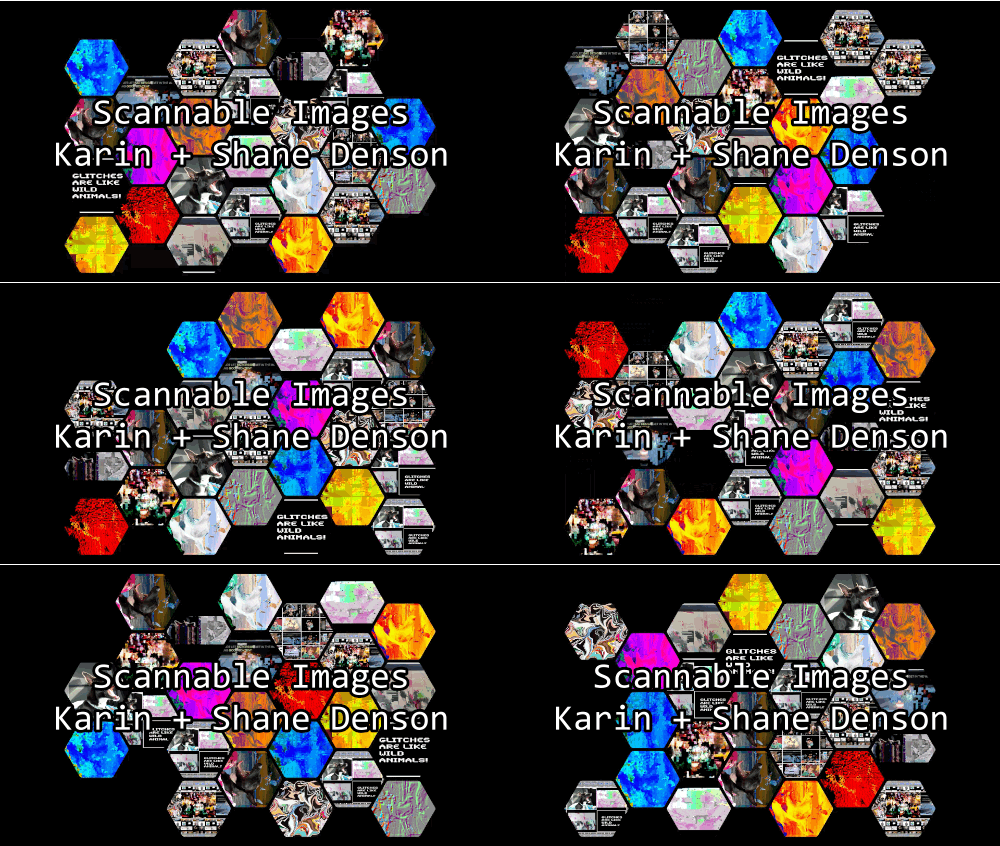
ScannableImages-smallgif

At the upcoming SCMS conference in Chicago, I will be participating in a workshop on “Deformative Criticism and Digital Experimentations in Film & Media Studies” (panel K3 on Friday, March 24, 2017 at 9:00am):

Deformative criticism has emerged as an innovative site of critical practice within media studies and digital humanities, revealing new insights into media texts by “breaking” them in controlled or chaotic ways. Deformative criticism includes a wide range of digital experiments that generate heretical and non-normative readings of media texts; because the results of these experiments are impossible to know in advance, they shift the boundaries of critical scholarship. Media scholars are particularly well situated to such experimentation, as many of our objects of study exist in digital forms that lend themselves to wide-ranging manipulation. Thus, deformative criticism offers a crucial venue for defining not only contemporary scholarly practice, but also media studies’ growing relationship to digital humanities.

Also participating in the workshop will be Jason Mittell (Middlebury College), Stephanie Boluk (UC Davis), Kevin L. Ferguson (Queens College, City University of New York), Mark Sample (Davidson College), and Virginia Kuhn (USC).

My own presentation/workshop contribution will focus on glitches and augmented reality as a deformative means of engaging with changing media-perceptual configurations, including the following case study:

Glitch, Augment, Scan

Scannable Images is a collaborative art/theory project by Karin + Shane Denson that interrogates post-cinema – its perceptual patterns, hyperinformatic simultaneities, and dispersals of attention – through an assemblage of static and animated images, databending and datamoshing techniques, and augmented reality (AR) video overlays. Viewed through the small screen of a smartphone or tablet – itself directed at a computer screen – only a small portion of the entire spectacle can be seen at once, thus reflecting and emulating the selective, scanning regard of post-cinematic images and confronting the viewer with the materiality of the post-cinematic media regime through the interplay of screens, pixels, people, and the physical and virtual spaces they occupy.

After.Video at Libre Graphics 2016 in London

banner_glitch_1

Recently, I posted about a project called after.video, which contains an augmented (AR) glitch/video/image-based theory piece that Karin Denson and I collaborated on. It has now been announced that the official launch of after.video, Volume 1: Assemblages — a “video book” consisting of a paperback book and video elements stored on a Raspberry Pi computer packaged in a VHS case, which will also be available online — will take place at the Libre Graphics Meeting 2016 in London (Sunday, April 17th at 4:20pm).

Hyperrhiz: Kits, Plans, and Schematics (Art Exhibit at Rutgers Camden)

hyperrhiz-at-rutgers

I’m very proud to be a part of this art exhibition at the Digital Studies Center at Rutgers University Camden, which opens October 14 and serves also to launch the issue 13 of Hyperrhiz: New Media Cultures. Data gnomes, data portraits, and other physical and augmented elements of Manifest Data, a project of the Duke S-1 Speculative Sensation Lab in collaboration with Karin Denson, will be on display alongside other contributions to this special issue on “Kits, Plans, and Schematics.”