Ancillary to Another Purpose

Michel Chion describes causal listening as a mode of attending to sounds in order to identify unique objects causing them; to identify classes of causes (e.g. human, mechanical, animal sources); or to at least ascribe to them a general etiological nature (e.g. “it sounds like something mechanical,” or “something digital,” etc.). “For lack of anything more specific, we identify indices, particularly temporal ones, that we try to draw upon to discern the nature of the cause” (Audio-Vision 27). Lacking any more concrete clues, we can, in this mode, trace the “causal history of a sound” even without knowing the sound’s cause.

As is already clear, there is a complex interplay between states of knowing and non-knowing in Chion’s description of listening modes, and this epistemological problematic is intimately tied to questions of visibility and invisibility. In other words, seeing images concomitant with sounds suggests to us causal relations, but these suggestions can be highly misleading – as they usually are in the case of the highly constructed soundscapes of filmic productions. This is why reduced listening – “the listening mode that focuses on the traits of the sound itself, independent of its cause and of its meaning” (29) – has often been associated with “acousmatic listening” (in which the putative causal relations are severed by listening blind, so to speak, i.e. without any accompanying images). As a form of phenomenological bracketing, acousmatic listening seeks to place us in a state of non-knowing with relation to causes and their visual cues, thus helping us to attend to “sound—verbal, played on an instrument, noises, or whatever—as itself the object […] instead of as a vehicle for something else” (29). In such a situation, we can focus on the sound’s “own qualities of timbre and texture, to its own personal vibration” (31) – or so it would seem.

Acousmatic listening is a path to reduced listening, perhaps, but only after an initial intensification of causal listening that occurs (that is, we try even harder to “see” the causes when we can’t simply look at them). In some respect, then, knowing the causes to begin with can actually help overcome this problem, allowing us to stop focusing on the question of causality so that we can more freely “explore what the sound is like in and of itself” (33).

I describe these complexities of Chion’s listening modes because they neatly summarize the complexities of my own experience of constructing, listening to, and experiencing a sound montage. This montage, which runs 2 minutes and 21 seconds in total, is constructed from found materials, all of which were collected on YouTube. The process of collection was guided by only very loose criteria – I was interested in finding sonic materials that are related in some way to changing human-technological relations. I thought of transitions from pre-industrial to industrial to digital environments and sought to find sounds that might evoke these (along with broader contrasts, real or imagined, between nature and culture, human and nonhuman, organic and technical).

The materials collected are: an amateur video of a “1953 VAC CASE tractor running a buzz saw” (http://youtu.be/wrGdgjoUJSg); an excerpt from the creation sequence in James Whale’s 1931 Frankenstein (http://youtu.be/8H3dFh6GA-A); “Sounds of the 90’s – old computer and printer starting up,” which shows a desktop computer ca. 1993 booting Windows 95 (http://youtu.be/JpSfgusep7s); a full-album pirating of Brian Eno’s classic album Ambient 1 – Music for Airports from 1978, set against a static image of the album cover (http://youtu.be/5KGMo9yOaSU); “1 Hour of Ambient Sound From Forbidden Planet: The Great Krell Machine (1956 Mono)” (http://youtu.be/0nt7q5Rw-R8); and “Leslie S5T-R train horn & Doran-Cunningham 6-B Ship horn,” an amateur demonstration of these two industrial horns, installed in a car and blasted in an empty canyon (http://youtu.be/cjyUfV3W5zk).

The fact that these sound materials were culled from a video-sharing site had implications for the epistemological/phenomenological situation of listening. In the case of the tractor, the old computer, and the industrial horns, the amateur nature of the video emphasized a direct causal link; presumably, a viewer of the video “knows” exactly what is causing the sounds. The situation is more complicated in the other three sources. The Eno album is the only specifically musical source selected; and while it is recognizably “musical,” in that musical instruments are identifiable as causes of sounds, the ambient nature of the music is itself designed to problematize causal listening and to open the very notion of the sound object to include the chance sounds that accompany its audition. Nevertheless, finding the object on YouTube, where it is attributed to Eno as an album, and where the still video track of the album cover objectifies the sound as an encapsulated and specifically musical product, reinforces a different level of causal indexing. Similarly, the ambient sounds from Forbidden Planet might be extremely difficult to identify without the attribution and the still video image on YouTube; with them, a very general causal relation (it sounds like the rumble of a space ship, for example) is established – despite the fact that the real sound sources, the production processes involved in the studio film’s soundtrack, are obscured. The sounds from Frankenstein, from which all dialogue has been omitted, seem even more causally determinate: the video shows us lightning flashes and technical apparatuses emitting sounds. Especially in this case, but to varying degrees in all of them, knowing where these sounds come from makes it hard to put aside putative causal knowledge, to reduce the sounds phenomenally to their sonic textures, and not to slide farther into a form of listening that would seek to move beyond the “added value” of the sound/image relation and to locate the “real” sources of the sounds (as sound effects).

In putting together the sound montage, I was therefore concerned to blend the materials in such a way that would not only obscure these sources for an imagined listener, but that would open them up to a different sort of listening – a reduced listening that severed the indexical links articulating what I thought I knew or didn’t know about the sounds’ causes – for myself. For the reasons listed above, this was no easy task. Shuffling around the sounds still seemed like shuffling around the tractor, the thunder, the horns, etc. It proved helpful to randomly silence various tracks, fading them out and back in at a given point without any specific reason, sonically, focusing instead on the relations between the visual patterns described by the sounds on my computer screen. Especially the ambient sounds (Frankenstein, Forbidden Planet) proved easy to obscure, and the fact of severing their indexical ties to films and the themes they involved allowed for alternate hearings of the other sonic elements (horns, Windows 95 startup sound, etc.), which still retained their character of foreground objects but could be imagined in different settings, etc. (i.e. I was still caught in a form of causal listening, but I had begun imaginatively varying what the causes might be). For example, by varying the volume levels of these tracks, so that they became less distinct from one another, a clicking sound produced by turning on the old computer could be reimagined as starting a tape deck, especially as it preceded the commencement of the Eno music.

Getting past this level of reimagining causal relations, and moving on to a reduced form of listening, was no easy task, and I doubt that it can ever be achieved fully or in purified form. In any case, I began to discover the truth of Chion’s remark, that a prior knowledge of causal relations can actually help liberate the listener from causal listening; thus, the complications described above, stemming from the fact that I found my materials on a video-sharing site, actually helped me to get past the hyper-causal listening that accompanies a purely blind, acousmatic audition. I began hearing low electrical hums rather than identifiable causes, for example, but it remained difficult to get beyond an objectifying and visualizing form of hearing with respect to the buzz saw. The latter instrument was, however, opened up to alternative scenes: perhaps it was a construction crew on a street, and the spaceship was actually a subway beneath that street. Inchoate scenes began to open up as soon as a texture was discovered behind a cause. A dreamy, perhaps hallucinatory, possibly arthouse-style but maybe more ironic or even humorous, visual landscape lay just outside this increasingly material sonic envelope. It remained, therefore, to be seen just what could be heard in these sounds, especially when they were combined with alternate visual materials.

In the process of assembling the found-footage video montage – which I did not begin doing until I had finalized the soundtrack – I discovered an agency or set of agencies in these sounds; they directed my placement of video clips, suggesting that I pull them to the left, nudge them back a bit to the right, shift them elsewhere, or cut them out completely. A sort of dance ensued between the images and the sounds, imbuing both of them with new color, new meaning, and transformed causal and material relations. The final result, which I have titled “Ancillary to Another Purpose,” still embodies many of the thematic elements that I thought it might when I began constructing the soundtrack, but not at all in the same form I anticipated.

Finally, however the results of my experiment might be judged, I highly recommend this exercise – which I undertook in the context of Shambhavi Kaul’s class on “Editing for Film and Video” at Duke University – to anyone interested in gaining a better, more practical, and more embodied understanding of sound/image relations.

Scholarship in Sound & Image

2015-02-05 02.45.18 pm

I have long been interested in “videographic criticism” — that is, scholarly (interpretive, argumentative, and sometimes more poetic) work done in the medium of sound and moving images. Such work is especially relevant for engagements with film and video, television, and video games — i.e. for the critical analysis of media that themselves operate with sound and moving images of various sorts. Until now, I have only dabbled in videographic criticism, but I regard it as an important means of gaining insight and materially grappling with moving-image media; the process of planning and executing a video essay can be literally eye-opening to students who are just coming to terms with concepts and practices of cinematographic framing and continuity editing, for example, but the experience is no less powerful for seasoned scholars who are used to engaging with moving images through the more conventional channel of written text.

Over the past few years, as a result, I have made a commitment to myself to work towards more fully integrating videographic modes and methods into my pedagogical and scholarly practice. I have encouraged students to produce video essays as seminar coursework (e.g. in my 21st-century film course) — and I have plans to expand my incorporation of such assignments in future courses. In the meantime, a great number of people have been busy developing the form, exploring best practices for conducting this type of work, and even setting up peer-reviewed journals for videographic criticism — if you haven’t seen it yet, be sure to check out the awesome journal [in]TransitionIn other words, while this is still a relatively new field of scholarly publication (though it clearly draws on older forms of documentary and creative work), there is a growing community of people and a growing body of work and experimentation that can be drawn upon and learned from.

I am therefore very excited to be attending a workshop this summer, “Scholarship in Sound & Image” (June 14-27, 2015 at Middlebury College), where I look forward to meeting some of these people and learning from their experience. Co-directed by Christian Keathley and Jason Mittell, and with guest presentations by the incomparable Catherine Grant and Eric Faden, the workshop promises to be a once in a lifetime learning event.

In other words: Expect to see more moving-image experiments on this blog!

Livestream: Visualizing Digital Seriality

2015-01-28 02.54.54 pm

According to the Duke Visualization Friday Forum website, my talk this Friday — “Visualizing Digital Seriality: Correlating Code and Community in the Super Mario Modding Scene” — will be streamed live: here.

The talk will take place at 12:00 Eastern time, Jan. 30, 2015.

Video: Post-Cinematic Interfaces with a Postnatural World

There’s something fitting about the fact that the audio recording of my “3 Theses” on postnaturalism and post-cinema — which I presented at the 2014 annual conference of the DGfA, “America After Nature” — is overrun by the nonhuman voices of nameless birds calling to one another, blissfully indifferent to my theoretical speculations. What at first presented itself to me as something of a disappointment, viz. the generally poor quality of the recording and the occasional difficulty of discerning spoken words in particular, seemed on second thought a nice illustration — or better: enactment — of some of the ideas I put forward about the distributed agency of affect’s environmental mediation: here the human voice competes with “natural” and “cultural” forces ranging from songbirds to smartphones, failing to command their attentions but contributing to an improbable concert for a sufficiently non- or posthuman ear immersed in an ecology of material interaction.

Looking at it (or listening to it) from this angle, and getting over my initial disappointment, I decided to add some video of the various postnatural landscapes I encountered while in Germany on my recent trip. The result is another of what I have begun referring to as “metabolic images” — where the computational capture and processing of moving images, along with their temporal (and microtemporal) modulation, point to the subpersonal effects (and affects) of our embodied interfaces with a post-cinematic media environment. (See here, here, or here for more…)

(For the full effect, be sure to view the video in HD on vimeo. And finally, if you happen to have a more humanly inflected interest in the discursive “contents” put forward here, you can find the full text of my presentation here.)

Post-Cinematic: Video Essays

Screenshot_2014-04-23-20-55-23

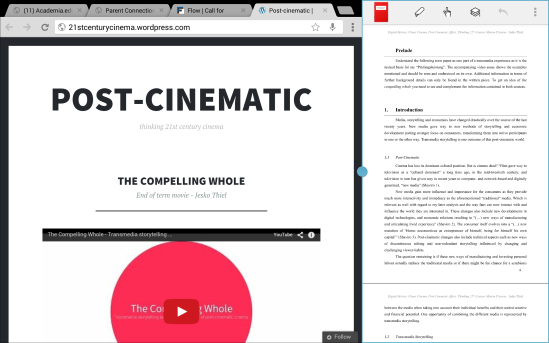
For their final projects in my 21st-century film class, three of my students chose to make video essays, which they have now made available on a blog that they set up especially for this purpose. Over at 21stcenturycinema.wordpress.com, you will find Jesko Thiel’s exploration of transmedia storytelling, Christopher Schramm’s analysis of editing techniques in videogame-based “fragmovies,” and Andreas Merokis’s look at violence as narrative and/or spectacle in contemporary cinema. Take a look and leave them a comment!

“What if the camera / really do / take your soul?”

If the medium is the message, as Marshall McLuhan famously claimed, then the so-called “selfie” may be less about the face that constitutes the recognizable content of such an image, and more about a deeper, less obvious form of material-aesthetic mediation with respect to the transformation of “self” in an age of ubiquitous post-cinematic cameras.

Clearly, such acts of mediation have many levels. On the one hand, we “stage” or “perform” our selves for ourselves and for our friends (and, of course, for our Facebook “friends”); at the same time, though, we do so with an awareness of the machinery of geolocated surveillance and algorithmic facial recognition systems that we feed and help to optimize with the offering of our selfies (and the metadata they contain). Is this a self-destructive tendency or an act of defiance? Do we taunt and shake our fists at the invisible all-seeing God of Hyperinformatic Imagery (or the NSA), heroically though baselessly asserting our autonomy despite our knowledge of its baselessness? Or is it just that we have resigned ourselves to the new “situation,” in which Berkeley’s maxim esse est percipi has been made a reality through a media-technical dispositif that renders superfluous the whole apparatus of angelic and divine perceptions that Bishop Berkeley still needed to keep his system from falling apart?

But the post-cinematic camera is a post-perceptual camera. Esse is now post-percipi in the sense that networks of digital and increasingly “smart” cameras are not just collecting images of “you” or “me” but instituting radical changes in the fine-grained, “molecular” scale of temporal becoming that subtends subjective (or “molar”) perception. As I have been arguing recently (see here, for example), post-cinematic cameras produce “metabolic images” — images that operate outside of visual or perceptual registers and modulate our pre-personal relations to the environment, directly influencing us at the level of our metabolic processing of duration and relation through which our embodied agencies are defined. This has to do with (among other things) the sheer speed of computational processes, which outstrip our own cognitive and perceptual processing abilities. But it also has to do with the affective density that post-cinematic cameras themselves accrue by virtue of the gap — what Bergson would call a “center of indeterminacy,” or simply a body — that these cameras install between the input and output of images, in the space of their microtemporal computational processing. On this basis, a synchronization of human and technical temporalities is made possible at the micro-level. And perhaps this is the hidden message of the medium: the selfie is not just a paradoxical performance of self (in the way that, say, reality shows problematize authenticity), it is in fact the product of a whole new ecology of agency, an ecology of anthropotechnically co-ordinated metabolisms invisibly subtending the visible images by which we seek to represent our “selves.”

With every selfie, we experiment with this interplay of visible manifestation and invisible infrastructure. Who can we be, now, and in relation to an environment filled with rapidly proliferating digital images, where everything is in flux, nothing apparently stable? Perhaps we encounter here, and try to dispel, an old fear in a new guise: that the camera is capable of stealing our souls — both through integration into systems of surveillance, and in the dissolution of our former agencies when set in relation to the molecular, metabolic processes embodied by the post-cinematic camera. In the words of Montreal-based indie rock band Arcade Fire:

What if the camera
Really do
Take your soul?
Oh no...

Hit me with your flashbulb eyes!
You know I've got nothing to hide
You know I got nothing
No I got ... nothing

Above, my own mixed-media “reflections” on the problem of the selfie in the age of metabolic modulation. Featuring artworks by Thomas Böing (Ohne Titel [Museum König], 2006), currently on display at the impressive Kolumba — Art Museum of the Archdiocese of Cologne as part of the exhibition “show cover hide. Shrine. An exhibition on the aesthetics of the invisible,” which runs until August 25, 2014.

Film Series on “Imagining Media Change” — Screening #3: Digital Short Films

On June 12, 2013 (6:00 pm in room 615, Conti-Hochhaus), the Initiative for Interdisciplinary Media  Research is proud to present the third installment of our ongoing series of film screenings, “Imagining Media Change.”  (See here for a flyer with more details about our film series and related events, and here for a description of the symposium that forms the conceptual centerpiece.)

http://www.youtube.com/watch?v=ylu-uCR4ZZI

In a departure from our usual format of screening feature-length movies, this time we will watch a handful of recent science-fiction-themed ‘digital’ short films –  among them Derek Van Gorder’s and Otto Stockmeier’s Kickstarter-funded short C (299,792 kilometers per second) (2013), Neill Blomkamp’s Alive in Joburg (2006) – the proof-of-concept for what became 2009’s District 9 –  and the first episode of RCVR (2011), a Motorola-sponsored Web-TV series released via Machinima.com and Youtube. All of these films – as products of a throughly digitalized media environment – not only point us to the various transformations connected to contemporary media change (from crowd-funding to the use of digital video and the viral distribution of content via online video sites); as science-fiction films, they are also centrally about futuristic and/or alien technology and present us with their own takes on media change.

As always, the screening is free and open for all! Finally, the films themselves are embedded here in case you can’t make it.

Video: Animation as Theme and Medium — Frankenstein and Visual Culture

Above, you’ll find a video presentation of my talk, “Animation as Theme and Medium: Frankenstein and Visual Culture,” which I gave on April 20, 2013 at Dartmouth College — at the great Illustration, Comics, and Animation conference masterfully organized by Michael A. Chaney. Judging by the feedback I received at the time, my talk went over quite well — especially the visual presentation with which I illustrated my arguments (and particularly the “wall” of Frankenstein images you’ll see around 6:03, as well as the animated presentation of Marvel Comics’ Frankenstein series from about 12:52 onward).

(Note that a high-resolution video can be found by following the link to YouTube.)

Admittedly, the screencast video presentation is a weird medium. It tends to foreground things that, when presented live, serve as background images — images that are positioned above and behind a human speaker, talking and gesticulating, communicating (at least ideally) with an audience. In the screencast video, that speaker vanishes into the disembodied ether of a voiceover track, at times leaving images (like the title slide here) lingering on screen longer than might seem appropriate. Perhaps I haven’t yet mastered the medium and discovered a way to achieve the elegance we see in video essays, documentaries, and other related media; or perhaps the screencast video is simply doomed to be a forever awkward, weird, transitional, or incomplete medium.

In any case, the form is not everyone’s cup of tea, and an exemplar like this one is certainly pushing the limits at just over 18 minutes long. As a result, I have taken several steps to make sure that the video is as watchable and as useful as possible for anyone who might be interested in the arguments I make about Frankenstein, film, comics, animation, and visual culture. First, at the cosmetic level, I’ve added some music to deflect attention from my voice and to make the video a bit less “dry” than it otherwise might be (see below for music credits). Also, I have chosen to include the full text of the paper here, which you will find below; this way, you can skim, scan, and search, and “try before you buy” if you like, or decide what parts of the video you’d like to watch. Also, I offer a sort of “table of contents” to the video, with approximate times indicated for the various topics discussed:

0:00 — Introduction: Animation as Theme and Medium

1:30 — Animation as Framing Condition for Modern Visual Culture

4:28 — Frankenstein’s Monster as Iconic Emblem of Animation

5:30 — The Early Proliferation of the Monster’s Image

6:03 — The Plurimedial Explosion of Images and the Visual Serialization of the Monster (illustrated by the “wall” of images that many saw as the central visual attraction of the presentation itself)

7:40 — Frankenstein Films, Self-Reflexivity, and Animation

8:53 — Thomas Edison’s Frankenstein (1910)

12:52 — Marvel Comics’ Frankenstein (1973 – 1975)

17:25 — Conclusion

The presentation draws on several previous works, including Chapter 3 of my dissertation (on Edison’s Frankenstein) and an article called “Marvel Comics’ Frankenstein: A Case Study in the Media of Serial Figures” — so be sure to check those out if anything is of interest to you here.

Here is the text of the talk:

Animation as Theme and Medium: Frankenstein and Visual Culture

Shane Denson – Dartmouth College, April 20, 2013

Long marginalized in critical discourses, animation seems to occupy an unprecedented position in our popular and visual cultures today. It has been argued, for instance, that in the age of digital cinema all film becomes animated film as photographic images’ indexical relations to the world are severed by processes of digital rendering. And not only film: comics, too, seem to be caught in the tractor beam of animation – partly as a result of general convergence trajectories and partly as a result of specific transmedia franchising efforts that place ever more superheroes in sleek new CGI outfits. Simultaneously, comics proper migrate from paper to digital formats and devices, bringing with them animation processes as elements of images and of presentation formats (like the “guided view” function on iPhone apps, which animate the transition from panel to panel). But if it’s true that the boundaries between animation and other forms of visual media have become problematic in the digital age, I want to suggest that this is not entirely new. My aim is therefore to open up a sort of media archaeological perspective that will allow us to look at animation as both a theme and a medium that plays a significant if non-obvious role throughout the modern era. Drawing on retellings of Frankenstein in film and comics, I argue that the tale’s serial proliferation reveals a hidden backstory to our current situation, one in which animation can be seen as the very framing condition for much of our modern popular visual culture.

By emphasizing modernity and popularity, the visual culture I’m talking about is connected explicitly to industrialization, which coincided with the institution of a conceptual wedge between art and technology – i.e. between the fine arts and the applied arts – such that aesthetic experience was figured as “disinterested” and opposed to the realms of practical technology and commercial culture. And out of the industrial-era reorganizations within the broad realm of technē flow a variety of fears and fantasies of technical animation (embodied in automata like the Mechanical Turk, and in narratives such as E.T.A. Hoffmann’s “Der Sandmann” and Mary Shelley’s Frankenstein). Such thematic concerns with “animation” – or the giving of life to inanimate matter – would have a lasting impact on (popular/visual) culture as the arts became increasingly technical, industrial, reproducible, and (in more senses than one) serialized; from Metropolis to Blade Runner and beyond, the dream of artificial life has been a staple of science-fiction film. But beyond the thematic level, a medial aspect or determination of “animation” is also involved: not only was the technical infrastructure of steam-driven printing presses, automata, and pre-cinematic devices uncanny in its liveliness and activity; also, at the dawn of the industrial age, the fine arts were framed in such a way as to marginalize animation as a possible medium. Lessing’s famous division of temporal and spatial arts (with poetry, drama, and narrative on the one side, sculpture, painting, and image on the other) preemptively banished a range of popular forms from the domain of serious art. But against these injunctions of aesthetic purity, post-industrial visual culture is characterized by a preponderance of images that spring to life as they are set in motion and animated by mechanical means. Film and comics, most centrally, would blur the boundaries between the static image and the temporal flow of narration. Generally and conceptually speaking, if not narrowly and technically, “animation” names these media’s affront to the division of the arts – their violation both of the division between temporal and spatial arts and of their separation from the merely technical and commercial domain of modern popular culture. This is another way of saying that animation, broadly conceived, is a sort of framing condition for modern visual culture, which can be seen in constant struggle with the image granted life or set in motion, alternately advancing toward and retreating from the conceptual and technological threat of visual kinesis that aesthetics as such was born in order to contain.

Seen in this way, modern visual culture’s ambivalent relation to animation is not altogether different from Frankenstein’s initial fascination with and sudden repulsion by the creature he brought to life. And it is the creature, of course, who provides the iconic emblem of animation as a monstrous threat. I want to argue that this image embodies both the thematic and the medial aspects of animation that I’ve been discussing, and it self-reflexively probes animation’s role in a visual culture that is both technological and remarkably autonomous in its ability to multiply images across various channels or media. Exhibiting a promiscuous, plurimedial sort of seriality, the monster’s image – as an image of animation – presents a special case for thinking the dynamic intermedial networks that constitute our visual culture. Cinema gives us the “classic” version of the monster’s image, but the figure’s visual proliferation has a serial history that predates the cinema and lives on in other forms as well. At the center of visual interest is the creation scene, which Shelley’s novel of 1818 treats only in a very cursory manner, but which gives rise immediately to a growing number of theatrical adaptations. Shelley herself saw a performance of Richard Brinsley Peake’s 1823 play Presumption; or the Fate of Frankenstein, and thus witnessed her tale escaping her authorial control much as the story’s monster had escaped its creator’s, prompting her famously in the introduction to the 1831 edition of her book to “bid [her] hideous progeny go forth and prosper.” The image on the frontispiece of the 1831 edition thus entered into a stream of visual images proliferating on theater stages, in political cartoons, and later in film, comics, and other media. Taken together, these images are not, I suggest, just illustrations of a story but themselves enactments of a media-technical interrogation of modern processes of animation and the self-replicating action of our visual culture. Essential to this view is a conception of the monster not so much as a developed character but as a flat, serialized figure that has escaped the novel and acquired a life of its own. As such, the monster is marked materially by a form of seriality that is intimately tied to the serial production processes of industrial culture and, more specifically, to the sequentiality and reproducibility of images in modern visual media such as film and comics. Appearing again and again in various media, the monster becomes what I call a serial figure, existing not within a series but in fact as a series – as the expanding set of stagings or instantiations across media. The monster thus evolves not within a uniform diegetic space, but between or across such spaces of narration and visualization. As a serial figure, the monster leads a sort of surplus existence outside of any one given telling, thus placing it in a perfect position to reflect on the manner – and the media – of its repeated stagings. Specifically, it explores modern visual culture’s challenge to the inert spatial image, its tendency to transgress the injunction against animation. The familiar cry – “It’s alive!” – thus refers as much to the media of sequential and temporal images as it does to the creature they depict.

Let’s start with Frankenstein films. There’s a sense in which it’s tempting to see film itself as a sort of Frankensteinian technology. Like Frankenstein selecting parts from corpses and infusing life into a composite body, filmmakers utilize the technical means of film to (re)animate the “dead” (or photographically preserved) traces of living organisms (actors) into new visual narrative compositions. In his discussion of Frankenstein films, William Nestrick writes: “The film is the animation of the machine, a continuous life created by the persistence of vision in combination with a machine casting light through individual photographs flashed separately upon the screen. Since ‘life’ in film is movement, the word that bridges the worlds of film and man is ‘animation’ – the basic principle by which motion is imparted to the picture” (294-95). It will be objected, however, that this invitingly simple analogy is too general in its scope; it overlooks historically specific transformations in the way such “animation” has been staged. Luckily, the long history of Frankenstein adaptations amply documents such changes and makes up for the missing nuance.

Take, for instance, Thomas Edison’s Frankenstein from 1910, which stands between the early, image-technology oriented “cinema of attractions” and the coming narrative-oriented classical Hollywood style that would take shape around 1917. In 1910, the medium was in transition, torn between lowbrow technological spectacle and an uncertain reorientation along the lines of the respectable theater. Accordingly, advertising for the film emphasized both the “photographic marvel” of the creation sequence and the story’s origin in “Mrs. Shelley’s […] work of art.” The film aimed to be both visual and technological spectacle and narrative high culture. And this multiple address relates directly to the uncertain significance of “animation” at this historical juncture.

The creation sequence’s so-called “marvel” consists of footage of a burning mannequin projected in reverse – a bit of cinematic magic that, in the context of early film, served to exhibit cinematic technology by focusing attention on the filmic images themselves rather than the objects they depict. Frankenstein’s reactions here channel the scopophilic pleasure of a “primitive” viewer, for whom he stands in as a proxy. Importantly, “animation” here is a self-reflexive topos which links the monster’s creation with the term “animated photography,” still common in 1910 as a description of film in general.

However, the final showdown ambivalently signals a change of course towards narrative integration. The Edison Company claims that the scene communicates the story’s moral that love conquers all. But since the monster was identified with filmic technology in the creation sequence, Frankenstein’s battle with the monster is also with the medium of film as an animating technology, especially since trick effects are essential to the staging of the conflict. The film’s narrative closure is therefore mixed with a self-reflexive countercurrent. The mirror functions here like the projection surface of the cinema screen. The similarity is not merely abstract but in fact visually perceptible due to the scene’s technical means of production: the images in the mirror are themselves flickering filmic images. The result is a film within the film, and Frankenstein is again a film viewer. His battle with the monster is a battle with the images and especially with the “primitive” type of reception that he exemplified in the creation sequence. But this time he is reformed, and instead of staring at the medial surface, he now acquires the ability to look through rather than at the mirror. So Frankenstein is finally in a position to devote his attentions to the reality of his environment – which means, for us, to the world of the diegesis.

In the context of the cinema’s transitional phase, the film’s narrative development is linked to a larger, non-diegetic narrative of filmic development: Frankenstein’s psychological maturation, which is consummated in the mirror scene, allegorizes a historical-normative process of cinematic maturation and of spectatorial progress towards a proto-classical relation to film. And significantly, this transitional trajectory coincided with the historical differentiation of film, or “animated photography,” according to which animation in the narrower sense came to be distinguished from, and subordinated to, a more respectable form of live-action filmmaking that favored drama and characterization over novelty gags and trick-film effects. The monster, a literal product of animation, charts this differentiation at the same moment people like Winsor McCay were popularizing techniques of animation in its narrower sense. Thus, the monster embodies the technology of the animated spectacle, and his marginalization reflexively indicates the framing function of animation in film and visual culture more generally, reminding us that live-action cinema is animation too, but in a normalized or naturalized form.

Now I want to jump ahead to a comic-book appropriation that offers a somewhat different perspective on animation as theme and medium owing to its reflexive engagement with the formal properties of graphic narrative. Here the monster is recalibrated for an interrogation of the specific means by which comics animate their tales – that is, the means by which discrete images both remain discrete and are subject to combinatory reframings that bring a graphic story to life. Marvel’s series The Monster of Frankenstein (later retitled The Frankenstein Monster) ran for 18 issues from January 1973 to September 1975. The first four issues retell the tale of Shelley’s novel, and they reproduce its nested frame structure: the monster’s own tale is at the center, embedded in Frankenstein’s account of events, which he recounts to the Arctic explorer Captain Walton while aboard his ship; Walton, in turn, records everything and passes it along in the form of letters to his sister back home, and these letters make up the novel Frankenstein. Now the Marvel series, in its re-telling, ingeniously adds an additional frame: Walton IV, the great-grandson of the novel’s captain, narrates the outermost tale, set a full century after the novel, thus laying the ground for the story’s continuation into the twentieth century from issue #5 onward.

With an eye to the monster’s place in visual culture more generally, what interests me above all about this is the way that these various framings and reframings are navigated visually, and the role that the technically animated creature plays in the process. Issue #2 features several exemplary moments that I’d like to focus on. The monster’s tale is prefaced visually with a close-up of the monster’s face, which functions as a gateway or border between external and internal narrative frames (between the cave setting in which the monster relates his tale to Frankenstein and the innermost frame of the related tale) (6, panel 5). The creature tells how he came to his senses, how he observed a blind man and his family, learned their language, and was eventually driven from human society. Finally, his narrative closes with a close-up of the creature’s yellow eye in a wavy-bordered panel that exists liminally between one narrative frame and another (18, panel 3): Spatially attached both to the (self-narrated) monster persecuted by a mob of angry villagers and to the (narrating) monster in the mountain cave, the eye stands between and links the two temporal frames of narration. From this intermediate position, the monster’s eye mirrors the reader’s eye as well, the eye that moves from one graphic frame or panel to the next in the temporal process of reading. Emerging from the page in close-up and protruding from the narrated world to enter the space of the reader, this eye is medially self-reflexive in a strong sense: it directs attention towards the processes of medial construction at the same time that it serves a constructive medial purpose, viz. the transition from one visual and narrative frame to another. And something similar is staged several pages later. Having discovered the corpse of his friend Clerval, the traumatized Frankenstein is arrested for murder, and his face is foregrounded with a blank eye staring at—or through—the reader in a panel that transitions back to the outermost narrative frame, aboard Walton IV’s ship in 1898 (25, panel 4), which suddenly rams an iceberg and begins to sink, bringing issue #2 to a cliffhanger close.

At the outset of the next issue, sailors scramble into lifeboats in the belief that the monster, thrown overboard in the crash, is dead. But when the monster, whose hand juts ominously out of the water, boards their boat and begins wreaking havoc, one of the sailors exclaims, “God help us! It’s still alive!” (3)—an intensification of the standard line in Frankenstein films, fully self-aware of its seriality. Sparing the captain, his cabin-boy, and his guide, the monster rows them to firm ice. There, the monster insists: “The story, man! You must tell me the rest of the story!” (5). Then, with his back turned, Walton IV prepares to continue the narrative, while the monster’s face, set in profile, literally replaces the gutter between two panels and forms the border between two spatiotemporal frames as well: the “here and now” that he shares with Walton IV and the “there and then” of Walton’s story (6, panels 1 and 2). Once again, the monster’s face and eyes mediate the threshold between narrative frames, between temporal settings, and between the act and the content of mediation.

In conclusion, then, Frankenstein’s monster functions variously, as we have seen in these examples from film and comics, to envision the dynamic workings of modern visual culture. The creature doubles with the medium in order to envision visuality itself in its modern, highly kinetic forms. It gives visible form, in other words, to the invisible framing condition of animation, exposing the mechanisms by which static images routinely transgress their spatial borders and assert a temporal dimension, and exploring the role of mediating technologies in the serialized proliferations of images that animate the modern visual landscape.

Finally, here are the music credits for the video (all songs licensed with Creative Commons licenses and made available via dig.ccmixter.org):

1. Creative Commons License Constructions normales (Je ne suis pas un remix) by vo1k1 is licensed under a Noncommercial Sampling Plus (the song begins at 0:00 in the video);

2. Creative Commons License Sawmill by Gurdonark is licensed under a Attribution (3.0) (beginning ca. 4:04);

3.Creative Commons License pling by jaspertine is licensed under a Attribution Noncommercial (3.0) (beginning ca. 7:03);

4. Creative Commons License Yiourgh by DoKashiteru is licensed under a Sampling Plus (beginning ca. 12:18);

5. Creative Commons License Prism in the Ether by Fireproof_Babies is licensed under a Attribution Noncommercial (3.0) (beginning ca. 16:17).

Day of the Future 2013

http://www.youtube.com/watch?v=oh6huonZLOs

Today is Zukunftstag (“Future Day” or “Day of the Future”) here in Germany. On this day, 5th graders go to a place of work (a corporation, a bank, a hospital, a factory, police department, etc.) instead of going to school. Today, my ten-year-old son (a.k.a. DrZombie999) came with me to the university to see what it’s like to work here. I showed him what kinds of things we do here everyday: you know, the usual things like playing video games, goofing around, and surfing YouTube…

But then we decided to get serious, and we put together the video above. Having built the world you see in the popular game Minecraft, DrZombie999 takes us on a little guided tour, which we then saved as a screencast video, edited with nonlinear editing software (where he learned how to add transitions, effects, music, etc.), posted to a brand new YouTube account, and blogged here to get the word out.

DrZombie999 promises that this is only the first in an ongoing series of videos, and he asks viewers to vote for what they’d like to see him build next (from the Lord of the Rings universe). Please leave a comment on his YouTube site if you’ve got an idea! He’ll only be taking votes for one month (until May 25, 2013)!

Conspiracies and Surveillance — In Media Res Theme Week

Caméra de vidéo-surveillance avec sa torche infra-rouge

Over at the media commons site in media res, what promises to be a great theme week on “Conspiracies and Surveillance” has just gotten underway. All of the contributions sound exciting, and among them is one by our very own Felix Brinker, who’s up tomorrow (Tuesday, April 9) with a piece on the “logics of conspiracy” in American TV series. (And in case you missed it, make sure you check out the longer text on the topic that Felix allowed me to post here recently.)

Here’s the full lineup for the in media res theme week:

Monday, April 8, 2013 – Jason Derby (Georgia State University) presents: Scandalous Conspiracies: Making Sense of Popular Scandal Through Conspiracy

Tuesday, April 9, 2013 – Felix Brinker (Leibniz University of Hannover, Germany) presents: Contemporary American Prime-Time Television Serials and the Logics of Conspiracy

Wednesday, April 10, 2013 – Meagan Winkelman (University of Oregon) presents: Sexuality and Agency in Pop Star Conspiracy Theories

Thursday, April 11, 2013 – Perin Gurel (University of Notre Dame) presents: Transnational Conspiracy Theories and Vernacular Visual Cultures: Political Islam in Turkey and America

Friday, April 12, 2013 – Jack Bratich (Rutgers University) presents: Millions of Americans Believe Conspiracy Theories Exist

Each day’s contribution, consisting of a video clip of up to three minutes accompanied by a short essay of 300-350 words, is designed to serve as a conversation starter aimed at involving a broad audience in discussion of key topics relating to the topic of “Conspiracies and Surveillance.”

Please check out all the contributions as they go live here, and consider joining the discussion (to participate, you will need to register at in media res).