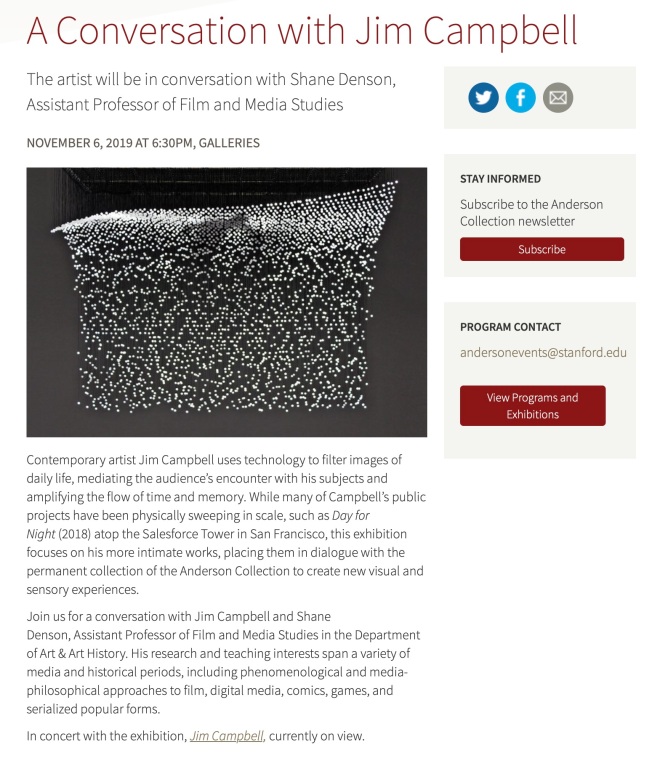
Next Wednesday, November 6, 2019, I will be in conversation with media artist Jim Campbell at the Anderson Collection at Stanford, where a stunning exhibition of his LED-based works is currently on show.
Category: Things
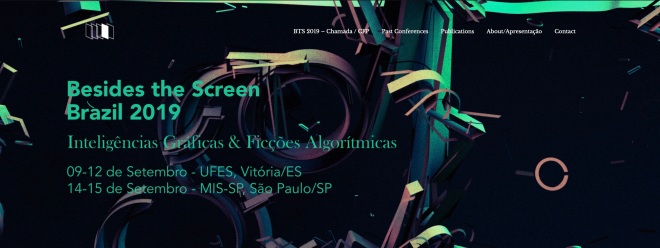
The Algorithmic Nickelodeon at Besides the Screen Festival (Vitoria, Brazil, September 9-12, 2019)

I am happy to report that my deformative, EEG-driven interactive video project, The Algorithmic Nickelodeon, which was screened last month at the ACUD-Kino in Berlin, has been selected for screening at the Besides the Screen Festival taking place in Vitória and São Paulo, Brazil this September. My understanding is that it will be among the works shown in Vitória from September 9-12.
Videographic Criticism: Roundtable Videos

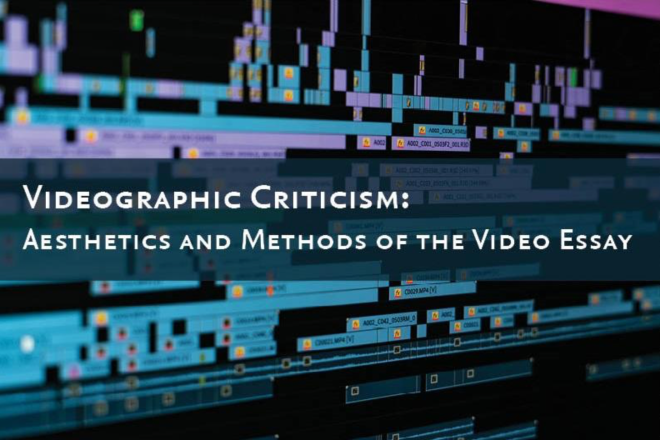
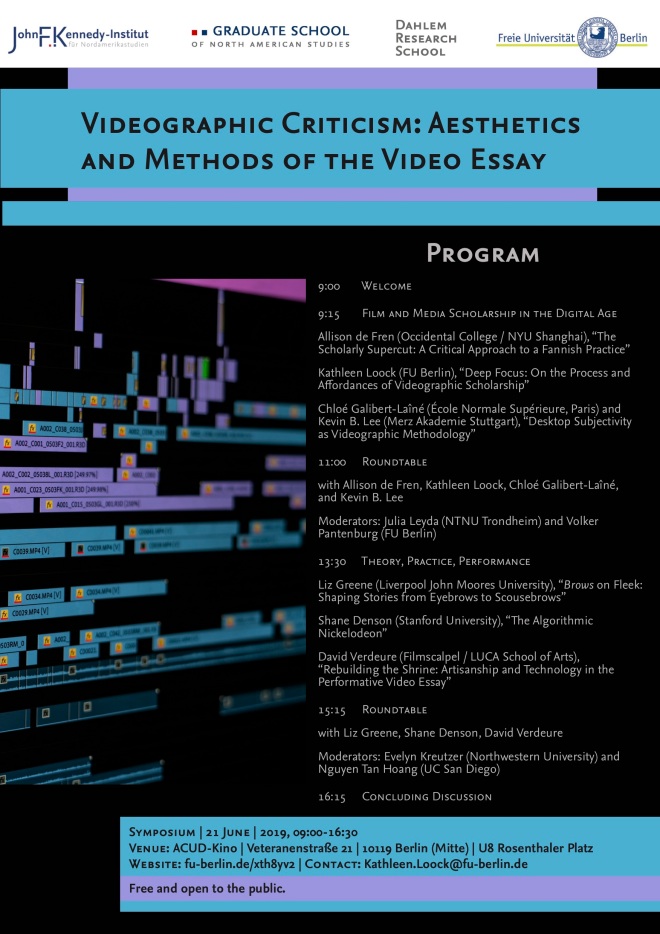
Recently, I posted my my video, “The Algorithmic Nickelodeon,” which I presented on June 21 at the ACUD-Kino in Berlin, in the context of a symposium on “Videographic Criticism: Aesthetics and Methods of the Video Essay” organized by Kathleen Loock.
Now the videos of the two roundtable discussions with Allison de Fren, Kathleen Loock, Chloé Galibert-Laîné, and Kevin B. Lee (moderated by Julia Leyda), and with Liz Greene, David Verdeure, and myself (and moderated by Evelyn Kreutzer) are online, here.
Thanks again to Kathleen Loock for organizing and to the ACUD-Kino for hosting this event!
The Algorithmic Nickelodeon
Yesterday was the first event on my trip to Germany and Switzerland: the symposium Videographic Criticism: Aesthetics and Methods of the Video Essay, organized by Kathleen Loock, and with talks/screenings from her, Allison de Fren, Chloé Galibert-Laîné and Kevin B. Lee, Liz Greene, David Verdeure, and myself.
Above, you will find my video contribution, “The Algorithmic Nickelodeon,” which builds on work started at the Duke S-1: Speculative Sensation Lab during my time there as a postdoc. The video is offered as proof-of-concept for an experimental approach to videographic theory–using video not (only) as a vehicle for theoretical expression but as a more radically transductive medium of media-theoretical exploration and transformation.
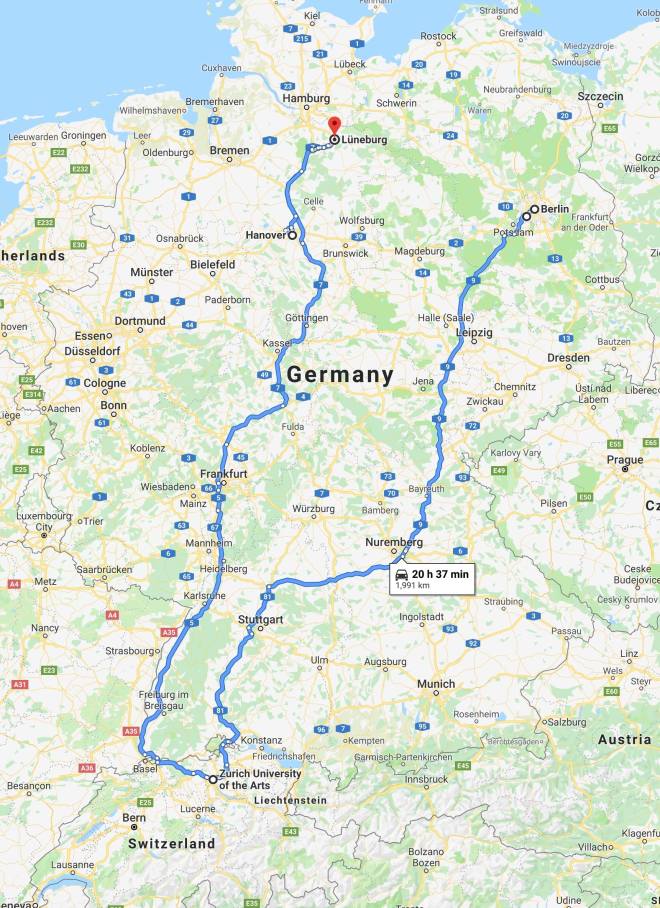
Talks and Events: Germany/Switzerland, June-July 2019

This summer, I will be spending a month in Germany, along with a short trip to Switzerland, for a series of talks and other events. Here is the full list:
June 21: “The Algorithmic Nickelodeon” — Screening and presentation at symposium on “Videographic Criticism: Aesthetics and Methods of the Video Essay,” ACUD-Kino Berlin
June 23-28: Stanford-Leuphana Summer Academy 2019: “Against Presentism” — at Stanford Berlin Campus
June 26, 6pm: “Desktop Horror: Screening Fear/Fearing Screens” — Presentation at the JFK Institute for North American Studies, Freie Universität Berlin
June 29: “Discorrelation and Seamfulness” — Presentation at the media-philosophical workshop on “Reflexivity in Digital Media,” Zürcher Hochschule der Künste, Zurich
July 1-19: Research Fellowship at the Institute for Advanced Study on Media Cultures of Computer Simulation — Leuphana University, Lüneburg
July 3: “Images of Discorrelation” — Presentation in the Media Cultures of Computer Simulation/Center for Digital Cultures Evening Colloquium Series, Leuphana University, Lüneburg
July 10: “Post-Cinematic Realism” — Presentation in the Sprache, Migration, und Vielfalt series at the Leibniz Universität Hannover
“The Algorithmic Nickelodeon” at ACUD-Kino Berlin — Symposium on Videographic Criticism

Next Friday, June 21, 2019, I am excited to present “The Algorithmic Nickelodeon,” a literally mind-bending EEG-powered videographic experiment, in the context of the symposium on “Videographic Criticism: Aesthetics and Methods of the Video Essay.”
The symposium, organized by Kathleen Loock, will take place at the ACUD-Kino in Berlin, and will bring together lots of leading practitioners of videographic scholarship to screen their work and discuss questions of aesthetics, methods, and theory.
The event is free and open to the public, so come by if you’re in the neighborhood!
Resistance is Futile Against Hot Asexuality
Recently, I wondered whether it was time to leave social media and reboot the blog as a space of active thinking and sharing. The jury is still out on whether that is feasible and even desirable. But I would like to use this space to post more than just upcoming talks and publications. In that spirit, I’d like to point out Yvette Granata’s 360-degree video CLONE (2017), which you can see above (but which is better viewed on a smartphone through the YouTube app, and even better with Google Cardboard or similar contraption).
On her website, Granata describes the video thus:
CLONE (HD Video, 2017) is a 360 video essay and a para-sexual design fiction. It narrates a future time after global climate collapse and mass pollution have made sexual reproduction no longer viable. Both sexual reproduction and the networked technology of the 21st century have all melted from the humidity produced by runaway greenhouse gasses. In this speculative future, a Xenofeminist world government has re-purposed the data farms of former tech companies for Mono-auto-sexual cloning clinics — the artificial wombs for the hot asexuality of the future.
I have recently been writing about this remarkable video against the background of big-budget movies about artificial women, including Her (2013), Ex Machina (2014), and Blade Runner 2049 (2017). Those movies, all of which happen to be directed by white men, are interesting meditations on, or parables of, artificial creation in an age of computer-generated imagery. But Granata’s weird video, drawing inspiration from the Xenofeminist Manifesto, goes farther than any of those movies in raising questions about the interface between gender, capital, climate change, and moving-image media.
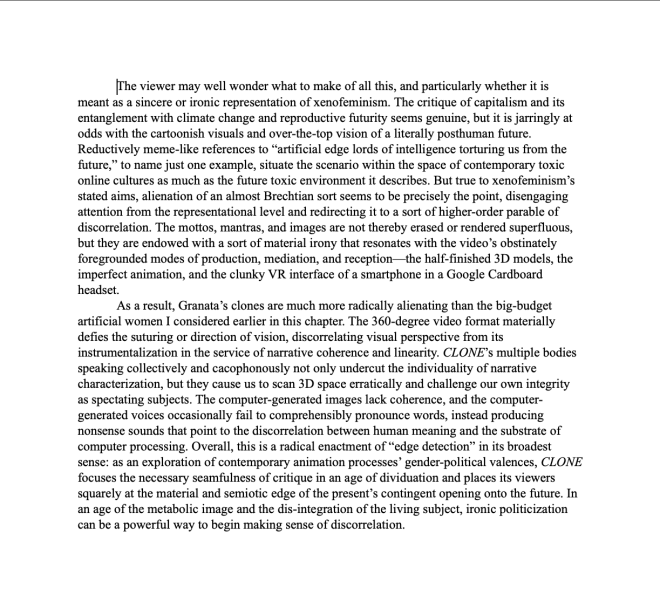
Here is a brief snippet of what I’ve been writing:

I’m being targeted with phishing attacks — from my employer!

Today, I received this suspicious message on my university email account about a purchase, made on my “Smartpone,” and related to a game I don’t play. I promptly reported it as spam to Stanford IT. Within seconds, I was “rewarded” with the following message:
Thank you for reporting this suspicious message. This was a simulated phishing email sent as part of Stanford’s Phishing Awareness Program. Congratulations on successfully identifying and reporting it to us! No further action is necessary.
Yay! I guess…
Yeah, well, I think it’s kind of weird to get phishing messages from your employer, and I am getting this gamified spam on a regular basis — several “simulated” phishing messages a week.
But what is the status of a “simulated” phishing attack anyway? In this connection, I am reminded of Baudrillard on the impossibility of “simulating” a bank robbery:
Organize a fake holdup. Verify that your weapons are harmless, and take the most trustworthy hostage, so that no human life will be in danger (or one lapses into the criminal.) Demand a ransom, and make it so that the operation creates as much commotion as possible — in short, remain close to the “truth,” in order to test the reaction of the apparatus to a perfect simulacrum. You won’t be able to do it: the network of artificial signs will become inextricably mixed up with real elements (a policeman really will fire on sight; a client of the bank will faint and die of a heart attack; one will actually pay you the phony ransom).
This sounds exactly like what my employer — a major research university situated in the midst of Silicon Valley, the simulacral heart of the control society — is doing. And in their attempt to remain close to the “truth” to test the reaction of the apparatus to a perfect simulacrum, the network of artificial signs is bound to get mixed up with real elements, perhaps by design: these simulated attacks pretend towards an attempt to inoculate us against the danger, but they are also tools of control: of surveillance and, if need be, shaming (I am told by colleagues who have clicked on the links that a finger-wagging message appears and tells the user to be more careful…).
Having recently parried one of these attacks to the satisfaction of my employer, I received the usual message of congratulations. Being knee-deep in a major writing project, I may have been feeling a little humorless that day. I wrote back:
Thanks, but I am not sure that this really adds to my productivity.
I got a message back, within minutes, from someone claiming to be a human (but it seems I should have required they fill out a Captcha or click on all the stoplights in a picture or something). Anyway, this “human” wrote back a message so chilling that it sent shivers down my spine the likes of which I have rarely experienced outside of Poe or Kafka:
Hi Prof. Denson, we give up a little bit of our productivity for an increased amount of security. Thank you for the feedback and for reporting the email.
The Rebirth of the Blog?

I quipped the other day on Facebook, “Thank god blogs are dead!” — thinking of some particularly toxic moments and scenes from “back in the day.” Facebook must have heard me… I wanted to post the rough scrap of writing above to that piece of … social media today (with the clever caption: “Brian O’Blivion makes a surprise cameo appearance in my book! Was not expecting this…”), but FB won’t accept my image or post my comment. I know that the network is having major difficulties today, difficulties that will likely pass quickly, but this episode has gotten me thinking (somewhat romantically) about the possibility of a different Internet. The blogosphere was often horrible, but could it ever be as bad as Facebook? Could #FacebookDown and #InstagramDown spark a mass migration and a revival of blogs? Probably not… But leave a comment if you’d like to see it happen! (Or if not, why not.)
Out Now: Videographic Frankenstein in Hyperrhiz 19
I am excited to announce that the Videographic Frankenstein exhibit, which ran September 26 – November 2, 2018 at Stanford, lives on in an online version — out now in Hyperrhiz 19! There you will find 10 video works on various facets of Frankenstein‘s moving-image legacy, from early film to television and digital animation, along with creators’ statements that reflect on this history and its relations to videographic scholarship, among other monstrosities.
Thanks again to the Stanford Medicine and the Muse Frankenstein@200 Initiative and the Stanford Department of Art & Art History and Program in Film & Media Studies for their generous support of the project.
Thanks also to Helen Burgess, editor at Hyperrhiz, for entertaining the notion of publishing an exhibition of creative and scholarly videos, and for working with me to find the right format.
And thanks, finally, to the contributors for all their hard work: Matthew Fishel, Jason Mittell, Allison de Fren, David Verdeure, Carlos Valladares, Lester Friedman, Kristine Vann, and Spencer Slovic!
Also, be sure to check out the full issue of Hyperrhiz, which is chock full of more excellent scholarly and creative work!