Shane Denson, “Animation as Theme and Medium: Frankenstein and Visual Culture”

MonsterOfFrankenstein1

Here is the abstract for Shane Denson’s talk at the Illustration, Comics, and Animation Conference at Dartmouth College (April 19 – 21, 2013):

Animation as Theme and Medium: Frankenstein and Visual Culture

Shane Denson

Frankenstein and above all Frankenstein’s monster are emphatically plurimedial figures; already in the nineteenth century, they escaped the confines of Mary Shelley’s novel and proliferated on theater stages and in political cartoons before embarking, in the twentieth century, on a long career in film, radio, TV, comics, and video games. In the course of these developments, the monster in particular has become an unmistakable visual icon, the general contours of which were more or less fixed in our visual culture through Boris Karloff’s embodiment in the early 1930s. The image, however, remains flexible enough as to be instantly recognizable in cartoonish illustrations adorning cereal boxes. In this presentation, I contend that the monster’s image presents a special case for thinking the intermedial networks that constitute our visual culture, owing to the fact that this icon is linked inextricably with “animation” as both a thematic and media-technical topos. The act of animation, or bringing a creature composed of dead corpses to life—subject to only cursory treatment in the novel—becomes the main subject and visual attraction of the tale’s filmic iterations, where animation is motivated not solely by narrative but linked also to a self-reflexive probing of film as a medium. The first Frankenstein film, Thomas Edison’s Frankenstein (1910), used reverse motion and trick photography to animate its creature, and it linked into early discourses of cinema, according to which moving images in general (rather than, as later, a special class of films) were referred to as “animated film”—for the cinema brought “dead” photos (cf. 19th century memento mori) back to life, as attested in the names of early-film companies and apparatuses (Bioscope, Vitagraph, etc). James Whale’s Frankenstein (1931), too, probes animation as both theme and medium in the midst of change, reviving this nexus (and the monster) in the wake of the sound transition, with its foregrounding of uncanny figures “electrified” by technical sound, showcased all the more by a mute monster capable only of inarticulate moans. Besides the cinematic trajectory, moreover, there is also a rich Frankensteinian comics tradition—which includes fumetti film tie-ins, Dick Briefer’s Frankenstein series of the 1940s and 1950s, various serializations at Marvel and DC, and even crossovers with superheroes like Batman, Spiderman, or the X-Men—that similarly probes “animation” as the thematic/medial wellspring of modern visual culture. Both in film and comics, graphic/visual treatments of Frankenstein approach animation (asymptotically, perhaps) as an enabling frame or parergon and thus relive, again and again, an iconic Urszene of the birth of modern visual culture and its self-reflexive mediality.

Shane Denson, “On the Phenomenology of Reading Comics”

phenomenology_comics

On Friday, January 25, 2013, I will give a talk “On the Phenomenology of Reading Comics” in the context of Felix Brinker‘s “Introduction to Visual Culture” seminar (12 pm in room 615, Conti-Hochhaus). Anyone interested in attending the talk is asked to contact either me or Felix.

Post-Cinematic Affect: Theorizing Digital Movies Now — #SCMS13

capture-of-affect

At the upcoming conference of the Society for Cinema and Media Studies (March 6-10, 2013 in Chicago), I will be participating in a panel on “post-cinematic affect” with Steven Shaviro (who, literally, wrote the book on the topic), Therese Grisham (who organized a great roundtable discussion on the topic in La Furia Umana, which I was also proud to be a part of — and which can alternatively be found here if La Furia Umana is down), and Julia Leyda (who also participated in the roundtable and will serve as respondent on our SCMS panel).

Here is a description of our panel, which is scheduled for Thursday, March 7, from 3:00 – 4:45 pm (Session H):

Post-Cinematic Affect: Theorizing Digital Movies Now

If cinema and television, as the dominant media in the twentieth century, shaped and reflected our cultural sensibilities, how do new digital media in the twenty-first century help to shape and reflect new forms of sensibility? Continuing from roundtable discussions on “post-cinematic affect” in the online film journal La Furia Umana, this panel explores the emergence of a new “structure of feeling” (Raymond Williams) or “episteme” (Foucault) in post-millennial film, one that is evident in new formal strategies, radically changed conditions of viewing, and new ways in which films address their spectators. Contemporary films, from blockbusters to independents and the auteurist avant-garde, use digital cameras and editing technologies, incorporating the aesthetics of gaming, webcams, and smartphones, to name a few, as well as Internet media. For this reason alone, we argue, the aesthetic boundaries between art-house film and blockbuster have become blurred. Moreover, the aesthetic elements of contemporary film do not just simulate the environments created by digital technologies and media, but break more radically with the geometry and logic of films in the twentieth century. In this way, they reflect or transmit the effects, not only of digitization, but also of economic globalization and the financialization of more and more human activities. But these changes have only begun to be theorized. In this panel, we continue the work of theorizing a critical aesthetics of film culture today. The papers take as their critical starting-points David Bordwell on “intensified continuity,” Matthias Stork on “chaos cinema,” and Steven Shaviro on post-cinematic affect and “post-continuity.”

The papers explore key critical issues for analyzing post-cinematic affect, in terms of the ambivalent aesthetics of recent films exhibiting a longing for cinema as the lost object of desire (Therese Grisham on Martin Scorsese’s Hugo), post-continuity stylistics (Steven Shaviro on Tony Scott’s films, particularly his 2005 Domino), and philosophical and technological approaches to the contemporary camera (Shane Denson on images “discorrelated” from human sense ratios in a variety of recent films).

Bibliography:

Bordwell, David. “Intensified Continuity: Visual Style in Contemporary American Film.” Film Quarterly, Vol. 55, No. 3. (Spring, 2002), pp. 16–28.

Grisham, Therese, with Julia Leyda, Nicholas Rombes, and Steven Shaviro. “Roundtable Discussion on the Post-Cinematic in Paranormal Activity and Paranormal Activity 2.” http://www.lafuriaumana.it/index.php?option=com_content&view=article&id=385:roundtable-discussion-about-post-cinematic&catid =59:la-furia-umana-nd-10-autumn-2011&Itemid=61

Shaviro, Steven. “Post-Continuity”. Blog posting: The Pinocchio Theory, March 26, 2012, http://www.shaviro.com/Blog/?p=1034

Shaviro, Steven. Post-Cinematic Affect. Winchester: Zer0 Books, 2010.

Stork, Mattias. “Video Essay: Chaos Cinema: The Decline and Fall of Action Filmmaking.” IndieWire, Press Play, August 24, 2011. Retrieved on August 30, 2012.
http://blogs.indiewire.com/pressplay/video_essay_matthias_stork_calls_out_the_chaos_cinema 

Finally, here are links to the individual abstracts:

Therese Grisham, “Martin Scorsese and Hugo (2011): Our Reluctant Contemporaries”

Steven Shaviro, “Angel of Fire: Post-Continuity in Tony Scott’s Domino (2005)”

Shane Denson, “Crazy Cameras, Discorrelated Images, and the Post-Perceptual Mediation of Post-Cinematic Affect”

Shane Denson, “Crazy Cameras, Discorrelated Images, and the Post-Perceptual Mediation of Post-Cinematic Affect” — #SCMS13

200Hz_Grafik

[UPDATE March 7, 2013: Full text of the talk now posted here.]

Here is the abstract for Shane Denson’s paper on the panel “Post-Cinematic Affect: Theorizing Digital Movies Now” at the 2013 SCMS conference (Session H — Thursday, March 7, 2013, 3:00 – 4:45 pm):

Crazy Cameras, Discorrelated Images, and the Post-Perceptual Mediation of Post-Cinematic Affect

Shane Denson

Post-millennial films are full of strangely irrational cameras – physical and virtual imaging apparatuses that seem not to know their place with respect to diegetic and nondiegetic realities, and that therefore fail to situate viewers in a coherently designated spectating-position. While analyses ranging from David Bordwell’s diagnosis of “intensified continuity” to Matthias Stork’s recent condemnation of “chaos cinema” have tended to emphasize matters of editing and formal construction as the site of a break with classical film style, it is equally important to focus on the camera as a site of material, phenomenological relation between viewers and contemporary images. Thus, I aim to update Vivian Sobchack’s film-theoretical application of Don Ihde’s groundbreaking phenomenology of mediating apparatuses to reflect the recent shift to what Steven Shaviro has identified as a regime of “post-cinematic affect.” By setting a phenomenological focus on contemporary cameras in relation both to Shaviro’s work and to Mark B. N. Hansen’s recent work on “21st century media,” I will show that many of the images in today’s films are effectively “discorrelated” from the embodied interests, perspectives, and phenomenological capacities of human agents – pointing to the rise of a fundamentally post-perceptual media regime, in which “contents” serve algorithmic functions in a broader financialization of human activities and relations.

Drawing on films such as District 9MelancholiaWALL-E, or Transformers, the presentation sets out from a phenomenological analysis of contemporary cameras’ “irrationality.” For example, virtual cameras paradoxically conjure “realism” effects not by disappearing to produce the illusion of perceptual immediacy, but by emulating the physical presence of nondiegetic cameras in the scenes of their simulated “filming.” At the same time, real (non-virtual) cameras are today inspired by ubiquitous, aesthetically disinterested cameras that – in smartphones, surveillance cams, satellite imagery, automated vision systems, etc. – increasingly populate and transform our lifeworlds; accordingly, they fail to stand apart from their objects and to distinguish clearly between diegetic/nondiegetic, fictional/factual, or real/virtual realms. Contemporary cameras, in short, are deeply enmeshed in an expanded, indiscriminately articulated plenum of images that exceed capture in the form of photographic or perceptual “objects.” These cameras, and the films that utilize them, as I shall argue in a second step, mediate a nonhuman ontology of computational image production, processing, and circulation – leading to a thoroughgoing discorrelation of contemporary images from human perceptibility. In conclusion, I will relate my findings to recent theorizations of media’s broader shift toward an expanded (no longer visual or even perceptual) field of material affect.

Bibliography:

Bordwell, David. “Intensified Continuity: Visual Style in Contemporary American Film.” Film Quarterly 55.3 (2002): 16-28.

Hansen, Mark B. N. Feed-Forward: The Future of 21st Century Media. Unpublished manuscript, forthcoming 2013/2014.

Ihde, Don. Technology and the Lifeworld: From Garden to Earth. Bloomington and Indianapolis: Indiana UP, 1990.

Shaviro, Steven. Post-Cinematic Affect. Winchester: Zer0 Books, 2010.

Sobchack, Vivian. The Address of the Eye: A Phenomenology of Film Experience. Princeton: Princeton UP, 1992.

It’s Not Television (Or Is It?)

its_not_tv

Three members of the Initiative for Interdisciplinary Media Research (Felix Brinker, Florian Groß, and Shane Denson) will be presenting papers at the upcoming conference “It’s Not Television” (22-23 February 2013, Goethe University of Frankfurt). Our abstracts can be found here:

Felix Brinker: “Narratively Complex Television Series and the Lure of Conspiracy – On the Politics of Long-Form Serial Storytelling and the Paranoid Eye of Active Audiences”

Shane Denson: “Serial Bodies: Corporeal Engagement in Long-Form Serial Television”

Florian Groß: “Born Alone, Die Alone, But Never Dine Alone: The Creative Individual and Generic Family Structures in Recent TV Series”

Shane Denson: “Corporeal Engagement in Long-Form Serial Television”

bodies_on_tv

Abstract for Shane Denson’s talk at the conference “It’s Not Television” (Frankfurt, 22-23 February 2013). See here for talks by other members of the Initiative for Interdisciplinary Media Research.

Serial Bodies: Corporeal Engagement in Long-Form Serial Television

Shane Denson

Discussions of so-called “Quality TV” and the narrative complexity seen to characterize the best of contemporary serial television productions often trade on categories of distinction derived from comparisons with “respectable” cultural forms (e.g. the novel as a model for “serious” engagement); these discourses value an intellectually demanding, heady sort of appeal that is opposed both to the narrative simplicity supposedly characteristic of older televisual forms (strictly episodic forms, melodramatic soap operas, etc.) and to the baser appeals of contemporary “trash TV” (e.g. the basically voyeuristic interest encouraged by reality TV). Interestingly, though, graphic scenes of sex and violence proliferate across contemporary television series, including shows widely valued for their cognitive demands; today, bodies are put on display, violated, tortured, dissected, and ripped apart in ways unimaginable on TV screens just a decade ago. In this presentation, I argue that these body spectacles – which range from clinical/forensic to brutal/gory to pornographic – challenge us to rethink the basis of television studies’ formal and normative distinctions. In particular, the complex mental operations valued as correlates of narratological complexity must be seen to take place side by side with a range of more corporeal responses on the part of television viewers. Finally, I propose an alternative view of televisual complexity and serialization: appealing to the body as much as the head, contemporary television will be shown to involve a serialization of bodies (both onscreen and off) that constitutes a central affective mechanism for engaging viewers week after week in long-form serial television.

Batman and the “Parergodic” Work of Seriality in Interactive Digital Environments

wayne-tech

On Saturday, December 15 (11:30 am, 6th floor of the Conti-Hochhaus, room TBA) — in the context of a research colloquium of the American studies department — I will be presenting some work in progress from my “Habilitation” project Figuring Serial Trajectories (more info about my project here; also, more info about the larger collaborative project with Ruth Mayer on serial figures here, and the website of the overarching research group on popular seriality here).

The topic of my talk will be Batman, computer games, and digital media environments. I will be expanding on, and trying to make somewhat more concrete, the idea of “parergodicity” which I presented at the recent FLOW conference (see here for my position paper).

Here is the abstract for my talk:

Batman and the “Parergodic” Work of Seriality in Interactive Digital Environments

Shane Denson

In the twentieth century, serial figures like Tarzan, Frankenstein’s monster, and Sherlock Holmes enacted a broadly “parergonal” logic; that is, in their plurimedial instantiations (in print, film, radio, TV, etc.), they continually crossed the boundaries marked by these specific media, slipped in and out of their frames, and showed them – in accordance with the logic of the parergon as described by Jacques Derrida – to be reversible. Through such oscillations, serial figures were able to transcend the particularity of any single iteration, and more importantly they were able to constitute themselves as higher-order frames or media, within which the transformations of first-order (i.e. apparatically concrete) media could be traced in the manner of an ongoing – though not altogether linear – series.

In the twenty-first century, many classic serial figures have declined in popularity, while the basic functions and medial logics of those that remain have been transformed in conjunction with the rise of interactive, networked, and convergent digital media environments. As I will argue in this presentation, the figure of Batman exemplifies this shift as the transition from a broadly “parergonal” to a specifically “parergodic” logic; the latter term builds upon Espen Aarseth’s notion of the “ergodic” situation of gameplay – where ergodics combines the Greek ergon (work) and hodos (path), thus positing nontrivial labor as the aesthetic mode of players’ engagement with games. Expanded beyond narrowly ludological frames of reference to include a wider variety of interactive and participatory potentials in contemporary culture, ergodic media give rise to new forms of seriality that accompany, probe, and trace the developmental trajectories of the new media environment. These new forms and functions of seriality, as embodied by a figure like Batman, raise questions about the blurring of relations between work and play, between paid labor and the incidental work or “immaterial labor” culled from our leisure activities and entertainment practices, in the age of the “control society” (Deleuze) or of “post-cinematic affect” (Shaviro). Following Batman’s transitions from comics to graphic novels, to the films of Tim Burton and Christopher Nolan, and on to the popular and critically acclaimed videogames Arkham Asylum and Arkham City, I will demonstrate that the dynamics of border-crossing which characterized earlier serial figures has now been re-functionalized in accordance with the ergodic work of navigating computational networks – in accordance, that is, with work and network forms that frame all aspects of contemporary life.

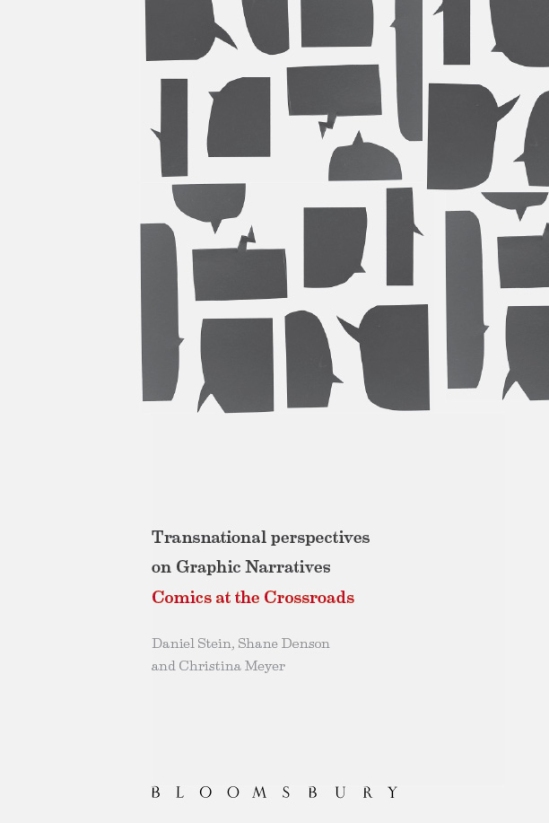
Coming Soon: Transnational Perspectives on Graphic Narratives

Transnational_cover-1

[UPDATE March 28, 2013: The book is now available; see here for more info]

We’re in the home stretch now with Transnational Perspectives on Graphic Narratives: Comics at the Crossroads (eds. Shane Denson, Christina Meyer, and Daniel Stein). The manuscript is almost through the production phase at Bloomsbury, and everything is set for the book to appear on time in March 2013. A description can be found on the publisher’s website (here), and the book is already up on amazon (US site here; British site here; German site here). A more affordable e-book version is in preparation, and a paperback is planned as well (contingent upon sales of the hardcover — so please ask your library to purchase a copy)!

Here is the final Table of Contents:

Foreword

John A. Lent

Introducing Transnational Perspectives on Graphic Narratives: Comics at the Crossroads

            Shane Denson, Christina Meyer, and Daniel Stein

Part I: Politics and Poetics

1          Not Just a Theme: Transnationalism and Form in Visual Narratives of US Slavery

            Michael A. Chaney

2          Transnational Identity as Shape-Shifting: Metaphor and Cultural Resonance in Gene Luen Yang’s American Born Chinese          

            Elisabeth El Refaie

3          Cosmopolitan Suspicion: Comics Journalism and Graphic Silence

            Georgiana Banita

4          Staging Cosmopolitanism: The Transnational Encounter in Joe Sacco’s Footnotes in Gaza    

             Aryn Bartley

5          “Trying to Recapture the Front”: A Transnational Perspective on Hawaii in R. Kikuo Johnson’s Night Fisher  

             Iris-Aya Laemmerhirt

6          Folding Nations, Cutting Borders: Transnationalism in the Comics of Warren Craghead III

             Daniel Wüllner

Part II: Transnational and Transcultural Superheroes

7          Batman Goes Transnational: The Global Appropriation and Distribution of an American Hero

             Katharina Bieloch and Sharif Bitar

8          Spider-Man India: Comic Books and the Translating/Transcreating of American Cultural Narrative

             Shilpa Davé

9          Of Transcreations and Transpacific Adaptations: Investigating Manga Versions of Spider-Man

             Daniel Stein

10         Warren Ellis: Performing the Transnational Author in the American Comics Mainstream

              Jochen Ecke

11         “Truth, Justice, and the Islamic Way”: Conceiving the Cosmopolitan Muslim Superhero in The 99

              Stefan Meier

Part III: Translations, Transformations, Migrations

12         Lost in Translation: Narratives of Transcultural Displacement in the Wordless Graphic Novel

              Florian Groß

13         Hard-Boiled Silhouettes: Transnational Remediation and the Art of Omission in Frank Miller’s Sin City

              Frank Mehring

14         The “Big Picture” as a Multitude of Fragments: Jason Lutes’s Depiction of Weimar Republic Berlin

              Lukas Etter

15         “Scott Pilgrim Gets It Together”: The Cultural Crossovers of Bryan Lee O’Malley

              Mark Berninger

16         A Disappointing Crossing: The North American Reception of Asterix and Tintin

              Jean-Paul Gabilliet

Afterword

Framing, Unframing, Reframing: Retconning the Transnational Work of Comics

              Shane Denson

M: Movies, Machines, Modernity — An Introduction

Above, a somewhat streamlined and re-focused version of the talk I gave last Thursday at the first screening in our film series “M: Movies, Machines, Modernity.” Text and video: Shane Denson. Music: Jared C. Balogh, “Break in the Action,” licensed under a Creative Commons Attribution-NonCommercial-Sharealike License.

Out Now: American Comic Books and Graphic Novels

American Comic Books and Graphic Novels is a special issue of Amerikastudien / American Studies (issue 56.4), edited by Daniel Stein and Christina Meyer (my co-editors on the forthcoming Transnational Perspectives on Graphic Narratives: Comics at the Crossroads), together with Micha Edlich from the University of Mainz. The special issue, which I just found in my mailbox, has turned out to be a very nice collection of essays, bringing together theorizations of comics and graphic narratives as a medium or medial form and close readings of specific case studies. Also included is an interview with David Mack, conducted by Henry Jenkins. Daniel Stein has posted the full table of contents at his academia.edu page (here).

My own contribution, “Marvel Comics’ Frankenstein: A Case Study in the Media of Serial Figures,” continues my recent explorations of the nexus of seriality and/as mediality. Here’s the abstract:

This essay argues that Marvel’s Frankenstein comics of the 1960s and 1970s offer a useful case study in the dynamics of serial narration, both as it pertains to comics in particular and to the larger plurimedial domain of popular culture in general. Distinguishing between linear and non-linear forms of narrative seriality—each of which correlates with two distinct types of series-inhabiting characters—I argue that Marvel’s staging of the Frankenstein monster mixes the two modes, resulting in a self-reflexive exploration and interrogation of the comics’ story- telling techniques. Furthermore, I contend that this process sheds light on the medial dynamics of serial figures—that is, characters such as the monster (but also superheroes like Batman and Superman or other figures like Tarzan and Sherlock Holmes) that are adapted again and again in a wide variety of forms, contexts, and media. Though narrative continuity may be lacking between the repeated stagings of serial figures, non-diegetic traces of previous incarnations accumulate on such characters, allowing them to move between and reflect upon medial forms, never wholly contained in a given diegetic world. Accordingly, Marvel’s depiction of the Frankenstein monster leads to a self-reflexive probing of comic books’ forms of narrative and visual mediality, ultimately problematizing the very building blocks of comics as a medium—the textual and graphic framings that, together, narrate comics’ serialized stories.