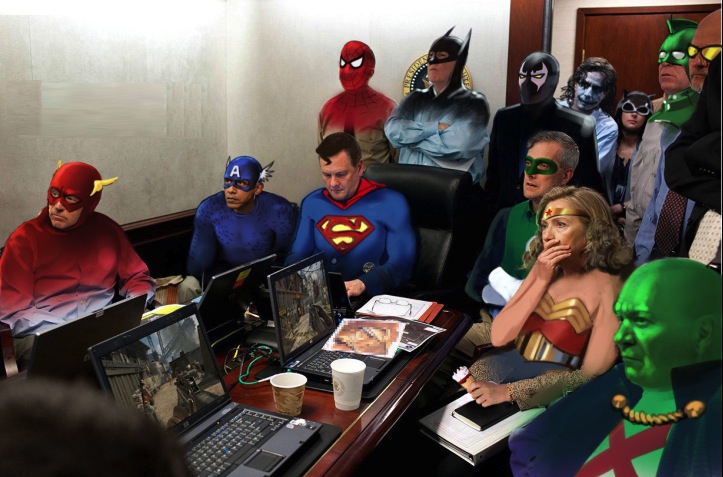
Comics and Politics
7th Annual Conference of the Gesellschaft für Comicforschung (Society for Comics Studies)
at the Institute for Media Culture Studies, University of Freiburg
September 27-29, 2012
comfor2012.comicgesellschaft.de
We invite abstracts for each of the following three parts of the conference: Talks on the main conference topic, Comics and Politics (1); reports on ongoing research projects for any aspect of comics studies for open workshop sessions (2); as well as posters on any topic concerning comics studies (3).
1. Call for Papers on Comics and Politics
Comics interact with politics and the political in several obvious ways: As a format of artistic expression, as a sometimes popular, alternative or marginalized genre, and not least as an element of new media, comics feature specific political dimensions that are not always sufficiently covered by concepts developed for the description of politics in other art forms. While several studies have dealt with particular instances, the special role of comics as archive, player, playing field, and constituent of political processes has rarely been examined under a common perspective.
The 7th Annual Conference of the Gesellschaft für Comicforschung thus invites contributions from different disciplines and starting points that deal with any of the many constellations of comics and politics. Some of these views might, for instance, connect to recent thoughts on an ‘ethical turn’ in cultural studies, or equally to contemporary questions and theories from pictorial studies.
Contributions might address any of the following three broad subjects, among others:
I. Comics Activism: Criticism and Propaganda
Political elements in comics are most conspicuous where they are dealt with topically and explicitly: In depictions, evaluations, negotiations and interventions of political issues. Such comics come in many different forms, from propaganda with a clear political, religious, or cultural agenda, through satirical, subversive, and socially critical work, up to and including alternative media and grey publications. Along with other fictional or documentary comics on contemporary or historical political issues, they also add to an archive of political topics and discourses. Some prominent examples here might connect to Postcolonial or Gender Studies, which have sometimes been somewhat neglected in existing comics studies.
Contributions to this area might, for instance, deal with contexts of publication, habits of reading, dimensions of social effect, as well as topical content and delivery of political concepts in comics. Some objects for research might include cultural treatments of political processes (such as comics ‘about’ the Third Reich, the Cold War, 9/11, etc.); as well as comics that are actively engaged in political debate (such as comics ‘in favour of’ Christian fundamentalism, alternative energy sources, equal rights movements, etc.); but also and not least comics that are foremost conceived and produced as parts of official or alternative political discourses (such as comics ‘in’ politics: the report of the 9/11-commission, military informational and instructional material, etc.).
II. Comics under Control: Censorship and Comic Codes
From a different angle, comics appear as objects of political processes: Where they have been regarded dominantly as children’s and youth literature, they have variously come under the gaze of different concepts of education and socialization, and have been discussed as paradigmatic ‘new media’ – both in apocalyptic warnings of destructive media or as positive vehicles of integration. In other contexts, comics have been described as subversive and alternative forms of communication: Underground Comix and other formats often deliberately play with a performative self-marginalization, employing ostentative obscenity, phantasmagorical depictions of violence, pornography and other echoes of content excluded in controlled media.
Contributions to this area might, for instance, deal with explicit calls for censorship (such as those connected to Wertham’s Seduction of the Inncocent or the Comics Code Authority) through circumstantial pressure on forms and contents (such as modified imagery in recent Barks- and Hergé-publications) up to texts that offer self-reflective commentary on their own limits (perhaps most prominently in Maus’ differentiated self-commentary on the limits and discomforts of its animal allegories). In all of these, political control of media can also be read as a political view of media: In these discourses, comics are first described as harmful, deviant, dangerous, or as productive, useful, educational, in order to justify calls for their restriction or propagation. Can Wertham’s condemnation of comics also count as one of the first detailed, if controversial, analyses of comic books and panel structures?
III. Comics as a Political Art Form: Aesthetics and Ideology
Beyond the explicit treatment of the political in comics, and the explicit treatment of comics in political discourse, many further questions concern the political dimension of specific aesthetics, imageries, and media dispositives in comics. Connecting to models of cultural criticism (from Benjamin and Adorno through to Didi-Huberman, Rancière, or Badiou, or particular theories of pictorial ideology by the likes of Oudart or Heath, and many more), contributions to this area might deal, for instance, with basic constituents of comics and their mimetic conventions, structural effects, processes of narrativization and fictionalization, body imaginations and genre traditions. The very division of the sensual realm into writing and image can no less avoid political relevance than the many issues surrounding a just and justifiable depiction of realities and intentions.
This opens up questions about the formal semantics of the art form, some of which are again dealt with explicitly in comics. Are comics systematically, or are particular comics especially, politically resistant, by the very means of their artistic practice? Or does their connection to mass production and mass media ground them in politically affirmative mainstream cultures? Which concepts might be employed to describe such a basic political dimension of comic book aesthetics?
2. Call for Papers for the Open Workshop
Beyond the discussion of each year’s special topic, the German Society for Comics Studies aims to further co-operation and dialogue in all areas of comics research. The 7th Annual Conference will therefore re-introduce an open workshop format that allows researchers to present and gather feedback on on-going projects within comics studies in all stages of development, and without any thematic restrictions – not limited to comics and politics. The invitation stands for colleagues in all phases of academic careers to discuss any projects on which they are currently working, be it as BA, MA or PhD candidates, established institutional researchers, or free scholars.
3. Call for Papers for the Poster Section
The third part of the conference will, for the first time, present a poster section. Ongoing as well as concluded research projects on all topics – not limited to comics and politics – can be presented on posters. Posters will be on exhibition for the whole time of the conference, and a special poster session will give the authors an opportunity to explain and discuss their work in detail.
We invite short abstracts (1) for 30-minute talks on any topic concerning comics and politics, or (2) for 20-minute presentations in the Open Workshop, or (3) for contributions to the Poster Section.
Please clearly mark your abstract as (1), (2) or (3), and include a short biography and bibliography. Abstracts are welcome by email, as pdf or rtf files. Deadline: February 1, 2012.
For further information, please see comfor2012.comicgesellschaft.de .
Contact:
Dr. Stephan Packard Juniorprofessor für Medienkulturwissenschaft Albert-Ludwigs-Universität Freiburg Werthmannstraße 16 79098 Freiburg Tel. +49-761-203-97842 stephan.packard@medienkultur.uni-freiburg.de