There’s nothing really funny about any of this, of course, but there are some ingenious (and in some cases quite disturbing) images over at Occupy Lulz (via BoingBoing) that — as with these images exploiting and propagating the immediate iconicity of UC Davis Police Lt. John Pike — testify to the central role of imaging technologies and social media in the phenomenon that is #Occupy.
Faith in Technology: TV Studies and Televangelism
Lately, there has been a lot going on around here in the area of TV studies: the Film & TV Reading Group recently discussed Jason Mittell’s work, and we are preparing to discuss that of Lynn Spigel; moreover, these two scholars, Mittell and Spigel, will be giving keynotes at the “Cultural Distinctions Remediated” conference, which is being co-organized by the Initiative for Interdisciplinary Media Research. Also, Jason Mittell is giving a series of workshops in Göttingen, in association with the DFG Research Unit “Popular Seriality — Aesthetics and Practice.” And in Hannover, Florian Groß has been teaching a seminar on Mad Men, while a number of interesting student projects are currently dealing with a variety of contemporary television series. In this context, and against the background of discussions of “Quality TV,” “narrative complexity,” and, more generally, of narrative TV, I’d like to point to some alternative avenues that I’ve been exploring — avenues that, while in no way opposed to the type of work that’s been going on of late, might enrich TV studies through a very different set of emphases, objects, and approaches.
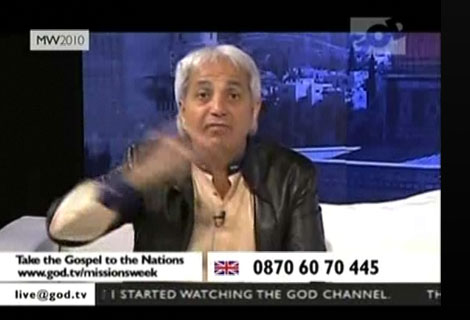
The background for this post is that I have just received final confirmation that a paper of mine, “Faith in Technology: Televangelism and the Mediation of Immediate Experience,” has been accepted and will be appearing soon in Phenomenology & Practice. The paper, which attempts a “techno-phenomenology” of faith-healing televangelism and the call to “touch the screen,” has its origins in a collaborative effort between myself and Christoph Bestian, formerly a sociology grad student here in Hannover. Together, we sought to synthesize our areas of expertise in, respectively, phenomenological approaches to media and the sociology of religion in order to forge a type of media analysis that would be more robust than either of the individual approaches in isolation — a polyvocal approach able to draw strength from interdisciplinary dialogue and differences of perspective. Of course, I take full responsibility for any shortcomings in this product of our collaboration, but I am grateful to Christoph for challenging my views and placing them alongside a very different tradition of inquiry. What I’d like to suggest is that perhaps a similarly productive encounter is possible between the phenomenological perspective that I outline in the paper on televangelism and the topics and approaches of TV studies; especially studies that emphasize the self-reflexivity of contemporary television stand to profit, I believe, from a detailed phenomenological analysis of embodied reception — not as a replacement for, but as a complement to, the more standard narratological perspectives.
In any case, this is work that remains to be done. My paper on televangelism does not engage directly with work in the field of TV studies, but it might be seen as laying a foundation for that sort of encounter. Here is the abstract for the paper:
This paper seeks to illuminate the experiential structures implied in the viewing of televangelistic programming — with particular focus on programming of the charismatic faith-healing variety that culminates in the televangelist’s appeal to viewers to “touch the screen” and consummate a communion that transcends the separation implied by the televisual medium. By way of a “techno-phenomenological” analysis of this marginal media scenario, faith-healing televangelism is shown to involve experiential paradoxes that are tied to processes of social marginalization as well. Thus, it is argued, faith-healing televangelism functions as a call to viewers to mount a head-on confrontation with the technological infrastructure of secular modernity and thereby to effect a specifically material negotiation of evangelical culture’s precarious balancing act between an entrenchment in and a self-marginalization from the secular mainstream.
*************
And here is the original introduction to the paper, which has now fallen to the cutting-room floor, but which gives an idea of the paper’s approach and the scope of the argument:
*************
Faith in Technology: Televangelism and the Mediation of Immediate Experience
Shane Denson
What is it like to watch televangelism? For many late-night channel surfers, televangelism occasionally provides a form of entertaining diversion unsurpassed on the fringe-media landscape of infomercials and call-in astrology consultations for its ability to render parody superfluous. If, however, the spectacles of mass-mediated religion offer amusement to the unbeliever, they can as readily generate an unsettling experience of disbelief: how can anyone, such a viewer may ask, take these transparent displays of charlatanry seriously? Watching televangelism as unintentional comedy is therefore a short-lived entertainment, for its pleasures are both predicated upon and potentially undermined by a distanced attitude, one that implies a critical difference from, and thus also a particular reading of, what it must be like for true believers to watch the shows. Thus, entertainment easily gives way to a form of armchair sociology or media psychology, and the humor of a televangelist asking us to put our hand on the screen to feel the power of the holy spirit becomes diluted by a concern for, or a disdain of, the “other” viewer: one naïve enough to buy into the promises of spiritual fulfillment and worldly prosperity that are peddled like so much snake oil. Like the promised rewards, the investments being solicited are both spiritual and material, and the spectacular lifestyle enjoyed by some televangelists, flying in private jets from one engagement to the next to spread the gospel to an audience that includes some of the poorest members of society, attests both to the existence of the true believer and to the dishonorable motivations of many TV preachers. Indeed, perennial sex and fraud scandals have made it common knowledge that televangelists don’t always practice what they preach, thus making it hard for our late-night ironic viewers to sympathize with their exploited counterparts.
Interpreting televangelists’ praxeological inconsistencies not just as typically human failures but as straightforward hypocrisy, the increasingly cynical viewer may detect broader contradictions in the televangelistic enterprise. The conservative theology espoused on the airwaves often seems quite at odds with the modern secular world, and yet televangelism is inextricably tied up with modernity. TV ministries often engage directly in worldly politics, lending their support to causes ranging from anti-pornography crusades to the waging of mechanized wars on foreign soil. Even more centrally, religious conservatives never tire of condemning “the media,” not just for the perceived liberal slant or indecency that characterizes mainstream media contents but also for the isolating effects of modern technological forms of mediation; paradoxically, though, televangelism is dependent for its very existence on precisely these technologies of mass communication.
However, focusing on these apparent contradictions fails to capture some of the most significant paradoxes of televangelism. Certainly, part of the reason is that the perspective outlined above — that of “the cynic” — is based on simplifying stereotypes of televangelists, their modes of address, and their audiences. Not only is there a wide range of theological content represented in today’s religious programming, but also a variety of styles and formats employed in televangelism (religious talk shows, alternative news programs, infomercial-type paid programming, issue-based fundraisers, preacher-centered motivational shows, and televised congregational church services, among others). Accordingly, it is impossible to identify a singular implied viewer or a coherent audience base of televangelism. The supposed contradictions with which televangelism is charged, it might be argued, are partially generated by lumping these differences indiscriminately together. Nevertheless, the cynic’s view does touch upon one of the central issues that any analysis of televangelism must confront—the tension between conservative evangelical theology and the mediating technology of television. But we fail to appreciate the tension’s true import so long as we reduce it to a competition between an anti-modern message and a modern channel of dissemination. At stake is not a message per se at all, I suggest, but an experience that is seen as immediate — the direct communion of the holy spirit with a believer’s body and soul. The question, then, is this: how can an inherently immediate experience be communicated through electronic media?
Posing the question in this way requires that we go beyond the dichotomies of form/content or channel/message and focus instead on the embodied experience of viewing televangelism. Recognizing the variety of televangelism’s forms and modes of address, I seek not to reify one monolithic type of televangelistic experience but to address a paradigm case in which the tension between mediation and immediatism reaches its apex: the case of the televangelist faith-healer’s appeal to viewers to touch the screen and consummate a laying on of hands at a distance. As a preliminary step towards such a phenomenological analysis, we must contextualize televangelism historically and socially and reconsider the relations between conservative evangelicalism and modern processes of secularization. As I shall demonstrate, there is an inherent connection between the two that is obfuscated by emphasizing evangelicalism’s overt rejections of secular modernity. At the level of religious practice, conservative evangelicalism and fundamentalism are less anti-modern movements than they are attempts to provide an alternative experience of modernity. As one field of such practice, televangelism is a decidedly modern phenomenon; it aims not to disseminate a pre-existing (and pre-modern) message but actively produces new constellations of discursive content and experience that are intrinsically tied to modernity and its technologies. Seen from this angle, the televangelist’s invitation to touch the TV screen is an invitation to confront modernity head on, to undergo not just a test of faith but to submit oneself to a technological ordeal in which a qualitatively new form of faith may emerge that is tuned to and inseparable from the technological conditions of modernity. Thus, rather than writing off viewers’ interaction with the screen as simple-minded naiveté that overlooks a damning contradiction, we must come to appreciate the dynamic, productive potential of the experiential paradox.
Eternal Shame
[youtube http://www.youtube.com/watch?v=WmJmmnMkuEM]
Above, video from UC Davis yesterday, in which heavily armed police officers brutally pepper-spray peaceful protestors at close range. Watch the whole video, though, for an incredible show of solidarity. The incident has prompted Assistant Professor Nathan Brown (Department of English, Program in Critical Theory at University of California at Davis) to post this open letter to Chancellor Linda P.B. Katehi, calling for her resignation.
The pain these officers inflicted will subside, but thanks to Youtube, the shame of their deeds is eternal. The world is watching.
See BoingBoing for more background and another video from an alternative POV.
More on #OccupyTheGoddamnBatman
[youtube http://www.youtube.com/watch?v=WkBnqHQ9Obs]
The more I think about it, #OccupyTheGoddamnBatman is a necessary development or outgrowth of #OWS. For one thing, there’s such an abundance of (coincidentally linked but thematically relevant) material that’s just asking to be appropriated (i.e. occupied) and virally reproduced, such as the photos from the film shoot that Keith Olbermann referenced. (A lot of this work has been started, as the images and clips here demonstrate.) As one commenter remarks on the pictures of the film shoot (there’s been talk of using protesters as extras):
“This weekend Batman visited New York and shot a home movie called The Dark Knight Rises with his buddy Christopher Nolan. The Occupy Wallstreet people may not have a job, a place to piss, or any hope for the future, but at least they got to meet the Goddamn Batman. And Catwoman was there, too. Rawr.”
Meanwhile, Frank Miller, author of the series that gave us the famous “goddamn Batman” line — and the meme it spawned — recently came out with some “putrid false righteousness” concerning the #Occupy movement (those are his words, which he uses to describe #OWS). See Miller’s post here, if you must, for his full condemnation of the protesters, whom he calls “pond scum” and “schmucks,” and about whom he writes insightful things like this:
“Occupy” is nothing short of a clumsy, poorly-expressed attempt at anarchy, to the extent that the “movement” – HAH! Some “movement”, except if the word “bowel” is attached – is anything more than an ugly fashion statement by a bunch of iPhone, iPad wielding spoiled brats who should stop getting in the way of working people and find jobs for themselves.
[youtube http://www.youtube.com/watch?v=zE-2ccp34fs]
In response to Miller’s blathering, digital illustrator Dane Cypel has begun the occupation of the goddamn Batman, recognizing that Miller’s “Batman’s not really the goddamn Batman, he’s also the goddamn one-percent”:
(“I’m the Goddamn 1%!”, from Cypel’s blog The Greatest Dane, here)
And here are some similarly themed images from around the Web:
#OccupyTheGoddamnBatman
#Occupy the Goddamn Batman
[youtube http://www.youtube.com/watch?v=CxG4g62rnd8]
A few days ago, Keith Olbermann discussed the injustice of NYC Mayor Bloomberg’s response to #OWS. Among the more humorous of his remarks was this:
Who else but a publicity addict like Bloomberg could have enabled the arrest of 700 protesters on the Brooklyn Bridge and yet, two months later, frozen 20 square miles of New York City in gridlock traffic over two days, so somebody could film another GODDAMNED BATMAN movie on the 59th Street Bridge? Leading to the inescapable conclusion that — if you want to tie up a little traffic during a protest for equality and freedom from corporate domination on a bridge in New York City — you will be arrested. But — if you want to tie up all of the traffic during a goddamned movie shoot for the financial benefit of corporate domination — the city of New York will embrace you and give you tax breaks.
Now fans of Batman will recognize here more than just a tirade against GODDAMNED BATMAN movies; there’s also an allusion — perhaps a fannish, loving allusion — to words uttered by Batman himself: “I’m the goddamn Batman!” (panel 1, page 10, All Star Batman and Robin the Wonder Boy, issue 2)
This has since become a widespread Internet meme (see the Know Your Meme site for some background), as displayed in images like this:
So while Olbermann was making a serious point in his commentary on Bloomberg and GODDAMNED BATMAN movies, he was also invoking this line of humorous appropriation — or OCCUPATION — and bringing it into connection with #OWS. We might read this, then, as a call for the occupation of Batman — or, more accurately, for the politicization of the occupation represented by the “goddamn Batman” meme.
Almost as if in response, what is appropriately being called a “Bat-signal” for #OWS (created by Mark Read) was projected yesterday on the Verizon Building during the #N17 march on the Brooklyn Bridge (see the video above). (The story behind Read’s projection is quite interesting, so check out the interview with him at BoingBoing.) And while I haven’t seen anyone explicitly connecting Olbermann’s comments, the “goddamn Batman” meme, and this so-called “Bat-signal,” I think there’s something to be said for doing so, and good (i.e. strategically sound) reason for actively taking up these connections as part of the viral imagery of the #Occupy movement. #OWS itself is about reclaiming, rewriting, about techniques familiar from the medium of comics — about retcon and the proliferation of alternate universes, as these words from the Bat-signal for the 99% demonstrate:
99% / MIC CHECK! / LOOK AROUND / YOU ARE A PART / OF A GLOBAL UPRISING / WE ARE A CRY / FROM THE HEART / OF THE WORLD / WE ARE UNSTOPPABLE / ANOTHER WORLD IS POSSIBLE /…
#OCCUPY THE GODDAMN BATMAN!
Jason Mittell’s Third Way: A Preview
Television scholar Jason Mittell, who is currently spending a year in Göttingen as a fellow in the DFG Research Unit “Popular Seriality–Aesthetics and Practice,” will–as readers of this blog will already know–be giving one of two keynote lectures at our conference “Cultural Distinctions Remediated,” December 15-17, 2011 (our other keynote speaker is Lynn Spigel).
Now, over at his blog Just TV, Jason has a new post on Michael Z. Newman and Elana Levine’s new book Legitimating Television: Media Convergence & Cultural Status. And included in this “unofficial review” (as he puts it) of Newman and Levine’s book is also what would appear to be an (unofficial?) preview of Jason’s talk in Hannover. I recommend reading the review in full, but I wanted to highlight those points that give us an idea of what kind of ground we can expect Jason to be covering in his keynote, “The Complexity of Quality.”
Jason writes, “this response [to Newman and Levine’s book] will be part of a larger argument I’ll be making in a presentation next month at the conference Cultural Distinctions Remediated at University of Hannover, so I will point toward larger arguments still to come, and welcome feedback to help me craft that talk.”
So what can we look forward to in Mittell’s keynote? Jason identifies what he takes to be a central problem in Legitimating Television: namely, a “false dichotomy” that he sees Newman and Levine putting forward in their book. According to Mittell:
“The book links the discourses of legitimation to structures of gender and class, highlighting how television has traditionally been feminized and stigmatized as lowbrow, arguing that recent legitimation practices work to masculinize and “class up” television. While I think this is correct, I do not see it as a self-evident problem to be avoided at all costs like Newman & Levine seem to, as suggested by the book’s final words: “We love television. But legitimizing that love at such a cost? Paying for the legitimation of the medium through a perpetuation of hierarchies of taste and cultural value and inequalities of class and gender? No” (171). Implied in this conclusion and their analysis throughout is a choice: we (as scholars, critics and viewers) can either embrace legitimation and its concomitant reinforcement of cultural hierarchies, or we can reject it, with the latter framed as the more politically progressive choice.”
Later, and here’s where we get an indication of – some very interesting – things to come at his talk in December, Jason writes:
“What I wanted from the book that I did not get was a third way to discuss television’s cultural legitimation, moving beyond either accepting legitimation discourses of quality television and progress, or rejecting them as illegitimate or ungrounded. (In my talk at Hannover, I hope to offer such a third approach, specifically concerning cultural evaluation.)”
I’m sure I’m not alone in saying that these are exciting prospects; I very much look forward to hearing Jason’s argument and his vision of/for this “third way.”
Bollywood Nation: Dilwale Dulhania Le Jayenge
On Thursday, November 24, 2011, we will be screening the second film in our Bollywood Nation series: Dilwale Dulhania Le Jayenge [The Big Hearted Will Take the Bride]. Please note that this and subsequent screenings in the series are now scheduled to begin at 6:00 PM (room 615 in the Conti-Hochhaus).
The film, directed by Aditya Chopra and released in 1995, was the first successful new global NRI film, considered a classic of its kind. The short description at imdb.com indicates the global scope of the conflicts, concerns, and identities that inform the film:
“A young man and woman – both of Indian-descent, but born and raised in England – fall in love during a trip to Switzerland. However, the girl’s traditional father takes her back to India to fulfill a betrothal promise.”
Why #Occupy needs Bloomberg
[youtube http://www.youtube.com/watch?v=yoG9PmdGaT8]
Lost in Media: Conference in Weimar
On November 25-26, 2011, the Bauhaus University Weimar will be hosting the conference “Lost in Media,” where the focus will be on the television series Lost as a form of reflection and projection of media change. Among the speakers, two members of the DFG Research Unit “Popular Seriality–Aesthetics and Practice” will be giving talks at the conference:
Jason Mittell, Fellow of the Research Unit, will be giving a keynote address entitled “Getting Lost in Transmedia: The Perils and Possibilities of Mapping an Island Across Media,” and Andreas Jahn-Sudmann will be speaking on “Watching Lost and Exploring Outbidding (Überbietung) as a Serial Form.”
For further information and the full conference program click here. Here is the conference description:
Kaum eine Fernsehserie lässt sich aus so vielfältigen Perspektiven betrachten wie LOST. Die Serie bringt eine weitläufige wissenschaftliche Auseinandersetzung hervor, die um die Komplexität ihrer narrativen und zeitlichen Struktur kreist oder sich mit der Tatsache beschäftigt, dass kaum eine Serie bisher so massiv ihre Expansion in andere Medien vorangetrieben und so konsequent Genre-Grenzen unterlaufen hat. Zudem bildet sich um LOST eine sehr aktive Fangemeinde, die nicht nur auf die quasi-religiösen, quasi-philosophischen Eschatologien der Serie reagiert, sondern Lost auf einer Vielfalt neuer digitaler Medienplattformen rezipiert und dort mit den Themenkomplexen der Serie interagiert.
Gerade wegen ihrer thematischen und ästhetischen Reichhaltigkeit wird die Tagung eine ganz spezifische Interessenlage an die Serie herantragen. Es soll darum gehen, LOST als eine Agentur der Reflexion und der Projektion des (medialen) Wandels zu untersuchen. Dabei nimmt LOST allerdings auf faszinierende Weise eine widersprüchliche und ambivalente Rolle in Bezug auf Mediatisierung und medialen Wandel ein, die ein zentrales Motiv einer wissenschaftlichen Auseinandersetzung und der besonderen Reflexionsleistung der Serie darstellen: Während auf vielfältige Weise Effekte des medialen Wandels mit der Serie verknüpft sind – z. B. transmediales Erzählen, neue televisuelle Rezeptionsformen, TV III-Age – und die Serie in der Narration und Ästhetik Effekte des vernetzten, nicht-linearen Erzählens und der Genreüberschreitung realisiert, verweist die Serie selbst jedoch nicht unmittelbar auf die Mediatisierung, die sie symbolisiert und auch verursacht.
Diese konkrete Fragestellung ist eingebettet in eine generelle Vermutung zum Verhältnis des Fernsehens und des (medialen) Wandels, wonach das Medium eine dreifache Funktion im Geschehen des Medienwandels seit 1950 und insbesondere in der aktuellen Gegenwart erfüllt. Es beobachtet – erstens – den Wandel und macht ihn so auf strukturierte Weise sichtbar. Diese Beobachtungen stellt es dann dem Sinnhaushalt, dem Selbstbeschreibungs- und Selbstverfertigungszyklus der Gesellschaft zur Verfügung. In dem Umfang, in dem es dabei – zweitens – insbesondere den Medien eine z.B. technologische, institutionelle oder epistemische Mitwirkung oder gar Urheberschaft am beobachteten Wandel beimisst, ist es selbst Agent des Wandels und beobachtet sich selbst auf diese Funktion hin. Schließlich ist es – drittens – dem beobachteten Wandel bzw. seinen Folgen wiederum seinerseits ausgesetzt und muss die Formen und Formate seiner Beobachtungen ständig den Wirkungen des beobachteten Wandels aussetzen, muss den Wandel an sich selbst mitvollziehen. Insbesondere der Fernsehserie, auf Grund ihrer Fiktionskraft und spezifischen Temporalität, kommt dabei, so die These, eine herausgehobene Position zu.
Am Beispiel von LOST soll dieser These nachgegangen werden. Angesprochen ist dabei vor allem der mediale Grenzgang der Serie selbst, deren Ausweitung in andere Medien nichts weniger aufwirft als die Frage nach dem Status ihres Herkunftsmediums Fernsehen innerhalb der rezenten multiplen Medienlandschaft, aber auch etwa ihre komplexe Temporalität, welche die Theoretisierung televisiver Zeitlichkeit und auch Historizität vor neue Herausforderungen stellt.
Kontakt: Dipl.-Kulturwiss. (Medien) Daniela Wentz, daniela.wentz [at] uni-weimar.de
Weitere Informationen zum Projekt:
Mic Check (verb, transitive)
[youtube http://www.youtube.com/watch?v=1oHRdiklTlU]
The human microphone, born out of prohibitions against protestors’ use of technical means of amplification, has been transformed from a simple medium to a message in its own right. And as the Occupy movement (or idea, tendency, effort, etc.) has gone viral, so too has the human microphone, moving from the street to the auditorium, where it serves as a (non-neutral) means for dissenting audiences to speak back. Here, we see Wisconsin Governor Scott Walker (above) and House Majority Leader Eric Cantor (below) getting “mic checked” by Occupy supporters.
[youtube http://www.youtube.com/watch?v=7i-nCqINfAI]