Spectral Seriality: The Sights and Sounds of Count Dracula

Below you’ll find the talk that Ruth Mayer and I recently gave at the “Popular Seriality” conference in Göttingen (June 6-8, 2013). We will be expanding the paper for publication, so comments and criticisms are very welcome!
SpectralSeriality_Presentation.001

Spectral Seriality: The Sights and Sounds of Count Dracula

Shane Denson, Ruth Mayer – Leibniz Universität Hannover

1. Introduction

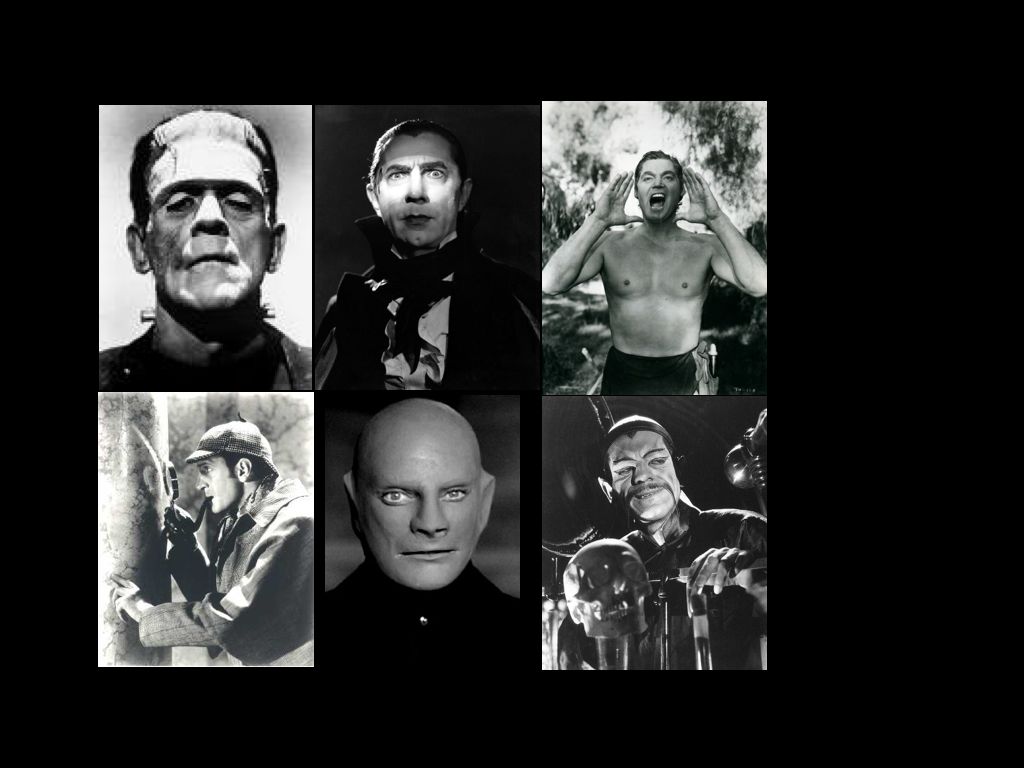
In this talk we will be looking at the medial logics and serial dynamics of iconic popular figures, taking Dracula as a paradigmatic example of a “spectral” logic that enables serial figures to proliferate across medial channels. By “serial figure,” we mean a type of stock character populating the popular-cultural imagination of modernity; a “flat” and recurring figure, subject to one or more media changes over the course of its career. We see serial figures as integral and ideologically powerful components of the political and economic order of modernity, which works expansively to increase commensurability and connectivity. Serial figures operate in this system as mediating instances between the familiar and the unknown, the ordinary and the unusual. It is thus not by accident that such figures are characteristically liminal, transitional, or border-crossing beings – straddling the divide between nature and technology like Frankenstein’s monster, between life and death like Dracula, human and animal like Tarzan, or oscillating between moral and ethnic positions like Sherlock Holmes, Fantômas, or Fu Manchu. These figures parasitically appropriate the media ensembles of a given period, taking up residence in them and making them their own; at the same time, serial figures are in a way themselves media of modernization, higher-order media that gather together and focus attention on media undergoing change. This is especially true with regard to the cultural and commercial logic of the “update,” according to which transformations and transitions in the modern media landscape are negotiated and sold as “innovations.” But characterized as they are by a reversible relation to media as both instrument and environment – as both (diegetic) object of interest and as the very horizon of perception, expression, or narration – serial figures lend themselves also to a retrospective view of media change as non-teleological, overdetermined by competing forces and yet haunted by a spirit of indeterminacy and a sense that “things could have been otherwise.”
SpectralSeriality_Presentation.002

In the following, we will first try to flesh out this picture and explain more precisely what a serial figure is, what it does, and how it operates. Our focus will be on the figure of Dracula, who perhaps more than any other serial figure brings into focus what we’re designating the “spectral” logic of serial proliferation: that is, a ghostly and flickering relation to presence, or the present, which characterizes the medial historicity of the serial figure and propels its ongoing transformations as it moves between old and new media – from text, to film, to radio, TV, and toward the digital. Seen in this light, it is the spectrality of the figure, the fact that it’s neither (completely) here nor there, that keeps the figure alive – or, more precisely, undead – never quite exhausted by a single, definitive instantiation but always at least potentially available for yet another serial iteration.

2. Serial Framings & the Spectral Integrity of the Icon

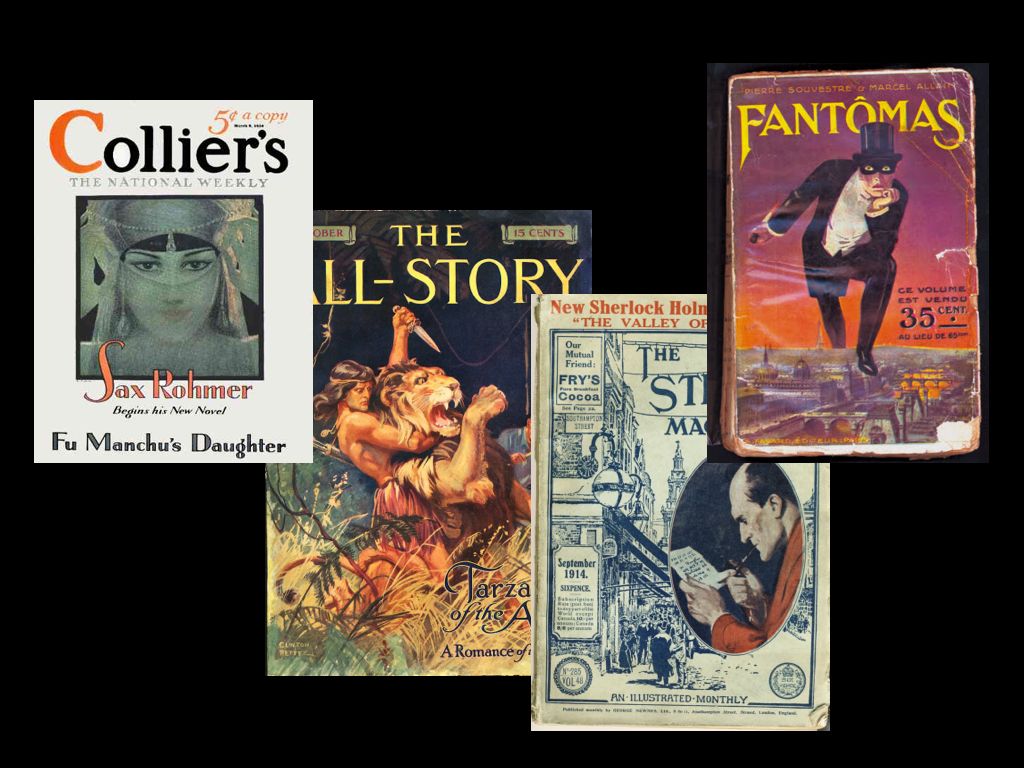
A serial figure is a figure that needs no explanation, no introduction, and no elaborate framing – it is familiar, even if one has never dealt explicitly with the figure. The serial figure is distinguished here from the series character, which is developed in an ongoing narrative (for example, a soap opera, a serial novel, or a saga). Serial figures – as Umberto Eco once wrote of Superman – undergo a “virtual beginning” with each new staging, “ignoring where the preceding event left off.” Series characters grow and develop a more or less linear biography, while serial figures are characterized by repetitions, revisions, and even the occasional “reboot” of their entire history. Serial figures and series characters must, however, be understood as ideal-typical figurations; often, they blend into one another in the course of their narrative unfolding. Indeed, serial figures quite often derive from series characters: many (like Tarzan, Sherlock Holmes, Fu Manchu, Fantômas) were first introduced in the continuing narratives of serialized magazine productions, then further developed in novel series, before eventually mutating into serial figures proper as they jumped across various medial channels (Denson/Mayer 2012a/b).
SpectralSeriality_Presentation.005

Serial figures have an extreme affinity to modern media, and they seem positively to thrive on media changes. Though many classical serial figures were established in literary texts, they all jumped very quickly to other media, mutated, fanned out, proliferated, and reproduced without losing their distinctive forms, features, trademark equipment or gear. As a result, they are particularly good at introducing the cultural or medial “new,” and thus at mediating novelty against the background of a figure’s familiarity – serial figures both foreground or exoticize and familiarize the foreign or unknown. This marking and familiarization is achieved not only narratively, but also formally – by way of serial iteration. Serial figures are not developed linearly from A to B; rather, their careers unfold along branching paths, across nodes, loops, and resonances, by way of a “concrescent” or compounding, sedimenting rather than sequential form of seriality.

Even before the comics superheroes of the 1930s took up and adapted many of their characteristics, serial figures presented themselves as both long-familiar and strangely new, at once timeless and hypermodern, universal and particular alike. For a long time, however, the serial figures of the turn of the century have been read almost exclusively in terms of the atavistic, the primitive, the unconscious – in any case, not the modern. This approach culminated in the 1960s in the reception history of Northrop Frye’s Anatomy of Criticism. For Dracula, Frye’s impact registers in the assumption of a “majestic immutability” informing the representation of the vampire through the ages, as Nina Auerbach delineated in her cultural history of the vampire (1995: 130; cf. Douglas 1966). This assumption then gave way, in the wake of intellectual history and Foucault’s “archaeology of knowledge,” to a more historically and medially specific approach, as exemplified by Nina Auerbach’s own take on vampires as “personifications of their age” (3): instead of transhistorical continuities, scholarship now foregrounded historical breaks and radical revisions.

But cultural contextualization alone is not enough to get a handle on the cultural careers of serial figures. We have to pay attention both to their iconicity and variability, and towards this end we have to focus on the serial figure’s mediality – or, more generally: its formal framing. To understand the constructive force of such framing, one should not stretch the frame too far. If you look not at Tarzan, but at primate-human hybrids in the history of Western culture, not at Dracula but the vampire from Byron to True Blood, not Frankenstein’s monster but man-machine configurations since the early modern era – you run the risk of overlooking the specific medial dynamics of popular seriality, a dynamics of modern and hence mass and technical media. Connected to the inherent reproducibility of modern media, this properly serial dynamic draws on an awareness of something being re-told, activating a dialectics of recognition and astonishment, of departures from and re-anchorings of previously staged narratives and images. The more concrete the anchor points and cross-references in a serial sequence, the more clearly does this logic manifest itself. And only with regard to this logic can we recognize the political-ideological and medial-material “work” of the serial figure, its anchoring in a specific world-historical era.

SpectralSeriality_Presentation.012

Dracula himself is very much a product of the late colonial era, and the threat he poses is accordingly “dynamic, totalizing.” Earlier monsters operated “on the margins of society, hidden away in their towers,” while modern creatures of horror are figures of expansion and spread. “The modern monsters,” writes Franco Moretti with a view particularly toward Dracula, “threaten to live for ever and to conquer the world. For this reason they must be killed” (Moretti 1982: 68). Dracula, not the generic vampire, comes from Transylvania, and thus from the border region between East and West; a region which does not yet demarcate horror and superstition at the time of the figure’s inception but “the vexed ‘Eastern Question’ that so obsessed British foreign policy in the 1880s and 90s” (Arata 1990: 627; see also Richards 1993: 56-64; Gibson 2006). In our minds, Dracula always has pointed teeth, he always wears a cape, always sleeps in a coffin, and he concentrates on female victims, even if he got along during various stretches of his serial career without some of these habits and accoutrements. In its iconicity, the figure of Dracula mobilizes a whole army of basic conceptual oppositions, pitting them against one other, but without the prospect of resolution: East meets West, the predator threatens civilized humanity, masculine agency preys on the female victim – and, of course, life and death entwine in the vampire’s uncanny body. None of these pairs of terms remains unproblematic or stable in the course of the figure’s long career, but all of them reappear again and again in various guises and constellations. In his serial specificity, Dracula thus stands out among vampires – he no longer embodies the sensibility of the early Victorian period, nor yet has he assumed that of our late televisual postmodernity. There is a diffuse – indeed spectral – integrity to the figure across its various medial instantiations; its iconic appearance will always by superimposed upon any and all possible concrete manifestations, even if (and perhaps especially if) the figure now appears in a different form.
SpectralSeriality_Presentation.011

3. Dracula’s Medial Dialectics

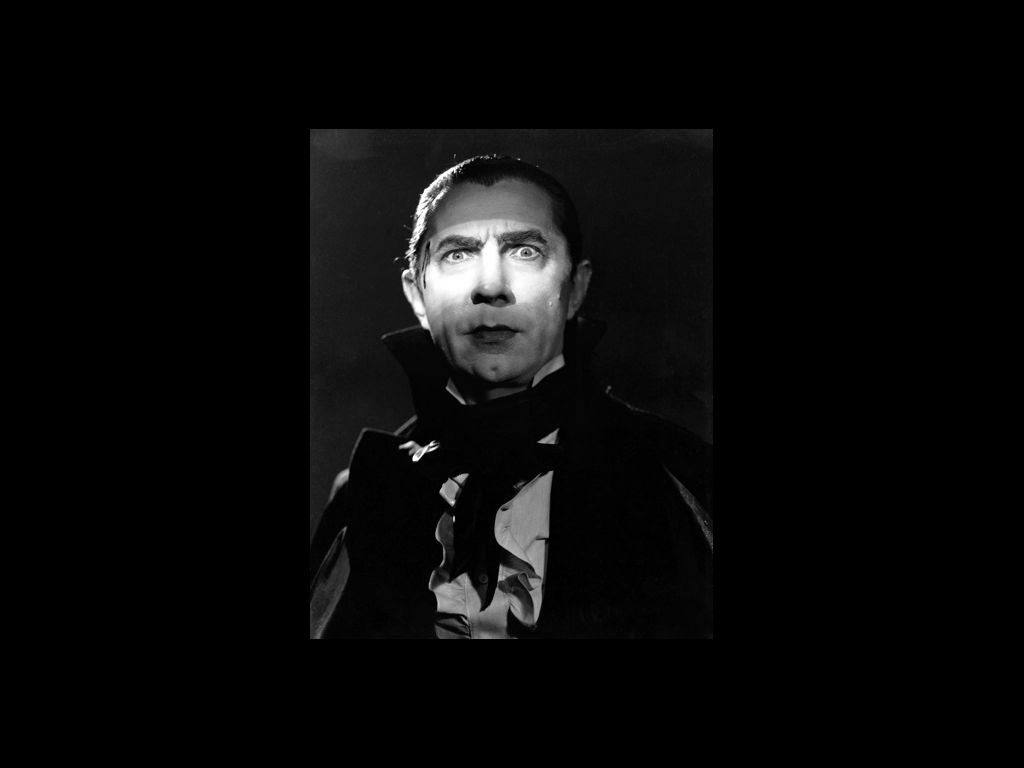
The figure’s iconic form has been fixed for us above all by Bela Lugosi’s portrayal of the Count in Tod Browning’s 1931 film version, to which we will return shortly, but first we turn briefly to Bram Stoker’s 1897 novel from which the figure first sprang to … uhh … “life.” The source text helps us to see the presence of a further conceptual pair at work in the serial unfolding of the figure: for the novel is marked, in a way that problematically straddles its diegetic “inside” and its medial “exterior,” by an unsettled tension between the diversification of media and an effort to commensurabilize or contain them. This tension is energized by the spirit of a transitional phase in which the medium of the novel – still the master medium of entertainment in the late Victorian era – starts to cede its territory to the technical mass media that shaped entertainment in the twentieth century. As we shall see, the unresolved tension between the specificity and generality of mediation is also generative of the sights and sounds of Count Dracula as he proliferates serially across the century’s audiovisual channels.

More than perhaps any other serial figure, Dracula reveals the active and creative power of technical media already at his literary point of departure. In Thomas Elsaesser’s estimation, which follows Friedrich Kittler’s seminal reading in Aufschreibesysteme, “[Dracula] may be the only original and authentic myth that the age of mechanical reproduction has produced” (2011: 111). Kittler read Dracula as “that perennially misjudged heroic epic of the final victory of technological media over the blood-sucking despots of old Europe” (Kittler, 1999: 86). And Kittler was not the only critic to read the novel as the document of a media struggle, in which an alliance built on modern media of communication is pitted against an ancient and totalitarian power (see also Wicke 1992; Richards 1993). While we very much agree that Dracula should be read as a novel about mediatization and media change, however, we are not so sure about its actual position within this battle – its sympathies, as it were. Technical media may prove superior in the battle of forces that the novel both depicts and takes part in. But the alliances or opposing camps within this battle are far less clear-cut than one might think. This may have to do with the fact that the triumph of the technical media of entertainment was about to deal a fatal blow to the very medium of the novel. The very particular novel at hand, Bram Stoker’s Dracula, does not openly militate against the media system of the twentieth century, we argue. But it is by no means as celebratory of its own format’s impending replacement as is often assumed.
SpectralSeriality_Presentation.013

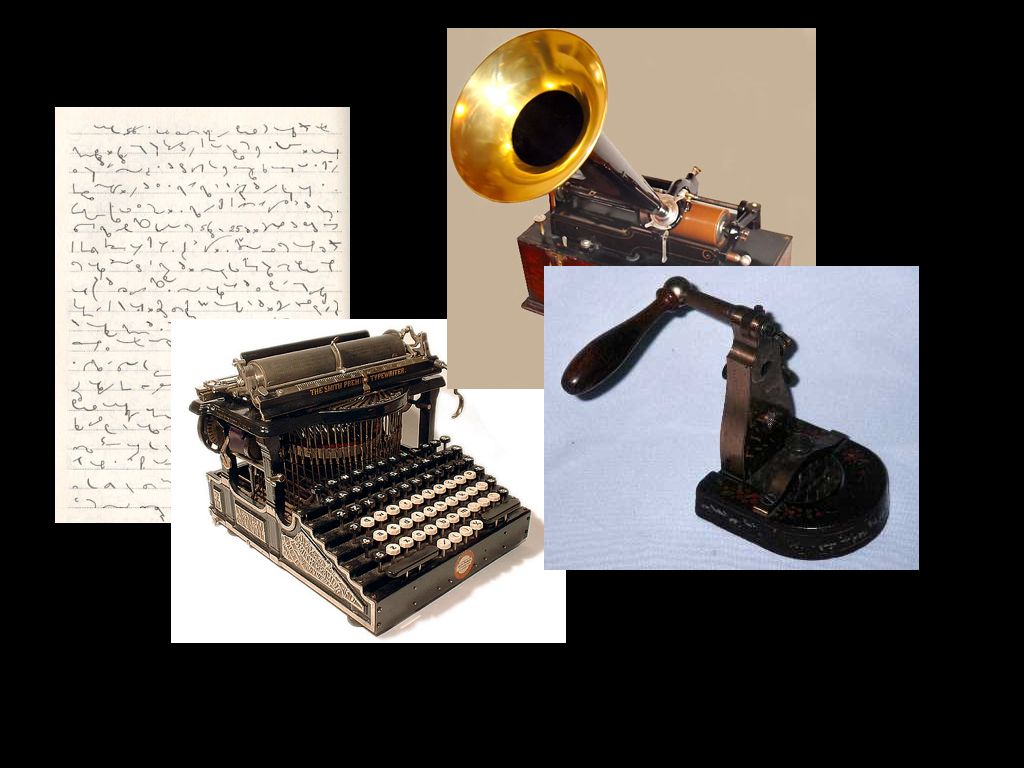
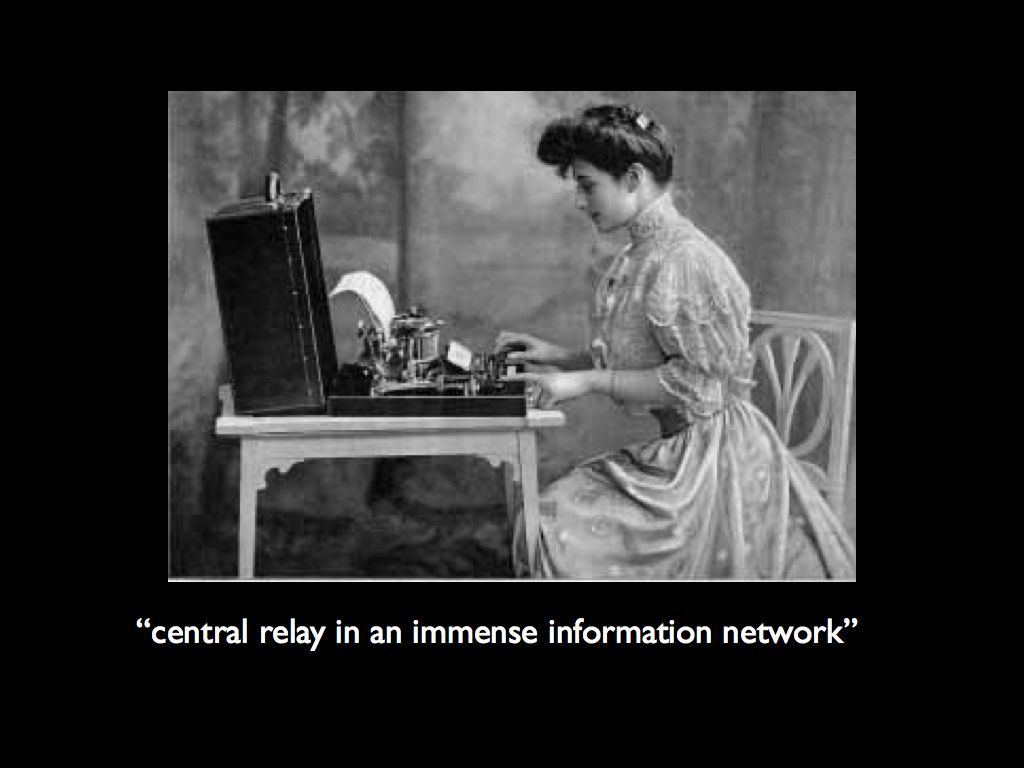
In line with this reconsideration of alliances and tensions, we contend that Dracula serves not so much as an outdated antecedent to the mass-media cultures of modernity, but as an integral element – perhaps even a basic principle – of them. Already at the point of his literary inception, Dracula embodies a principle of diffusion, of intermedial spectrality, according to which one material form is translatable into another: the humanoid, the wolf, bat, and fog. This allows him for a time to elude his pursuers, but they too are acquainted with a plurality of media forms: shorthand notation, the telegraph, the phonograph, and the typewriter play instrumental roles in this counter-project. Mina Harker, as Dracula’s most important opponent and the driving engine of the international alliance of vampire hunters in the metropolis, is a skilled typist, and she manages to render the fractured records of journals, newspapers, phonograph cylinders, and stenographic notes into the uniform medium of typewritten text, reproduced in triplicate; Mina becomes what Kittler called the “central relay in an immense information network” (Discourse Networks 354). In doing so, however, Mina also cleanses the new technological media of communication of their ‘rawness’ and authenticity: “I have copied out the words on my typewriter, and none other need to now hear your heart beat, as I did” (199), she reassures Dr. Seward after having reviewed his phonograph cylinders. Simultaneously, and interestingly, she defuses what could be considered the most powerful forcefield of the late Victorian novel, obliterating the traces of feeling, the trembling and the terror, the horrible events’ profound impact on the ‘soul.’ At the very end of the novel, her husband, Jonathan Harker, summarizes in frustration that “in all the mass of material of which the record is composed, there is hardly one authentic document; nothing but a mass of type-writing […]. We could hardly ask anyone, even did we wish to, to accept these as proofs of so wild a story” (335).
SpectralSeriality_Presentation.014

Fortunately, the version of the events that the book ultimately renders is not Mina’s purified, streamlined, typewritten collection of data, but Bram Stoker’s lurid and sprawling ‘imperial gothic’ (Brantlinger 1995). With this, the novel counters the “modern” ideal of totalizing data processing with another, older, aesthetics of totality – collating voices, perspectives, and media in order to achieve an impression of synchronicity and homogeneity. Dracula thus displays its tacit predilection for the media system of the nineteenth century and its unacknowledged skepticism vis-à-vis the technical media of the upcoming age. But the novel is fighting a losing battle on behalf of its own format. At the novel’s end, Dracula will be defeated while Mina has just given birth to a son, who shall bear all the first names of the league of vampire hunters. But, alas, in the story’s longer run, the powers of reproduction are afforded to the vampire rather than the Victorian lady. What distinguishes Mina in the novel – her interiority, her reflection, her robust presence – disqualifies her for a serial career and confines her to the bounds of the book. Dracula, in contrast, who is hardly ever ‘there’ in the novel, transgresses its boundaries and lives on, by virtue of his capacity to defer closure and synchronicity.

Rooted diegetically in the serial infection process by which the curse of the undead spreads, Dracula’s power far exceeds the text’s limits, formally and materially resisting the closure of the work. Dracula taunts his pursuers: “My revenge is just begun! I spread it over centuries, and time is on my side. Your girls that you all love are mine already; and through them you and others shall yet be mine […]” (273). In his flickering dispersion he seems to project various options for a future vampiric existence, tentatively envisioning nodes and links to future versions of himself. In that respect, the novel functions – against its own best interest and almost as if being operated by an alien force – as the ideal starting point for the figure’s serial proliferation.

Dracula’s spectral quality resides in his uncanny ability to navigate not only (diegetic) time and space but also to spread diffusely through the very real experiential timespaces that rub against one another in modernity, in the oppositional trajectories of medial particularization and convergent totalization. Transcending the novel – which is itself a site of convergent mediality wherein distinctions are effaced in the effort to correlate, coordinate, and ultimately thus to entomb the shape-shifting villain – Dracula emerges as a higher-order medium, thus acting simultaneously as a parasitic harbinger and a host of media transformation. The meta-medium of the serial figure accentuates the insufficient totality or completeness of the book as compared to audiovisual media – the media of silent and sound film, radio, and television into which the Count will successively and temporarily descend, before he inevitably pulls up stakes (so to speak) and moves on. In this interplay of first-order and second-order media, or between medial specificity and comparability, the sights and sounds of Dracula become the sights and sounds of media change itself.
Dracula_Title_Screen

4. The Icon as Transitional Medium

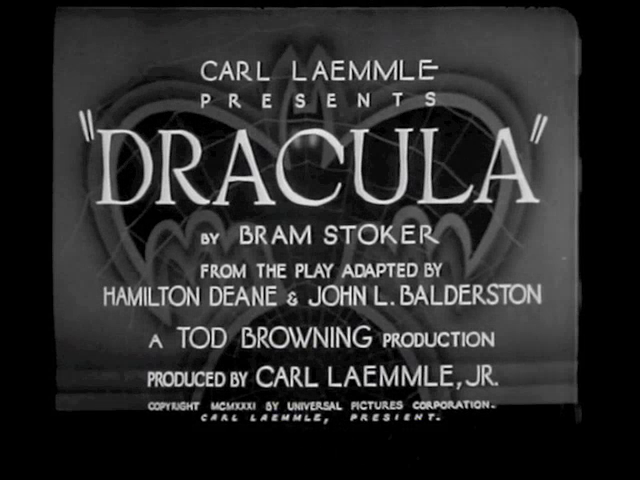
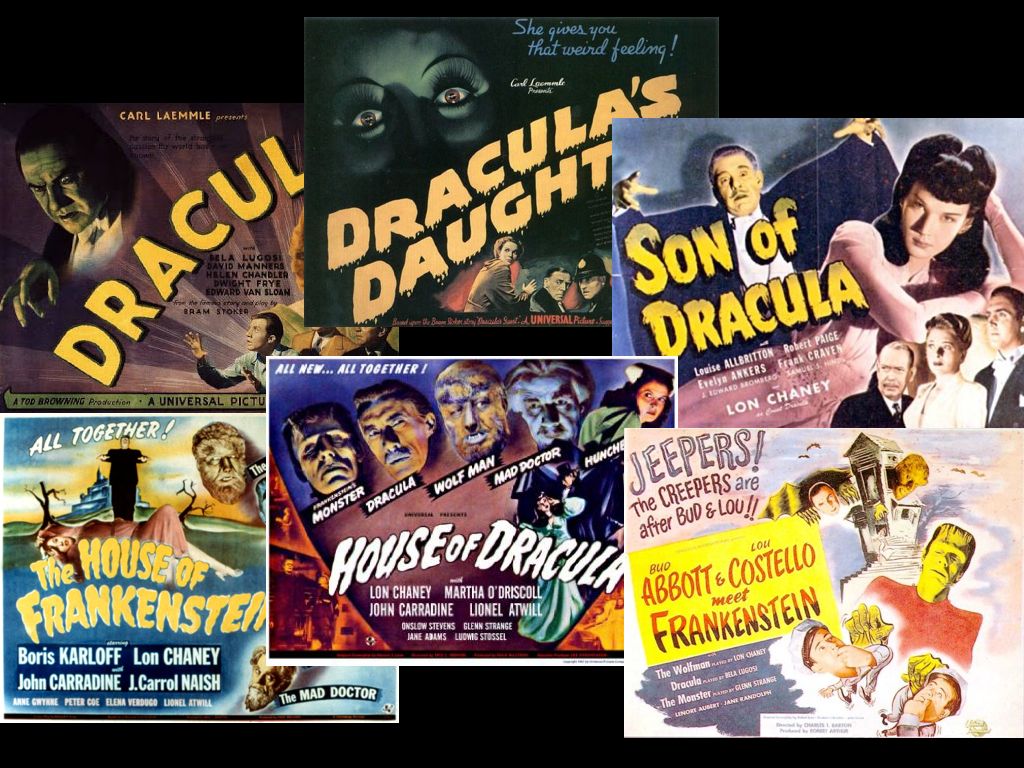
The transitional interplay of medial figure and ground is nowhere so tightly focused as in Tod Browning’s classic film from 1931 – particularly in the iconic image it bequeaths to us of Count Dracula. The film’s title card already evidences the plurimedial seriality that the figure had amassed over the previous three decades: “Carl Laemmle presents Dracula by Bram Stoker” – not as a direct adaptation of the novel, but “from the play adapted by Hamilton Deane & John L. Balderston,” which in fact refers to two plays: first a London-based production from 1924 and then a 1927 Broadway play based on it, and starring Bela Lugosi. Not mentioned here are Stoker’s own theatrical production, performed only once (prior to the novel’s publication) for the purpose of securing a copyright, Friedrich Murnau’s unauthorized adaptation Nosferatu from 1922, or any of the print editions, adaptations, abridgments, and serializations that had appeared since 1897. But what’s about to appear on screen will in any case overshadow all of those past interpretations, including the original novel, and it will continue to color our perception of any future instantiation for decades to come. Significantly, Browning’s film kicks off the horror-film cycle of the 1930s, including a series of Universal Studios productions featuring the Count: after Dracula (1931) comes Dracula’s Daughter (1936), then Son of Dracula (1943), the monster mash-ups House of Frankenstein (1944) and House of Dracula (1945), and finally Abbott and Costello Meet Frankenstein (1948), in which Lugosi reprises his role one last time. The figure, like the horror film, changes markedly over the course of this series, though, so it’s easy to lose sight of the originary medial functionality of Lugosi’s icon, which is born in the wake of the transition from silent to sound film. By film historian Donald Crafton’s reckoning, this transition was coming to its end by the time Dracula appeared in February 1931, but as Robert Spadoni has argued, the film harnessed a lingering experience of the first sounds moviegoers had heard emitted from the screen – an uncanny or “ghostly” experience resulting from the incomplete phenomenal coordination of sound and image. The Count gave a body to this recently bygone (but unforgotten, “undead”) experience, around which the horror genre itself was initially fashioned.
SpectralSeriality_Presentation.017

In this context, Browning’s film re-enacts the novel’s battle between medial particularization and generalization – abstracting it, though, from Mina’s and Stoker’s divergent efforts to coordinate medial fragments into a coherent textual whole, and transferring it to a probing of the cinema’s recent efforts to coordinate sight and sound into a coherent audiovisual whole. Dracula’s body is the central site of the struggle, the medial stakes of which are made clear in the film’s first ten minutes or so, leading up to the Count’s appearance and first encounter with his guest. The non-diegetic music with which the film opens will cease after the opening credits, and it will not reappear again until the closing credits. But the opening scene, set inside a noisy horse-drawn coach traveling through Transylvania, locates us more or less unproblematically in the sound-era of cinema, as onscreen characters converse and produce audible dialogue. Soon, though, as we move deeper into the wilds of Transylvania, this will stop and give way to an eerie silence. When the sun sets and our traveler Renfield (here playing the role of the novel’s Harker) sets out for Borgo Pass, a series of images show the Count’s distant castle, first from the outside, then its interior, bringing us swiftly to his coffin. There is no sound at all, until the interminable silence is broken by the sound of coffins opening, creaking, bumping, then rats squeaking, wolves barking, howling, as the camera moves in to reveal Dracula, who has silently appeared. The background of silence contrasts palpably with the use of non-diegetic music during the credits. This might be called a non-diegetic silence, as it foregrounds the images as silent, setting the stage for an uncanny sound, very different from the normalized sound of dialogue that precedes it. The silence has, of course, a diegetic aspect, but it is also double in a way, standing out as the spectral presence of a material and medial absence. (By way of contrast, a “regular” (diegetic) silence might conventionally be marked with the sound of crickets chirping.) Renfield’s carriage arriving now at Borgo Pass brings with it – and takes with it again just as quickly – the normalized (i.e. synchronized) sound we saw in the opening sequences, again foregrounding the uncanny silence of Dracula, who awaits Renfield ominously in his own carriage. Renfield’s somewhat fearful words to the silent count – “The coach from Count Dracula?” – seem awkwardly obtrusive against the background of silence, and the aural register itself alternates as ground and figure with the image of the tight-lipped count. Visually, Dracula’s bulging eyes accentuate this interplay, as they themselves describe a partially autonomous figure against the ground of his face – thereby singling out vision and visuality and setting them in a volatile and oscillating relation with sound and the sonic, before the Count’s coach heads off with its passenger toward the castle.
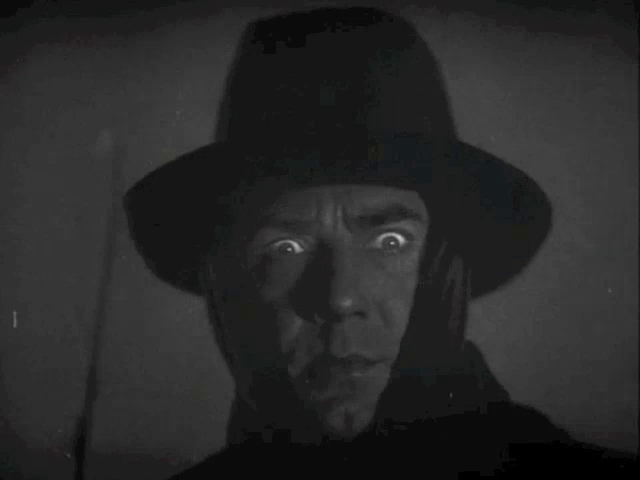
Dracula_Bulging_Eyes

Along the way, Renfield discovers that a bat has silently replaced the driver, and upon arrival he confirms that the driver is missing, while the castle door creaks open – autonomously and ostentatiously. Renfield enters, bats squeak, armadillos rustle. Dracula descends the staircase silently behind the frightened Renfield’s back. “I am Dracula.” Renfield explains hastily he thought he was in the wrong place. Awkwardly, Dracula replies, “I bid you welcome.” Wolves howl in the background. “Listen to them! Children of the night. What music they make.” This self-reflexive foregrounding of sound, captured for the purposes of the uncanny, reimagines the Jazz Singer’s famous “You ain’t heard nothin’ yet!” It will reverberate again in Tarzan’s yell, and – somewhat paradoxically – also in the muteness of Frankenstein’s monster, all of which stand in a self-reflexive relation to the sound-film transition.
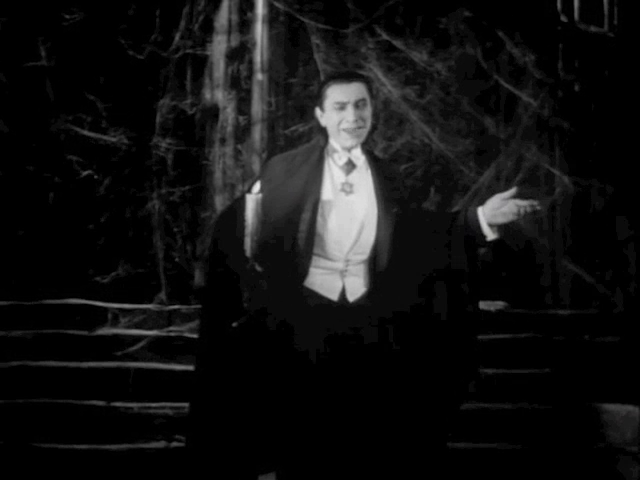
Dracula_Children_of_the_Night

The interplay of silence/sound, noise/speech, visual/sonic continues in London: there we hear the noisy metropolis, the scream of a first offscreen victim, and the music of the opera house, all of which are contrasted with the silence of the house at night, where a bat waits noiselessly at the window, enters without a sound, and where an offscreen transformation allows Dracula to appear just as noiselessly at Lucy’s bedside. This is followed by the screams of the madhouse and its raving lunatics, including Renfield, contrasted with the concentrated silence of Seward and the other doctors, and of van Helsing before he announces that they’re dealing with the undead, Nosferatu. Dracula communicates with Renfield without speech, seemingly with his eyes – which, in the iconic image, are highlighted with precise rays of light, producing an effect much like the bulging eyes earlier, again making vision/the visual the carrier of (a weird, for us indecipherable sort of) information, while sound is alienated from the image and rendered as incomprehensible noise – thus “denaturing” the recently naturalized, modern system of communication via synchronized sound and vision. It is significant that sound is produced, if not as dialogue, only by objects and nonhuman animals, never by the count’s body in humanoid form, which is perfectly and uncannily silent both in motion and at rest. Later, the count’s invisibility in the cigar-case mirror, first noticed by van Helsing, further problematizes sound/image relations, as Dracula is audible while not (mediately) visible. The fact that he “casts no reflection in the mirror” in fact mirrors or translates the fact that his body also emits no sound. Thus, sound and vision are dissociated from one another, both of them operating as channels of significance and its deformation in a joint effort to undo the habitualization of synchronized sound and reveal an experience of disjointedness and material excess at its base. This excess, this spectral materiality, refuses to be contained completely by the new medium of sound film. The latter is shown to be “haunted” by a stubborn spirit of medial transitionality, embodied by Dracula, which resists containment in a neat medial package just as the Count could not be contained in the novel.

The film reinstates, in this way, the excess that Mina, in the novel, had erased in her transcription of Seward’s cylinders. But it does so in a way that sits uneasily with Stoker’s own attempt to restore a novelistic “spirit” to his apparently dying medium. For the film transfers the mechanism of phonography, the technical capture of the aural real, from the level of content to that of the medium, which it self-reflexively foregrounds; accordingly, the material excess of breath (literally, “spirit”) and heartbeat that Mina erased from the cylinders are restored and channeled towards the nervous, embodied reactions of the spectator confronted with the early horror film.

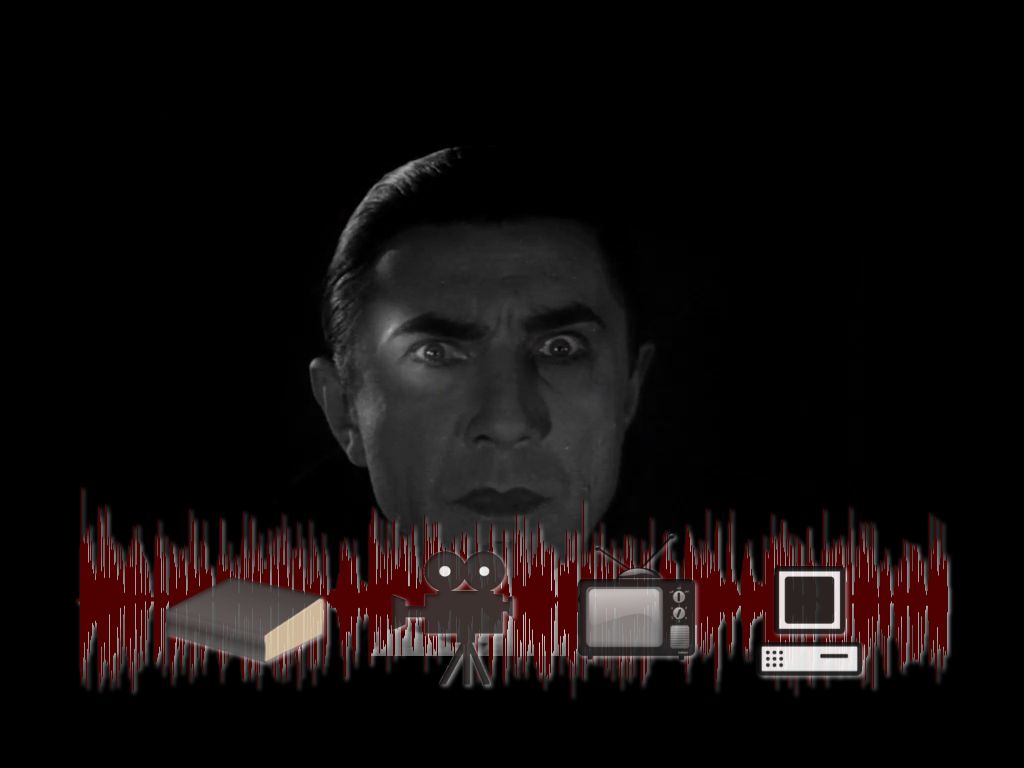
As in the novel, then, but for very different purposes, Dracula again thrives on, marks, and carries forth an unsettling spirit of medial transitionality: whereas Stoker sought to counter the impending changes to the media landscape of the nineteenth century, Browning allows the figure to extend the scope of the cinema’s sound transition – and with it the vampire’s own power. Problematizing the coordination of sound and image, Dracula’s uncanny image continually reinstates the distinction between sonic and visual registers, thus thwarting the medial coherence of the talkie, obstructing the normalization of a generalized audiovisual mediality. Rather than be contained by the medium of the sound film, Dracula himself becomes the medium in which the particular streams of sound and image can appear, juxtaposed and disjoined, forever at battle. Browning’s film thus continues the trajectory of serialization that the Count embarked upon when he escaped and transcended Mina’s and Stoker’s textualizing efforts in 1897. And though the medial self-reflexivity of the icon will fade from view as the sound transition recedes further into the past and the figure further establishes its place in popular culture, it is the icon’s spectral instrumentalization of the unsettled relations between medial particularity and generality that in part ensures its ongoing serial power.
SpectralSeriality_Presentation.030

Christina Meyer, “Technology – Economy – Mediality”

YellowKid-1897

Abstract for Christina Meyer’s talk at the symposium “Imagining Media Change” (June 13, 2013, Leibniz Universität Hannover):

Technology – Economy – Mediality: Nineteenth Century American Newspaper Comics

Christina Meyer

In my talk I will focus on one of the first serialized, colored comic figures of the late nineteenth century, which appeared in two competing New York newspapers (The World and the New York Journal): Mickey Dugan, better remembered as the Yellow Kid. This kid was one of the first successfully marketed, iconic comic figures to which the public was introduced, and whose adventures it encountered over a 5-year period (1893-1898). The Yellow Kid had not only a place, and served diverse functions, within the Sunday comic supplements – as a protagonist in the comic pages, as a want-ads promotional device, and as a front-page filler – but also ‘outside’ of them, in the form of all kinds of merchandise products, advertising, poster and billboard ‘sign,’ and as a name-giver for, or rather protagonist in, songs and theater plays (among other things). The Yellow Kid was a commodified ware to be purchased and collected in all kinds of forms. There were, among other things, Yellow Kid candy, chewing gum pets, Yellow Kid pin-back buttons (often giveaways distributed by tobacco companies that used the Yellow Kid to introduce and sell a new cigarette brand), wooden cigar boxes, numerous tins (in different sizes, and designed for all kinds of purposes), puzzles, dolls, and many more things. What interests me about the Yellow Kid, and what makes this comic figure a relevant research topic for this symposium, are precisely these ‘border-crossings’ or transitions, from one (carrier) medium to another and the effects these changes generate. One line of argumentation I wish to pursue in my talk is that the merchandising of the Yellow Kid is a narrative moment in itself, which is also, self-reflexively, commented upon in the Yellow Kid newspaper comic pages.

Ilka Brasch, “The Operational Aesthetic as a Receptive Mode”

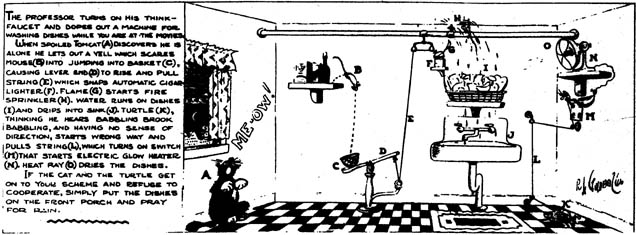
operational_aesthetic

Abstract for Ilka Brasch’s talk at the symposium “Imagining Media Change” (June 13, 2013, Leibniz Universität Hannover):

Facilitating Media Change: The Operational Aesthetic as a Receptive Mode

Ilka Brasch

When the Scientific American published Eadweard Muybridge’s famous photographs of a horse in motion on October 19th, 1878, the magazine advised its readers to cut the images and mount them into the drum of a zoetrope. By means of this nineteenth-century optical toy, the readers could then prove whether Muybridge’s photographs really did depict the movement of a horse during gallop (Newhall 43). In addition to being one historical instance of media change, the example describes an engagement with media that exceeds a simple acknowledgment of mediated content. The tinkerer’s play with technology, I argue, relates back to what Neil Harris termed the operational aesthetic: a critical engagement with the nature and structure of an artifact, which then allows for the observer to judge about its truth value (Harris 79).

Tracing the history of a critical engagement with developing machines, or ‘new media’, since the 1840s, I will establish the operational aesthetic as a particular mode of engagement with media. That receptive mode then influenced the ways in which tinkerers, operators, or spectators experienced media change. Although media change itself impacts the operational aesthetic, that particular receptive mode also impacts the engagement with ‘new media’. As a final step, I will consider how the operational aesthetic influenced, and was changed itself, during the spectators’ engagement with silent film serials up to the 1920s. All in all, the presentation will serve to offer the operational aesthetic as one way of imagining media change.

Harris, Neil. Humbug: The art of P. T. Barnum. Chicago: The University of Chicago Press, 1973.

Newhall, Beaumont. “Photography and the Development of Kinetic Visualization” Journal of the Warburg and Courtauld Insitutes, 7 (1944): 40-45.

Felix Brinker, “On Popular Seriality, Operational Aesthetics, and Audience Productivity”

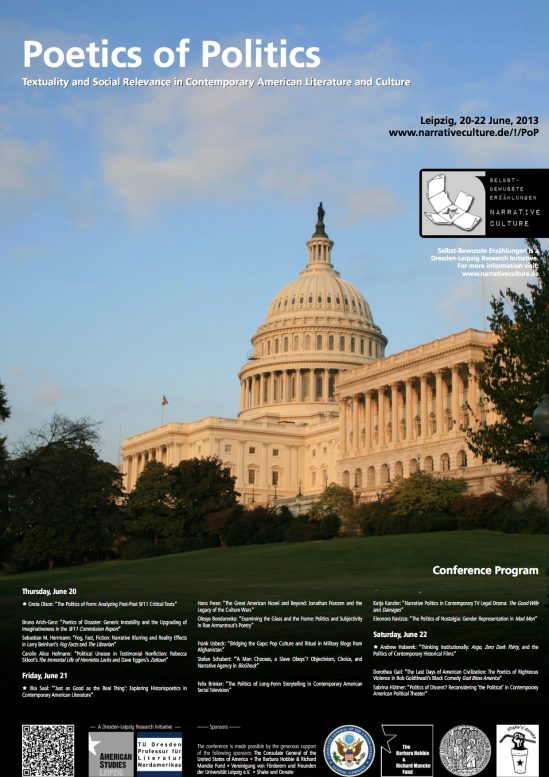
poetics_of_politics_poster

On Friday, June 21, 2013, Felix Brinker will be speaking about “The Politics of Long-Form Storytelling in Contemporary American Serial Television” at the “Poetics of Politics” conference in Leipzig. Felix’s talk builds upon recent work he’s been doing in the context of his dissertation project and related talks (for example, at the recent “It’s Not Television” conference in Frankfurt). Here is a preview of the upcoming talk:

The Politics of Long-Form Storytelling in Contemporary American Serial Television: On Popular Seriality, Operational Aesthetics, and Audience Productivity

Felix Brinker

The turn of American prime-time television dramas towards increasingly serialized storytelling during the last two decades seems to have coincided with an explicit politicization of their content. Especially shows discussed under the label of ‘Quality TV’ have been repeatedly celebrated and/or dismissed for their openly political agenda – be it for their engagement with the anxieties connected to the ‘War on Terror’ and the nebulous practices of intelligence agencies (as on Rubicon, Homeland and 24), or for attempts to tackle the social ills of contemporary urban America (as on The Wire or Breaking Bad). At the same time, other popular programs that at first glance seem to background political concerns in favor of more ‘escapist’ content (e.g. mystery-centric science-fiction or fantasy shows like Battlestar Galactica, Fringe, or Heroes) increasingly engage with matters of power, politics, and political intrigue and develop these motifs in ongoing storylines. While recent cultural and media studies publications on these phenomena have easily connected this renewed interest in political subject matters to the emergence of what Jason Mittell has termed ‘narratively complex television’ – that is, a (by now pervasive) shift in emphasis away from episodically contained storylines towards an ongoing serial narration that allows contemporary programming to construct richly furnished, expansive storyworlds and thus (among other things) opens up new possibilities for representing the complexities and intricacies of political systems and processes – less attention has so far been paid to the political dimensions of the increasingly active audience practices invited by such programming, and to the social aspects of popular seriality itself.

Located firmly within the competitive media environment of the convergence era, complex television series seek to engage their audiences in practices that extend well beyond ‘passive’ reception, and encourage them to become culturally and textually productive by participating in the discussion, interpretation and analysis of their favorite programs in dedicated online forums. Therefore, my paper argues that the political significance of narratively complex serial television manifests itself less on the level of content than on the level of form: By inviting their viewers to parse the complicated unfoldings of  narratives across longer periods of time, as well as across different media formats and paratexts, contemporary prime-time dramas ask their audiences to dedicate a considerable amount of their time to the engagement with a serially expanding text. By doing so, narratively complex serials not only ask their viewers to engage in cognitively challenging and time-consuming reception practices, but also inspire them to engage in the laborious creation of unofficial paratexts (such as wikis, blogs, and fansites) which chart the developments of storylines and characters – paratexts that serve both to render the increasingly complicated narratives accessible and as ‘free’ promotional materials that ensure the cultural visibility of these programs. These shows therefore thrive on the ‘free’ (i.e. unpaid) work of their viewers and employ it to secure their own continued serial proliferation. Drawing on recent conceptualizations of popular seriality that understand the active participation of audiences as an activity that is integral to the economic viability serial storytelling in general, as well as on post-operaist takes on immaterial labor as the predominant form of work in post-industrial societies, my paper argues that the contemporary centrality of such ‘participatory’ practices marks a profound shift in the relationship between work and leisure (or between recreational activity and professional media use) that coincides with the digitalization of our media environment.

To make its argument, my paper will take a closer look at contemporary serial dramas like HomelandThe Wire, and House of Cards, and identify the textual strategies by which these shows encourage a particularly active audience behavior. Drawing on Neil Harris’s concept of the ‘operational aesthetic’, I argue that especially moments of formal/medial and thematic self-reflexivity – that is, moments in which these series thematize, demonstrate, and comment both on the operations of the serial text and on the logics of the diegetic events it narrates – constitute central fulcra for facilitating the audiences’ ongoing and sustained engagement with serial television narratives. By repeatedly producing such moments of non-alienating self-reflexivity – for example in scenes in which a show asks their viewers to ‘recall’ events from earlier episodes and visualizes this by having its characters use diegetic media technologies – complex television dramas manage to call attention to the logics of their own narrative operations and suggest a particular, preferred way of engaging with the text without detracting from the story that is being being told. At the same time, I argue, these moments become productive for the representations of political systems and processes, since they usually also serve to thematize diegetic logics, processes, and chains of cause and effect. Such instances of formal and thematic self-reflexivity thus constitute moments in which the serial logics of narratively complex televisions shows are on display, and from which one could trace out the relationships between their representational politics and the politics of popular serial formats themselves.

Popular Seriality: June 6 – 8, 2013

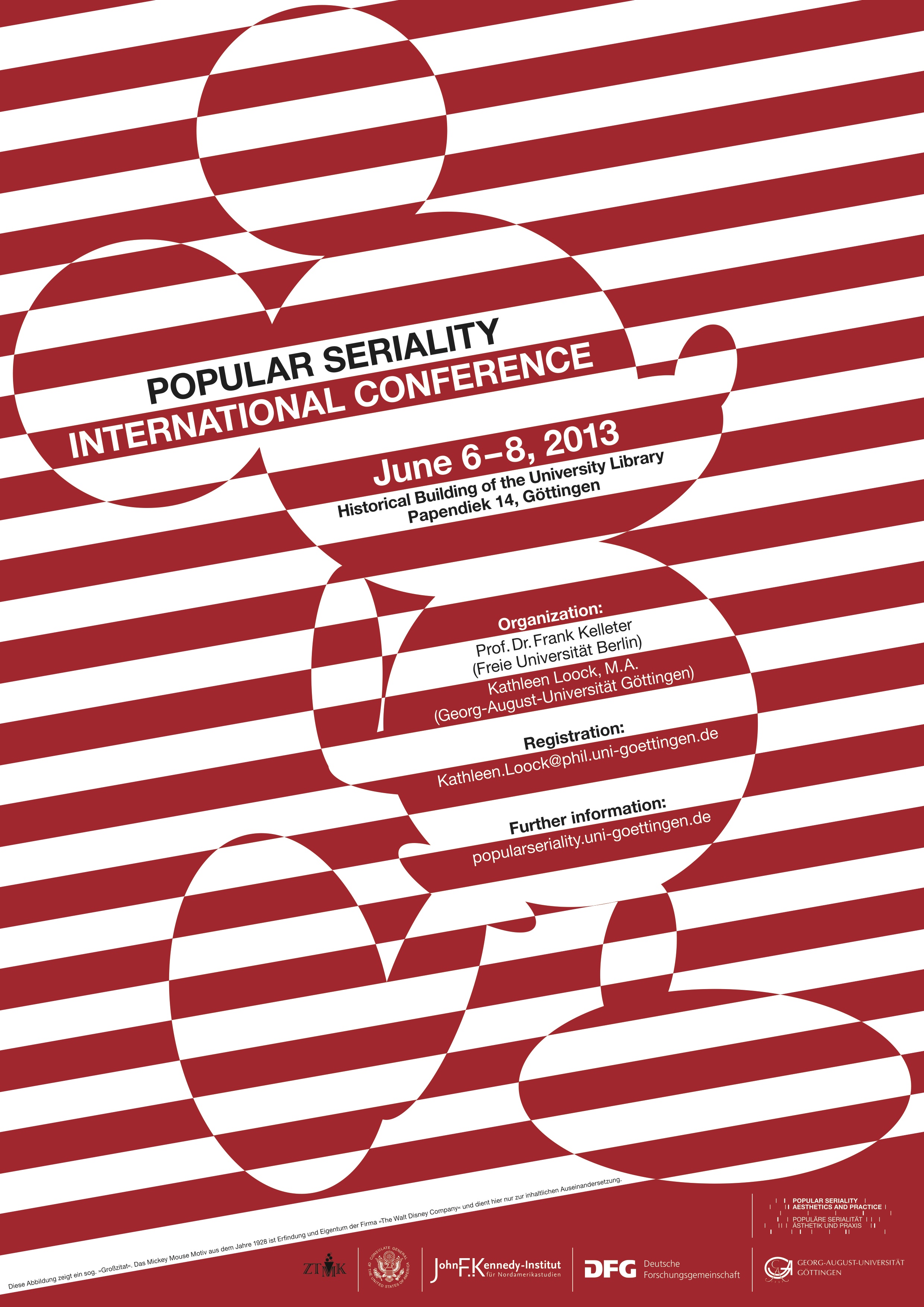
Popular_Seriality_Conference_Poster

Above, the wonderful poster for the upcoming “Popular Seriality” conference in Göttingen (June 6-8). Below, the final program.

More info about the conference can be found on the homepage of the DFG Research Unit “Popular Seriality: Aesthetics and Practice,” here.

[scribd id=143912998 key=key-1yli3a1asrohkfauh9xv mode=scroll]

Video: Animation as Theme and Medium — Frankenstein and Visual Culture

Above, you’ll find a video presentation of my talk, “Animation as Theme and Medium: Frankenstein and Visual Culture,” which I gave on April 20, 2013 at Dartmouth College — at the great Illustration, Comics, and Animation conference masterfully organized by Michael A. Chaney. Judging by the feedback I received at the time, my talk went over quite well — especially the visual presentation with which I illustrated my arguments (and particularly the “wall” of Frankenstein images you’ll see around 6:03, as well as the animated presentation of Marvel Comics’ Frankenstein series from about 12:52 onward).

(Note that a high-resolution video can be found by following the link to YouTube.)

Admittedly, the screencast video presentation is a weird medium. It tends to foreground things that, when presented live, serve as background images — images that are positioned above and behind a human speaker, talking and gesticulating, communicating (at least ideally) with an audience. In the screencast video, that speaker vanishes into the disembodied ether of a voiceover track, at times leaving images (like the title slide here) lingering on screen longer than might seem appropriate. Perhaps I haven’t yet mastered the medium and discovered a way to achieve the elegance we see in video essays, documentaries, and other related media; or perhaps the screencast video is simply doomed to be a forever awkward, weird, transitional, or incomplete medium.

In any case, the form is not everyone’s cup of tea, and an exemplar like this one is certainly pushing the limits at just over 18 minutes long. As a result, I have taken several steps to make sure that the video is as watchable and as useful as possible for anyone who might be interested in the arguments I make about Frankenstein, film, comics, animation, and visual culture. First, at the cosmetic level, I’ve added some music to deflect attention from my voice and to make the video a bit less “dry” than it otherwise might be (see below for music credits). Also, I have chosen to include the full text of the paper here, which you will find below; this way, you can skim, scan, and search, and “try before you buy” if you like, or decide what parts of the video you’d like to watch. Also, I offer a sort of “table of contents” to the video, with approximate times indicated for the various topics discussed:

0:00 — Introduction: Animation as Theme and Medium

1:30 — Animation as Framing Condition for Modern Visual Culture

4:28 — Frankenstein’s Monster as Iconic Emblem of Animation

5:30 — The Early Proliferation of the Monster’s Image

6:03 — The Plurimedial Explosion of Images and the Visual Serialization of the Monster (illustrated by the “wall” of images that many saw as the central visual attraction of the presentation itself)

7:40 — Frankenstein Films, Self-Reflexivity, and Animation

8:53 — Thomas Edison’s Frankenstein (1910)

12:52 — Marvel Comics’ Frankenstein (1973 – 1975)

17:25 — Conclusion

The presentation draws on several previous works, including Chapter 3 of my dissertation (on Edison’s Frankenstein) and an article called “Marvel Comics’ Frankenstein: A Case Study in the Media of Serial Figures” — so be sure to check those out if anything is of interest to you here.

Here is the text of the talk:

Animation as Theme and Medium: Frankenstein and Visual Culture

Shane Denson – Dartmouth College, April 20, 2013

Long marginalized in critical discourses, animation seems to occupy an unprecedented position in our popular and visual cultures today. It has been argued, for instance, that in the age of digital cinema all film becomes animated film as photographic images’ indexical relations to the world are severed by processes of digital rendering. And not only film: comics, too, seem to be caught in the tractor beam of animation – partly as a result of general convergence trajectories and partly as a result of specific transmedia franchising efforts that place ever more superheroes in sleek new CGI outfits. Simultaneously, comics proper migrate from paper to digital formats and devices, bringing with them animation processes as elements of images and of presentation formats (like the “guided view” function on iPhone apps, which animate the transition from panel to panel). But if it’s true that the boundaries between animation and other forms of visual media have become problematic in the digital age, I want to suggest that this is not entirely new. My aim is therefore to open up a sort of media archaeological perspective that will allow us to look at animation as both a theme and a medium that plays a significant if non-obvious role throughout the modern era. Drawing on retellings of Frankenstein in film and comics, I argue that the tale’s serial proliferation reveals a hidden backstory to our current situation, one in which animation can be seen as the very framing condition for much of our modern popular visual culture.

By emphasizing modernity and popularity, the visual culture I’m talking about is connected explicitly to industrialization, which coincided with the institution of a conceptual wedge between art and technology – i.e. between the fine arts and the applied arts – such that aesthetic experience was figured as “disinterested” and opposed to the realms of practical technology and commercial culture. And out of the industrial-era reorganizations within the broad realm of technē flow a variety of fears and fantasies of technical animation (embodied in automata like the Mechanical Turk, and in narratives such as E.T.A. Hoffmann’s “Der Sandmann” and Mary Shelley’s Frankenstein). Such thematic concerns with “animation” – or the giving of life to inanimate matter – would have a lasting impact on (popular/visual) culture as the arts became increasingly technical, industrial, reproducible, and (in more senses than one) serialized; from Metropolis to Blade Runner and beyond, the dream of artificial life has been a staple of science-fiction film. But beyond the thematic level, a medial aspect or determination of “animation” is also involved: not only was the technical infrastructure of steam-driven printing presses, automata, and pre-cinematic devices uncanny in its liveliness and activity; also, at the dawn of the industrial age, the fine arts were framed in such a way as to marginalize animation as a possible medium. Lessing’s famous division of temporal and spatial arts (with poetry, drama, and narrative on the one side, sculpture, painting, and image on the other) preemptively banished a range of popular forms from the domain of serious art. But against these injunctions of aesthetic purity, post-industrial visual culture is characterized by a preponderance of images that spring to life as they are set in motion and animated by mechanical means. Film and comics, most centrally, would blur the boundaries between the static image and the temporal flow of narration. Generally and conceptually speaking, if not narrowly and technically, “animation” names these media’s affront to the division of the arts – their violation both of the division between temporal and spatial arts and of their separation from the merely technical and commercial domain of modern popular culture. This is another way of saying that animation, broadly conceived, is a sort of framing condition for modern visual culture, which can be seen in constant struggle with the image granted life or set in motion, alternately advancing toward and retreating from the conceptual and technological threat of visual kinesis that aesthetics as such was born in order to contain.

Seen in this way, modern visual culture’s ambivalent relation to animation is not altogether different from Frankenstein’s initial fascination with and sudden repulsion by the creature he brought to life. And it is the creature, of course, who provides the iconic emblem of animation as a monstrous threat. I want to argue that this image embodies both the thematic and the medial aspects of animation that I’ve been discussing, and it self-reflexively probes animation’s role in a visual culture that is both technological and remarkably autonomous in its ability to multiply images across various channels or media. Exhibiting a promiscuous, plurimedial sort of seriality, the monster’s image – as an image of animation – presents a special case for thinking the dynamic intermedial networks that constitute our visual culture. Cinema gives us the “classic” version of the monster’s image, but the figure’s visual proliferation has a serial history that predates the cinema and lives on in other forms as well. At the center of visual interest is the creation scene, which Shelley’s novel of 1818 treats only in a very cursory manner, but which gives rise immediately to a growing number of theatrical adaptations. Shelley herself saw a performance of Richard Brinsley Peake’s 1823 play Presumption; or the Fate of Frankenstein, and thus witnessed her tale escaping her authorial control much as the story’s monster had escaped its creator’s, prompting her famously in the introduction to the 1831 edition of her book to “bid [her] hideous progeny go forth and prosper.” The image on the frontispiece of the 1831 edition thus entered into a stream of visual images proliferating on theater stages, in political cartoons, and later in film, comics, and other media. Taken together, these images are not, I suggest, just illustrations of a story but themselves enactments of a media-technical interrogation of modern processes of animation and the self-replicating action of our visual culture. Essential to this view is a conception of the monster not so much as a developed character but as a flat, serialized figure that has escaped the novel and acquired a life of its own. As such, the monster is marked materially by a form of seriality that is intimately tied to the serial production processes of industrial culture and, more specifically, to the sequentiality and reproducibility of images in modern visual media such as film and comics. Appearing again and again in various media, the monster becomes what I call a serial figure, existing not within a series but in fact as a series – as the expanding set of stagings or instantiations across media. The monster thus evolves not within a uniform diegetic space, but between or across such spaces of narration and visualization. As a serial figure, the monster leads a sort of surplus existence outside of any one given telling, thus placing it in a perfect position to reflect on the manner – and the media – of its repeated stagings. Specifically, it explores modern visual culture’s challenge to the inert spatial image, its tendency to transgress the injunction against animation. The familiar cry – “It’s alive!” – thus refers as much to the media of sequential and temporal images as it does to the creature they depict.

Let’s start with Frankenstein films. There’s a sense in which it’s tempting to see film itself as a sort of Frankensteinian technology. Like Frankenstein selecting parts from corpses and infusing life into a composite body, filmmakers utilize the technical means of film to (re)animate the “dead” (or photographically preserved) traces of living organisms (actors) into new visual narrative compositions. In his discussion of Frankenstein films, William Nestrick writes: “The film is the animation of the machine, a continuous life created by the persistence of vision in combination with a machine casting light through individual photographs flashed separately upon the screen. Since ‘life’ in film is movement, the word that bridges the worlds of film and man is ‘animation’ – the basic principle by which motion is imparted to the picture” (294-95). It will be objected, however, that this invitingly simple analogy is too general in its scope; it overlooks historically specific transformations in the way such “animation” has been staged. Luckily, the long history of Frankenstein adaptations amply documents such changes and makes up for the missing nuance.

Take, for instance, Thomas Edison’s Frankenstein from 1910, which stands between the early, image-technology oriented “cinema of attractions” and the coming narrative-oriented classical Hollywood style that would take shape around 1917. In 1910, the medium was in transition, torn between lowbrow technological spectacle and an uncertain reorientation along the lines of the respectable theater. Accordingly, advertising for the film emphasized both the “photographic marvel” of the creation sequence and the story’s origin in “Mrs. Shelley’s […] work of art.” The film aimed to be both visual and technological spectacle and narrative high culture. And this multiple address relates directly to the uncertain significance of “animation” at this historical juncture.

The creation sequence’s so-called “marvel” consists of footage of a burning mannequin projected in reverse – a bit of cinematic magic that, in the context of early film, served to exhibit cinematic technology by focusing attention on the filmic images themselves rather than the objects they depict. Frankenstein’s reactions here channel the scopophilic pleasure of a “primitive” viewer, for whom he stands in as a proxy. Importantly, “animation” here is a self-reflexive topos which links the monster’s creation with the term “animated photography,” still common in 1910 as a description of film in general.

However, the final showdown ambivalently signals a change of course towards narrative integration. The Edison Company claims that the scene communicates the story’s moral that love conquers all. But since the monster was identified with filmic technology in the creation sequence, Frankenstein’s battle with the monster is also with the medium of film as an animating technology, especially since trick effects are essential to the staging of the conflict. The film’s narrative closure is therefore mixed with a self-reflexive countercurrent. The mirror functions here like the projection surface of the cinema screen. The similarity is not merely abstract but in fact visually perceptible due to the scene’s technical means of production: the images in the mirror are themselves flickering filmic images. The result is a film within the film, and Frankenstein is again a film viewer. His battle with the monster is a battle with the images and especially with the “primitive” type of reception that he exemplified in the creation sequence. But this time he is reformed, and instead of staring at the medial surface, he now acquires the ability to look through rather than at the mirror. So Frankenstein is finally in a position to devote his attentions to the reality of his environment – which means, for us, to the world of the diegesis.

In the context of the cinema’s transitional phase, the film’s narrative development is linked to a larger, non-diegetic narrative of filmic development: Frankenstein’s psychological maturation, which is consummated in the mirror scene, allegorizes a historical-normative process of cinematic maturation and of spectatorial progress towards a proto-classical relation to film. And significantly, this transitional trajectory coincided with the historical differentiation of film, or “animated photography,” according to which animation in the narrower sense came to be distinguished from, and subordinated to, a more respectable form of live-action filmmaking that favored drama and characterization over novelty gags and trick-film effects. The monster, a literal product of animation, charts this differentiation at the same moment people like Winsor McCay were popularizing techniques of animation in its narrower sense. Thus, the monster embodies the technology of the animated spectacle, and his marginalization reflexively indicates the framing function of animation in film and visual culture more generally, reminding us that live-action cinema is animation too, but in a normalized or naturalized form.

Now I want to jump ahead to a comic-book appropriation that offers a somewhat different perspective on animation as theme and medium owing to its reflexive engagement with the formal properties of graphic narrative. Here the monster is recalibrated for an interrogation of the specific means by which comics animate their tales – that is, the means by which discrete images both remain discrete and are subject to combinatory reframings that bring a graphic story to life. Marvel’s series The Monster of Frankenstein (later retitled The Frankenstein Monster) ran for 18 issues from January 1973 to September 1975. The first four issues retell the tale of Shelley’s novel, and they reproduce its nested frame structure: the monster’s own tale is at the center, embedded in Frankenstein’s account of events, which he recounts to the Arctic explorer Captain Walton while aboard his ship; Walton, in turn, records everything and passes it along in the form of letters to his sister back home, and these letters make up the novel Frankenstein. Now the Marvel series, in its re-telling, ingeniously adds an additional frame: Walton IV, the great-grandson of the novel’s captain, narrates the outermost tale, set a full century after the novel, thus laying the ground for the story’s continuation into the twentieth century from issue #5 onward.

With an eye to the monster’s place in visual culture more generally, what interests me above all about this is the way that these various framings and reframings are navigated visually, and the role that the technically animated creature plays in the process. Issue #2 features several exemplary moments that I’d like to focus on. The monster’s tale is prefaced visually with a close-up of the monster’s face, which functions as a gateway or border between external and internal narrative frames (between the cave setting in which the monster relates his tale to Frankenstein and the innermost frame of the related tale) (6, panel 5). The creature tells how he came to his senses, how he observed a blind man and his family, learned their language, and was eventually driven from human society. Finally, his narrative closes with a close-up of the creature’s yellow eye in a wavy-bordered panel that exists liminally between one narrative frame and another (18, panel 3): Spatially attached both to the (self-narrated) monster persecuted by a mob of angry villagers and to the (narrating) monster in the mountain cave, the eye stands between and links the two temporal frames of narration. From this intermediate position, the monster’s eye mirrors the reader’s eye as well, the eye that moves from one graphic frame or panel to the next in the temporal process of reading. Emerging from the page in close-up and protruding from the narrated world to enter the space of the reader, this eye is medially self-reflexive in a strong sense: it directs attention towards the processes of medial construction at the same time that it serves a constructive medial purpose, viz. the transition from one visual and narrative frame to another. And something similar is staged several pages later. Having discovered the corpse of his friend Clerval, the traumatized Frankenstein is arrested for murder, and his face is foregrounded with a blank eye staring at—or through—the reader in a panel that transitions back to the outermost narrative frame, aboard Walton IV’s ship in 1898 (25, panel 4), which suddenly rams an iceberg and begins to sink, bringing issue #2 to a cliffhanger close.

At the outset of the next issue, sailors scramble into lifeboats in the belief that the monster, thrown overboard in the crash, is dead. But when the monster, whose hand juts ominously out of the water, boards their boat and begins wreaking havoc, one of the sailors exclaims, “God help us! It’s still alive!” (3)—an intensification of the standard line in Frankenstein films, fully self-aware of its seriality. Sparing the captain, his cabin-boy, and his guide, the monster rows them to firm ice. There, the monster insists: “The story, man! You must tell me the rest of the story!” (5). Then, with his back turned, Walton IV prepares to continue the narrative, while the monster’s face, set in profile, literally replaces the gutter between two panels and forms the border between two spatiotemporal frames as well: the “here and now” that he shares with Walton IV and the “there and then” of Walton’s story (6, panels 1 and 2). Once again, the monster’s face and eyes mediate the threshold between narrative frames, between temporal settings, and between the act and the content of mediation.

In conclusion, then, Frankenstein’s monster functions variously, as we have seen in these examples from film and comics, to envision the dynamic workings of modern visual culture. The creature doubles with the medium in order to envision visuality itself in its modern, highly kinetic forms. It gives visible form, in other words, to the invisible framing condition of animation, exposing the mechanisms by which static images routinely transgress their spatial borders and assert a temporal dimension, and exploring the role of mediating technologies in the serialized proliferations of images that animate the modern visual landscape.

Finally, here are the music credits for the video (all songs licensed with Creative Commons licenses and made available via dig.ccmixter.org):

1. Creative Commons License Constructions normales (Je ne suis pas un remix) by vo1k1 is licensed under a Noncommercial Sampling Plus (the song begins at 0:00 in the video);

2. Creative Commons License Sawmill by Gurdonark is licensed under a Attribution (3.0) (beginning ca. 4:04);

3.Creative Commons License pling by jaspertine is licensed under a Attribution Noncommercial (3.0) (beginning ca. 7:03);

4. Creative Commons License Yiourgh by DoKashiteru is licensed under a Sampling Plus (beginning ca. 12:18);

5. Creative Commons License Prism in the Ether by Fireproof_Babies is licensed under a Attribution Noncommercial (3.0) (beginning ca. 16:17).

Conspiracies and Surveillance — In Media Res Theme Week

Caméra de vidéo-surveillance avec sa torche infra-rouge

Over at the media commons site in media res, what promises to be a great theme week on “Conspiracies and Surveillance” has just gotten underway. All of the contributions sound exciting, and among them is one by our very own Felix Brinker, who’s up tomorrow (Tuesday, April 9) with a piece on the “logics of conspiracy” in American TV series. (And in case you missed it, make sure you check out the longer text on the topic that Felix allowed me to post here recently.)

Here’s the full lineup for the in media res theme week:

Monday, April 8, 2013 – Jason Derby (Georgia State University) presents: Scandalous Conspiracies: Making Sense of Popular Scandal Through Conspiracy

Tuesday, April 9, 2013 – Felix Brinker (Leibniz University of Hannover, Germany) presents: Contemporary American Prime-Time Television Serials and the Logics of Conspiracy

Wednesday, April 10, 2013 – Meagan Winkelman (University of Oregon) presents: Sexuality and Agency in Pop Star Conspiracy Theories

Thursday, April 11, 2013 – Perin Gurel (University of Notre Dame) presents: Transnational Conspiracy Theories and Vernacular Visual Cultures: Political Islam in Turkey and America

Friday, April 12, 2013 – Jack Bratich (Rutgers University) presents: Millions of Americans Believe Conspiracy Theories Exist

Each day’s contribution, consisting of a video clip of up to three minutes accompanied by a short essay of 300-350 words, is designed to serve as a conversation starter aimed at involving a broad audience in discussion of key topics relating to the topic of “Conspiracies and Surveillance.”

Please check out all the contributions as they go live here, and consider joining the discussion (to participate, you will need to register at in media res).

Counterpoint: Game of Thrones, Narrative, and Affect

The Internets are all abuzz still following the kickoff this past Sunday of the third season of HBO’s flagship series Game of Thrones. There was a great deal of online anticipation in the weeks, days, and hours leading up to the season premiere, fed in part by a set of trailers (above, as well as here and here, for example) that circulated on Youtube, in the twitterverse, and beyond. And following the actual airing of the show, records were allegedly set for the most illegal downloads of a television episode, while discussions, analyses, and reviews continue to proliferate across fan sites, blogs, and news media.

(As a preliminary note to those who are either weary of reading such pieces or who are avoiding them due to spoilers — fear not: this post is neither concerned directly with the latest episode, nor will I give away anything that could ruin it for anyone who hasn’t seen it.)

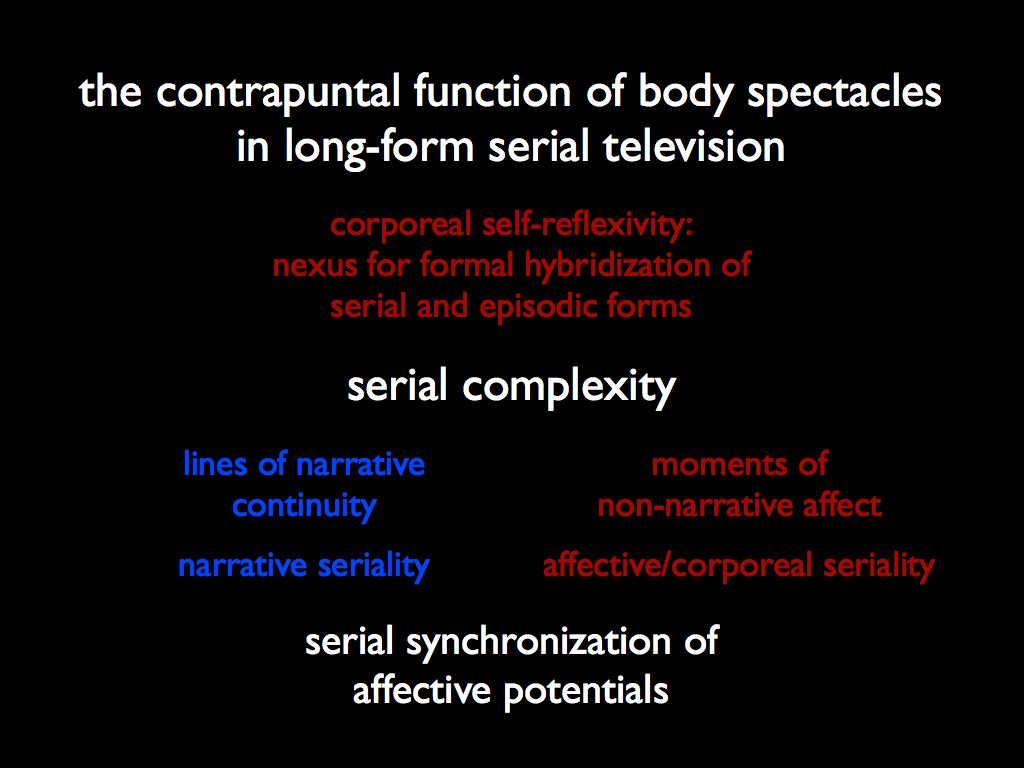
Instead, I wanted to take the opportunity to comment on an aspect of the series that I’ve been thinking about (and which I recently wrote about in the more general terms of serial complexity and affect theory as applied to contemporary television). Specifically, Game of Thrones derives much of its momentum, I think, from an interplay between a continuing, complex narrative (in Jason Mittell’s sense of “narrative complexity”) and relatively discontinuous, punctuating moments of affective appeal — a directly corporeal, often visceral, sort of appeal that constitutes momentary “lines of flight” from the story’s ongoing line of development. Like much of HBO’s serial fare, these moments of affect often concern violent and/or sexualized body images which, while not completely devoid of narrative relevance, also exhibit a sort of surplus value as images. In other words, they not only serve the representational functions of depicting significant events and contributing meaningfully to characterization, etc.; over and above that, they also assert a strong presentational and extra- or para-narrational facet, the function of which is to engage the viewer’s body more than his or her interpreting, cognizing brain. Such body images — for example, in narratively gratuitous sex scenes, images of painful injury, torture, or beheading — resonate with the viewer’s own bodily sensibilities, serving to titillate or to arouse a sense of physical vulnerability, anguish, panic, or disgust.

Seen from afar (so to speak), in the overall context of a television series like Game of Thrones, the interplay between narrative development and these moments of bodily affectivity results in what I have described as a “contrapuntal” relation between the two: narrative continuity is punctuated, interrupted by body images that exceed any dramatic motivation, thus constituting more or less insular, episodic forms in the midst of the serial stream; but these islands of affect are (at least potentially) themselves elements in a serial progression that exists in parallel to that of the narrative (and following a very different temporal logic). Repetition and variation of body spectacles can thus be just as important as narrative suspense as a means of ensuring viewer attachment over the course of long serial arcs.

SerialBodies12.012

Of course, some series are more successful than others in their employment of such contrapuntal seriality, and there are certainly a wide variety of styles and modes of implementing the counterpoint. Some series are anything but discreet as they shift gears between narrative and body-based affective appeals (and in this regard, they resemble musicals or pornographic films as they move from one more or less self-enclosed “number” to the next). And certainly, some of this can be seen in Game of Thrones, but my overall impression of the series is that it works with a relatively tight integration of affective and corporeally self-reflexive appeals into the informationally complex storyworld and the unfolding tale of rival houses, subtle intrigue, and uncertain outcomes.

A particularly poignant example of contrapuntal integration is provided by episode 7 of season 1, “You Win or You Die,” where we see the following conversation between Jamie and Tywin Lannister:

http://www.youtube.com/watch?v=47MazYDnmaU

Set in any other situation, this conversation — which neatly exemplifies the informational complexity of the series — would have a completely different impact. Sarah Hughes, writing in The Guardian‘s TV & Radio Blog, sees the “skinning and disembowelling [of] a deer” here as a “heavy-handed bit of symbolism given the deer is the sign of [rival] House Baratheon,” and I think she’s right to see the visual component of the scene enacting a layer of complexity beyond the content of the verbal. It’s not only a symbolic dimension, though, that is here overlaid upon the Lannisters’ discourse; in addition, I suggest, a dimension of visceral and dermic appeal spreads itself out as the very milieu within which the characters’ words sound out materially. The innards of the deer are more than just a sign: they are matter, and their material image transmits an affective force, establishing a material relation with our own viscera. The forceful separation of the animal’s skin from its muscles emphasizes, moreover, both the stubborn durability and the ultimate finitude of the organic body, arousing a diffuse affective awareness of the corporeal basis upon which our discursive subjectivities are erected. And all the while, royal politics are being discussed in detailed, lofty, and eloquent language. The scene conveys a sense of the unconscious drives that lend momentum to conscious pursuits and political “plots,” conveys a sense of the base and physical “will to power” animating social conflict. And it communicates this “message” by way of a tight contrapuntal integration of narrative information and bodily affect, thus self-reflexively exemplifying the series’ own larger strategy of instrumentalizing affect, infusing the complex (at times, overly complex) narrative with an appeal to animal nature, and in this way crafting a form of serial complexity that partakes equally of the discursive and affective.

International Conference: “Popular Seriality”

[scribd id=133357756 key=key-1070paqvhijzf8pcaxme mode=scroll]
International Conference: “Popular Seriality”
June 6-8, 2013 // University of Göttingen

Above, the preliminary program for the upcoming conference of the seriality research group that several of my colleagues and I are involved with.

Most readers of this blog will already be familiar with the seriality group, but in case you’re not: The Research Unit “Popular Seriality—Aesthetics and Practice,” funded by the German Research Foundation (DFG), brings together 15 researchers from the fields of American Studies, German Philology, Cultural Anthropology/European Ethnology, Empirical Cultural Studies, and Media Studies. Since 201o, six sub-projects have been investigating a narrative format that has become a defining feature of popular aesthetics: the series. The Research Unit addresses questions concerning the wide distribution and broad appeal of series since the 19th century and asks which new narrative formats have emerged through serialization. Further questions are: How do series influence the way we perceive and structure social reality? How are serial characters revised when they undergo one or more media shifts? How can we explain the progressively shrinking boundaries between producers and recipients in long running series? Which transformations in the field of cultural distinctions are produced by complex serial narratives, which are increasingly embedded in highbrow lifestyles and canonization practices?

From June 6 to 8, 2013, towards the end of the first funding period, the Research Unit will hold an International Conference in Göttingen. Talks will be given by members of the Research Unit and well-known researchers in the field of popular seriality. Among the scholars presenting at the conference are Sudeep Dasgupta, Jared Gardner, Julika Griem, Scott Higgins, Judith Keilbach, Lothar Mikos, Sean O’Sullivan, Patricia Okker, Irmela Schneider, Sabine Sielke, Ben Singer, William Uricchio, Constantine Verevis, Tanja Weber und Christian Junklewitz. Jason Mittell will give the keynote lecture.

For more information about the research unit, and to stay up to date on the conference and other activities, please refer to the group’s homepage: http://popularseriality.uni-goettingen.de/

Out Now: Transnational Perspectives on Graphic Narratives

transnational_perspectives_on_graphic_narratives

This past week, I found my copy of Transnational Perspectives on Graphic Narratives: Comics at the Crossroads (edited by me, Christina Meyer, and Daniel Stein) in my university mailbox — hot off the presses, I’m told, and ahead of schedule!

Interestingly, both amazon.co.uk and amazon.de list the book’s date of publication as March 23, while it appears that they both began shipping the book ahead of that; on the other hand, amazon.com and even the publisher Bloomsbury are listing the book as appearing a full two months later, on May 23, though both sites are accepting (pre-)orders and are sure to begin shipping much before then.

In any case, I can confirm that the book does in fact exist! And it’s nice to finally see all the contributions in physical form. For the time being, however, the only physical form available is a relatively expensive hardback, but a more affordable paperback will be on its way, pending sales — so please ask your library to purchase a copy!

And, in the meantime, you can get a free digital preview on Google Books, or you can order the full e-book version for about $24 from the publisher or about €16 from the Google play shop. (Please leave me a comment if you see it anywhere for cheaper.)

Anyway, we are very pleased with the book and with the high-quality contributions we received for it, and we hope it will find an interested readership at the intersections of comics studies, cultural and media studies, and transnational American studies!