It’s Not Television (Or Is It?)

its_not_tv

Three members of the Initiative for Interdisciplinary Media Research (Felix Brinker, Florian Groß, and Shane Denson) will be presenting papers at the upcoming conference “It’s Not Television” (22-23 February 2013, Goethe University of Frankfurt). Our abstracts can be found here:

Felix Brinker: “Narratively Complex Television Series and the Lure of Conspiracy – On the Politics of Long-Form Serial Storytelling and the Paranoid Eye of Active Audiences”

Shane Denson: “Serial Bodies: Corporeal Engagement in Long-Form Serial Television”

Florian Groß: “Born Alone, Die Alone, But Never Dine Alone: The Creative Individual and Generic Family Structures in Recent TV Series”

Felix Brinker: “On the Politics of Long-Form Serial Storytelling and the Paranoid Eye of Active Audiences”

truthisoutthere

Abstract for Felix Brinker’s talk at the conference “It’s Not Television” (Frankfurt, 22-23 February 2013). See here for talks by other members of the Initiative for Interdisciplinary Media Research.

Narratively Complex Television Series and the Lure of Conspiracy – On the Politics of Long-Form Serial Storytelling and the Paranoid Eye of Active Audiences

Felix Brinker

The threat of conspiracy looms large in a striking number of recent American television series. From the efforts of 24’s and Homeland’s protagonists to stop terrorists, to the nefarious government conspiracies on Last Resort, Rubicon, and Prison Break, and the shadowy cabals plotting on Lost, Fringe, and Battlestar Galactica: television narratives about secret plots against the reigning order of things appear to be well suited to capture the imagination of contemporary audiences in the US and elsewhere. While the engagement with this theme lends itself to politicized readings, the motif of conspiracy is also part and parcel of a robust narrative structure that enables the unfolding of complex storylines. In this respect, ‘conspiracy’ denotes not just a thematic preoccupation but also an organizational logic that allows these shows to tell long-running stories about investigations, cover-ups, and mysteries whose resolutions are perpetually deferred. As detective stories of a grand scope, these shows keep viewers hooked by juggling the appeals of suspense and mystery, by countering each revelation with a plot twist tailored to sustain audience interest.

My paper will sketch the basic parameters of this mode of storytelling and discuss the audience practices it inspires. I argue that, in order to perform within the competitive media environment of the convergence age, said shows rely on the structure of conspiracy to encourage audiences to carefully comb through their narrative material in search of hidden clues about the plots’ mysteries. By doing so, they ask viewers to rely on an interpretive logic that parallels the paranoid hermeneutics of conspiracy theorists: analysis and interpretation of transmedial story-worlds can thus become a pleasurable, associative, and open-ended activity that allows the viewer to assert her authority over the (shifting) overall meanings of (the) (hi)story. The political significance of these shows therefore lies less in their overt content, but rather manifests itself on the level of storytelling strategies and the audience practices enabled by the latter.

Shane Denson: “Corporeal Engagement in Long-Form Serial Television”

bodies_on_tv

Abstract for Shane Denson’s talk at the conference “It’s Not Television” (Frankfurt, 22-23 February 2013). See here for talks by other members of the Initiative for Interdisciplinary Media Research.

Serial Bodies: Corporeal Engagement in Long-Form Serial Television

Shane Denson

Discussions of so-called “Quality TV” and the narrative complexity seen to characterize the best of contemporary serial television productions often trade on categories of distinction derived from comparisons with “respectable” cultural forms (e.g. the novel as a model for “serious” engagement); these discourses value an intellectually demanding, heady sort of appeal that is opposed both to the narrative simplicity supposedly characteristic of older televisual forms (strictly episodic forms, melodramatic soap operas, etc.) and to the baser appeals of contemporary “trash TV” (e.g. the basically voyeuristic interest encouraged by reality TV). Interestingly, though, graphic scenes of sex and violence proliferate across contemporary television series, including shows widely valued for their cognitive demands; today, bodies are put on display, violated, tortured, dissected, and ripped apart in ways unimaginable on TV screens just a decade ago. In this presentation, I argue that these body spectacles – which range from clinical/forensic to brutal/gory to pornographic – challenge us to rethink the basis of television studies’ formal and normative distinctions. In particular, the complex mental operations valued as correlates of narratological complexity must be seen to take place side by side with a range of more corporeal responses on the part of television viewers. Finally, I propose an alternative view of televisual complexity and serialization: appealing to the body as much as the head, contemporary television will be shown to involve a serialization of bodies (both onscreen and off) that constitutes a central affective mechanism for engaging viewers week after week in long-form serial television.

Florian Groß: “The Creative Individual and Generic Family Structures in Recent TV Series”

madmen_family

Abstract for Florian Groß’s talk at the conference “It’s Not Television” (Frankfurt, 22-23 February 2013). See here for talks by other members of the Initiative for Interdisciplinary Media Research.

Born Alone, Die Alone, But Never Dine Alone:
The Creative Individual and Generic Family Structures in Recent TV Series

Florian Groß

Ever since television has been part of the American family, the American family has been part of television. Even under the “not TV”-paradigm, family remains a central aspect of television, as shows like The Sopranos or Six Feet Under attest. In many recent shows, this constitutive part of the televisual landscape interacts with a highly fetishized figure in contemporary television, the creative individual. Californication’s Hank Moody, Mad Men’s Don Draper, or 30 Rock’s Liz Lemon are but a few examples of non-conformist, iconoclast and ingenious characters who express their innate urges in various aesthetic(ized) fields and serially assert their individual freedom and self-reliance. Yet, despite their superficial undermining of traditional (family) concepts, they also take serial recourse to standard conceptions of family. They may be adulterers, divorcees, or singles, but they hardly ever define themselves without the (white, middle class, nuclear) family, which emerges as a structure that provides the creative heroes with boundaries that prevents them from becoming antisocial.

My paper analyzes this dynamic interaction between an aestheticized individualism and the continued relevance of family structures. Furthermore, I want to link this narrative aspect of television series to their respective take on genres. In an era that is purportedly moving beyond genre, it becomes nevertheless apparent that series frequently resort to classic televisual genres and thus return to their generic ‘family’. In the end, looking at recent television’s simultaneous deconstruction and reconstruction of the American family helps to explain how and why today’s segmented audience(s) are symbolically (re-)united by forms of television that restore the social function of an “electronic hearth” (Tichi).

Extending Play: Rutgers Media Studies Conference

Thanks to Aaron Trammell, who was scheduled to be on the “Game Studies as Media Studies” roundtable with me at the FLOW 2012 Conference, but who was unable to make it due to Hurricane Sandy, I have just learned of an exciting conference going on April 19-20, 2013 at Rutgers University (Aaron is on the organizing committee). The conference is entitled “Extending Play,” and it’s not too late to submit a proposal (but hurry, the deadline is December 1!). Here’s the CFP:

Can we still define play as an organizing principle in today’s technologically mediated world? 

Play can be hard work and serious business, and it’s time to push beyond the conceptualization of play as merely the pursuit of leisure and consider how the issues of power, affect, labor, identity, and privacy surround the idea and practice of play. The Rutgers Media Studies Conference: Extending Play invites submissions that seek to understand play as a mediating practice, and how play operates at the center of all media.

We are interested in all approaches to the traditions, roles, and contexts of play, and hope to explore how play can be broadly defined and incorporated as a fundamental principle extending into far-flung and unexpected arenas. Johan Huizinga characterizes man as the species that plays: “Law and order, commerce and profit, craft and art, poetry, wisdom and science. All are rooted in the primaeval soil of play” (Homo Ludens, p.5).  How does play operate as a civilizing function — or is it perhaps a technology that produces order?

Play is a means of exploring and joining various disciplines: Social media, mash-ups, and blogs have altered how we communicate and create; game design has influenced how businesses relate to consumers; citizen journalists have shifted the role of the professional in mediating information and forging a public sphere.

To explore these questions, we invite scholars, students, tinkerers, visionaries, and players to the first ever Rutgers Media Studies Conference: Extending Play, to be held April 19th and 20th, 2013 on the Rutgers University campus in New Brunswick, NJ. Confirmed speakers for our keynote conversations include Fred Turner (Stanford University) & Stephen Duncombe (New York University) and Trevor Pinch (Cornell University) & Paul D. Miller, aka DJ Spooky (The European Graduate School).

We invite individuals from media studies and related fields in the humanities and social sciences to participate. Potential topics for paper, panel, roundtable, and workshop may include, but are not limited to:

-Playing with labor: work-like games and game-like work
-Play as resistance (culture jamming, situationist art, or other contexts)
-Gendering (and gendered) play
-Music and performance
-Linguistic play
-Play and social media
-Playing with identity
-Love and play (flirtation, AI relationships, robotica, etc)
-Gamification and games in nontraditional settings
-Transgression, cheating, and “gaming” systems
-Darker side of play (trolling, gambling, or corruption)
-Game studies

The Rutgers Media Studies Conference: Extending Play promises to offer a memorable meeting of scholarship, and to that end, we are looking to play with standard conference conventions. One track throughout the conference will be a series of public workshop sessions in which scholars and practitioners will host roundtable discussions on contemporary issues that bring together an audience of experts and interested parties. In the academic panel track, each presenter will have a maximum of 15 minutes to offer his or her ideas as a presentation or interactive conversation, and will choose one of the following methods of presentation:
–material accompaniment (hand out a zine, scrapbook, postcard series, etc)
–performance (spoken word, song, verse, dance, recording, etc)
–limited visuals (a maximum of 3 slides and 25 total words)
–game (create rules and incorporate audience play)
For additional ideas on how to play with media, play with time, or play with space during your presentation, visit our Style Guide.

The deadline for proposals is Saturday, December 1, 2012. We invite individual proposals, full panel proposals (of four members), and proposals for roundtable and workshop sessions. Please email an abstract of approximately 247 words, along with your name, affiliation, presentation method, and a short biography to mediacon@rutgers.edu. If you are interested in proposing a topic for our public workshop track, or are interested in participating in one, please indicate that as well. Notifications of acceptance will be sent out by mid-January 2013.

For more info, see the conference website: mediacon.rutgers.edu

Ludic Serialities and the “Parergodicity” of Game Studies as Media Studies — #Flow12

Here’s my position paper for the “Game Studies as Media Studies” panel at the FLOW Conference 2012 in Austin, Texas (November 1-3).

Ludic Serialities and the “Parergodicity” of Game Studies as Media Studies

Shane Denson, Leibniz Universität Hannover

The topic of this panel, “Game Studies as Media Studies,” challenges us to stipulate relations (however tentatively) between two fields of study that are themselves in many ways intersectional, cross-disciplinary, and thus to a certain extent undefined. Indeed, by broaching this topic we are returned to the (self-proclaimed) inaugural moment of game studies: to the debates raging as Espen Aarseth famously announced, in 2001’s premiere issue of the online journal Game Studies, “Year One” of computer game studies. In his attempt to stake out the terrain for “a new discipline” and protect it from “colonising efforts” from film and literary studies, Aarseth declared games’ independence from “old mass media, such as theatre, movies, TV shows and novels.” Already eleven years ago, then, Aarseth rejected the idea of game studies as media studies, writing: “Some would argue that the obvious place for game studies is in a media department, but given the strong focus there on mass media and the visual aesthetics, the fundamentally unique aspects of the games could easily be lost.”

The background, of course, was the so-called narratology-versus-ludology debate. And though that debate has since subsided (to the point, even, that some question whether it ever took place at all; cf. Frasca 2003), many of the central points of contention inevitably arise again when we undertake to reassess the relations between game studies and media studies. The crux, of course, is the ludological idea that the defining feature of games as a medium, and hence the core concern of game studies, is the interactive or, in Aarseth’s (1997) term, “ergodic” situation of gameplay – where ergodics combines the Greek ergon (work) and hodos (path), thus positing nontrivial labor as the aesthetic mode of players’ engagement with games. From a ludological perspective, narrative then appears as marginal, subordinate, or at best supplementary or parallel to gameplay – hence para- or “parergodic,” as I propose calling it. And not just narrative, but many of the aspects that might interest media scholars occupy this marginal or framing field of parergodics: from visual forms on screen, for example, to the social and cultural formations they give rise to in the wider world, outside the games themselves.

But parergodicity, a term which combines Aarseth’s “ergodics” with Derrida’s (1987) “parergon,” is not clearly distinguishable from the core of ergodics; on the contrary, the parergodic enacts a logic of supplementarity, a multistable oscillation such as Derrida ascribes to the picture frame: standing outside the work and serving as its background, the frame can also shift and become part of the figure when seen against the background of the wall. Parergodicity, I propose, defines a broad space for media studies research on games, allowing us more generally to rethink the relations between media studies and game studies so as to avoid both extremes of incommensurability and of colonization: “game studies as media studies,” conceived as a field of parergodic inquiry, aims at once to acknowledge the medial specificity of games, their resistance to paradigms established by studying dominant media like film and TV, without thereby ignoring the many empirical and conceptual points of contact that exist.

A key field of parergodic phenomena that demonstrates this potential is the widespread but undertheorized seriality that characterizes games at virtually every level of their material, cultural, and intermedial expression. While the serialization practices that generate ever new iterations of Mario, Zelda, or Lara Croft might seem to be clearly extraneous to the ergodic activity of gameplay, this is far from obvious. In the context of a joint project entitled “Digital Seriality: The Serial Aesthetics and Practice of Digital Games,” Andreas Jahn-Sudmann and I have identified three levels across which seriality can be seen to resonate. Most basically, seriality informs gameplay directly through formal-algorithmic structures of repetition/variation and the intra-ludic seriality of progressive game “levels” (which often repeat, and vary, the basic representational but also actional structures established in earlier levels, thus establishing both episodic closure and continuation). Sequels, remakes, and other explicit serialization practices constitute inter-ludic serialities that are operative between games, but not without consequence or relation to gameplay proper and its infrastructure (the modularity of game engines promotes inter-ludic serialization, for example, essentially repeating the serial patterning of intra-game levels). Moreover, fan practices and transmedial phenomena beyond the games themselves instantiate extra- or para-ludic serialities, which tie gameplay into larger networks of media consumption and exchange. As parergodic phenomena, ludic serialities therefore cut across the divisions that were taken to separate narratological and ludological positions. Finally, then, these serial structures offer both a broad basis for cross-media comparisons (from dime novels, film serials, TV series, etc.), as well as the means for identifying salient differences of digital interactivity, thus articulating a field of parergodics as the site of overlap, complementarity, and mutual advantage for game studies and media studies.

Works cited:

Aarseth, Espen J. 1997. Cybertext: Perspectives on Ergodic Literature. Baltimore: Johns Hopkins UP.

Aarseth, Espen J. 2001. “Computer Game Studies, Year One.” Game Studies 1.1 (July 2001): <http://www.gamestudies.org/0101/editorial.html>.

Derrida, Jacques. 1987. The Truth in Painting. Trans. Geoff Bennington and Ian McLeod. Chicago: U of Chicago P.

Frasca, Gonzalo. 2003. “Ludologists love stories, too: Notes from a debate that never took place.” Level Up Conference Proceedings. Utrecht: University of Utrecht. 92-99. <http://www.digra.org/dl/db/05163.01125>.

Ludic Serialities @FlowConf2012 #Flow12

I am pleased to learn that my proposal has been accepted in a panel on “Game Studies as Media Studies” at this year’s FLOW Conference in Austin, Texas (organized biannually by graduate students in the Department of Radio-Television-Film at UT). Interestingly, no papers will be presented at the conference — just five-minute statements followed by panel discussions. The preliminary schedule is now up at the conference website, and for the most part it looks great (though I do regret to see that my panel is scheduled to run concurrently with the panel on “Teaching TV” — I was looking forward to seeing Jason Mittell there, who left Germany a few months ago after his year-long stay in Göttingen; I guess we’ll just have to get a beer afterwards…). Anyway, my proposal is based on a project that I’m currently developing with Andreas Jahn-Sudmann (on “Digital Seriality: The Serial Aesthetics and Practice of Digital Games”). Here’s my short abstract:

Ludic Serialities

Shane Denson

In order to think through the affordances and consequences of conceiving game studies as part of humanities-oriented media studies – as opposed both to non-disciplinary approaches to games as focal objects for many disciplines, as well as to strong disciplinary programs following from “ludological” assertions of digital games’ medial exceptionality – I propose looking at a widespread but undertheorized aspect of video games: viz. the seriality that characterizes games at virtually every level of their material, cultural, and intermedial expression. Seriality informs gameplay through formal-algorithmic structures of repetition/variation and the intra-ludic seriality of progressive game “levels”; sequels, remakes, and other explicit serialization practices constitute inter-ludic serialities; finally, fan practices and transmedial phenomena beyond the games themselves instantiate extra-ludic serialities. Careful attention to serial structures offers both a broad basis for cross-media comparisons (from dime novels, film serials, TV series, etc.), as well as the means for identifying salient differences of digital interactivity.

Seriality and Media Transformation #GöSerial

20120609-110934.jpg

When this post goes online, I’ll be participating in a panel discussion (together with Kathleen Fitzpatrick, Sean O’Sullivan, and Ruth Page, and moderated by Jason Mittell) on the topic of “seriality and media transformations” at the workshop on Popular Seriality going on at the Lichtenberg-Kolleg at the Georg-August-Universität Göttingen. Each of the participants has been asked to prepare a five-minute statement to set the stage and get things rolling. This is what I’ll be saying:

Seriality and Media Transformation

Shane Denson

The topic of this panel, seriality and media transformation, names a constellation of processes that, as I see it, are perhaps not essentially or necessarily linked, but which are nevertheless bound together as a matter of historical fact. I’m tempted to say that seriality and media transformation are “structurally coupled” under conditions of modernity. My thoughts on this topic follow from research I’ve been conducting with Ruth Mayer, where we’ve been looking at popular figures like Frankenstein’s monster, Sherlock Holmes, Tarzan, or Batman – what we call serial figures, which proliferate across a range of media (but in a fragmented, plurimedial way, not by way of the more coherent, and more recent, transmediality that Henry Jenkins describes in terms of “world building”). In the context of this research, where we look at the way these figures jump from one medium to another, perpetually re-creating themselves in the milieu of a new medium, we are concerned with a nexus between seriality and mediality – a nexus where series are not just the contents of specific media (film serials, radio series, TV series, and the like), but where seriality is constituted as a higher-order medium, one in which the relations between and the transformations of first-order media (media as we usually think of them) are put on display, made visible, and negotiated. To make a big claim – because what else can you do in five minutes? – I would claim that it is the very hallmark of modernity to forge and reforge such a nexus of seriality and mediality; in other words, the articulation of seriality as a higher-order medium of media change is a central device for measuring, and indeed for constituting, the progression or forward march of a future-oriented modernity.

So we have to regard the media-historical function of the nexus: Because series unfold over time, they are subject to any changes that their carrier media may undergo. Not just passive receivers, though, series actively trace these transformations as they enact their own temporal unfoldings: the self-historicization by which series mark new installments against the old and in some cases stage qualitative transformations of their internal norms (as when Lost suddenly shifts from using flashbacks to flashforwards) – such processes of serial self-renewal and innovation can also serve as indexes of media change, and as the means for updating the idea of modernity in the process. Modernity itself is all about the update, and more often than not the update in question is all about innovations in media and technologies of mediation. So I’m suggesting that serial forms, which are inherently concerned with perpetually updating themselves, are the “natural” forms in which modernity would seek to stage itself.

Of central importance here is the medial self-reflexivity that serial forms are in various respects capable of instantiating. I’ll just briefly consider the example of Frankenstein’s monster, conceived as a serial figure (or a figure of serialization). Originating in a highly self-reflexive novel about (among other things) the experiential deformations occasioned by industrialization, the monster was serially replicated on the increasingly mechanized theater stages of the nineteenth century, before it became subject, in 1910, of a highly self-reflexive film by the production company of Thomas Edison, the wizard of modern media-technological innovation himself. In the film, as in all the Frankenstein films that would follow in the course of the next century, animation is both a diegetic and a medial process. In 1910, the term “animated pictures” was still used to describe film in general and to distinguish it from the still pictures of photography, so the creation sequence instantiated a sort of “operational aesthetic” in which, against the background of the familiar figure, film could stage itself as a figure of modern media fascination. Importantly, this is at the outset of the cinema’s so-called transitional era, which would radically change the phenomenological and industrial functions of film. Nor is it an accident that the still iconic image of the monster, embodied by Boris Karloff, was established (in 1931) in the wake of the cinema’s sound transition. Robbed of speech, a mute icon served all the better to foreground the fact of sound and thus to stage the self-renewal of film, the updating of the medium’s modernity, against the background of the flat figure’s serialized history. The figure of the monster, which exists not in a series but as a series, which updates itself in color and widescreen formats, in 3-D and CGI, in comics, on TV, and in video games, increasingly becomes a medium itself: a second-order medium of media change, and of modernity as the trajectory of media-technical innovation, updating, and transformation.

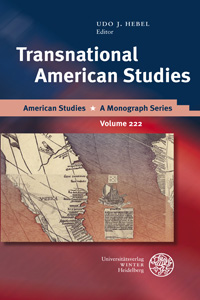
Transnational American Studies

I have yet to hear from anyone at the annual conference of the German Association for American Studies, which is going on now (May 31 – June 3, 2012) in Mainz, but the volume pictured above — Transnational American Studies, edited by Udo Hebel — was scheduled to make its debut there. (The Amazon page is up, but currently listing the book as not yet available.) In any case, I look forward to reading the contributions to the volume, which the publisher (Winter) describes thus:

Transnational approaches and theories have reshaped the interdisciplinary trajectory of American Studies since the turn of the millennium. The further extension of perspectives on the United States and North America to prominently include Atlantic Studies, Hemispheric Studies, and Pacific Studies has complicated long-standing notions of ‘American Studies’ and problematized concepts such as nation, identity, and American exceptionalism.

The collection gathers thirty original contributions to transnational American Studies from the fields of cultural studies, literature, history, politics, and media studies. Individual essays reassess the global role of the U.S. and its perceptions from within and without, discuss how transnational and comparative explorations emphasize multidirectional processes of cultural exchange and transfer, and show how paradigms of migration and cultural mobility have taken definitions and practices of American Studies beyond traditional geographical and disciplinary limits.

Oh, and did I mention that I have a chapter in the book? (Sorry for the self-promotion, but that’s what blogs are for, right?) Anyway, my piece is called “Frame, Sequence, Medium: Comics in Plurimedial and Transnational Perspective,” and it’s a reworking of a talk by the same title that I gave at last year’s DGfA conference. (In case you missed it but are interested, a screencast video of the full presentation can be viewed here.)

“Take anything and make it a matter of expression”: media | matter conference

media|matter:
the matter of media | the mediality of matter

Here’s the announcement I just received from Bernd Herzogenrath for an exciting conference coming up soon (May 31 – June 2, 2012) in Frankfurt. Be sure to click the link above for the conference program, list of speakers (including Bill Morrison, Thomas Köner, Lorenz Engell, and Hanjo Berressem), registration, and other info.

The 2012 media|matter conference reflects the increased interest in the material aspects of our culture, triggered by the material turn as postulated by Deleuze & Guattari, Varela & Maturana, Serres, and others. In consequence we will assess the implications of this blossoming field of research which focuses rather on what represents, than on what is represented.
The aim of our conference is to re-focus approaches in culture- and media-sciences and to open up and foster new, interdisciplinary perspectives and concepts towards a revised understanding of media. By highlighting the materiality of the medium and reading this very materiality as medium, questions occur: can content and form still be regarded as separate? Or shouldn’t we rather acknowledge that the matter of the medium affects the message that is conveyed and represented? Shouldn’t we consequently speak of informed matter and of materialized information?
In the same way, social- and cultural-sciences cannot ignore the findings of the life-sciences, especially in the fields of complexity-theory and non-linear systems. Thus this conference also intends to bring together artists and researchers from diverse disciplines with differing understandings of media and materiality, not only to create feedback-loops between natural- and cultural-sciences, but also to re-think the somewhat fuzzy concepts of nature and culture.