A Discorrelated Summary of Discorrelated Images

This is deeply weird. Google Books has a summary of Discorrelated Images up, and it’s definitely not from the publisher (compare Duke University Press’s summary here). While Google’s summary is not exactly *wrong* in anything that it says, it is far from a summary of what my book is actually about — and some sentences can’t really be judged in terms of truth or accuracy, as they just don’t make sense. (For example, the second sentence: “While film theory is based on past film techniques that rely on human perception to relate frames across time, computer generated images use information to render images as moving themselves.” What does that mean?!? It’s grammatical, and it *sounds* vaguely like something I might have written, but as far as I can tell, it is meaningless.)

Moreover, from this text it sounds like the book is primarily about Michael Bay’s TRANSFORMERS with a detour through Denis Villeneuve’s BLADE RUNNER 2049. To be clear, I do write about both of these, but I also write about Guy Maddin’s algorithmic SEANCES, about Basma Alsharif’s HOME MOVIES GAZA, about desktop horror, drones, speculative execution, animation, about the relations between the phenomenology of perception in relation to microtemporal and subperceptual events, about videogames, codecs, streaming video, and the end of the world.

Anyway, who wrote this summary? Why do I think it was a machine?

“Towards a Historical Aesthetics of Encounter”: My review of James J. Hodge, Sensations of History, in Critical Inquiry

My review of Jim Hodge’s excellent book Sensations of History: Animation and New Media Art (University of Minnesota Press, 2019) is online now at Critical Inquiry. This is an important book — definitely check it out!

Discorrelated Images in Duke University Press Fall 2020 Catalog (and about that cover image)

I am excited to see my book Discorrelated Images alongside so many truly impressive books in Duke University Press’s Fall 2020 catalog, which went online today. Take a look; there is so much good stuff in there!

And take a closer look at my book’s cover, below, which I am doubly excited about — first, because the press’s designer Drew Sisk did such a beautiful job on it, and second because it features a painting by my partner-in-crime/partner-in-life Karin Denson! (And if you know what you’re looking at, it also depicts our dog Evie — so there’s a third reason I’m super excited about it!)

Check out more of Karin’s work on her website at karindenson.com.

Discorrelated Images, cover design by Drew Sisk, featuring artwork by Karin Denson

Vivian Sobchack on Discorrelated Images

As I mourn the cancellation (due to the novel coronavirus) of my SCMS panel with the great Vivian Sobchack, I discover her blurb for my book Discorrelated Images, which has just appeared next to Steven Shaviro’s on the Duke University Press website. I am deeply honored and grateful to read these words of praise from a theorist whose work and words have been formative for me.

Steven Shaviro’s Blurb for Discorrelated Images

The world is falling apart, but my book Discorrelated Images is still set to come out in October — and I just discovered that Steven Shaviro has blurbed it! Also, the Duke University Press webpage for the book lists an affordable $25.95 cover price for the paperback!

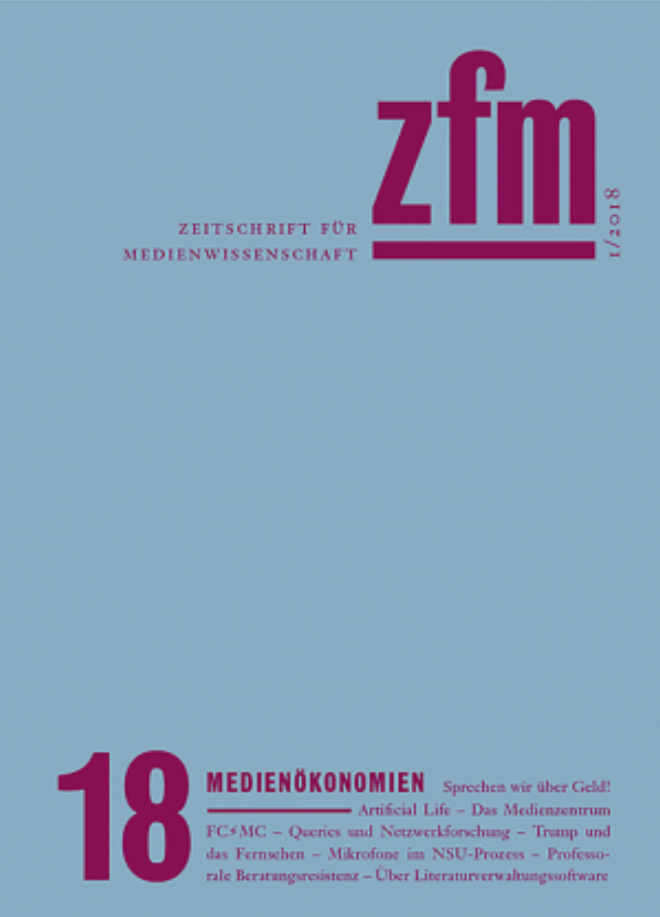
New Review of Post-Cinema in Zeitschrift für Medienwissenschaft 18 (2018)

Screen Shot 2018-05-02 at 11.09.08 AM

There is a new review of several works on all things post-cinematic, including Post-Cinema: Theorizing 21st-Century Film (which I co-edited with Julia Leyda), alongside Francesco Casetti’s The Lumière Galaxy; Malte Hagener, Vinzenz Hediger, and Alena Strohmaier’s edited collection The State of Post-Cinema; Vinzenz Hediger and Miriam de Rosa’s special issue Post-What? Post-When?; and Astrid Deuber-Mankowsky’s Queeres Post-Cinema.

The review, in German, is titled “Werden/Weiter/Denken: Rekapitulation eines Post-Cinema Diskurses” (roughly: Becoming/Further/Thinking — suggesting a thinking in flux and a thinking beyond — Recapitulation of a Post-Cinema Discourse). The text, by Elisa Linseisen from the Ruhr-Universität Bochum, appears in Zeitschrift für Medienwissenschaft 18 (2018). The full text is available as an open-access PDF.

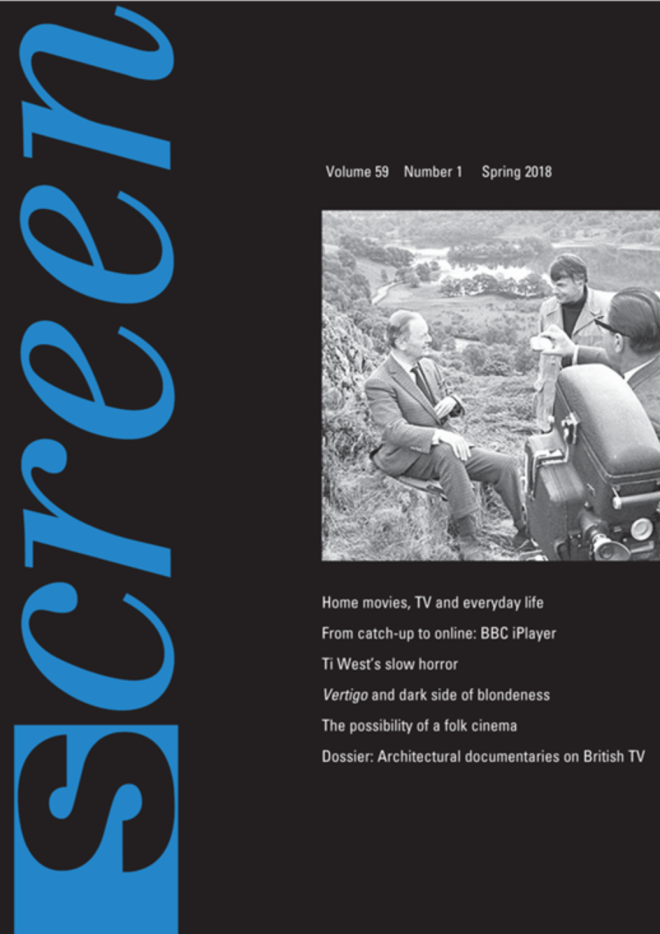
Review of Post-Cinema: Theorizing 21st-Century Film, Screen 59:1 (2018)

Screen Shot 2018-03-19 at 5.48.10 PM

Lisa Åkervall has a review out in the latest issue of Screen, covering three works on post-cinema: 1) the open-access volume that I edited with Julia Leyda, Post-Cinema: Theorizing 21st-Century Film; 2) the special issue of Cinéma & Cie (16:26-27, 2016), titled ‘Post-what? Post-when? Thinking moving images beyond the post-medium/post-cinema condition,’ edited by Miriam de Rosa and Vinzenz Hediger (which also includes my article on “Speculation, Transition, and the Passing of Post-Cinema”); and 3) Malte Hagener, Vinzenz Hediger, and Alena Strohmeier’s edited collection The State of Post-Cinema: Tracing the Moving Image in the Age of Digital Dissemination

About the collection I co-edited with Julia Leyda, Åkervall writes:

“Shane Denson and Julia Leyda’s comprehensive volume Post-Cinema: Theorizing 21st-Century Film, an open access online publication by Reframe Books, presents a multifaceted compendium. […] The editors’ framing in Post-Cinema is precise and penetrating, flexible enough to accommodate enduring themes in film and media studies while also making allowances for new questions associated with topics such as digital media aesthetics, media archaeology and environmental studies. Their volume rejects the idea that postcinema is merely a successor to cinema or a step in the teleological digitalization of all media, instead identifying it with competing perspectives on a changing media situation that bears on cinema as an institution, a practice and a medium. In this respect the volume admirably addresses our changing media landscape.”

Read the full review here.

All About Seriality: Henry Jenkins’s 4-Part Interview with Frank Kelleter

kelleter-serial-media

Following the recent publication of Media of Serial Narrative, edited by Frank Kelleter, there is a 4-part interview with Kelleter conducted by Henry Jenkins over on the latter’s blog. The interview is far-ranging and offers a good introduction to the volume and to the broader work conducted by the Popular Seriality Research Unit from 2010 to 2016, continued in ongoing work today.

Part one of the interview is here.

Part two.

Part three.

Part four.

Out Now: Media of Serial Narrative

IMG_1198

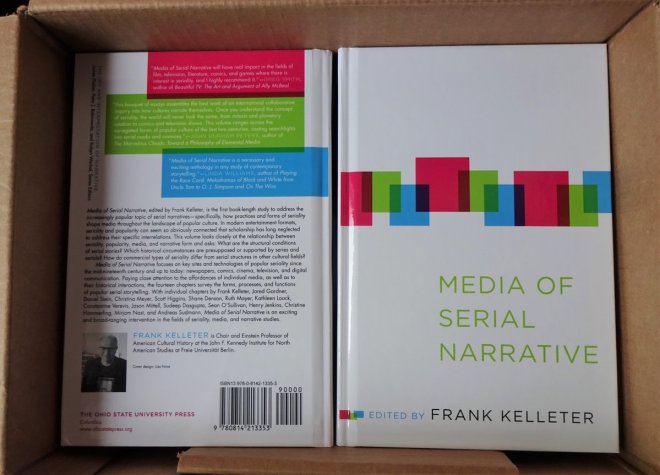
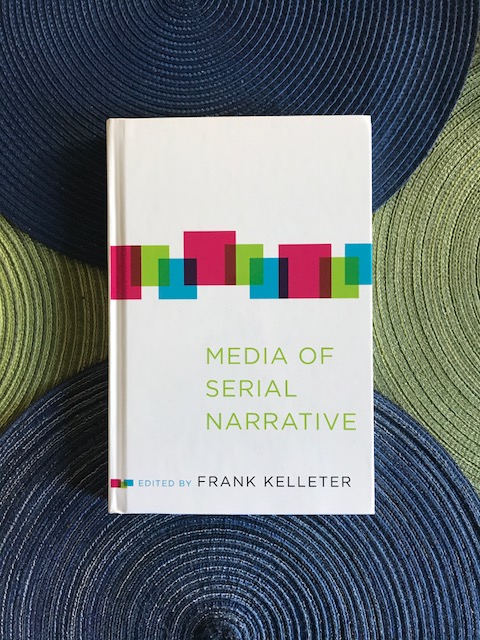
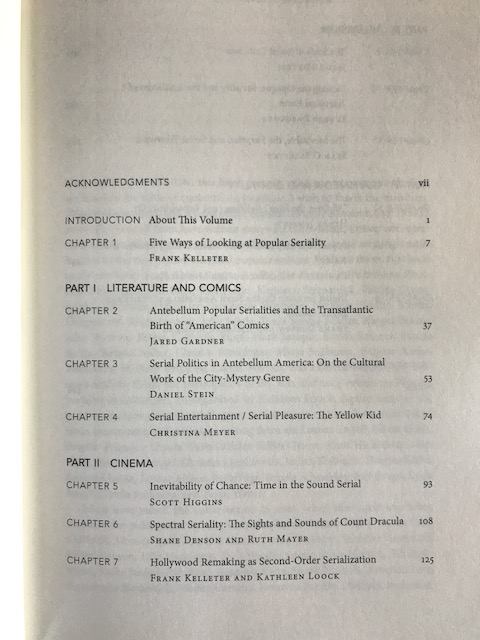
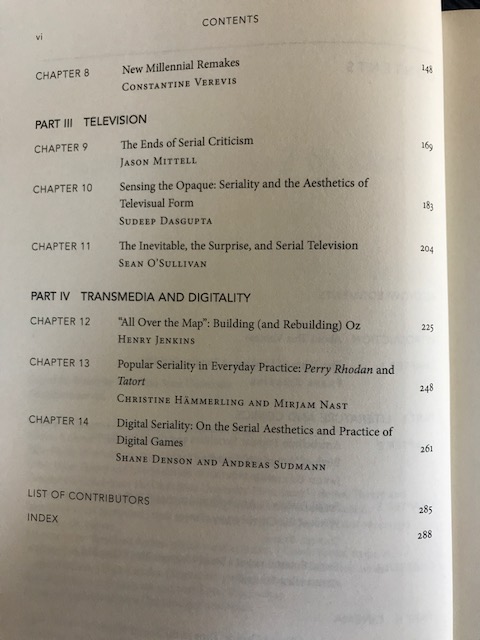
Media of Serial Narrative, edited by Frank Kelleter and published by The Ohio State University Press, is out now! The book includes 14 chapters, two of which I co-authored: “Spectral Seriality: The Sights and Sounds of Count Dracula” (co-authored with Ruth Mayer) and “Digital Seriality: On the Serial Aesthetics and Practice of Digital Games” (co-authored with Andreas Sudmann). Here’s the full table of contents:

IMG_1201IMG_1202

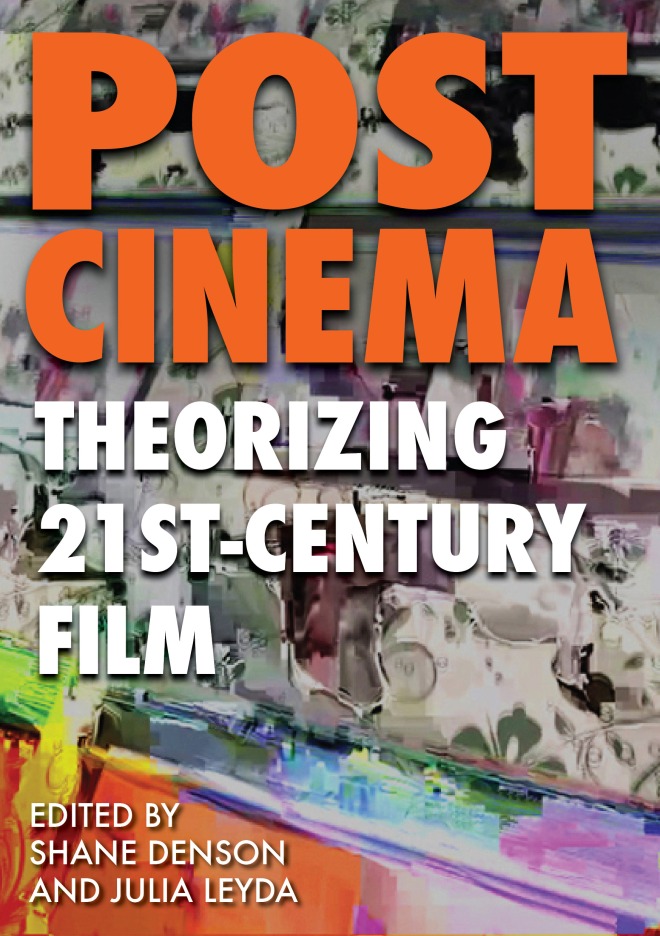
Download PDF — Post-Cinema: Theorizing 21st-Century Film

Post_cinema_cover_NEW

I am pleased to announce that Post-Cinema: Theorizing 21st-Century Film, which I co-edited with Julia Leyda, is now available for download in PDF format.

The open-access book, which has been available in an online HTML version since earlier this year, weighs in at a whopping 990 pages (!) and can now be downloaded for offline reading in two versions (9mb or a higher-quality 13mb version).

There are also two new endorsements for the book. First, from Tanya Horeck at Anglia Ruskin University:

Post-Cinema: Theorizing 21st-Century Film is an intellectually exciting and important book. Editors Shane Denson and Julia Leyda have assembled an extraordinary range of notable contributors with the aim to open up a critical conversation on the very notion of the post-cinematic – something they achieve in a most novel and engaging way. Through essays and roundtable discussions, Post-Cinema formulates fresh and nuanced questions about the consumption and spectatorship of post-millennial film and other media as they circulate through contemporary digital media ecologies. As is fitting given its subject matter of changing media formats, the design and layout of this book – with its open access digitality and its collaborative dialogues – is as relevant and pioneering as its content. Inviting us to rethink received ideas about how 21st-century media reshape “new forms of sensibility,” Post-Cinema: Theorizing 21st-Century Film is critically imperative reading for anyone interested in ongoing vital transformations in moving image media.

– Tanya Horeck, Reader in Film, Media, and Culture, Anglia Ruskin University

And also an endorsement from Michael Lawrence at University of Sussex:

The essays and discussions that have been assembled in Post-Cinema: Theorizing 21st–Century Film provide the reader with a remarkably comprehensive and compelling survey of the diverse critical and theoretical responses to the formal, technological, affective, political and ecological dimensions of our contemporary post-cinematic landscape. That landscape now has an authoritative and inspirational field guide: by gathering together foundational interventions alongside the most recent contributions this collection will prove indispensable to anyone wishing to take these conversations forward.

– Michael Lawrence, Reader in Film Studies, University of Sussex

More info and an official announcement can be found here.