More about Manifest Data

DH-WhatIDoWithData-POSTERManifestDataJan21

Above, another poster for the Manifest Data event on January 21, 2015, which I posted about a few days ago. Again, we’ll be presenting “a project that includes a 3D printed manifestation of personal Internet browsing data and an AR-enhanced data-based garden gnome” (as Amanda Starling Gould summed it up succinctly). If you’re in the Triangle area, do swing by! The event is free and open to all. (And if that’s not enough to entice you: as the poster says, “Light refreshments will be served!”)

See also the posts about the project on the HASTAC digital humanities network (here and here), as well the full list of events in the Duke Digital Scholarship Services series this semester (here).

Karl Marx Garden Gnome at The Carrack Modern Art

Karin_Denson-Karl-Marx-Garden-Gnome

I have written before about Karin Denson’s crazy hand-crafted garden gnomes, based on figures from popular culture, philosophy, and modern art (see here for a piece I posted about them last year). Recently, Karin’s gnomes have taken on new dimensions — quite literally, in fact — as she has transformed personal data collected during Internet browsing sessions into a sort of “portrait” of the user, subsequently turning this image of the interface into a gnome’s “data face,” and then subjecting the poor creature to a strict (but playful) regimen of photogrammetry, AR enhancement, and 3D printing. These new aspects, developed as part of the collaborative Manifest Data project, have further expanded the gnome’s artistic questioning of popular and high-art cultural formations, material and immaterial labor processes, class consciousness, national identity, and the role of seriality in all of them.

It is only fitting, then, that as we prepare for next week’s presentation of Manifest Data, in which context Karin’s data gnomes mount a brave attempt to reverse the neo-cyber-Marxian dictum that “all that’s solid melts into zeroes and ones,” another of Karin’s gnomes is also currently on display: Karl Marx himself, or his gnomic Doppelgänger, is haunting the gallery, bringing things down to earth, and making them concrete (literally: solid concrete). This week only, the Karl Marx gnome can be seen at The Carrack Modern Art, where he’s participating in a community show featuring 100 local artists from the Triangle area of North Carolina. The show runs today through Friday, 12-6pm, and Saturday 2-5pm. Also, as part of “Third Friday Durham,” there will be a reception with food, wine, and music this Friday, January 16, 2015, from 7-10pm. If you’re in or around Durham, don’t miss it!

Manifest Data

manifest_data

On January 21, 2015 (3:00-4:00pm), the S-1 Speculative Sensation Lab will be presenting a collaborative artwork titled Manifest Data at The Edge, the new space in Duke University’s Bostock Library devoted to “interdisciplinary, data-driven, digitally reliant or team-based research.”

Manifest Data brings together programmers, 3-D printing specialists, sculptors, and theorists to reflect on the production of value in the digital age, the materiality of information, and the (non-)place of mediated relations.

Code written by Luke Caldwell captures data that would otherwise be leaked as we browse the web, and exploited by the likes of Google and Facebook; in a second step, this data is transformed into a coordinate system that can be mapped as a 3D object. In collaboration with other lab members, artist Libi Striegl prepares and prints out the resulting “data creatures.” Karin Denson has reimagined these forms as beautifully grotesque garden gnomes — thus reappropriating a figure that has become a symbol for 3D printing and a marketing tool for companies like MakerBot. Together, Karin and I have further translated these figures into the hybrid spaces of augmented reality, planting the gnomes strategically and in such a way as to instantiate a very personal system for creating value that — dare we hope? — is immune to corporate cooptation. Lab members David Rambo and Max Symuleski, among others, round out the project with artistic-theoretical statements connecting the project of Manifest Data with a critical questioning of contemporary manifest destiny and a new phrenology for the digital age.

The S-1 Lab is directed by Mark B. N. Hansen and Mark Olson in the Media Arts + Sciences Program at Duke. The Manifest Data project was initiated by Amanda Starling Gould, who has continued to provide it with a guiding aesthetic-theoretical vision.

More information about the presentation, which happens to be the inaugural presentation in the “What I Do With Data” series of the Digital Scholarship Services at Duke, can be found here.

Post-Cinema and/as Environmental Media Theory #SCMS15

Post-Cinematic_Environment

I am very happy to announce that the panel I will be chairing at this year’s SCMS conference, “Post-Cinema and/as Speculative Media Theory,” has been chosen as one of eight panels to be officially sponsored by the Media and the Environment Special Interest Group. The group, of which I am proud to be a member, defines its mission thus:

The Media and the Environment Scholarly Interest Group (MESIG) aims to provide a forum for shared discussion of research and pedagogy at the intersections of media and environment. We believe that nearly every aspect of film and media practice and studies–from materials manufacturing and physical infrastructures, to filming locations and resources, to audiovisual aspects and themes, and beyond to marketing, preservation, obsolescence, and also scholarly discourse–touches matters of the environment and sustainability. Various approaches from an environmentalist perspective have been taken and more are still being developed to investigate how our mediated cultural practices have, do, and will position humans in relation to physical and natural worlds. How can we further film and media studies as a global–read planetary–concern, focused on dire changes and issues affecting the Earth and our natural surroundings? We believe our field has much to contribute to discussions and findings more frequently held in and attributed to science disciplines and Environmental Studies. With this Scholarly Interest Group, we seek to cultivate the study of significant matters of media and the environment within our field and through the representative collective that is SCMS.

I am honored that our panel — which includes one explicitly environmental film/media theorist (Adrian Ivakhiv) but also three others (Steven Shaviro, Patricia Pisters, and Mark Hansen) who are helping to define the subject of post-cinema in broadly ecological terms — has been chosen for sponsorship by the Media and the Environment SIG, and I am grateful for their recognition of the topic’s relevance for our ongoing attempts to rethink the relations between humans, our media technologies, and the environments that we inhabit, access, and transform with and through them.

Here, finally, is a list of all eight panels sponsored by the SIG:

A23: Ecocriticism

F8: Fossils, Films, and Sedimentation: Ecocritical Approaches to Archival Moving Images

G4: Media Waste: Technological Systems and the Environment

H22: Excess Hollywood: Economies of Waste in Media Industries

J12: Engaging Ecocinema: The Affects and Effects of Environmental Documentaries

J17: Media Environments

K7: Post-Cinema and/as Speculative Media Theory

P4: Cinema in/of the Anthropocene

SCMS 2015 Preliminary Schedule Online — #SCMS15

montreat2015

The preliminary schedule for the Society of Cinema and Media Studies 2015 conference in Montreal is now online (here). As I posted recently, I will be involved in two separate panels:

First, I will be chairing the panel on “Post-Cinema and/as Speculative Media Theory” (panel K7, Friday, March 27, 2015, 9:00-10:45am) — with presenters Steven Shaviro, Patricia Pisters, Adrian Ivakhiv, and Mark B. N. Hansen. You can find the complete panel description, as well as individual abstracts, here. Note also that all participants on this panel are contributors to the forthcoming Post-Cinema: Theorizing 21st-Century Film, which I am co-editing with Julia Leyda.

Second, I will be participating in a panel on “Digital Seriality” (panel Q20, Saturday, March 28, 2015, 3:00-4:45pm) — along with Andreas Jahn-Sudmann, Scott Higgins, Dominik Maeder, and Daniela Wentz. Panel description and abstracts can be found here. And, as with the other panel, this one too has a tie-in with a publication: all the participants on this panel were contributors to the special issue of Eludamos: Journal for Computer Game Culture that Andreas Jahn-Sudmann and I edited on the topic of “Digital Seriality.”
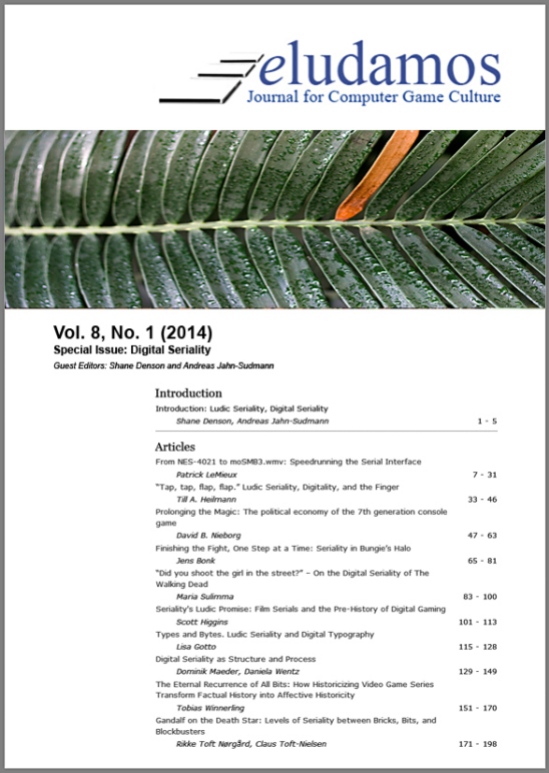
Out Now: Digital Seriality — Special Issue of Eludamos

eludamos-digital-seriality-cover

The latest issue of Eludamos: Journal for Computer Game Culture, a special issue devoted to the topic of “Digital Seriality” — edited by yours truly, together with Andreas Jahn-Sudmann — is now out! Weighing in at 198 pages, this is one of the fattest issues yet of the open-access journal, and it’s jam-packed with great stuff like:

  • Patrick LeMieux on the culture and technology of tool-assisted speedrunning
  • Jens Bonk on the serial structure of Halo
  • Scott Higgins on the ludic pre-history of gaming in serial films
  • Lisa Gotto on ludic seriality and digital typography
  • Tobias Winnerling on the serialization of history in “historical” games
  • Till Heilmann on Flappy Bird and the seriality of digits
  • David B. Nieborg on the political economy of blockbuster games
  • Rikke Toft Nørgård and Claus Toft-Nielsen on LEGO as an environment for serial play
  • Dominik Maeder and Daniela Wentz on serial interfaces and memes
  • Maria Sulimma on cross-medium serialities in The Walking Dead!

So what are you waiting for? Do yourself a favor and check out this issue now!

Visualizing Digital Seriality, Or: All Your Mods Are Belong to Us!

Visualizing_Digital_Seriality

In this post, I want to outline some ongoing work in progress that I’ve been pursuing as part of my postdoctoral research project on seriality as an aesthetic form and as a process of collectivization in digital games and gaming communities. The larger context, as readers of this blog will know, is a collaborative project I am conducting with Andreas Jahn-Sudmann of the Freie Universität Berlin, titled “Digital Seriality” — which in turn is part of an even larger research network, the DFG Research Unit “Popular Seriality–Aesthetics and Practice.” I’ll touch on this bigger picture here and there as necessary, but I want to concentrate more specifically in the following on some thoughts and research techniques that I’ve been developing in the context of Victoria Szabo’s “Historical & Cultural Visualization” course, which I audited this semester at Duke University. In this hands-on course, we looked at a number of techniques and technologies for conducting digital humanities-type research, including web-based and cartographic research and presentation, augmented and virtual reality, and data-intensive research and visualization. We engaged with a great variety of tools and applications, approaching them experimentally in order to evaluate their particular affordances and limitations with respect to humanities work. My own engagements were guided by the following questions: How might the tools and methods of digital humanities be adapted for my research on seriality in digital games, and to what end? What, more specifically, can visualization techniques add to the study of digital seriality?

I’ll try to offer some answers to these questions in what follows, but let me indicate briefly why I decided to pursue them in the first place. To begin with, seriality challenges methods of single-author and oeuvre or work-centric approaches, as serialization processes unfold across oftentimes long temporal frames and involve collaborative production processes — including not only team-based authorship in industrial contexts but also feedback loops between producers and their audiences, which can exert considerable influence on the ongoing serial development. Moreover, such tendencies are exacerbated with the advent of digital platforms, in which these feedback loops multiply and and accelerate (e.g. in Internet forums established or monitored by serial content producers and, perhaps more significantly, in real-time algorithmic monitoring of serialized consumption on platforms like Netflix), while the contents of serial media are themselves subject to unprecedented degrees of proliferation, reproduction, and remix under conditions of digitalization. Accordingly, an incredible amount of data is generated, so that it is natural to wonder whether any of the methods developed in the digital humanities might help us to approach phenomena of serialization in the digital era. In the context of digital games and game series, the objects of study — both the games themselves and the online channels of communication around which gaming communities form — are digital from the start, but there is such an overwhelming amount of data to sort through that it can be hard to see the forest for the trees. As a result, visualization techniques in particular seem like a promising route to gaining some perspective, or (to mix metaphors a bit) for establishing a first foothold in order to begin climbing what appears an insurmountable mountain of data. Of particular interest here are: 1) “distant reading” techniques (as famously elaborated by Franco Moretti), which might be adapted to the objects of digital games, and 2) tools for network analysis, which might be applied in order to visualize and investigate social formations that emerge around games and game series.

Inter-Ludic-Seriality

Before elaborating on how I have undertaken to employ these approaches, let me say a bit more about the framework of my project and the theoretical perspective on digital seriality that Andreas Jahn-Sudmann and I have developed at greater length in our jointly authored paper “Digital Seriality.” Our starting point for investigating serial forms and processes in games and gaming communities is what we call “inter-ludic seriality” — that is, the serialization processes that take place between games, establishing series such as Super Mario Bros. 1, 2, 3 etc. or Pokemon Red and Blue, Gold and Silver, Ruby and Sapphire, Black and White etc. For the most part, such inter-ludic series are constituted by fairly standard, commercially motivated practices of serialization, expressed in sequels, spin-offs, and the like; accordingly, they are a familiar part of the popular culture that has developed under capitalist modernity since the time of industrialization. Thus, there is lots of continuity with pre-digital seriality, but there are other forms of seriality involved as well.

Intra-Ludic-Seriality

“Intra-ludic seriality” refers to processes of repetition and variation that take place within games themselves, for example in the 8 “worlds” and 32 “levels” of Super Mario Bros. Here, a general framework is basically repeated while varying and in some cases increasingly difficult tasks and obstacles are introduced as Mario searches for the lost princess. Following cues from Umberto Eco and others, this formula of “repetition + variation” is taken here as the formal core of seriality; games can therefore be seen to involve an operational form of seriality that is in many ways more basic than, while often foundational to, the narrative serialization processes that they also display.

Para-Ludic-Seriality

Indeed, this low-level seriality is matched by higher-level processes that encompass but go beyond the realm of narrative — beyond even the games themselves. What we call “para-ludic seriality” involves tie-ins and cross-overs with other media, including the increasingly dominant trend towards transmedia storytelling, aggressive merchandising, and the like. Clearly, this is part of an expanding commercial realm, but it is also the basis for more.

Serial-Superstructure

There is a social superstructure, itself highly serialized, that forms around or atop these serialized media, as fans take to the Internet to discuss (and play) their favorite games. In itself, this type of series-based community-building is nothing new. In fact, it may just be a niche form of a much more general phenomenon that is characteristic for modernity at large. Benedict Anderson and Jean-Paul Sartre before him have described modern forms of collectivity in terms of “seriality,” and they have linked these formations to serialized media consumption and those media’s serial forms — newspapers, novels, photography, and radio have effectively “serialized” community and identity throughout the nineteenth and twentieth centuries.

Infra-Ludic-Seriality

Interestingly, though, in the digital era, this high-level community-building seriality is sometimes folded into an ultra low-level, “infra-ludic” level of seriality — a level that is generally invisible and that takes place at the level of code. (I have discussed this level before, with reference to the BASIC game Super Star Trek, but I have never explicitly identified it as “infra-ludic seriality” before.) This enfolding of community into code, broadly speaking, is what motivates the enterprise of critical code studies, when it is defined (for example, by Mark Marino) as

an approach that applies critical hermeneutics to the interpretation of computer code, program architecture, and documentation within a socio-historical context. CCS holds that lines of code are not value-neutral and can be analyzed using the theoretical approaches applied to other semiotic systems in addition to particular interpretive methods developed particularly for the discussions of programs. Critical Code Studies follows the work of Critical Legal Studies, in that it practitioners apply critical theory to a functional document (legal document or computer program) to explicate meaning in excess of the document’s functionality, critiquing more than merely aesthetics and efficiency. Meaning grows out of the functioning of the code but is not limited to the literal processes the code enacts. Through CCS, practitioners may critique the larger human and computer systems, from the level of the computer to the level of the society in which these code objects circulate and exert influence.

Basically, then, the questions that I am here pursuing are concerned with the possibilities of crossing CCS with DH — and with observing the consequences for a critical investigation of digital game-based seriality. My goal in this undertaking is to find a means of correlating formations in the high-level superstructure with the infra-ludic serialization at the level of code — not only through close readings of individual texts but by way of large collections of data produced by online collectives.

Romhacking

As a case study, I have been looking at ROMhacking.net, a website devoted to the community of hackers and modders of games for (mostly) older platforms and consoles. “Community” is an important notion in the site’s conception of itself and its relation to its users, as evidenced in the site’s “about” page:

ROMhacking.net is the innovative new community site that aggressively aims to bring several different areas of the community together. First, it serves as a successor to, and merges content from, ROMhacking.com and The Whirlpool. Besides being a simple archive site, ROMhacking.net’s purpose is to bring the ROMhacking Community to the next level. We want to put the word ‘community’ back into the ROMhacking community.

The ROMhacking community in recent years has been scattered and stagnant. It is our goal and hope to bring people back together and breathe some new life into the community. We want to encourage new people to join the hobby and make it easier than ever for them to do so.

Among other things, the site includes a vast collection of Super Mario Bros. mods (at the time of writing, 205 different hacks, some of which include several variations). These are fan-based modifications of Nintendo’s iconic game from 1985, which substitute different characters, add new levels, change the game’s graphics, sound, or thematic elements, etc. — hence perpetuating an unofficial serialization process that runs parallel to Nintendo’s own official game series, and forming the basis of communal formations through more or less direct manipulation of computer code (in the form of assembly language, hex code, or mediated through specialized software platforms, including emulators and tools for altering the game). In other words, the social superstructure of serial collectivity gets inscribed directly into the infra-ludic level of code, leaving traces that can be studied for a better understanding of digital seriality.

But how should we study them? Even this relatively small sample is still quite large by the standards of a traditional, close reading-based criticism. What would we be looking for anyway? The various mods are distributed as patches (.ips files) which have to be applied to a ROM file of the original game; the patches are just instruction files indicating how the game’s code is to be modified by the computer. As such, the patch files can be seen, rather abstractly, as crystallizations of the serialization process: if repetition + variation is the formal core of seriality, the patches are the records of pure variation, waiting to be plugged back into the framework of the game (the repeating element). But when we do plug it back in, then what? We can play the game in an emulator, and certainly it would be interesting — but extremely time-consuming — to compare them all in terms of visual appearance, gameplay, and interface. Or we can open the modified game file in a hex editor, in which case we might get lucky and find an interesting trace of the serialization process, such as the following:

2014-12-02 12.23.19 pm

Similar to Super Star Trek with its REM comments documenting its own serial and collective genesis, here we find an embedded infratext in the hexcode of “Millennium Mario,” a mod by an unknown hacker reportedly dating back to January 1, 2000. Note, in particular, the reference to a fellow modder, “toma,” the self-glorifying “1337” comment, and the skewed ASCII art — all signs of a community of serialization operating at a level subterranean to gameplay. But this example also demonstrates the need for a more systematic approach — as well as the obstacles to systematicity, for at stake here is not just code but also the software we use to access it and other “parergodic” elements, including even the display window size or “view” settings of the hex editor:

Millennium-Resize-Infratext

In a sense, this might be seen as a first demonstration of the importance of visualization not only in the communication of results but in the constitution of research objects! In any case, it clearly establishes the need to think carefully about what it is, precisely, that we are studying: serialization is not imprinted clearly and legibly in the code, but is distributed in the interfaces of software and hardware, gameplay and modification, code and community.

Again, I follow Mark Marino’s conception of critical code studies, particularly with respect to his broad understanding of the object of study:

What can be interpreted?

Everything. The code, the documentation, the comments, the structures — all will be open to interpretation. Greater understanding of (and access to) these elements will help critics build complex readings. In “A Box Darkly,” discussed below, Nick Montfort and Michael Mateas counter Cayley’s claim of the necessity for executability, by acknowledging that code can be written for programs that will never be executed. Within CCS, if code is part of the program or a paratext (understood broadly), it contributes to meaning. I would also include interpretations of markup languages and scripts, as extensions of code. Within the code, there will be the actual symbols but also, more broadly, procedures, structures, and gestures. There will be paradigmatic choices made in the construction of the program, methods chosen over others and connotations.

In addition to symbols and characters in the program files themselves, paratextual features will also be important for informed readers. The history of the program, the author, the programming language, the genre, the funding source for the research and development (be it military, industrial, entertainment, or other), all shape meaning, although any one reading might emphasize just a few of these aspects. The goal need not be code analysis for code’s sake, but analyzing code to better understand programs and the networks of other programs and humans they interact with, organize, represent, manipulate, transform, and otherwise engage.

But, especially when we’re dealing with a large set of serialized texts and paratexts, this expansion of code and the attendant proliferation of data exacerbates our methodological problems. How are we to conduct a “critical hermeneutics” of the binary files, their accompanying README files, the ROMhacking website, and its extensive database — all of which contain information relevant to an assessment of the multi-layered processes of digital seriality? It is here, I suggest, that CCS can profit from combination with DH methods.

2014-12-08 03.44.57 pm

The first step in my attempt to do so was to mine data from the ROMhacking website and paratexts distributed with the patches and to create a spreadsheet with relevant metadata (you can download the Excel file here: SMB-Hacks-Dec1). On this basis, I began trying to analyze and visualize the data with Tableau. But while this yielded some basic information that might be relevant for assessing the serial community (e.g. the number of mods produced each year, including upward and downward trends; a list of the top modders in the community; and a look at trends in the types of mods/hacks being produced), the visualizations themselves were not very interesting or informative on their own (click on the image below for an interactive version):

2014-12-08 04.02.56 pm

How could this high-level metadata be coordinated with and brought to bear on the code-level serialization processes that we saw in the hexcode above? In looking for an answer, it became clear that I would have to find a way to collect some data about the code. The mods, themselves basically just “diff” files, could be opened and compared with the “diff” function that powers a lot of DH-based textual analysis (for example, with juxta), but the hexadecimal code that we can access here — and the sheer amount of it in each modded game, which consists of over 42000 bytes — is not particularly conducive to analysis with such tools. Many existing hex editors also include a “diff” analysis, but it occurred to me that it would be more desirable to have a graphical display of differences between the files in order to see the changes at a glance. My thinking here was inspired by hexcompare, a Linux-based visual diff program for quickly visualizing the differences between two binary programs:

hexcompare

However, the comparison here is restricted to local use on a Linux machine, and it only considers two files at a time. If this type of analysis is to be of any use for seriality studies, it will have to assess a much larger set of files and/or automate the comparison process. This is where Eric Monson and Angela Zoss from Visualization & Information Services at Duke University came in and helped me to develop an alternative approach. Eric Monson wrote a script that analyzes the mod patch files and records the basic “diff” information they contain: the address or offset at which they instruct the computer to modify the game file, as well as the number of bytes that they instruct it to write. With this information (also recorded in the Excel file linked to above), a much more useful and interactive visualization can be created with Tableau (click for an interactive version):

2014-12-08 04.38.04 pm

Here, Gannt charts are used to represent the size and location of changes that a given mod makes to the original Mario game; it is possible to see a large number of these mods at a single glance, to filter them by year, by modder, by title, or even size (some mods expand the original code), etc., and in this way we can begin to see patterns emerging. Thus, we bring a sort of “distant reading” to the level of code, combining DH and CCS. (Contrast this approach with Marino’s 2006 call to “make the code the text,” which despite his broad understanding of code and acknowledgement that software/hardware and text/paratext distinctions are non-absolute, was still basically geared towards a conception of CCS that encouraged critical engagements of the “close-reading” type. As I have argued, however, researching seriality in particular requires that we oscillate between big-picture and micro-level analyses, between distant readings of larger trends and developments and detailed comparisons between individual elements or episodes in the serial chain.)

But to complete this approach, we still need to correlate this code-based data with the social level of online modding communities. For this purpose, I used Palladio (a tool explicitly designed for DH work by the Humanities + Design lab at Stanford) to graph networks on the basis of metadata contained in Readme.txt files.

shout-outs

Here, I have mapped the references (“shout-outs,” etc) that modders made to one another in these paratexts, thus revealing a picture of digital seriality as an imagined community of modders.

community-references

Here, on the other hand, I have mapped references from paratextual materials associated with individual mods to various online communities that have come and gone over the years. We see early references to the defunct TEKhacks, by way of Zophar’s Domain, Acmlm’s and Insectduel’s boards, with more recent references to Romhacking.net, the most recent community site and the one that I am studying here.

smb3-references

As an example of how the social network and code-level analyses might be correlated, here I’ve filtered the network graph to show only those modders who refer in their paratexts to Super Mario Bros. 3 (hence bringing inter-ludic seriality to bear on their para- and infra-ludic interventions). The resulting graph reveals a small network of actors whose serializing activity involves mixing and referencing between SMB1 and SMB3, as well as between each other. The Tableau screenshot on the right then selects just these modders and reveals possible similarities and sites of serialization (for closer scrutiny with hexcompare or tools derived from the modding community itself). For example, we find that the modder AP’s SMB3-inspired patches from September 2005 and flamepanther’s SMB DX patches from Oct 2005 exhibit traces of possible overlap that deserve to be looked at in detail. The modder insectduel’s After World 8 (a mod that is referenced by many in the scene) from February 2006 shares large blocks around 31000-32000 bytes with many of the prolific modder Googie’s mods (which themselves seem to exhibit a characteristic signature) from 2004-2006. Of course, recognizing these patterns is just the beginning of inquiry, but at least it is a beginning. From here, we still have to resort to “close reading” techniques and to tools that are not conducive to a broad view; more integrated toolsets remain to be developed. Nevertheless, these methods do seem promising as a way of directing research, showing us where to look in greater depth, and revealing trends and points of contact that would otherwise remain invisible.

Finally, by way of conclusion and to demonstrate what some of this more detailed work looks like, I’d like to return to the “Millennium Mario” mod I considered briefly above. As we saw, there was an interesting infratextual shoutout and some ASCII art in the opening section of the hexcode. With Tableau, we can filter the “diff” view to display only those mods that exhibit changes in the first 500 bytes of code, and to map that section of code in greater resolution (this is done with the slider in the bottom right corner, marked “Start” — referring to the byte count at which a change in the game starts):

Millennium-and-other-earlybytemods1

Here we find two distinctive (visual) matches: viz. between “Millennium Mario” and Raysyde’s “Super Mario Bros. – Remix 2” from 1999, and between ATA’s “Super Mario Bros. – Yoshi’s Quest” and Krillian’s “Mario Adventure 2,” both from 2000. The latter two mods, while clearly different from the former two, also exhibit some overlap in the changes made to the first 20 or so bytes, so it will be interesting to compare them as well.

hexcompare-SMBRemix2-Millennium-b

Now we can use hexcompare for finer analysis — i.e. to determine if the content of the changed addresses is also identical (the visual match only tells us that something has been changed in the same place, not whether the same change has been made there).

hexcompare-SMBRemix2-Millennium

Here we find that Raysyde’s “Super Mario Bros. – Remix 2” does in fact display the same changes in the opening bytes, including the reference to “toma” and the ASCII art. This then is a clear indication of infra-ludic serialization: the borrowing, repetition, and variation of code-level work between members of the modding community. This essentially serial connection (an infra-serial link) would hardly be apparent from the level of the mods’ respective interfaces, though:

2000-01-01-Millennium1999-01-01-SMBRemix2

When we compare “Millennium Mario” with ATA’s “Super Mario Bros. – Yoshi’s Quest,” we find the ASCII art gone, despite the visual match in Tableau’s mapping of their “diff” indications for the opening bytes:

hexcompare-Millennium-YoshisQuest

“Yoshi’s Quest” corresponds in this respect to Krillian’s “Mario Adventure 2”:

hexcompare-YoshisQuest-MarioAdv2

Thus we have another clear indication of infra-ludic serialization, which would hardly have been evident other than by means of a directed filtering of the large dataset, in conjunction with a close analysis of the underlying code.

Again, however, this is just the beginning of the analysis — or more broadly of an encounter between DH and CCS. Ideally, the dataset would be expanded beyond ROMhacking.net’s database; other online communities would be mined for data; and, above all, more integrative tools would be developed for correlating social network graphs and diff-maps, for correlating community and code. Perhaps a crowdsourced approach to some of this would be appropriate; for what it’s worth, and in case anyone is inclined to contribute, my data and the interactive Tableau charts are linked above. But the real work, I suspect, lies in building the right tools for the job, and this will clearly not be an easy task. Alas, like digital seriality itself, this is work in progress, and thus it remains work “to be continued”…

Thanks finally to Eric Monson, Angela Zoss, Victoria Szabo, Patrick LeMieux, Max Symuleski, and the participants in the Fall 2014 “Historical & Cultural Visualization Proseminar 1” at Duke University for the various sorts of help, feedback, and useful tips they offered on this project!

Comics as Mediator of the Print/Digital Divide

o-BEST-AMERICAN-COMICS-6-570

Over at Huffington Post, Bill Kartalopoulos has an interesting article on “Why Comics are More Important than Ever” (from whence the image above is taken). I highly recommend reading the piece in full, as it offers a clear, concise, and nicely illustrated exposition of some of the core medial properties of comics, along with an argument about comics’ liminal or transitional position between print and digital media.

The upshot of Kartalopoulos’s argument, which I find quite convincing, is that comics can (or do) serve us as mediators in negotiating some of the shifts and uncertainties we experience in a world that is still undergoing large-scale digitalization — but which is not destined to become digital-only. In other words, pre-digital forms are not going away; there is no “manifest destiny” of the digital, and so we must learn to navigate between medial forms that exhibit very different affordances and demands. Comics marry aspects of both forms, so that they might be seen as privileged mediators of the contemporary (and future) media landscape. As Kartalopoulos puts it:

For more than a century, comics have demonstrated a form of communication that marries the linear sequence of typography with the global perception of an internet-like matrix of simultaneous parts. […]. As we struggle within the cognitive tug of war of our new media landscape, comics offer a useful model for a new type of reading: one that might help resolve the tensions of the current media age to move us toward new productive modes of expression and understanding.

This resonates with an argument I have made regarding the serial properties of the medium — particularly with respect to what Thierry Groensteen calls the “restrained” and “general arthrology” of the comics form: the articulations or linkages that, respectively, work to unite elements in either a linear, sequential dynamics of panel-to-panel transitions or through nonlinear, networked relations between distant panels.

I have touched on these topics in “Framing, Unframing, Reframing,” my afterword to Transnational Perspectives on Graphic Narratives. What I don’t explore in that piece, but which I had in mind when writing it, was the transitional and mediating position between digital and print forms that Kartalopoulos ascribes to comics. In the hopes that it adds something useful to the discussion, and since I’ve never published it anywhere, I offer here the concluding paragraph of a talk, called “Multistable Frames: Notes Towards a (Post-)Phenomenological Approach to Comics,” which I gave in October 2011 at a conference in Bern, Switzerland:

So effectively, what I am proposing here, in the name of a phenomenological approach, is an expansion of the general arthrology developed by Groensteen, who notes that the narrative operations of comics take root in linear sequences of contiguous panels but give rise to braidings or translinear series that establish themselves between distant panels. By following these braided networks beyond the diegesis, beyond the work, and into a plurimedial field of connectivities and the lifeworld it structures, we can appreciate the truth of a remark that Groensteen makes in the conclusion of his book. There, he writes: “comics, which marries the visual and the verbal, demonstrates a discontinuity, a staggering, and the effects of networks, and finally constitutes a sort of image bank, appear to be situated not far from the turning point between the civilization of the book and that of multimedia” (160). We can say, then, that comics are transitional between old and new media due to the emergent seriality that proliferates as a result of comics’ nested multistabilites, a seriality that Groensteen describes as a “supplementary relation” that is “inscribed like an addition that the text secretes beyond its surface” (146-147). Always vacillating between the linear narrative sequence and the translinear network, comics define their seriality as a space of the in-between: between self-enclosed books on the one hand and the total network of hypertext and convergent digital media on the other. As this in-between space of serial proliferation, comics are not assimilable to the monomedial narration of the book, and they resist as well the higher-level closure of transmedial storytelling while upsetting the exhaustive cataloguing projects of digital databases and wikis. With their plurimedial seriality, comics remain squarely in-between. With their techniques of retcon and reboot, for example, and more generally the fact of multistable framing at every level, proliferating in an unruly seriality, comics can be said to have set the stage for a consideration of the experiential gaps between old and new media. As a truly transitional medium, comics inherently confound every attempt at closure or totalization—both the self-contained book and the encyclopedic database depend on discrete categories that are incapable of accommodating the ambiguity and plurality of the multistable frame. And so, despite appearances that they might settle down, let themselves be tamed according to book-centric categories of “respectable” literature—as graphic novels—or captured and rendered coherent and manageable in the convergent space of the digital, comics remain elusive, on the move, and productive of a self-serializing dynamics of the transition. In this respect, they may be useful for understanding the parameters of a rapidly changing visual culture.