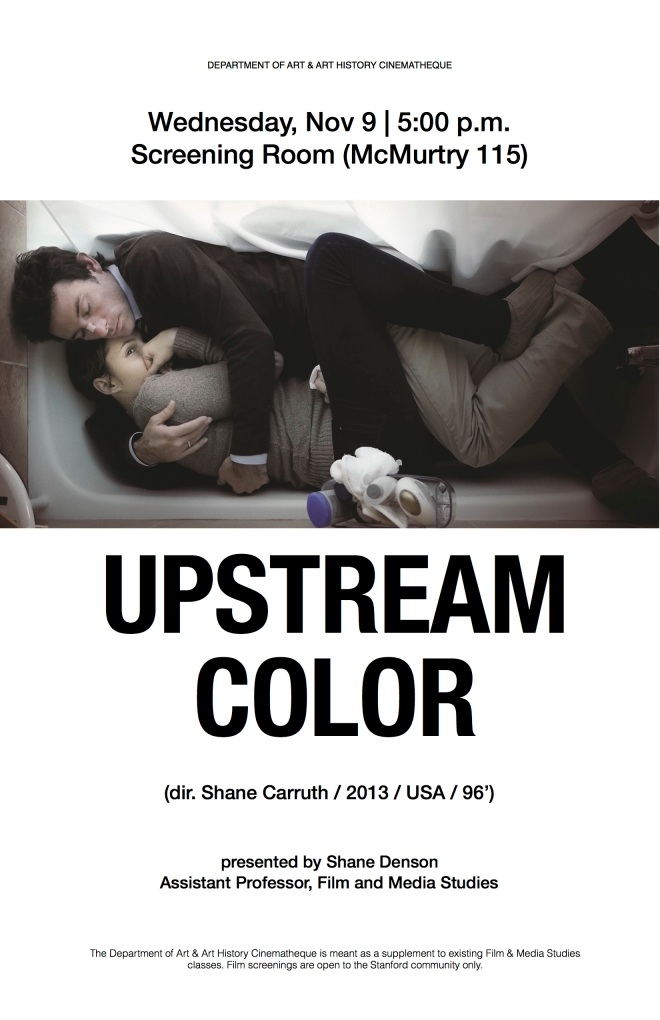
At this week’s Art & Art History Cinematheque, I will be presenting Shane Carruth’s Upstream Color (2013). Wednesday, Nov. 9, 2016 at 5pm (McMurtry Building 115).

At this week’s Art & Art History Cinematheque, I will be presenting Shane Carruth’s Upstream Color (2013). Wednesday, Nov. 9, 2016 at 5pm (McMurtry Building 115).

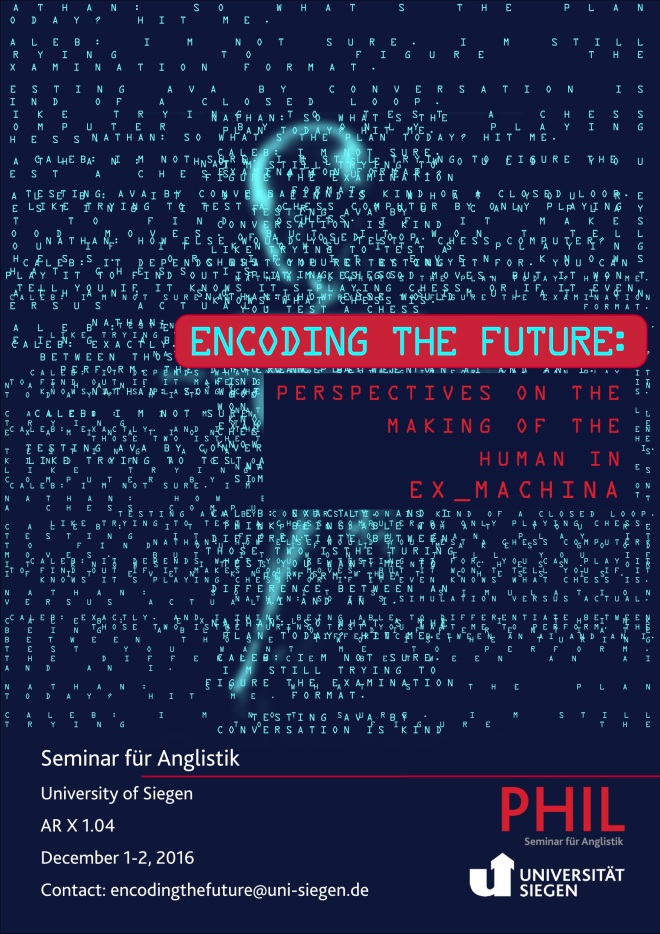
I am excited and honored to be delivering one of the keynote addresses at this conference on “Encoding the Future” at the University of Siegen, December 1-2, 2016. More info and program here.

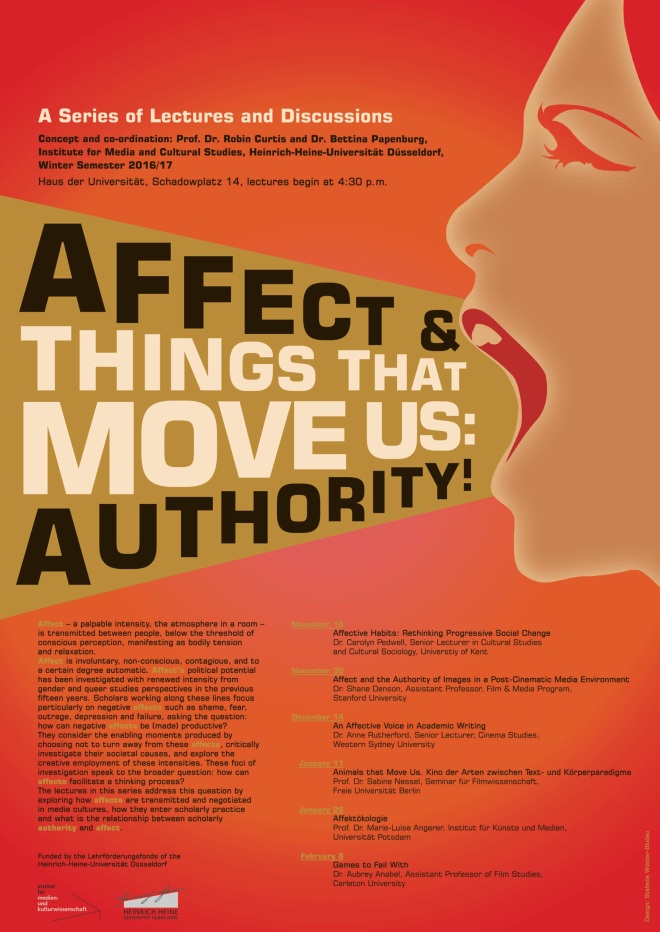
I am honored to be participating in this lecture series at the Heinrich-Heine-Universität Düsseldorf. My talk, titled “Affect and the Authority of Images in a Post-Cinematic Media Environment,” will take place on November 30.
I am pleased to announce that Post-Cinema: Theorizing 21st-Century Film, which I co-edited with Julia Leyda, is now available for download in PDF format.
The open-access book, which has been available in an online HTML version since earlier this year, weighs in at a whopping 990 pages (!) and can now be downloaded for offline reading in two versions (9mb or a higher-quality 13mb version).
There are also two new endorsements for the book. First, from Tanya Horeck at Anglia Ruskin University:
Post-Cinema: Theorizing 21st-Century Film is an intellectually exciting and important book. Editors Shane Denson and Julia Leyda have assembled an extraordinary range of notable contributors with the aim to open up a critical conversation on the very notion of the post-cinematic – something they achieve in a most novel and engaging way. Through essays and roundtable discussions, Post-Cinema formulates fresh and nuanced questions about the consumption and spectatorship of post-millennial film and other media as they circulate through contemporary digital media ecologies. As is fitting given its subject matter of changing media formats, the design and layout of this book – with its open access digitality and its collaborative dialogues – is as relevant and pioneering as its content. Inviting us to rethink received ideas about how 21st-century media reshape “new forms of sensibility,” Post-Cinema: Theorizing 21st-Century Film is critically imperative reading for anyone interested in ongoing vital transformations in moving image media.
– Tanya Horeck, Reader in Film, Media, and Culture, Anglia Ruskin University
And also an endorsement from Michael Lawrence at University of Sussex:
The essays and discussions that have been assembled in Post-Cinema: Theorizing 21st–Century Film provide the reader with a remarkably comprehensive and compelling survey of the diverse critical and theoretical responses to the formal, technological, affective, political and ecological dimensions of our contemporary post-cinematic landscape. That landscape now has an authoritative and inspirational field guide: by gathering together foundational interventions alongside the most recent contributions this collection will prove indispensable to anyone wishing to take these conversations forward.
– Michael Lawrence, Reader in Film Studies, University of Sussex
More info and an official announcement can be found here.
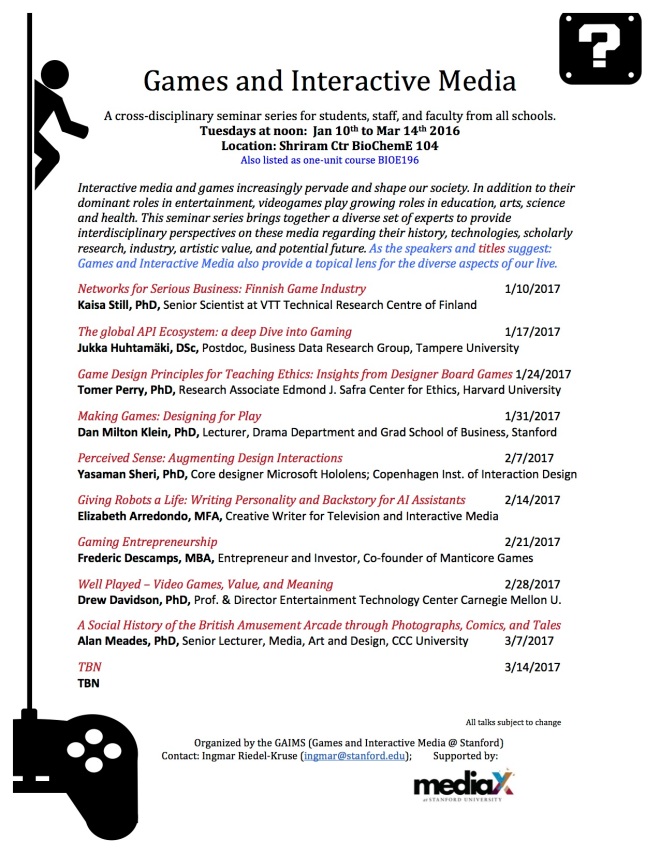
Above you’ll find the video of my talk, “Digital Seriality: Code & Community in the Super Mario Modding Scene,” which I delivered on September 27, 2016 as part of the Interactive Media & Games Seminar Series at Stanford University.
Here is the abstract for my talk:
Digital Seriality: Code & Community in the Super Mario Modding Scene
Shane Denson
Seriality is a common feature of game franchises, with their various sequels, spin-offs, and other forms of continuation; such serialization informs social processes of community-building among fans, while it also takes place at much lower levels in the repetition and variation that characterizes a series of game levels, for example, or in the modularized and recycled code of game engines. This presentation considers how tools and methods of digital humanities — including “distant reading” and visualization techniques — can shed light on serialization processes in digital games and gaming communities. The vibrant “modding” scene that has arisen around the classic Nintendo game Super Mario Bros. (1985) serves as a case study. Automated “reading” techniques allow us to survey a large collection of fan-based game modifications, while visualization software helps to bridge the gap between code and community, revealing otherwise invisible connections and patterns of seriality.
Syllabus for my Introduction to Media course, starting Monday, September 26.
Network Ecologies is a great new open-access collection edited by Amanda Starling Gould and Florian Wiencek and published by the Duke Franklin Humanities Institute. The collection takes advantage of the Scalar publishing platform to include a variety of media alongside scholarly texts. Among other things, it includes a collection of artworks by Karin Denson and myself, which we developed for an exhibit at Duke in 2015 (also organized by Amanda Starling Gould) and which grew out of a collaboration with the Duke S-1: Speculative Sensation Lab. There is also an archive of videos from a 2013 symposium, including contributions from Jussi Parikka, Mark Hansen, Stephanie Boluk, Patrick LeMieux, and many others. Lots of great things to discover here–check it out!


I am excited to be chairing and participating in the panel “Generativity and Creative Agency in Post-Cinematic Media” at the 2016 conference of the Society for Literature, Science, and the Arts (SLSA), which will be taking place this year in Atlanta, November 3-6, 2016. Below you will find the panel description and links to the individual abstracts.
Generativity and Creative Agency in Post-Cinematic Media
SLSA 2016 Panel
Chair: Shane Denson, Stanford University
This panel seeks to elucidate the generative potentials and creative agencies of contemporary audiovisual media, or post-cinematic media. We explore these potentials in terms of technological, aesthetic, affective, and political processes involved in 21st-century media, theorizing their impact on the images that dominate our experience of the contemporary lifeworld. Collectively, these presentations provide a picture of post-cinema as a field of material, cultural, informatic, and ideological agencies—a media regime that exhibits an unprecedented form of productivity, or creative force, owing in part to the shift from a photographic-indexical to a computational ontology, but continuing to speak to human sensibilities through images that actively generate an interface with sub-perceptual and informational processes.
Shane Denson’s contribution introduces the notion of post-cinema as a framework for contemporary experience—a generative framework that displaces human perspectives while simultaneously re-situating them with respect to the microtemporal processes that subtend perception in the age of digital, networked media. Mark Hansen’s talk turns to the use of military drones in the production of strategic and aesthetic images, questioning the relation between the visual and the informatic. Ozgun Eylul Iscen picks up this thread and links the political power of post-cinematic images to the generative power of the glitch, a phenomenon which hovers between properly perceptual and infrastructural registers. Finally, Jason Lajoie’s contribution focuses on interactive potentials and the reconfiguration of photographic media and agencies in contemporary videogames.
Abstracts for the individual papers:
Shane Denson, “Post-Cinema as a Generative Media Regime”
Ozgun Eylul Iscen, “Indexicality as ‘Shadow Archive’ in Post-Cinema”
Mark B. N. Hansen, “Between Information and Fabulation: Cinema After Drones”
Jason Lajoie, “Playing the Photographer: Creative Self-Expression through In-Game Photography”

My abstract for the panel “Generativity and Creative Agency in Post-Cinematic Media” at SLSA 2016 in Atlanta:
Post-Cinema as a Generative Media Regime
Shane Denson, Stanford University
This presentation examines recent theories and approaches to post-cinema, understood broadly as the informatically informed audio-visual media regime that follows in the wake of electronic and digital media’s absorption and re-tooling of cinematic technologies and modes of representation. Taking cues from Steven Shaviro’s Post-Cinematic Affect (2010) and the diverse contributions to the collection Post-Cinema: Theorizing 21st-Century Film (2016, co-edited by Shane Denson and Julia Leyda), among others, I aim in particular to foreground the ways in which what has often been conceived in terms of loss (e.g. the loss of indexicality, the demise of celluloid, or the death of cinema as an institution or context for collective reception) inevitably also involves an additive or generative moment—a moment of technical and cultural creation informed by the microtemporal and computational processes that displace and transform the photographic ontology of cinema. Such generativity has been glimpsed in a variety of critical and theoretical statements, such as Lev Manovich’s argument that digital processes render all images “animation,” Steven Shaviro’s focus on “affect” as the pre-perceptual site of these images’ registration, or Vivian Sobchack’s recent meditations on the emergence of a new spatiotemporal dimension within the “screen-sphere” that now encompasses all of human life. As of yet, however, these approaches have not been synthesized into a more general, comprehensive framework of post-cinematic generativity. This talk aims to make a step in this direction by identifying the technical, phenomenological, and pre-personal foundations of the post-cinematic media regime and its particular mechanisms of creative agency.