Shane Denson: “Corporeal Engagement in Long-Form Serial Television”

bodies_on_tv

Abstract for Shane Denson’s talk at the conference “It’s Not Television” (Frankfurt, 22-23 February 2013). See here for talks by other members of the Initiative for Interdisciplinary Media Research.

Serial Bodies: Corporeal Engagement in Long-Form Serial Television

Shane Denson

Discussions of so-called “Quality TV” and the narrative complexity seen to characterize the best of contemporary serial television productions often trade on categories of distinction derived from comparisons with “respectable” cultural forms (e.g. the novel as a model for “serious” engagement); these discourses value an intellectually demanding, heady sort of appeal that is opposed both to the narrative simplicity supposedly characteristic of older televisual forms (strictly episodic forms, melodramatic soap operas, etc.) and to the baser appeals of contemporary “trash TV” (e.g. the basically voyeuristic interest encouraged by reality TV). Interestingly, though, graphic scenes of sex and violence proliferate across contemporary television series, including shows widely valued for their cognitive demands; today, bodies are put on display, violated, tortured, dissected, and ripped apart in ways unimaginable on TV screens just a decade ago. In this presentation, I argue that these body spectacles – which range from clinical/forensic to brutal/gory to pornographic – challenge us to rethink the basis of television studies’ formal and normative distinctions. In particular, the complex mental operations valued as correlates of narratological complexity must be seen to take place side by side with a range of more corporeal responses on the part of television viewers. Finally, I propose an alternative view of televisual complexity and serialization: appealing to the body as much as the head, contemporary television will be shown to involve a serialization of bodies (both onscreen and off) that constitutes a central affective mechanism for engaging viewers week after week in long-form serial television.

Florian Groß: “The Creative Individual and Generic Family Structures in Recent TV Series”

madmen_family

Abstract for Florian Groß’s talk at the conference “It’s Not Television” (Frankfurt, 22-23 February 2013). See here for talks by other members of the Initiative for Interdisciplinary Media Research.

Born Alone, Die Alone, But Never Dine Alone:
The Creative Individual and Generic Family Structures in Recent TV Series

Florian Groß

Ever since television has been part of the American family, the American family has been part of television. Even under the “not TV”-paradigm, family remains a central aspect of television, as shows like The Sopranos or Six Feet Under attest. In many recent shows, this constitutive part of the televisual landscape interacts with a highly fetishized figure in contemporary television, the creative individual. Californication’s Hank Moody, Mad Men’s Don Draper, or 30 Rock’s Liz Lemon are but a few examples of non-conformist, iconoclast and ingenious characters who express their innate urges in various aesthetic(ized) fields and serially assert their individual freedom and self-reliance. Yet, despite their superficial undermining of traditional (family) concepts, they also take serial recourse to standard conceptions of family. They may be adulterers, divorcees, or singles, but they hardly ever define themselves without the (white, middle class, nuclear) family, which emerges as a structure that provides the creative heroes with boundaries that prevents them from becoming antisocial.

My paper analyzes this dynamic interaction between an aestheticized individualism and the continued relevance of family structures. Furthermore, I want to link this narrative aspect of television series to their respective take on genres. In an era that is purportedly moving beyond genre, it becomes nevertheless apparent that series frequently resort to classic televisual genres and thus return to their generic ‘family’. In the end, looking at recent television’s simultaneous deconstruction and reconstruction of the American family helps to explain how and why today’s segmented audience(s) are symbolically (re-)united by forms of television that restore the social function of an “electronic hearth” (Tichi).

Glühwein, Film & Vortrag

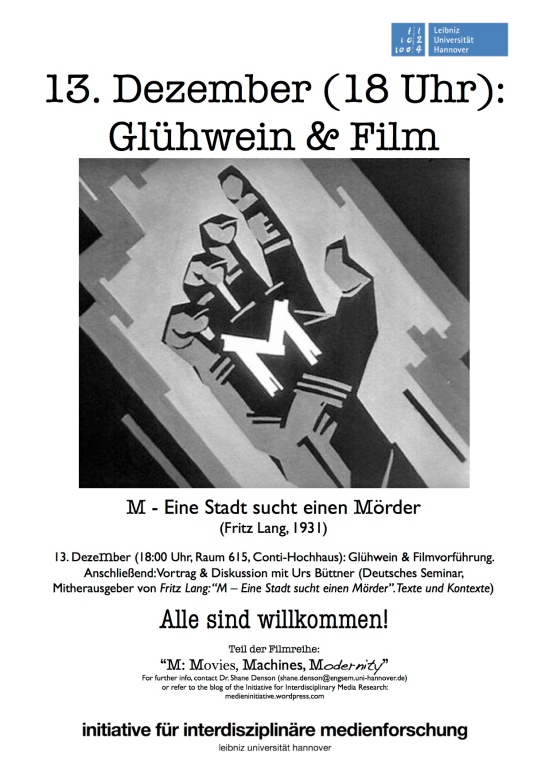
M-EineStadtSuchtEinenMoerderA4

As announced recently, our screening of Fritz Lang’s M will take place this Thursday, Dec. 13, at 6 pm in room 615 of the Conti-Hochhaus. There will be Glühwein and, following the screening, a presentation and discussion with Urs Büttner. See here for more info.

Batman and the “Parergodic” Work of Seriality in Interactive Digital Environments

wayne-tech

On Saturday, December 15 (11:30 am, 6th floor of the Conti-Hochhaus, room TBA) — in the context of a research colloquium of the American studies department — I will be presenting some work in progress from my “Habilitation” project Figuring Serial Trajectories (more info about my project here; also, more info about the larger collaborative project with Ruth Mayer on serial figures here, and the website of the overarching research group on popular seriality here).

The topic of my talk will be Batman, computer games, and digital media environments. I will be expanding on, and trying to make somewhat more concrete, the idea of “parergodicity” which I presented at the recent FLOW conference (see here for my position paper).

Here is the abstract for my talk:

Batman and the “Parergodic” Work of Seriality in Interactive Digital Environments

Shane Denson

In the twentieth century, serial figures like Tarzan, Frankenstein’s monster, and Sherlock Holmes enacted a broadly “parergonal” logic; that is, in their plurimedial instantiations (in print, film, radio, TV, etc.), they continually crossed the boundaries marked by these specific media, slipped in and out of their frames, and showed them – in accordance with the logic of the parergon as described by Jacques Derrida – to be reversible. Through such oscillations, serial figures were able to transcend the particularity of any single iteration, and more importantly they were able to constitute themselves as higher-order frames or media, within which the transformations of first-order (i.e. apparatically concrete) media could be traced in the manner of an ongoing – though not altogether linear – series.

In the twenty-first century, many classic serial figures have declined in popularity, while the basic functions and medial logics of those that remain have been transformed in conjunction with the rise of interactive, networked, and convergent digital media environments. As I will argue in this presentation, the figure of Batman exemplifies this shift as the transition from a broadly “parergonal” to a specifically “parergodic” logic; the latter term builds upon Espen Aarseth’s notion of the “ergodic” situation of gameplay – where ergodics combines the Greek ergon (work) and hodos (path), thus positing nontrivial labor as the aesthetic mode of players’ engagement with games. Expanded beyond narrowly ludological frames of reference to include a wider variety of interactive and participatory potentials in contemporary culture, ergodic media give rise to new forms of seriality that accompany, probe, and trace the developmental trajectories of the new media environment. These new forms and functions of seriality, as embodied by a figure like Batman, raise questions about the blurring of relations between work and play, between paid labor and the incidental work or “immaterial labor” culled from our leisure activities and entertainment practices, in the age of the “control society” (Deleuze) or of “post-cinematic affect” (Shaviro). Following Batman’s transitions from comics to graphic novels, to the films of Tim Burton and Christopher Nolan, and on to the popular and critically acclaimed videogames Arkham Asylum and Arkham City, I will demonstrate that the dynamics of border-crossing which characterized earlier serial figures has now been re-functionalized in accordance with the ergodic work of navigating computational networks – in accordance, that is, with work and network forms that frame all aspects of contemporary life.

M – Eine Stadt sucht einen Mörder (1931): Movies, Machines, Modernity

http://www.youtube.com/watch?v=GT_s_6F5hCc

On December 13, we will be screening Fritz Lang’s M – Eine Stadt sucht einen Mörder (1931), the third film in our series “M: Movies, Machines, Modernity.” (See here for a flyer with more details about our film series, and here for a short video introduction that frames it conceptually.)

Following the screening, Urs Büttner (co-editor, with Christoph Bareither, of Fritz Lang: “M – Eine Stadt sucht einen Mörder”. Texte und Kontexte) will discuss the film with us and help us to understand it in its historical context and in the context of the cinema’s negotiations of modernity. (Vortrag — wie auch die Filmvorführung — in deutscher Sprache.)

And because it’s getting to be that time of year again, we will have Glühwein for all!

As always, the screening (6:00pm on Thursday, Dec. 13, in room 615, Conti-Hochhaus) is free and open to all, so spread the word to anyone who might be interested in joining us. More info here and here.

Coming Soon: Transnational Perspectives on Graphic Narratives

Transnational_cover-1

[UPDATE March 28, 2013: The book is now available; see here for more info]

We’re in the home stretch now with Transnational Perspectives on Graphic Narratives: Comics at the Crossroads (eds. Shane Denson, Christina Meyer, and Daniel Stein). The manuscript is almost through the production phase at Bloomsbury, and everything is set for the book to appear on time in March 2013. A description can be found on the publisher’s website (here), and the book is already up on amazon (US site here; British site here; German site here). A more affordable e-book version is in preparation, and a paperback is planned as well (contingent upon sales of the hardcover — so please ask your library to purchase a copy)!

Here is the final Table of Contents:

Foreword

John A. Lent

Introducing Transnational Perspectives on Graphic Narratives: Comics at the Crossroads

            Shane Denson, Christina Meyer, and Daniel Stein

Part I: Politics and Poetics

1          Not Just a Theme: Transnationalism and Form in Visual Narratives of US Slavery

            Michael A. Chaney

2          Transnational Identity as Shape-Shifting: Metaphor and Cultural Resonance in Gene Luen Yang’s American Born Chinese          

            Elisabeth El Refaie

3          Cosmopolitan Suspicion: Comics Journalism and Graphic Silence

            Georgiana Banita

4          Staging Cosmopolitanism: The Transnational Encounter in Joe Sacco’s Footnotes in Gaza    

             Aryn Bartley

5          “Trying to Recapture the Front”: A Transnational Perspective on Hawaii in R. Kikuo Johnson’s Night Fisher  

             Iris-Aya Laemmerhirt

6          Folding Nations, Cutting Borders: Transnationalism in the Comics of Warren Craghead III

             Daniel Wüllner

Part II: Transnational and Transcultural Superheroes

7          Batman Goes Transnational: The Global Appropriation and Distribution of an American Hero

             Katharina Bieloch and Sharif Bitar

8          Spider-Man India: Comic Books and the Translating/Transcreating of American Cultural Narrative

             Shilpa Davé

9          Of Transcreations and Transpacific Adaptations: Investigating Manga Versions of Spider-Man

             Daniel Stein

10         Warren Ellis: Performing the Transnational Author in the American Comics Mainstream

              Jochen Ecke

11         “Truth, Justice, and the Islamic Way”: Conceiving the Cosmopolitan Muslim Superhero in The 99

              Stefan Meier

Part III: Translations, Transformations, Migrations

12         Lost in Translation: Narratives of Transcultural Displacement in the Wordless Graphic Novel

              Florian Groß

13         Hard-Boiled Silhouettes: Transnational Remediation and the Art of Omission in Frank Miller’s Sin City

              Frank Mehring

14         The “Big Picture” as a Multitude of Fragments: Jason Lutes’s Depiction of Weimar Republic Berlin

              Lukas Etter

15         “Scott Pilgrim Gets It Together”: The Cultural Crossovers of Bryan Lee O’Malley

              Mark Berninger

16         A Disappointing Crossing: The North American Reception of Asterix and Tintin

              Jean-Paul Gabilliet

Afterword

Framing, Unframing, Reframing: Retconning the Transnational Work of Comics

              Shane Denson

Film & TV Reading Group: Baudrillard, The Ecstasy of Communication

baudrillard

On December 5, 2013, the Film & TV Reading Group will meet (at 4 pm in room 613, Conti-Hochhaus) to discuss “The Ecstasy of Communication” by Jean Baudrillard (pp. 126 – 134 in The Anti-Aesthetic: Essays on Postmodern Culture, ed. Hal Foster). Julia Schmedes will moderate the discussion. As always, all are welcome to join us! (Feel free to contact me for more info — email address can be found on the “About” page.)

Extending Play: Rutgers Media Studies Conference

Thanks to Aaron Trammell, who was scheduled to be on the “Game Studies as Media Studies” roundtable with me at the FLOW 2012 Conference, but who was unable to make it due to Hurricane Sandy, I have just learned of an exciting conference going on April 19-20, 2013 at Rutgers University (Aaron is on the organizing committee). The conference is entitled “Extending Play,” and it’s not too late to submit a proposal (but hurry, the deadline is December 1!). Here’s the CFP:

Can we still define play as an organizing principle in today’s technologically mediated world? 

Play can be hard work and serious business, and it’s time to push beyond the conceptualization of play as merely the pursuit of leisure and consider how the issues of power, affect, labor, identity, and privacy surround the idea and practice of play. The Rutgers Media Studies Conference: Extending Play invites submissions that seek to understand play as a mediating practice, and how play operates at the center of all media.

We are interested in all approaches to the traditions, roles, and contexts of play, and hope to explore how play can be broadly defined and incorporated as a fundamental principle extending into far-flung and unexpected arenas. Johan Huizinga characterizes man as the species that plays: “Law and order, commerce and profit, craft and art, poetry, wisdom and science. All are rooted in the primaeval soil of play” (Homo Ludens, p.5).  How does play operate as a civilizing function — or is it perhaps a technology that produces order?

Play is a means of exploring and joining various disciplines: Social media, mash-ups, and blogs have altered how we communicate and create; game design has influenced how businesses relate to consumers; citizen journalists have shifted the role of the professional in mediating information and forging a public sphere.

To explore these questions, we invite scholars, students, tinkerers, visionaries, and players to the first ever Rutgers Media Studies Conference: Extending Play, to be held April 19th and 20th, 2013 on the Rutgers University campus in New Brunswick, NJ. Confirmed speakers for our keynote conversations include Fred Turner (Stanford University) & Stephen Duncombe (New York University) and Trevor Pinch (Cornell University) & Paul D. Miller, aka DJ Spooky (The European Graduate School).

We invite individuals from media studies and related fields in the humanities and social sciences to participate. Potential topics for paper, panel, roundtable, and workshop may include, but are not limited to:

-Playing with labor: work-like games and game-like work
-Play as resistance (culture jamming, situationist art, or other contexts)
-Gendering (and gendered) play
-Music and performance
-Linguistic play
-Play and social media
-Playing with identity
-Love and play (flirtation, AI relationships, robotica, etc)
-Gamification and games in nontraditional settings
-Transgression, cheating, and “gaming” systems
-Darker side of play (trolling, gambling, or corruption)
-Game studies

The Rutgers Media Studies Conference: Extending Play promises to offer a memorable meeting of scholarship, and to that end, we are looking to play with standard conference conventions. One track throughout the conference will be a series of public workshop sessions in which scholars and practitioners will host roundtable discussions on contemporary issues that bring together an audience of experts and interested parties. In the academic panel track, each presenter will have a maximum of 15 minutes to offer his or her ideas as a presentation or interactive conversation, and will choose one of the following methods of presentation:
–material accompaniment (hand out a zine, scrapbook, postcard series, etc)
–performance (spoken word, song, verse, dance, recording, etc)
–limited visuals (a maximum of 3 slides and 25 total words)
–game (create rules and incorporate audience play)
For additional ideas on how to play with media, play with time, or play with space during your presentation, visit our Style Guide.

The deadline for proposals is Saturday, December 1, 2012. We invite individual proposals, full panel proposals (of four members), and proposals for roundtable and workshop sessions. Please email an abstract of approximately 247 words, along with your name, affiliation, presentation method, and a short biography to mediacon@rutgers.edu. If you are interested in proposing a topic for our public workshop track, or are interested in participating in one, please indicate that as well. Notifications of acceptance will be sent out by mid-January 2013.

For more info, see the conference website: mediacon.rutgers.edu