In the last teaching week of this semester the English Theatre Group will present Our Country’s Good by Timberlake Wertenbaker.
Based on historical events, the play concerns the arrival in 1788 of the first British convict ships in Botany Bay, South Australia. The treatment of the prisoners at the hands of military officers is brutal. However, the Governor of the colony has high ideals about creating a civilized society and about how the convicts should be treated. Believing that “the theatre is an expression of civilization”, he encourages a certain officer to produce a play with the convicts as actors. Our Country’s Good dramatizes the challenges of rehearsing George Farquhar’s The Recruiting Officer in the face of contempt of most of the officers and a lack of unity amongst the convicts.
The play was written in 1988 and first presented at London’s Royal Court Theatre.
Performances will take place at 7.30pm each evening on
Monday 28 January
Tuesday 29 January
Wednesday 30 January
(no Thursday performance)
Friday 1 February, and
Saturday 2 February
at
Hildesheimer Straße 39A
30169 Hannover
(U-Bahn Schlägerstraße)
Tickets can be purchased in advance from the sales point in the foyer of the Conti-Hochaus at Königsworther Platz 1 during the advance ticket-selling hours:
weekdays from 10am until 4pm, Monday 14 January through to Friday 25 January.
On January 16, 2013, the Film & TV Reading Group will meet (at 4 pm in room 613, Conti-Hochhaus) to discuss “Prolog zum Fernsehen” [Prologue to TV] by Theodor W. Adorno (pp. 507 – 517 in Adorno’s Gesammelte Schriften, Band 10.2: Kulturkritik und Gesellschaft II — Eingriffe, Stichworte, Anhang). Felix Brinker will moderate the discussion. As always, all are welcome to join us! (Feel free to contact me for more info — email address can be found on the “About” page.)
I am pleased to announce that this year’s Campus-Cultur Prize has been awarded to the Film & TV Reading Group and the student members of the Initiative for Interdisciplinary Media Research!
The award recognizes students’ active participation, initiative, and creativity in curricular and extracurricular contexts. The prize is awarded annually by CampusCultur, an association dedicated to promoting the cultural life of the humanities and social sciences at the Leibniz University of Hannover.
The Film & TV Reading Group offers interested students from all disciplines the opportunity to engage with key texts on film, television, and media theory. In conjunction with the film series, lectures, and other activities of the Initiative for Interdisciplinary Media Research, it offers students and instructors a space in which to discuss relevant media phenomena and media-theoretical issues.
Congratulations and thank you to everyone who helped make this possible, particularly to the student members of the reading group and media initiative!
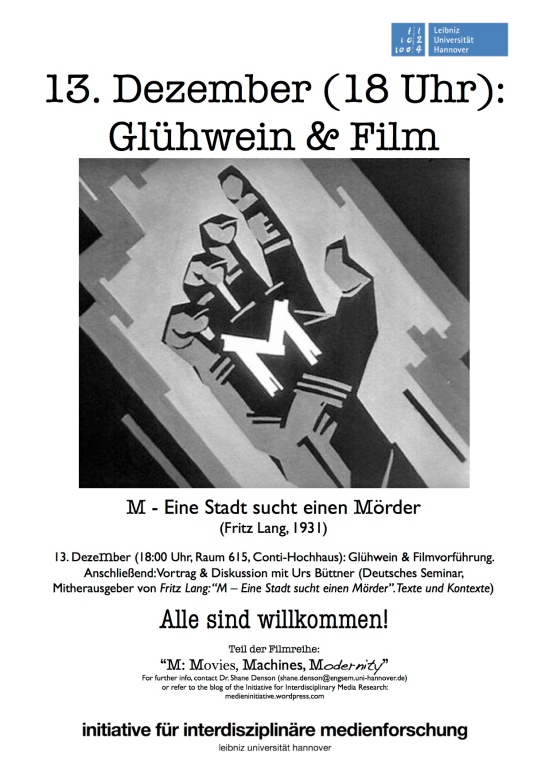
As announced recently, our screening of Fritz Lang’s M will take place this Thursday, Dec. 13, at 6 pm in room 615 of the Conti-Hochhaus. There will be Glühwein and, following the screening, a presentation and discussion with Urs Büttner. See here for more info.
On December 13, we will be screening Fritz Lang’s M – Eine Stadt sucht einen Mörder(1931), the third film in our series “M: Movies, Machines, Modernity.” (See here for a flyer with more details about our film series, and here for a short video introduction that frames it conceptually.)
Following the screening, Urs Büttner (co-editor, with Christoph Bareither, of Fritz Lang: “M – Eine Stadt sucht einen Mörder”. Texte und Kontexte) will discuss the film with us and help us to understand it in its historical context and in the context of the cinema’s negotiations of modernity. (Vortrag — wie auch die Filmvorführung — in deutscher Sprache.)
And because it’s getting to be that time of year again, we will have Glühwein for all!
As always, the screening (6:00pm on Thursday, Dec. 13, in room 615, Conti-Hochhaus) is free and open to all, so spread the word to anyone who might be interested in joining us. More info here and here.
On November 29, 2012, we will be screening Dziga Vertov’s Man with a Movie Camera (1929), the second film in our series “M: Movies, Machines, Modernity.” (See here for a flyer with more details about our film series, and here for a short video introduction that frames it conceptually.)
In his discussion of Man with a Movie Camera, Roger Ebert begins with the following observation:
In 1929, the year it was released, films had an average shot length (ASL) of 11.2 seconds. “Man With a Movie Camera” had an ASL of 2.3 seconds. The ASL of Michael Bay‘s “Armageddon” was — also 2.3 seconds.
If, as I have argued, Michael Bay’s post-cinematic filmmaking captures something of the nonhuman processing of contemporary life by algorithmic means, then Dziga Vertov’s captured something of the machinic materiality of the modern age — a similarly nonhuman view emphasized in the Kinoks movement (from “kino-oki” or kino-eyes) to which Vertov belonged. From the Wikipedia article on “Kinoks”:
The Kinoks rejected “staged” cinema with its stars, plots, props and studio shooting. They insisted that the cinema of the future be the cinema of fact: newsreels recording the real world, “life caught unawares.” Vertov proclaimed the primacy of camera (“Kino-Eye”) over the human eye. The camera lens was a machine that could be perfected infinitely to grasp the world in its entirety and organize visual chaos into a coherent, objective picture.
But perhaps coherence is in the eye (or kino-eye) of the beholder. As Ebert remarks,
There is a temptation to review the film simply by listing what you will see in it. Machinery, crowds, boats, buildings, production line workers, streets, beaches, crowds, hundreds of individual faces, planes, trains, automobiles, and so on.
In many ways, the film resembles what the object-oriented ontologists, following Ian Bogost, call the “Latour litany“: a rhetorical device, consisting in a list of apparently unrelated things, which peppers the writings of Bruno Latour and is employed extensively in OOO to emphasize the plurality of things or objects populating the world and to encourage a break with our normal tendencies to view them anthropocentrically. Bogost recommends the device in his Alien Phenomenology, or What It’s Like to Be a Thing, and perhaps it’s fair to see Vertov’s general project of the Kino-Eye, and its specific expression in Man with a Movie Camera, as precisely an alien-phenomenological undertaking, designed to help us feel “what it’s like to be a thing” in the modern age.
As for the connection with Michael Bay-style “chaos cinema” and the post-cinematic discorrelation of digital images from the human subject, a recent project, the “Global Participatory Remake” of Man with a Movie Camera, brings the two types of alien phenomenologies — the contemporary algorithmic/database-driven and Vertov’s filmic kino-eye — together in an exciting way. At the same time, this project might be seen to raise some rather unsettling questions. What is the relation of contemporary “participatory culture” to the ideals of socialism, when the empowerment experienced by the participants is grounded in the same informatic infrastructure that turns our own entertainment into “immaterial labor” exploitable by corporations wielding algorithms incommensurable with our human concerns, values, perspectives? While the “Global Remake” is hardly guilty, I think, of such exploitation, it enjoins us materially to attend to media-historical and political changes, and to recall that while Vertov’s project was undertaken in the cause of the Revolution, we still have to assess what the revolutionary potential might be — if any, either historical or contemporary — of an alien phenomenology…
As always, the screening (6:00pm on Thursday, Nov. 29, in room 615, Conti-Hochhaus) is free and open to all, so spread the word to anyone who might be interested in joining us. Feel free also to bring along snacks and refreshments. More info here and here.
Tomorrow (November 14, 2012), there are two events at the University of Hannover that might be of interest to readers of the blog.
First up, there’s the first meeting this semester of the Film & TV Reading Group (see the flyer here), where we’ll be discussing Walter Benjamin’s famous Artwork essay. We’ll meet from 4 to 6 pm in room 613 (Conti-Hochhaus). The reading group always welcomes new participants, so please spread the word to anyone who might be interested in joining us!
Second, and immediately following the reading group, Frank Kelleter will be giving a talk entitled “Massenkultur, Serienkultur, Populärkultur am Beispiel des Wonderful Wizard of Oz und seiner Variationen” [roughly: Mass Culture, Serial Culture, Popular Culture, with Reference to the Wonderful Wizard of Oz and its Variations]. The talk, from 6 to 8 pm in room 103 (Conti-Hochhaus), will take place in the context of the seminar “Massenkultur: Unterhaltung, Konsum, Medialität” [Mass Culture: Entertainment, Consumption, Mediality], which is being jointly taught by Ruth Mayer and Michael Gamper. Frank Kelleter is professor of American studies in Göttingen and the speaker for the DFG Research Group “Popular Seriality — Aesthetics and Practice” (in which Ruth Mayer and I are collaborating on the project “Serial Figures and Media Change”). He has recently published a chapter entitled “‘Toto, I Think We’re in Oz Again’ (and Again and Again): Remakes and Popular Seriality” in Film Remakes, Adaptations and Fan Productions: Remake / Remodel, edited by Kathleen Loock and Constantine Verevis.
Our film series “M: Movies, Machines, Modernity” kicks off tomorrow night (November 8, 2012, at 6:00 pm in room 615, Conti-Hochhaus) with Fritz Lang’s Metropolis. The screening is free and open to all, so spread the word to anyone who might be interested in joining us. Feel free also to bring along snacks and refreshments. And for more info about the film series, see here: M: Movies, Machines, Modernity.
As indicated on the flyer above, the Film & TV Reading Group will have its first meeting of the semester on Wednesday, November 14 (4:00 pm in room 613, Conti-Hochaus), where we will discuss Walter Benjamin’s famous “Artwork” essay. The topics for the following meetings have not been determined yet, so if there is anything you would like to discuss, please let me know. Tentatively, the following dates have also been reserved: December 5 and January 16 (also 4:00 – 6:00 pm in room 613). New participants are always welcome!
This semester the Initiative for Interdisciplinary Media Research at the Leibniz Universität Hannover will again be organizing a series of film screenings. We have decided to show public domain versions of the films so that we can make the screenings free and open to all. (Feel free also to bring along snacks and refreshments.)
The topic this semester is “M: Movies, Machines, Modernity”:
From the beginning, movies have presented themselves as the preeminent machines of modernity. On the one hand, they have served as a medium for imagining and envisioning modern landscapes and machinic cities. On the other hand, the movies were involved directly in the making of said modernity. The image of a machine is often a movie’s reflexive image of itself, or of that which it imagines itself to be…
Screenings will take place in the rooms of the English Department / American Studies (room 615, Conti-Hochhaus — all screenings begin at 6:00 pm). The schedule, put together this time by Felix Brinker, Ilka Brasch, and Shane Denson, includes the following four films:
November 8, 2012: Metropolis (Fritz Lang, 1927)
November 29, 2012: Man with a Movie Camera (Dziga Vertov, 1929)
December 13, 2012: M – Eine Stadt sucht einen Mörder (Fritz Lang, 1931)
January 17, 2013: Modern Times (Charlie Chaplin, 1936)